Do Poets and Writers of Short Prose Need an MFA?

By Nadja Maril

Attend any writer’s conference or weekend of workshops and invariably a topic raised amongst the attendees, (those aspiring to be published writers), is a discussion on the value of an MFA.

Will an MFA is help me professionally?

Will graduate school provide me with useful introductions to members of the publishing industry?

Will the process of earning a Masters degree serve to teach me useful skills I couldn’t learn independently?

No simple answer exists, because every writer and their aspirations are different. And every MFA program is different.

Photo by Gu00fcl Iu015fu0131k on Pexels.com

I found pursuing an MFA  to be a rewarding intellectual experience, as an older adult. I received my MFA  from the Stonecoast  Low Residency Writing Program at in University of Southern Maine in literary fiction in January 2020.  

Low residency didn’t start up with the internet or the pandemic. For decades, many scholars have recognized that much of a graduate student’s work consists of independent study and research under the tutelage of a mentor. Low residency programs convene in person each semester for one or two weeks and the remainder of communication is done by email, snail mail and video conferencing.  The set-up enables students to continue with another professional career and family responsibilities.

While I wished I ‘d attended grad school in my twenties or thirties, sometimes you appreciate something more when you are forced to wait.

When I asked some of my colleagues at Old Scratch Press if they could share some of their thoughts  about MFA’s,  Collective  member Robert Fleming  told me about Mark Fishbein, who he met at the Poetry Academy of the District of Columbia poetry critique workshop. To join contact Mark at mark@poetwithguitar.com

To Mark Fishbein, Robert posed the following questions:

Why did you choose an MFA?:

M.F.: As retired, the purpose at the age of 74 means deciding to buy your container of milk before or after your nap. As a young man I thought to live the life of poet/academician, but got sidetracked and spent my life differently. But as a lifelong poet, I now give lectures in poetry workshops and I would like to teach it. In order to do so I must have, at minimum, an MFA.

Mark began in the Fall, 2023 an in-person MFA in creative writing: poetry at Columbia College in Chicago, IL. This is a traditional residential full-time program.

Why did you chose this specific school? :

M.F.: The program is well received; it’s walking distance from home, the price is more reasonable and the vibe less full of itself as I have experienced. It’s in the heart of downtown. No campus fraternities.

Mark is the chancellor of the Poetry Academy of the District of Columbia and most recently published Reflections in the Time of Trumpius Maximus, by Mark Fishbein | Atmosphere Press

So what is your thoughts on the topic? We’d be happy to hear from you.

Thank you for reading. Check out the latest submission call from Instant Noodles Literary Magazine here.
Introducing Collective Member Nadja Maril

            “I like a challenge,” says writer/poet Nadja Maril, “Which is why I like short-form writing. Carefully choosing just a few words to depict a scene or describe an experience is skill that requires tenacity. The process is humbling. The results gratifying.”

            Ten dedicated writer poets comprise the Old Scratch Short Form Collective,
with the goal of working with the Devil’s Party Press, a small independent publisher, to bring to fruition the concept of publishing chapbooks of poetry and short form prose under the
imprint Old Scratch Press.

            This week we are introducing Nadja Maril.

            Nadja began her writing career as a freelance journalist and subsequently as a magazine editor, but her love has always been creative writing. “I remember reading Shirley Jackson’s  short story in high school, “The Lottery,” and wanting to re-read it again, to fully digest everything it contained and thinking what a gift,” she says, “to write a story less than 10 pages long, so powerful that it calls out to be read over and over again.”

            Nadja Maril’s first published books, while she was still in her twenties, were two children’s books about Molly Midnight, the artist’s cat (Stemmer House) that were short form in their own way. Inspired by her artist father Herman Maril’s paintings of the family cat, the text required brevity and the use of simple language. “The content,” Nadja says, “Needed to appeal to a child and to the adult who was reading the book to the child. A favorite children’s book is read many times, but it can’t be boring to the parent or caregiver. It has to sound pleasing to the ear, be visually appealing, and tell a story worthy of reflection.”

            An expert on antique American lighting from the late 19th and early 20th century, Nadja’s two books on the subject (Schiffer) became mainstays in collector’s libraries as she continued to pen weekly newspaper and magazine columns about antiques.

            Refocusing her efforts on further refining her creative work, in 2018, she returned to school to earn her MFA in literary fiction from Stonecoast at the University of Southern Maine (graduating in January 2020). Her essays, short fiction, and poetry has been published in dozens of literary magazines including; Lunch Ticket, The Journal of Compressed Literary Arts, and Invisible City Literary Journal.

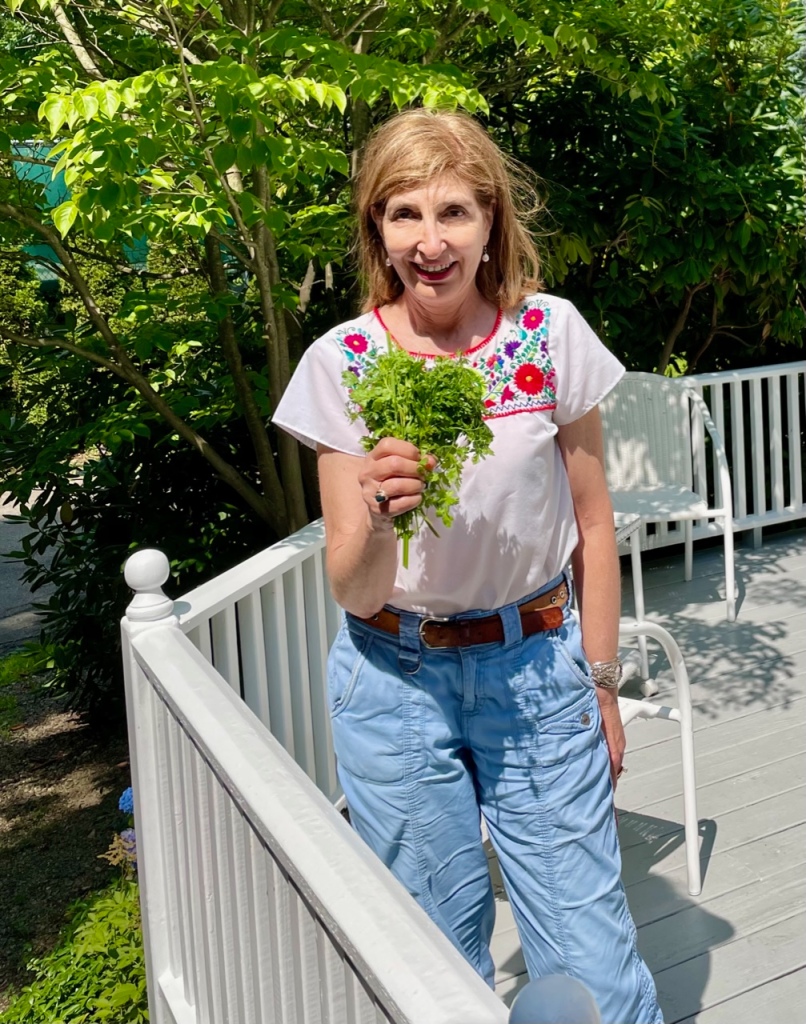
            “I like flash fiction,” she says, “Under 750 words. But then I discovered short memoir, which takes on the form of a prose poem.” Her working title for her chapbook, tentatively scheduled to be published by Old Scratch Press in 2024, is Recipes from My Garden: herb and memoir short prose and poetry.

“I’ve published a number of pieces about herbs, vegetables, and kitchen memories,” she says, “And I like the idea of putting them together in a small book.” One of her favorites, published last summer by Anti-Heroin Chic is “Cilantro.” Her prose piece, “Reboot,” appearing in the upcoming edition of the Devil Party’s Press literary magazine Instant Noodles, has a number of components, but the imagery of growing things play an important role in the story line.

Concurrently, working on a novel, Nadja likes to write and revise her work in the context of each short chapter or section, being complete in itself. “I like telling a long story from several points of view which means that each point of view is short story within itself, another short form, she says.

This year, in  2023,  Old Scratch Press is looking forward to the upcoming releases of chapbooks by Ellis Elliot and Robert Fleming.

Don’t forget to visit our Old Scratch Press Facebook Page and follow us on Twitter to find out what our contributors are up to and the latest poetry news. Thank You as always for your support.

            “