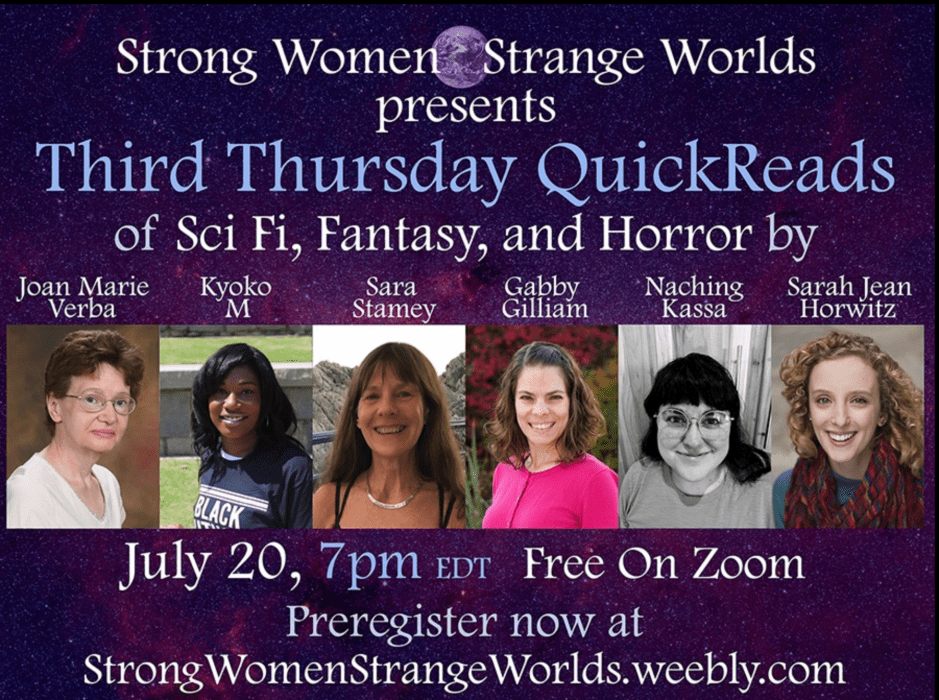
TOMORROW IS THE DAY!

If you don’t know writing by Gabby Gilliam, you sure should. She is a fantastic and surprising and original author.

AND THIS IS FREE!

Click here to add this event to your life today!

We are proud to announce that Old Scratch Press will be publishing Gabby’s first chapbook of poems. The working title is No Ocean Spit Me Out. Approximately 30 pages in length, the poems in No Ocean Spit Me Out explore the dynamics and evolution of family relationships. It is scheduled for release in 2024, so keep following our website as well as Gabby for more details.

Favorite Poem Series Continues with Emily Dickinson

By Ellis Elliot

When Old Scratch Poetry Collective Members were asked to write about a favorite poem, I knew my choice would be my first poem love affair. Before this poem, which I was introduced to in college, I had a healthy love of words, and a newfound interest in poetry, but it was more about my intrigue with the craft of it. I liked learning how things like rhyme and meter, form and pattern, didn’t need to hit you over the head. The tools of poetry were more like puzzle pieces that you both created, took apart, then put together again. But then came Emily.

Ample Make This Bed

by Emily Dickinson

Ample make this bed.
Make this bed with awe;
In it wait till judgment break
Excellent and fair.

Be its mattress straight,
Be its pillow round;
Let no sunrise’ yellow noise
Interrupt this ground.

I can’t explain exactly what alchemical combination occurred to cause me to fall for this particular poem by Emily Dickinson. I know it had to do mostly with the way the lines, “Let no sunrise’ yellow noise/Interrupt this ground” made me feel. I was blown away by two lines. The image of the “noise” of a sunrise, the choice of the word “interrupt”, the idea of this sacred “ground”. All of it. Who knows how or why such a thing speaks to you?

Much like falling in love, the factors that come together to create the feeling are a mystery. I know it was a combination of the known entity of craft mixed with the necessary ingredient of emotion. I had no need to do a critical exorcism of the poem, or analyze each syllable in every word, to know how the poem made me feel.

Dickinson scholar Marta Warner says that “she (Dickinson) is a constant summons to think about language and its preciseness. And not only its preciseness, but its power”. Dickinson was prolific, writing over 1800 poems, and while her image is as a recluse, she was actually quite social in her younger years. She lived in the mid-1800’s, and her poetry was practically unknown during her lifetime. It certainly was not a time of female literary empowerment (has that happened yet?). Dickinson would go on to become a “beacon of verbal power”, and I know her light certainly led me to a lifelong love of poetry.

***

Old Scratch Press is delighted to be publishing Ellis’s first chapbook, a collection of poems entitled A Break in the Field. In her poetic statement about herself on her Bewilderness Writing website, Ellis says,

“I am a perennial student of nature, inner realms, and the wisdom of the body, and write to bear witness and disentangle the world as I perceive it.”

Approximately fifty pages in length, the poems in A Break in the Field grapple with the concept of how human perception can change, depending on the vantage point. You can pre-order the book by clicking on the link in the previous sentence.

ABOUT THE AUTHOR:

Ellis Elliott is a writer, ballet teacher, and facilitator of online writing groups called Bewilderness Writing. She has a blended family of six grown sons and splits her time between Juno Beach, FL., and the mountains of Crozet, VA. She has an MFA from Queens University, is a contributing writer for the Southern Review of Books, and an editor/workshop teacher for The Dewdrop contemplative journal. She has been published in Signal Mountain Review, Ignation Literary Magazine, Literary Mama, OPEN: Journal of Arts and Letter, Plainsongs Poetry Magazine/Award Poem, Sierra Nevada Review, Women of Appalachia Project Anthology, Delmarva Review, The Rail, Spotlong Review, Euphony Journal, and others. 

ROBERT FLEMING Shortlisted for Blood Rag 2023 Poet of the Year!

Old Scratch Press (OSP) is pleased to announce that our contributing editor Robert Fleming is one of just six poets who were short-listed for 2023 the Blood Rag Poet of the Year and we couldn’t be prouder.

In Blood Rag Editor Matt Wall’s audio blog, three of Robert’s poems, previously published in the Blood Rag, were featured

Ep. 86: Blood Rag Poet of the Year Shortlist P.1 featuring Richard Fleming, Bunny Wilde & Rich Boucher|I Hate Matt Wall Poetry Podcast – Matt Wall

 And for your reading pleasure, here is one of Robert’s published poems.

Included in Issue #8 of Blood Rag
6-word flash fiction
 

Madame chopstick walker trips on kabuki.

Melt Marilyn Monroe into a pizza.

The hungry poisoner fed a pear.

Praying the tea will be strong.

I unbrick to Annabel Lee’s silence.

Five bullets left in the barrel.

My vocal cords speak for silence.

Matt Wall says: “I like how weird and strange Robert is; he describes himself as a word-artist; Robert is out there, not what others are doing; unique voice distinct as shit.

Robert’s upcoming visual poetry chapbook, White Noir, will be published by Devil’s Party Press’ Old Scratch Press this year, so check back here for the exact release date.

In the meantime, you may want to check out Robert’s 12-page poetry chapbook, Con-Way, a tribute to P.T. Barnum, published 7/9/2023 as part of Four Feathers Press: 4 in 1 November, 2023.

Please contact Robert if you’d like to buy the chapbook: https://www.facebook.com/robert.fleming.5030/

Robert is grateful to publishers who promote their writers by nominating them for awards. He’d like to thank: Matt Wall of the Blood Rag 

Dianne Pearce and David Yurkovich of Devil’s Party Press 

Failbetter, a journal of literature and art

Volume 8 — Ethel (ethelzine.com)

Lothlorien Poetry Journal

You too can support poets and writers by 1) commenting on the work you admire when you read it online 2) purchasing their books and supporting the publications where their work is featured 3) Contacting editors and publishers directly to suggest nominations for various awards 4) Voting, when you are able, if awards ask for reader participation. THANK YOU.

A Favorite Poem and Thoughts on Metaphors

Our series on “Favorite Poems” and why we think about them over and over again, continues with a post by Contributing Editor Virginia Watts.

Perhaps the World Ends Here

by Joy Harjo

The world begins at a kitchen table. No matter what, we must eat to live.

The gifts of earth are brought and prepared, set on the table. So it has been since creation,
     and it will go on.

We chase chickens or dogs away from it. Babies teethe at the corners. They scrape their
     knees under it.

It is here that children are given instructions on what it means to be human. We make
     men at it, we make women.

At this table we gossip, recall enemies and the ghosts of lovers.

Our dreams drink coffee with us as they put their arms around our children. They laugh
     with us at our poor falling-down selves and as we put ourselves back together once
     again at the table.

This table has been a house in the rain, an umbrella in the sun.

Wars have begun and ended at this table. It is a place to hide in the shadow of terror.
     A place to celebrate the terrible victory.

We have given birth on this table, and have prepared our parents for burial here.

At this table we sing with joy, with sorrow. We pray of suffering and remorse. We give
     thanks.

Perhaps the world will end at the kitchen table, while we are laughing and crying, eating
     of the last sweet bite.


I love this poem because as much as the kitchen table is metaphor, it is not. I remember both of my grandmother’s kitchen tables, one had a well-worn aquamarine Formica top and the other was round and oak.

I remember the things I ate there, tea sandwiches, lemon sponge pie, fresh caught rainbow trout from the mountain creek tumbling by. I remember the smell of coffee. I remember listening to the adults, learning about life.

The table in Harjo’s poem can be seen as a metaphor for a human lifetime. Within it, childhood, adulthood, love, births, old age, war, joy, sorrow, death. Throughout what it means to live a human life we can always return to the feeling a being surrounded by those who nurture us, believe in us, where we were shaped and where we dreamed. We are never alone at this table and if you think about it, our kitchen table is with us always.

Do you have a favorite poem you’d like to share? We’d be happy to publish your comments here. Part of the mission of Old Scratch Press is to promote the love of poetry.

Poetry Practice:

Twice a week, says Virginia Watts, I listen to the podcast Poetry Unbound where Irish poet Padraig O Tuama unpacks one poem in his uniquely contemplative, conversational, kind and down to earth way. Each podcast is less than fifteen minutes. Like his recent book “50 Poems to Open Your World” his podcast opens hearts and minds to poems and poets from around the world. It feels like an invaluable gift each and every time I listen.

Don’t forget to follow us on Facebook and Twitter.

Introducing Collective Member Nadja Maril

            “I like a challenge,” says writer/poet Nadja Maril, “Which is why I like short-form writing. Carefully choosing just a few words to depict a scene or describe an experience is skill that requires tenacity. The process is humbling. The results gratifying.”

            Ten dedicated writer poets comprise the Old Scratch Short Form Collective,
with the goal of working with the Devil’s Party Press, a small independent publisher, to bring to fruition the concept of publishing chapbooks of poetry and short form prose under the
imprint Old Scratch Press.

            This week we are introducing Nadja Maril.

            Nadja began her writing career as a freelance journalist and subsequently as a magazine editor, but her love has always been creative writing. “I remember reading Shirley Jackson’s  short story in high school, “The Lottery,” and wanting to re-read it again, to fully digest everything it contained and thinking what a gift,” she says, “to write a story less than 10 pages long, so powerful that it calls out to be read over and over again.”

            Nadja Maril’s first published books, while she was still in her twenties, were two children’s books about Molly Midnight, the artist’s cat (Stemmer House) that were short form in their own way. Inspired by her artist father Herman Maril’s paintings of the family cat, the text required brevity and the use of simple language. “The content,” Nadja says, “Needed to appeal to a child and to the adult who was reading the book to the child. A favorite children’s book is read many times, but it can’t be boring to the parent or caregiver. It has to sound pleasing to the ear, be visually appealing, and tell a story worthy of reflection.”

            An expert on antique American lighting from the late 19th and early 20th century, Nadja’s two books on the subject (Schiffer) became mainstays in collector’s libraries as she continued to pen weekly newspaper and magazine columns about antiques.

            Refocusing her efforts on further refining her creative work, in 2018, she returned to school to earn her MFA in literary fiction from Stonecoast at the University of Southern Maine (graduating in January 2020). Her essays, short fiction, and poetry has been published in dozens of literary magazines including; Lunch Ticket, The Journal of Compressed Literary Arts, and Invisible City Literary Journal.

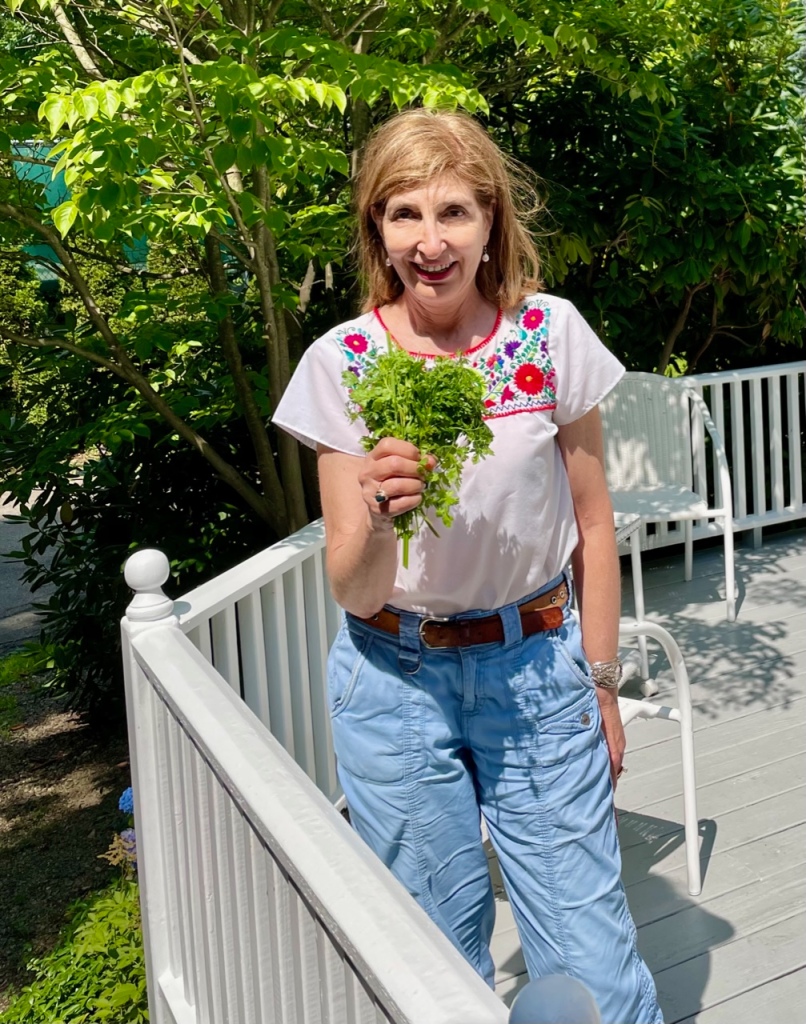
            “I like flash fiction,” she says, “Under 750 words. But then I discovered short memoir, which takes on the form of a prose poem.” Her working title for her chapbook, tentatively scheduled to be published by Old Scratch Press in 2024, is Recipes from My Garden: herb and memoir short prose and poetry.

“I’ve published a number of pieces about herbs, vegetables, and kitchen memories,” she says, “And I like the idea of putting them together in a small book.” One of her favorites, published last summer by Anti-Heroin Chic is “Cilantro.” Her prose piece, “Reboot,” appearing in the upcoming edition of the Devil Party’s Press literary magazine Instant Noodles, has a number of components, but the imagery of growing things play an important role in the story line.

Concurrently, working on a novel, Nadja likes to write and revise her work in the context of each short chapter or section, being complete in itself. “I like telling a long story from several points of view which means that each point of view is short story within itself, another short form, she says.

This year, in  2023,  Old Scratch Press is looking forward to the upcoming releases of chapbooks by Ellis Elliot and Robert Fleming.

Don’t forget to visit our Old Scratch Press Facebook Page and follow us on Twitter to find out what our contributors are up to and the latest poetry news. Thank You as always for your support.

            “

Introducing Collective Member Janet Holmes Uchendu

Ten dedicated writer poets comprise the Old Scratch Short Form Collective,
with the goal of working with the Devil’sParty Press, a small independent publisher, to bring to fruition the
concept of publishing chapbooks of poetry and short form prose under the
imprint Old Scratch Press.

This week we are introducing founding member Janet Holmes Uchendu.

Janet Holmes Uchendu grew up in Eudora, AR, with a love of reading, writing, abstract drawing, and music. She wrote many poems and stories, created loads of colorful abstract drawings, and sang in her church and school choirs.

When she graduated from high school in 1973 she left behind her love of drawing and writing, and focused on music. She attended the University of Arkansas at Monticello with the aid of a vocal scholarship majoring in vocal performance. In 1978 she attended Henderson State University, and finally earned her BA in Music Education from Philander Smith College in 1985.

Life has taken many twists and turns, but Janet never lost her love of reading and writing. She will tell you that the dream of being a writer never died. It was simply a dream deferred. In April 2018, thirty-three years after earning her BA, she enrolled in an Introduction to Creative Writing class at the University of Central Arkansas. It took another two and a half years before she decided to apply to graduate school.

“It was always my intention to go to grad school after I retired from the workforce,” says Janet. “When Covid-19 moved my retirement date up to about two years earlier than I had planned, my deferred dream of being a writer woke up, spoke up, and said the time is now.”

She is currently studying for her master’s in creative writing through the Arkansas Writer’s MFA Workshop at UCA.

Janet is working on a poetry collection, and a memoir. She is a longtime member of a poetry writing group titled, Pens on Fire, that meets weekly via Zoom. She has been a guest contributor in the Arkansas Democrat-Gazette, her story, “The Color Red,” was posted on the Arkansas Heritage blog in August 2021 and you can read it here.  She has also been published in Writing Our Lives, A Southern Storytellers Anthology, Volume IV, and Volume V.

Don’t forget to visit our Old Scratch Press Facebook Page and follow us on Twitter to find out what our contributors are up to and the latest poetry news. Thank You as always for your support.

Introducing Collective Member Alan Bern

For writer, poet, photographer and performer Alan Bern, pairing of images and words, what are termed photo-poems is a daily practice. As he states in his introduction to his work “next S-s-startle” published in Mercurious : “Creating photo-haiga is a central part of my daily art practice: I find it both invigorating and meditative, an often odd, but for me, happy combination. I have found that my photo-haiga can bring some readers closer to the poems. And please note that sometimes I find the photos to match poems sitting in waiting.”

One of the ten founding writer poets comprising the Old Scratch Short Form Collective, this week we introduce Alan Bern.

Alan Bern is the author of three books of poetry: : No no the saddest and Waterwalking in Berkeley, Fithian Press; greater distance and other poems, Lines & Faces press. Alan launched broadside press  linesandfaces.com, with artist Robert Woods. Robert and Alan grew up together in Berkeley in the 1960s. Both men became commercial printers, but also continued to produce works that combined Woods’s prints and Bern’s writing as well as the writing of other poets, such as Robert Hass and John Anson.  

Alan has been short-listed for several poetry and prose awards and has published in a wide variety of online and print publications. Alan’s story, “The alleyway in the downtown library,” was a runner-up for The Raw Art Review’s The John H. Kim Memorial Prize for Short Fiction

A photographer and a performer with dancer/choreographer Lucinda Weaver as PACES and with musicians from Composing Together, Alan also had a career as a children’s librarian. Drawing inspiration from his work as a librarian, he has a book forthcoming from UnCollected Press, titled IN THE PACE OF THE PATH. which is a fictionalized memoir, a hybrid of prose, poetry, and photo-images. As Alan describes it, “It is a book about homelessness as seen and understood by a librarian — I worked as a public librarian for over 25 years before retiring three years ago — and also about the town where the librarian grew up and where he still lives. “

The draft title for Alan Bern’s chapbook, to be published by Old Scratch Press is sway. The theme/content of the chapbook, says Alan, “is (loosely) my responses as an American to the Festa di Sant’Agata in Catania, Sicilia. This chap is the intertwining of my words and photo-images, a vital part of my daily art practice. ”

Members of the Old Scratch Short Form Collective work together with the Devil’s Party Press, a small independent publisher, to bring to fruition the concept of publishing chapbooks of poetry and short form prose under the imprint Old Scratch Press.

Don’t forget to visit our Old Scratch Press Facebook Page and follow us on Twitter to find out what our contributors are up to and the latest poetry news. Thank You as always for your support.

Introducing Collective member R. David Fulcher

In 1993, while still a student at the University of Maryland, College Park, R. David Fulcher founded a literary magazine. As he writes in an article, this is how it all began:

“During my studies I came across the Buddhist concept of samsara, the continuous cycle of suffering and rebirth until one achieves enlightenment.  Of course, my twisted college brain immediately thought:  “Why wouldn’t that be wonderful!  A literary journal based on suffering!”

Well, maybe there was a  bit more to it than that.  After all, the official theme of the journal is artwork, poetry and fiction centered around suffering and healing, the latter being arguably far more important to us as human beings.

Through the years, the magazine’s reach has expanded (we’ve published writers from Africa, Canada, Mexico, France, Japan, and the United Kingdom), and my wonderful wife Lisa Flach-Fulcher joined the effort as the Managing Editor, vastly improving many of the day-to-day operations of the journal.  Despite these changes, Samsara has remained true to form, only accepting works that emphasize the central theme of suffering and healing.  Beyond that, the magazine has no genre restrictions, and we’ve been amazed by the variety of ways that artists and writers have incorporated these themes into their submissions over the years.

We expected stories from cancer survivors, those recovering from addiction, and those mourning a lost love.  All these themes are critically important to Samsara.  But the creative spark will not be denied, and we received pleasantly unexpected new spins on suffering and healing as well.  Consider the suffering of an alien race slowly perishing due to a dying sun, or a vampire with dementia.  Consider a man plagued by the voice of a subway train that lures him to his death, or a paranoid individual convinced that fish live in his waterbed, giving him incurable insomnia.”

It’s not surprising that when publisher Dianne Pearce thought of writers she’d worked with, that she invited R. David Fulcher to be one of the founding members of the writers working behind the scenes to help support the concept of a press focused on publishing poetry and short form work.

Ten dedicated writer poets comprise the Old Scratch Short Form Collective, with the goal of working with the Devil’s Party Press, a small independent publisher, to bring to fruition the concept of publishing chapbooks of poetry and short form prose under the imprint Old Scratch Press.

This week we are introducing founding member R. David Fulcher

David’s work has appeared in numerous small press publications including Lovecraft’s Mystery Magazine, Black Satellite, The Martian Wave, Burning Sky, Shadowlands, Twilight Showcase, Heliocentric Net, Gateways, Weird Times, Freaky Frights and the anthologies Dimensions and Silken Ropes. Fulcher’s work can also be found in the DPP collection Halloween Party 2019, available at Amazon and at the DPP online store.

Author of horror, science fiction, fantasy, and poetry. Major literary influences include H.P. Lovecraft, Dean Koontz, Edgar Allen Poe, Fritz Lieber, and Stephen King. Fulcher’s first novel, a historical drama set in World War II, Trains to Nowhere, and his second novel, a collection of fantasy and science fiction short stories, Blood Spiders and Dark Moon, are both available from authorhouse.com and  Amazon.

In the Fall of 2023, Devil’s Party Press released a new collection of R. David Fulcher’s horror tales called The Pumpkin King: The Collected Horror Stories of R. David Fulcher. While some of these stories have appeared in the past in other collections and anthologies, this will be the first time all of horror stories will be consolidated into two volumes.

The first volume, The Pumpkin King, will focus on his traditional horror stories.  The second volume, Asteroid 6 and Other Tales of Cosmic Horror, will focus on his cosmic horror stories. 

A writer, with diverse interests and talents, if you’d like to check out one of David’s poems, entitled “Perception” published by Poetry Pacific in May 2020, here’s a link, Enjoy. And don’t forget to sign up to follow this blog, where you’ll get the latest news about the Old Scratch Press writers and ways to stay connected to the poetry and short form prose community. Thank you for reading.

Introducing Collective Member Virginia Watts

“My prose and poetry is about daily human life, the small moments in the hometowns of contemporary America,” says writer and poet Virginia Watts. “Through my work, I hope to celebrate the unique characteristics of close-knit communities, shared family histories, local war heroes, larger-than-life characters.  I am interested in exploring the concept of home, whether that is a city, suburbia, rural life, the far future. Why does one person leave while another stays? Why do some people go back? What haunts those who never do?”

Ten dedicated writer poets comprise the Old Scratch Short Form Collective, with the goal of working with the Devil’s Party Press, a small independent publisher, to bring to fruition the concept of publishing chapbooks of poetry and short form prose under the imprint Old Scratch Press.

This week we are introducing Virginia Watts.

Virginia Watts is the author of poetry and stories found in CRAFT, The Florida Review, Reed Magazine, Pithead Chapel, Permafrost Magazine, Broadkill Review among others. Her poetry chapbooks are available from Moonstone Press. She has been nominated four times for a Pushcart Prize and Best of the Net. A short story collection is upcoming from The Devil’s Party Press.

On her website she introduces herself by stating, “I have always been drawn to creating with words. In fifth grade, I began staying inside during recess to write stories. I didn’t care about the taunts of “nerd,” because once my pencil hit the paper it never stopped flying until the bell rang. I wish I’d kept those notebooks. I do remember one entry was entitled “Peanut Butter and Peas.”

To enjoy Virginia’s poetry and prose, there are no shortage of opportunities available just by googling her name, but here are links to two notable poems you might enjoy. The first poem published by Two Hawks Quarterly is entitled “The News” and the second one, first place winner of the Joan Ramseyer Poetry contest, is entitled “Choose a Memory to Keep.”

If you’d like to learn more about Virginia’s writing practice and sources of inspiration, this link to her interview with Dark Lane Books will provide more insight.

And don’t forget to visit our Facebook Page and follow us on Twitter to find out what our contributors are up to and the latest poetry news. Thank You as always for your support.

Welcome to Old Scratch Press

Old Scratch Press, specializing in poetry and short form prose is an imprint of the Devil’s Party Press, LLC family. We’ve set up this website, administered by members of the Old Scratch Short Form Collective, to share our love for poetry and short form prose with the global community.