
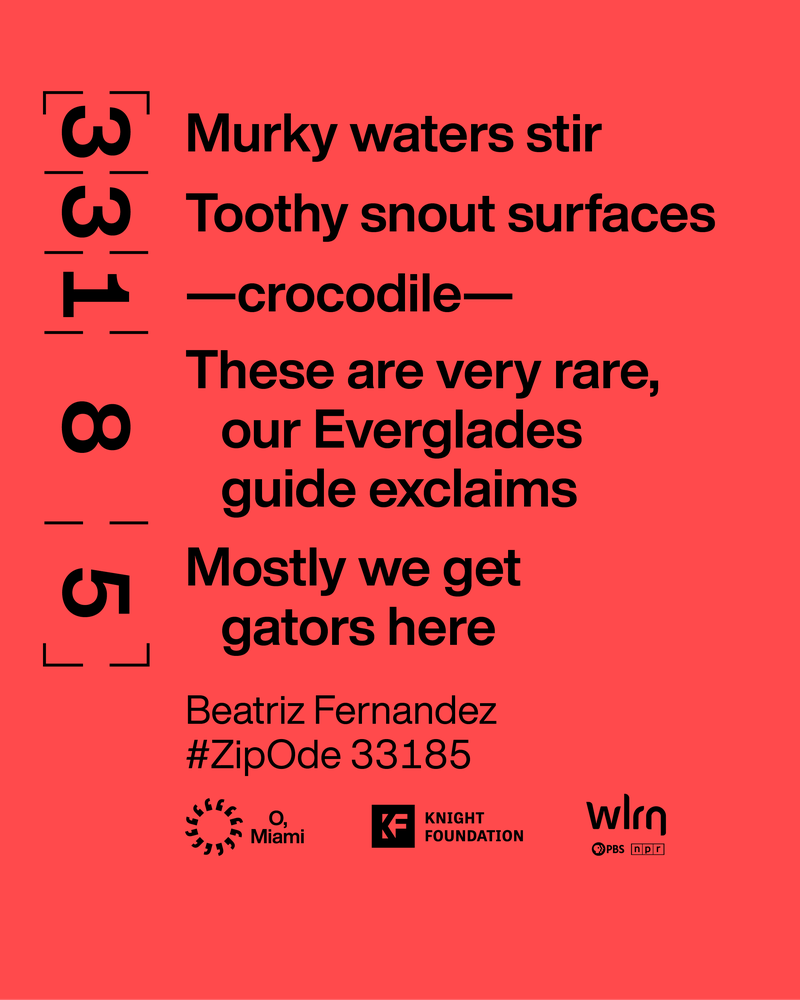
The ZipOde, aka Zip Ode, is a fun, five-line poetry form invented by the O,Miami Poetry Festival in collaboration with WLRN Public Radio and Television.
The ZipOde celebrates the local life, the daily struggle, the beauty and ugliness, the minor and major frustrations and joys of living in a specific place.
Here is how you can write an ode to your own zip code!
- Write the numbers of your zip code on five separate lines.
- Each number will determine how many words that line will have.
- (Similar to haikus but substitute words for syllables.)
- If you have a zero in your zip code, then you can either leave it blank, insert an emoji or image or consider it a wildcard line of 1-9 words!
WLRN celebrated the 10th anniversary of the invention of the ZipOde in 2025 and as it turns out, I was the very first person to submit a ZipOde in O, Miami’s first call for submissions back in 2015. Always on the lookout for inspiration in unexpected places, I liked the idea of writing a place-centered short poem that celebrated my neighborhood.
You can read some stories about the 10th anniversary celebration and read some ZipOdes here.
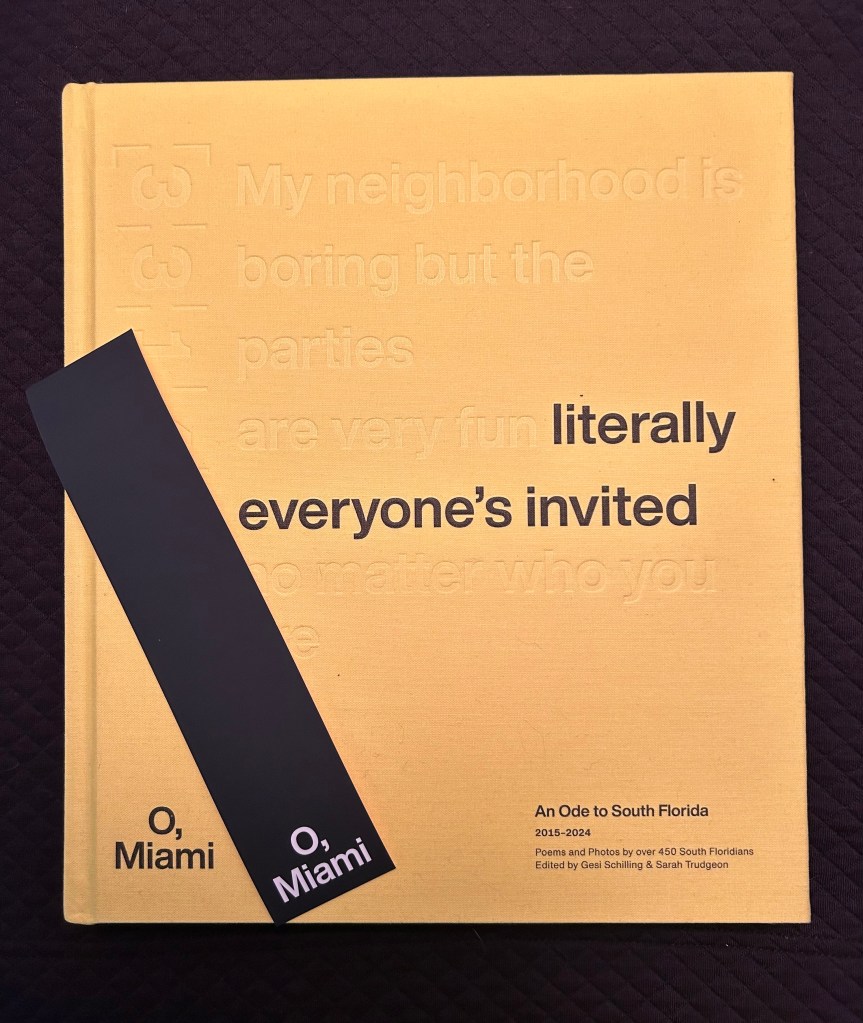
O, Miami has produced a colorful, beautifully illustrated 10th anniversary commemorative book as well:
You can see some sample pages here:
Literally Everyone's Invited ZipOdes Book – OMiami
ZipOdes everywhere!
Although the ZipOde form originated in South Florida, it has been celebrated in several other cities; O, Miami and WLRN offer it as a resource to anyone who wants to try it, as long as they attribute its creation to the O, Miami Poetry Festival and WLRN.
Tips for writing a ZipOde:
- Use impactful words
- Work those contractions!
- Limit your scope but remain expansive
- Anchor it geographically
If you have a 1 in your Zip Code (as I do), use it to maximum effect by making it a memorable, impactful word. Don’t waste the limited real estate in a ZipOde by using it for a connecting word like “and,” not that there haven’t been some excellent ZipOdes that do just that!
When you’re dealing with a limited word count—make contractions your friend! Why say “we have” when “we’ve” will work?
My favorite ZipOdes by other writers are the funny, pithy ones, but for my own, my preference is to look around me and celebrate the beauty and mystery of the nature that surrounds us—the trees, the birds, the animals, the wide-open skies.
ZipOde Examples
33185
Panthers’ eyes gleam
deep in the
Everglades
blinking under that kite of stars, the Pleiades.
What they’ve seen, we’ve forgotten.
33185
Hidden between hurricanes,
this city’s soul
quivers
like the flight of the Miami blue butterfly
killed by the slightest frost
It’s best to focus on one image, given the brevity of the poem, but the form lends itself to much experimentation and infinite variety.
I like to try to add a word that anchors the ZipOde to a place, since that is the whole point of the form! Images work, but also consider evocative scents, tastes, colors.
If you read some examples online, you will see that other poets celebrate their families, homes, neighborhoods in every way possible. The unique qualities of South Florida life are highlighted in trenchant, wryly fond-toned odes.
ZipOdes as Memoir
You can have fun commemorating all the different places you have lived and worked by writing ZipOdes! My workplace has two 9s in its zip code—riches! But even if yours has 1s and 0s, consider it a challenge—similar to when composing a haiku—to express yourself so succinctly.
33199
Driving to campus,
coffee in cupholder
steaming,
the morning sun Stonehenged between skyscrapers in the east–
in my rearview mirror, a flock of ibises rises..
ZipOdes can be dedicated love notes to your birthplace (or your child’s) or your favorite vacation spot or the place you met your significant other. As a collection, they can tell the story of your life—in code!
Thank you for reading and please follow us here and on Facebook: https://www.facebook.com/OLDSCRATCHPRESS/
Beatriz F. Fernandez is a Miami area poet and University Reference librarian. She is the author of three poetry chapbooks, the most recent of which is Simultaneous States (2025) by Bainbridge Island Press. In 2025, she became a member of Old Scratch Press.
(ZipOde photo provided to the poet by WLRN.org. Numbers photo credit to Tara Winstead.)

 OLD SCRATCH PRESS