
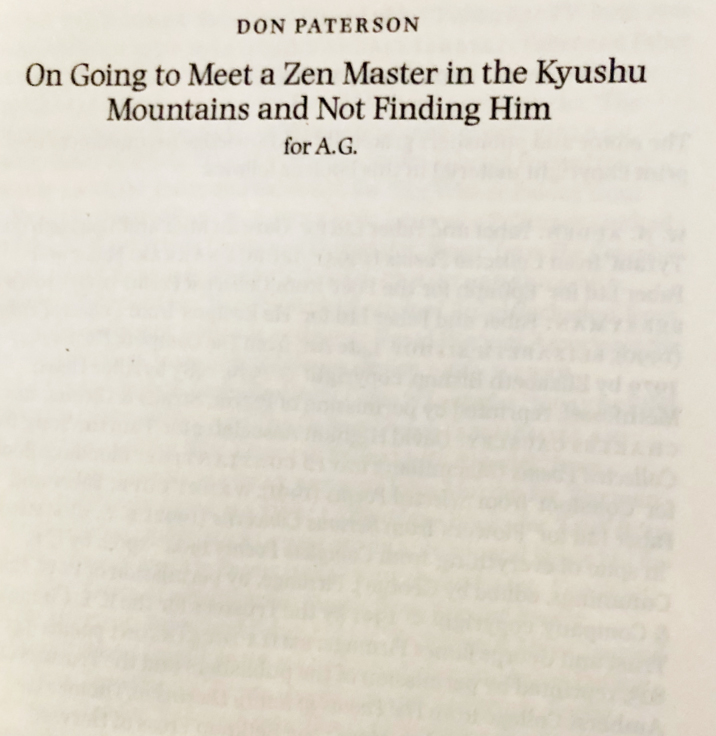
Above you see Don Paterson’s take on the titular poem, with a poem where the title is the whole poem.
A titular poem is a poem where the title is part of the poem, a line in it. In my own poetry I have really liked using this device, and often use my titles as the last line of the poem, the conclusion to the whole action of the poem. I have been described by my teachers as a narrative and magical realist poet. In my defense against these allegations I will let you know that I grew up listening to songs like “Jolene,” by Dolly Parton, “Ruby,” by Kenny Rodgers, “The Wreck of the Edmund Fitzgerald,” by Gordon Lightfoot, “Dark Lady” by Cher, and the oddest one of all, “Angie Baby,” by Helen Reddy. My formative years were two-to-three decades of songs with strange narratives in them. It isn’t my fault!
I have written many titular poems, some remarkably more successful than others, but I will share with you today one that is probably my personal favorite. This was written when I was in graduate school for my first writing degree. I had moved back in with my family. My house was helmed by two working parents, both too ready to have a drink, both too generous with money and not much else, and both not great at respecting boundaries. But I was able to go to school for my Master’s Degree and teach at the school part time, which pretty much took up 10 hours of each day, but made about one third of what a person needed for rent in those days, so, without my old room, I never could have done it. There were a lot of challenges though, one of which was a mother who was threatened by education, and really tried to impede it even as she envied it. My most repeated story, and least believed, was the one where I went up to my room to work on a paper due the next day that had to be twenty-five pages. My mother burst in to the room, my dad in tow, and began to lay out sheets of wallpaper over my (yes, I’m not kidding) word processor and desk. “We’re wallpapering the bathroom,” my mother announced.
“What, now? Tonight? It’s seven,” I said in disbelief.
“We have to do it now,” she said. “Right Vince?” My dad looked at me and shrugged. What could I do? I went downstairs, and waited. They finished a little after eleven, and I finished the paper a little after four the next morning. Yes, I should have probably written it sooner, but that aside, who competes with their kid with wallpaper? Sigh. No one I shared my graduation program with ever believed my stories. So, one day I wrote this poem to see if it could explain it to my fellow authors that my stories were true. As you read the poem remember… this is a titular poem, so see if you can understand how the title works as the title, and also as the last line of the poem. Yes, there are obscenities in the poem that some may find offensive. I’m a salty old girl, and, once, I was a salty young one.
A Few Dry Old Peas Rattling Around In A Waxed Paper Dixie Cup
Jesus fucking Christ goes through my mind as I sit here,
trying to read the poems from my poetry workshop,
and my brother, who doesn’t live here,
appears suddenly at the front window
like an unwelcome trio of Jehova’s Witnesses,
causing my dog,
who had just been whining at my leg for my bagel
to bark loudly and repeatedly at the window as
the phone rings, making me jump like a bean,
and I answer it,
all the while looking in exasperation at my beloved bother of a brother,
who is unaware that I am here,
and if he comes in the house will joke,
as if he were the opening act for the Jerry Lewis Telethon,
“Still in your pajamas? Ah you and that school racket,”
while I say, “Hello” the the phone with my voice
trying to sound
pointed
and
pissed
and my mother’s voice says,
“Read me what the calendar says my dentist appointment is,”
and says,
“I know you’d like nothing better than to put my wash
in the dryer—how ’bout it?”
and says,
“Don’t just sit around; do your windows,”
and says,
“You’re home todays so I won’t be home to let the dogs out,”
although she wants to be
’cause she thinks I don’t do it right,
and tells me again how to do it before she hangs up,
but my brother has not come in, has disappeared, so I go back to reading
for two seonds because here comes the dog again,
whine whine bagel bagel scratch me, and I stamp at her;
she looks at me—Big whoop—says her scroungy toothless expression,
and I hear a loud banging, so I look up and a strange truck,
a truck that would have turned up the noses
of Sanford and Son
and a man who obviously was designed with the truck in mind,
are in the driveway,
and he is pulling a gigundous lawnmower
off the truck while I try to think and come up with
Jesus, shit! Don’t unload that! Did I ask for that thing?!
and Who the fuck is this toothless guy? and wonder
for a scared second
if he’s a relative I don’t recognize
which is usual for me,
when I see my brother coming ’round the side of the truck
and I run upstairs thinking, What the hell is that guy here for?
Bill is going to bring this strange man to see me
in my pajamas, and the dog is lifting off the floor now
in little hydraulic barks—I am thinking
Christ Bill, now you’re going to wake Lee and I
am giving up on reading poetry; I’ll write some instead,
and I retreat to my room and start typing trying
to ignore the barking of slamming truck parts and lawnmowers out front,
but I am right,
my brother does wake my sister, and when she gets up,
by opening her door she releases another dog to bark,
and it runs downstairs to join in, eager to catch up,
while my sister
walks into the bathroom and pees loudly with the door open,
and does not flush,
puts on striped spandex, and goes tour-de-fourcing
down the stairs where, like a swift grifter,
she switches out the tape in the VCR for an aerobics tape and turns it
up
up
“Lift ’em up! That’s grrrreat! You can do it!”
but I can’t do it
because I can still hear my brother and Mister May-Be-A-Relative,
so I am able to hear another voice added to theirs
as my mother says, “Oh, I wondered if you’d be here.
I just came home to let the dogs out,” and my friends wonder
why I’m tense and why I never want to visit the zoo,
and I think,
Dad must be coming home any minute to tell us all the jokes
he’s heard today, like, “Duck walks into a pharmacist,
says gimmee a Chapstick and put it on my bill,”
or the one about the Avon lady who farts in a elevator,
after which he will laugh that long, wheeze, Lou Costello laugh
“Hey Abbott”
and somehow,
in this rapidly escalating cacophony,
a small sound,
like a maraca gently shaken,
is in my ears
pulling me to it,
causing me to think one final thought at the end of my morning study time,
because,
pricklingly familiar,
I think I’ve heard that small hollow sound before, and I think
I now know exactly what my brain is like.
Did you make it to the end? Could you see how the titular title ended the poem? I must admit I’ve always felt that the title must work as the title, of course, but should also resonate at the end of a poem, because our eyes, having reached the end, especially of a long poem, will zip back up to the top to refresh, remind us of what we were reading in the first place.
Have you ever written a titular poem? If so, I’d love to have you share it in the comments. Have you ever read one that you especially liked, or that flummoxed you? Let me know.
All these years later, through many different rounds of education at many schools, through being a life-long adjunct: always running place-to-place, through infertility and a trip to China to become a mother, through a few trips back and forth across the country with a full car and a moving van, through working with so many different and wildly talented authors, I do still feel a bit like I’m a plate-spinner with a brain that might like a long vacation on a deserted island.
Thanks for reading! I hope you’ll share back something titular.~ Dianne
Dianne Pearce is the publisher and main editor at Current Words Publishing. She also designs and formats each issue of INSTANT NOODLES LIT MAG, and had to learn how to work computers to do it!
Don’t miss the second submission period for INSTANT NOODLES 2025. Submit today!
 OLD SCRATCH PRESS