Robert Fleming’s Valentine’s Day Advice

By Robert Fleming

On Valentine’s Day, write a sonnet. A sonnet is for love. In the 13th-century, the sonnet was invented by Giacomo da Lentini, a member of the Italian Court of the Holy Roman Emperor Frederick II in Palermo, Sicily.

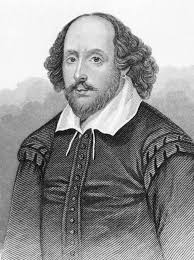
William Shakespeare popularized the sonnet. William lived 1564–1616 in Stratford-upon-Avon, Warwickshire, England.

The original sonnet is a fourteen-line poem in iambic pentameter with endline rhyme with the sequence: ABAB CDCD EFEF GG. The last two lines, GG, are a change, called a Volta. I still confuse iambic pentameter with the Olympic Pentameter event where a shepherd guides lambs over hurdles.

Perhaps, William’s most famous sonnet is #18: Shall I compare thee to a summer’s day?

Shall I compare thee to a summer’s day?

Thou art more lovely and more temperate:

Rough winds do shake the darling buds of May,

And summer’s lease hath all too short a date;

Sometime too hot the eye of heaven shines,

And often is his gold complexion dimm’d;

And every fair from fair sometime declines,

By chance or nature’s changing course untrimm’d;

But thy eternal summer shall not fade,

Nor lose possession of that fair thou ow’st;

Nor shall death brag thou wander’st in his shade,

When in eternal lines to time thou grow’st:

                So long as men can breathe or eyes can see,

                So long lives this, and this gives life to thee.

Where is William’s poetry title? Don’t poems have to have a title? Some poets don’t give titles and when published the publisher makes the first line the title.

As a poet for fifty years, I have written many sonnets and teach a two-hour workshop on how to write a sonnet. I am proud, at the end of my workshop, many participants write a first draft and complain they are exhausted. Beware of the sonnet sweat.

My writing which responds to William’s sonnet #18:

William does this frock make me look fat?

Why should I compare you?
Shall my rating do good?
Will it make me want

you more than what I had,

nor worse than what I can’t get?
Your score will be my score.

Shall there come a day when you won’t ask?
Oh no, no, not that frock, take it off!

Robert, your poem does have a title, but only nine lines. It is not a sonnet. As a tribute to Cole Porter, who composed Anything Goes in 1934, the less taxing American sonnet was invented which is a fourteen-line poem that does not demand iambic pentameter nor endline rhymes. If the American sonnet’s fourteen lines is still too sweaty for you, write a monostich-1 line poem: I Love You.

The author, Robert Fleming is a founding/contributing editor of Old Scratch Press (OSP). To read more of Robert’s work:

Bam, Crack, Klunk: Why Sound Matters in Poetry

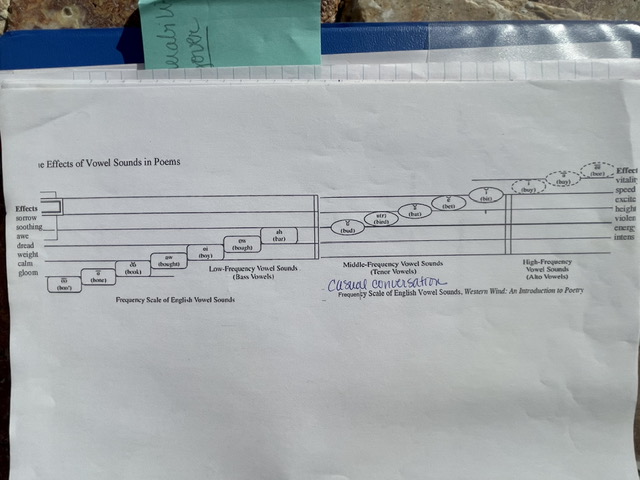
“Bam!”, “Crrraack!”, “Klunk!” are just a few on the list of words used in the 1960’s TV show Batman, usually held within a colorful cartoon bubble. We immediately conjure what is trying to be conveyed, and part of that understanding is because of the sounds of these particular words. In any writing, the sounds of words can produce not only feelings, but physical effects on the body. In poetry specifically, sounds become even more important because words must be carefully chosen in order to “say the most with the least”. We must pay attention to the vowels, consonants, stresses, etc. in the words we choose dependent on the idea or tone we are trying to convey.

Take a look at the information about vowel and consonant sounds pictured above, courtesy of Cathy Smith Bowers, Queens University., (excuse my notes and shadow!)Then, look at these two examples below. Read them aloud and ask yourself if it feels like flow and glide, or stop and start? Is there an emotion or physical reaction you can sense as you read?

I caught this morning morning’s minion, king-

            dom of daylight’s dauphin, dapple-dawn-drawn Falcon, in his

            riding.

                                                -from The Windhover,by Gerard Manley Hopkins

We real cool. We

Left school. We

Lurk late. We

Strike straight.

                                                –from We Real Cool by Gwendolyn Brooks

That was pretty easy, huh? Now, go to one of your favorite poems and see if you can see how the word choices the poet made regarding sound serve the tone, subject matter, and larger themes of the poem. Then, look at one of your own.

Sound is just one of the many devices poets use, and it is a powerful one. A poem that uses short lines with high-frequency vowel sounds will sound very different than one with long lines using low-frequency sounds. And remember, the importance comes from not just the reaction to the words in your ears, but also the subsequent emotion or felt reaction in the body, and there is music to be found in all of them.

Thank you for reading. Don’t forget to sign up to follow our blog as well as follow us on facebook.

Ellis is author of the National Book Award nominee poetry collection Break in the Field published by Old Scratch Press.

Want to Get Published? Where & How to Submit Your Work

By Ellis Elliot

Sharing your work by submitting it for publication can be a daunting task in many ways, not only because it causes a vulnerability hangover, but also because it can be overwhelming and hard to figure out where to start. I’m hardly an expert, but I have submitted dozens of poems to literary journals and contests, and found a good bit of success, and this is what I’ve learned.

            First, begin by stalking online and print literary journals. Find some you like and respect. Consider the type of writing you want to submit. You would not submit your Southern Gothic short story to a literary journal for Christian Sci-Fi (yes, that’s a thing). Find the right kind of “fit”, as far as genre and theme, for your work. See if the journal resonates with you. And while it is never wrong to “shoot for the stars” and submit to the New Yorker or another of that ilk, it also makes sense to spread your net wide, over a variety of journals, big and small.

How do you even find these journals in the first place? Maybe your school has one, or you can broadly search online for ones in your genre, and then read some. Read to get a sense of specific journals, and what all is out there.

Also, there are numerous free and paid websites that have lists of journals, and some can even narrow it down for you based on your preferences.  A few I use are: Submittable, Duotrope, Poets and Writers magazine, Writer’s Digest, and Authors Publish. (See links below) These provide lists of publications, along with dates and details. Always check if there are fees involved, and choose wisely. I’m the first to admit, it is a lot of work to wade through the sea of lit journals in order to filter down to the ones you want, but once you find them, your list has begun, and from there you can only add to it. Plus, once those algorithms get in your computer, you’ll be getting all sorts of lit-related stuff, like it or not.

Once you’ve narrowed it down to the journals you want to send your work to, be sure to read the guidelines carefully. You don’t want your work tossed because you sent five poems when they asked for one, or sent a 500-word bio when they asked for 50.

Photo by Pixabay on Pexels.com

Be prepared with a good cover letter, short biography, and a photo. Your cover letter should be addressed to the editor of your genre in that publication. It should be brief and can include references to the journal you’re submitting to, like how you enjoyed their recent issue on butterfly migration, but don’t overdo. They are there to read your writing, not your cover letter. Be sure to thank them for their time and effort, because it does require a lot of both.

The bio should also be matter-of-fact, including salient facts, like where you live, what job you have, or family and pets. Include any writing-related experience you’ve had, whether it’s school, workshops, or clubs. If you’ve been previously published, be sure to include those titles. 

You can always throw in a little personality and add things like, “in my spare time I like to taxidermy butterflies and run on the beach.”

            Finally, the photo. I recently paid for a headshot, but that was only after years of using shots I made my husband take of me immediately after I got home from the hair salon. Just be sure you have something ready to go.

            Once you’ve sent your best work in the best way you can, you wait. Most lit journals get a boat-load of submissions and turn-over time can take months. When you get an inevitable rejection, know that the process is entirely subjective. If it is your best, then it is art, and no two people necessarily will see your art in the same way. If you get accepted, let that feeling cover you like syrup, do a happy dance, then get to work withdrawing from all the journals you sent that piece to. Most journals allow “simultaneous submissions” with the caveat that you alert them if it is accepted elsewhere. It’s a good problem, but necessary to maintain good

            I write all of the above only after having made every conceivable mistake and had innumerable rejections. But, I have learned a lot along the way.  Like anything, submitting is work, and a job unto itself. It is also well worth it when you have the satisfaction of seeing your work in print.

Ellis is one of our founding collective members. Her poetry collection, Break in the Field, is available for purchase here.

Below are some links to get you started on sending out your work.

https://www.submittable.com/

https://duotrope.com/

https://www.pw.org/

Favorite Poet Ted Kooser

By Virginia Watts

When people hear that I try to write some poetry, I can tell they are thinking, formulating the common question. I stiffen and get ready for it. “Who is your favorite poet?” I used to respond with the complete truth, that I have many favorites. Sometimes I’d tick off a list of names they didn’t ask for and wouldn’t remember.

Now, I tell them first that a favorite poet is someone a reader returns to when they need them most. Your favorite poet is a companion, a friend’s voice in the dark. Poetry gives us laughter when we need it. Poetry comforts us when we are afraid, sad, lost. I tell people this because I hope they will search for a favorite poet of their own. I know once they find one, they’ll understand.

My favorite poet is Ted Kooser, a former United States Poet Laureate and winner of the Pulitzer Prize in 2005. He has published numerous books of poetry as well as children’s books and works of nonfiction. Kooser’s poems are drawn from midwestern landscape and everyday rural life. I read poetry often, as much as I can, but Kooser’s poems are the ones I return to like home’s fire to sit with again.

IT DOESN’T TAKE MUCH

BY TED KOOSER

Maybe an hour before sunrise, driving alone
on the way to reach somewhere, seeing,
set back from the highway, the dark shape
of a farmhouse up against deeper darkness,
a light in one window. Or farther along

into a gray, watery dawn, passing
a McDonald’s, lighted bright as a city,
and seeing one man, in ball cap, alone
in a booth, not looking down at his table
but ahead, over the empty booths. Or

maybe an hour farther, in full daylight,
at a place where a bus stops, seeing
a woman somewhere in her forties,
dressed for cold, wearing white ear muffs,
a red and white team jacket, blue jeans

and Muk Luks, one knit mitten holding
a slack empty mitten, her bare hand
extended, pinching a lit cigarette,
dry leaves—the whole deck of a new day—
fanned out face-down in the gutter, but

she’s not stooping to turn over a card,
but instead watching a long ash grow
even longer at the ends of her fingers.
Just that much might be enough for one
morning to make you feel part of it all.

From The Path to Kindness: Poems of Connection & Joy.
Forthcoming from Storey Publishing, 2022.

Thank you for reading. Follow us on Facebook and X. We’d love to hear about which poets inspire you.

Simple Poems That Pack A Punch, Make a List

By Nadja Maril

Today I was attending an online workshop led by CNF writer and poet Nicole Breit and she was talking about different writing forms. One of those forms was the list format, which Nicole has used in her essay entitled, Atmospheric Pressure, published in Room Magazine. Her lyric list form essay jumps backwards and forwards in time to convey the cycle of grief

The mention of lists, immediately brought to mind flash prose.  Plenty of flash fiction and CNF flash stories use the list form. Just think of what kind of story you can tell with a curated shopping list, a packing list, or list of desired skills in the Help Wanted section of the classifieds.

Before Nicole began focusing on writing memoir, she was writing poetry, Many of her creative ideas for creative nonfiction come from poetry, which got me to thinking about List Poetry. 

Simply stated, a list poem consists of a list of images or adjectives. The compilation of the items as a group creates the poem. By their nature, List Poems use repetition. They also often use what is called anaphora, the reoccurrence of the same sound to create a driving rhythm.

An old favorite poem of mine is by Alice Duer Miller (1874-1942) who was very active in the American suffragette movement.

Photo by Pixabay on Pexels.com

Why We Oppose Pockets for Women

By Alice Duer Miller

1. Because pockets are not a natural right.
2. Because the great majority of women do not want pockets. If they did they would have them.
3. Because whenever women have had pockets they have not used them.
4. Because women are required to carry enough things as it is, without the additional burden of pockets.
5. Because it would make dissension between husband and wife as to whose pockets were to be filled.
6. Because it would destroy man’s chivalry toward woman, if he did not have to carry all her things in his pockets.
7. Because men are men, and women are women. We must not fly in the face of nature.
8. Because pockets have been used by men to carry tobacco, pipes, whiskey flasks, chewing gum and compromising letters. We see no reason to suppose that women would use them more wisely.

Another famous poem that also takes the form of a list, is Walt Witman’s (1819-1892) I Hear America Singing.

Photo by RDNE Stock project on Pexels.com

I Hear America Singing

By Walt Whitman

I hear America singing, the varied carols I hear,
Those of mechanics, each one singing his as it should be blithe and strong,
The carpenter singing his as he measures his plank or beam,
The mason singing his as he makes ready for work, or leaves off work,
The boatman singing what belongs to him in his boat, the deckhand singing on the steamboat deck,
The shoemaker singing as he sits on his bench, the hatter singing as he stands,
The wood-cutter’s song, the ploughboy’s on his way in the morning, or at noon intermission or at sundown,
The delicious singing of the mother, or of the young wife at work, or of the girl sewing or washing,
Each singing what belongs to him or her and to none else,
The day what belongs to the day—at night the party of young fellows, robust, friendly,
Singing with open mouths their strong melodious songs.

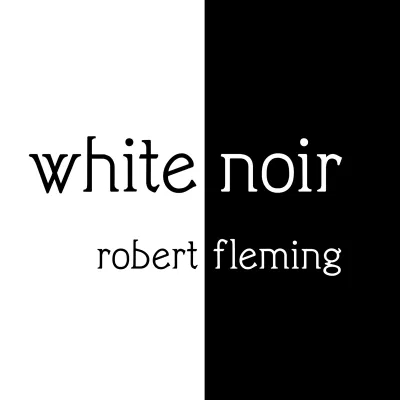
Thank you for reading the Old Scratch Press blog. Please sign up to follow us if you haven’t already done so, and check out our next chapbook, Robert Fleming’s White Noir.

Visual Poetry or ConCrete Poetry or Graphic Poetry…Try It

Poetry is recited and sung.  In some traditions it is committed to memory and orally passed down from one generation to the next.  The choice of rhythm, alliteration, words that rhyme, all contribute to the emphasis on how a poem will sound when it is heard.

What happens when a poem is read silently? Poems, often considered sacred, were copied onto parchment and carved into rock. The manner in which the words were placed took on new meaning.

Written in elegant sprawling letters in colored inks or boldly painted, visual poetry is another type of expression which has been around for centuries.

The 20th century brought what is known as the Concrete Poetry Movement. Influenced by the Dada, Surrealist, and Futurist movements; poets sought to break the rules by challenging how words were placed on the page, how they were spelled. The most famous of these early 20th century poets was e.e. cumming. Just think about his poem Grasshopper.

Below is a page from Lewis Carroll’s Alice’s Adventures in Wonderland with the “Mouse’s tale” in the shape of a tail.

But take a step back in time further and what you may not know is that  there was a English poet at the beginning of the 17th century George Herbert (1593-1633) who, although formal in approach, started the ball rolling towards the concept of creating a visual statement with poetic verse.  A contemporary of poets Henry Vaughn, Richard Crashaw and Thomas Traherne, Herbert was read by the poets who followed him including Gerard Manley Hopkins, T. S. Elliot and Emily Dickinson to name a few.

Here to enjoy are two of his poems, now in the public domain.

The Altar

By George Herbert

  A broken ALTAR, Lord, thy servant rears,

 Made of a heart and cemented with tears:

  Whose parts are as thy hand did frame;

No workman’s tool hath touch’d the same.

        A HEART alone

         Is such a stone,

         As nothing but

           Thy pow’r doth cut.

             Wherefore each part

          Of my hard heart

                Meets in this frame,

            To praise thy name:

       That if I chance to hold my peace,

 These stones to praise thee may not cease.

   Oh, let thy blessed SACRIFICE be mine,

     And sanctify this ALTAR to be thine.

Easter Wings

By George Herbert

Lord, who createdst man in wealth and store,

      Though foolishly he lost the same,

            Decaying more and more,

                  Till he became

                        Most poore:

                        With thee

                  O let me rise

            As larks, harmoniously,

      And sing this day thy victories:

Then shall the fall further the flight in me.

My tender age in sorrow did beginne

      And still with sicknesses and shame.

            Thou didst so punish sinne,

                  That I became

                        Most thinne.

                        With thee

                  Let me combine,

            And feel thy victorie:

         For, if I imp my wing on thine,

Affliction shall advance the flight in me.

(If you place Easter Wings horizontally, the poem looks even more like wings.)

What shape is your next poem inspired to take and when writing a visual poem. It’s an interesting process, one you might want to try. Being a poet is all about following where inspiration takes you, but experimenting with a variety of poetic forms can expand you writing practice. Remember if you decide to submit a visual poem for publication it is important to save it as a pdf to insure that if it is shared with others it will look the same way you envisioned it.

Thank you for reading the Old Scratch Press Blog and please remember to follow us here on WordPress and on Facebook.

Telling Halloween Stories with Scary Poems

by Nadja Maril

Halloween. The weather turns cool. Leaves on the trees change colors, fall to the ground, and orange pumpkins are set out on porches. As a child it was a big deal to decide, what sort of costume I’d find and wear, for Trick or Treating and parties. But first, it was important to get into the mood and one poem, in my favorite book of poems would always do the trick. In the original spelling, the author wrote orphant not orphan. So I knew the poem as Little Orphan Annie. The illustration showed a young woman in front of a kitchen hearth with small children gathered around her. I loved reading this poem, Little Orphan Annie, which was both fun and scary.

Here’s the original version written by James Whitcomb Riley (1849-1916) an American poet who hailed from Indiana, who was also a  journalist. Folksinger Anne Hill has done a lovely job in the country bluegrass style, setting this poem to music and you can listen to her sing it here.

Little Orphant Annie

by James Whitcomb Riley

Little Orphant Annie’s come to our house to stay,
An’ wash the cups an’ saucers up, an’ brush the crumbs away,
An’ shoo the chickens off the porch, an’ dust the hearth, an’ sweep,
An’ make the fire, an’ bake the bread, an’ earn her board-an’-keep;
An’ all us other childern, when the supper things is done,
We set around the kitchen fire an’ has the mostest fun
A-list’nin’ to the witch-tales ‘at Annie tells about,
An’ the Gobble-uns ‘at gits you
             Ef you
                Don’t
                   Watch
                      Out!

Onc’t they was a little boy wouldn’t say his prayers,—
So when he went to bed at night, away up stairs,
His Mammy heerd him holler, an’ his Daddy heerd him bawl,
An’ when they turn’t the kivvers down, he wasn’t there at all!
An’ they seeked him in the rafter-room, an’ cubby-hole, an’ press,
An’ seeked him up the chimbly-flue, an’ ever’wheres, I guess;
But all they ever found was thist his pants an’ roundabout–
An’ the Gobble-uns’ll git you
             Ef you
                Don’t
                   Watch
                      Out!

An’ one time a little girl ‘ud allus laugh an’ grin,
An’ make fun of ever’one, an’ all her blood an’ kin;
An’ onc’t, when they was “company,” an’ ole folks was there,
She mocked ‘em an’ shocked ‘em, an’ said she didn’t care!
An’ thist as she kicked her heels, an’ turn’t to run an’ hide,
They was two great big Black Things a-standin’ by her side,
An’ they snatched her through the ceilin’ ‘fore she knowed what she’s about!
An’ the Gobble-uns’ll git you
             Ef you
                Don’t
                   Watch
                      Out!

An’ little Orphant Annie says when the blaze is blue,
An’ the lamp-wick sputters, an’ the wind goes woo-oo!
An’ you hear the crickets quit, an’ the moon is gray,
An’ the lightnin’-bugs in dew is all squenched away,–
You better mind yer parents, an’ yer teachers fond an’ dear,
An’ churish them ‘at loves you, an’ dry the orphant’s tear,
An’ he’p the pore an’ needy ones ‘at clusters all about,
Er the Gobble-uns’ll git you
             Ef you
                Don’t
                   Watch
                      Out!

Photo by James Wheeler on Pexels.com

American poet Carl Sandburg (1878-1967) takes a different approach with this beautiful poem that captures the magic of nature while igniting the element of the unknown.

Theme in Yellow

by Carl Sandburg

I spot the hills

With yellow balls in autumn.

I light the prairie cornfields

Orange and tawny gold clusters

And I am called pumpkins.

On the last of October

When dusk is fallen

Children join hands

And circle round me

Singing ghost songs

And love to the harvest moon;

I am a jack-o’-lantern

With terrible teeth

And the children know

I am fooling.

Fun and intimate, is how I’d characterize this third poem by American poet Sarah Teasdale (1884-1933).  Which leads to the question of what kind of poem you’d write, if tasked with writing a “Halloween Poem.”

Dusk in Autumn

By Sarah Teasdale

The moon is like a scimitar,

A little silver scimitar,

A-drifting down the sky.

And near beside it is a star,

A timid twinkling golden star,

That watches likes an eye.

And thro’ the nursery window-pane

The witches have a fire again,

Just like the ones we make,—

And now I know they’re having tea,

I wish they’d give a cup to me,

With witches’ currant cake.

Decorate the outside of your house with scary poems. Instead of fortune cookies give out treats with poetry inside. Halloween is a time for bonfires and storytelling. What a great time to recite poetry. Don’t forget to follow us on Facebook and follow this blog. Today is October 9th which means there’s less than one week left to submit your Cooold Turkey themed Holiday/End of the Year start of a New Year Winter Poems (2), or very short fiction or fact to Instant Noodles Literary Magazine. Members of the Old Scratch Press Collective are guest editors for this upcoming issue. Submission Link here

Submissions Still Open For Winter Issue & READ the Latest Issue of INSTANT NOODLES LITERARY Magazine

Hello fellow literary enthusiasts, We are thrilled to bring you the fall edition of the Instant Noodles Lit Mag! Get ready to dive into a world of literary delights: https://instantnoodleslitmag.com And for this issue celebrate the circle of life, the circle of the seasons as authors and artists interpret the theme: It Should Always Be Fall in the Cemetery.

✨ Original Short Stories: Discover captivating tales from emerging and established authors that will transport you to different worlds and leave you craving more.🖋️ Poetry: Immerse yourself in the evocative and thought-provoking verses of poets who paint with words.🗞️ Engaging creative non-fiction that resonates deeply.

🌟 Art and Illustrations: Telling wordless stories as a way to hit the theme… perfect!

And many of the authors read their pieces for you! For example: LIPSTICKS THE WITCHES WORE TO THE HALLOWEEN BALL ~ PAMELA BERKMAN 📣 Join Our Community 📣 We invite you to become a part of our literary community:✉️ Subscribe: Don’t miss a single issue of Instant Noodles Lit Mag! Sign up for our newsletter to receive updates, special content, and more directly in your inbox.📝 Submit Your Work: Are you a writer or artist looking for a platform to showcase your talent? We welcome submissions of fiction, poetry, essays, and artwork. Visit our website for submission guidelines. Next deadline in October 15th.🎉 Help Us Spread the Word 🎉 If you’re as excited as we are about Instant Noodles Lit Mag, please help us spread the word. Share our website and newsletter with your fellow bookworms, writers, and artists, and together, let’s create a vibrant literary community.🌐 Follow Us: Thank you for joining us on this literary adventure. We can’t wait to share our love for words and creativity with you. https://instantnoodleslitmag.com/
Visit our Facebook page for Old Scratch Press to keep up with the latest news. https://www.facebook.com/OLDSCRATCHPRESS/

Do Poets and Writers of Short Prose Need an MFA?

By Nadja Maril

Attend any writer’s conference or weekend of workshops and invariably a topic raised amongst the attendees, (those aspiring to be published writers), is a discussion on the value of an MFA.

Will an MFA is help me professionally?

Will graduate school provide me with useful introductions to members of the publishing industry?

Will the process of earning a Masters degree serve to teach me useful skills I couldn’t learn independently?

No simple answer exists, because every writer and their aspirations are different. And every MFA program is different.

Photo by Gu00fcl Iu015fu0131k on Pexels.com

I found pursuing an MFA  to be a rewarding intellectual experience, as an older adult. I received my MFA  from the Stonecoast  Low Residency Writing Program at in University of Southern Maine in literary fiction in January 2020.  

Low residency didn’t start up with the internet or the pandemic. For decades, many scholars have recognized that much of a graduate student’s work consists of independent study and research under the tutelage of a mentor. Low residency programs convene in person each semester for one or two weeks and the remainder of communication is done by email, snail mail and video conferencing.  The set-up enables students to continue with another professional career and family responsibilities.

While I wished I ‘d attended grad school in my twenties or thirties, sometimes you appreciate something more when you are forced to wait.

When I asked some of my colleagues at Old Scratch Press if they could share some of their thoughts  about MFA’s,  Collective  member Robert Fleming  told me about Mark Fishbein, who he met at the Poetry Academy of the District of Columbia poetry critique workshop. To join contact Mark at mark@poetwithguitar.com

To Mark Fishbein, Robert posed the following questions:

Why did you choose an MFA?:

M.F.: As retired, the purpose at the age of 74 means deciding to buy your container of milk before or after your nap. As a young man I thought to live the life of poet/academician, but got sidetracked and spent my life differently. But as a lifelong poet, I now give lectures in poetry workshops and I would like to teach it. In order to do so I must have, at minimum, an MFA.

Mark began in the Fall, 2023 an in-person MFA in creative writing: poetry at Columbia College in Chicago, IL. This is a traditional residential full-time program.

Why did you chose this specific school? :

M.F.: The program is well received; it’s walking distance from home, the price is more reasonable and the vibe less full of itself as I have experienced. It’s in the heart of downtown. No campus fraternities.

Mark is the chancellor of the Poetry Academy of the District of Columbia and most recently published Reflections in the Time of Trumpius Maximus, by Mark Fishbein | Atmosphere Press

So what is your thoughts on the topic? We’d be happy to hear from you.

Thank you for reading. Check out the latest submission call from Instant Noodles Literary Magazine here.

White Noir by Robert Fleming: A Darkly Captivating VIsual Poetry Journey

Old Scratch Press is pleased to announce the forthcoming release of Robert Fleming’s newest poetry chapbook, White Noir.

Are you ready to embark on an unforgettable journey through the depths of human existence? Look no further than WHITE NOIR, by Robert Fleming, a mesmerizing black and white visual poetry book that delves into the enigmatic tapestry of life, from birth to death and beyond. This book is not just a collection of verses; it’s a visual and emotional experience that will leave you spellbound.

Who Should Dive into WHITE NOIR?

  • Appreciators of Visual Poetry: If you’re someone who finds beauty in the fusion of words and images,WHITE NOIR is your treasure trove. Fleming’s mastery of visual poetry will leave you in awe.
  • Lovers of Graphic Arts: This book is a canvas of creativity, merging the artistry of words and visuals in a way that will captivate anyone with an appreciation for graphic arts.
  • Devotees of Dark Humor: WHITE NOIR thrives on dark humor, taking you on a rollercoaster ride of emotions that ultimately ends with a glimmer of hope. It’s a unique blend of wit and introspection.

What Awaits You in WHITE NOIR?

  • A Profound Human Journey: WHITE NOIR takes you on a journey that spans the entire lifespan of humanity. It explores the diverse facets of existence, from the raw and unfiltered to moments of humor and reflection.
  • Balance of Text and Images: The book strikes a perfect balance between text and visuals, creating a multi-sensory experience that will leave you immersed in its world.
  • Taboo Themes: Fleming fearlessly tackles taboo subjects, including religion, sex, politics, and gun violence, inviting readers to confront and contemplate these complex issues.
  • Experimental Poetry Forms: Get ready for a literary adventure as Fleming explores experimental poetry forms, such as phone texting, Alexa questions, and palindromes, pushing the boundaries of conventional poetry.

Why Will You Love WHITE NOIR?

  • A Petite Delectation: You can devour this thought-provoking journey in a single sitting, making it perfect for a cozy afternoon or an intellectual escape.
  • Original and Modern: “White Noir” is a testament to contemporary poetry, offering a fresh perspective on life’s most profound questions.
  • Perfect Gift: Looking for a unique gift for a friend or loved one? “White Noir” is a one-of-a-kind present that will leave a lasting impression.
  • Robert Fleming, the Doodleman, infuses his work with influences from literary giants like Robert Frost, Dr. Seuss, and the Beats, as well as the artistic visions of Salvador Dali and Andy Warhol. With over 400 works published internationally, Fleming’s talent is undeniable, earning him recognition and accolades from various literary circles.

Don’t miss the opportunity to explore the captivating world of “White Noir.” Order your copy today and join the ranks of those who have been moved and inspired by Robert Fleming’s unique vision of human existence. 

It’s not just a book; it’s an experience waiting to be embraced….

Scheduled for November 15th release, order your copy now.