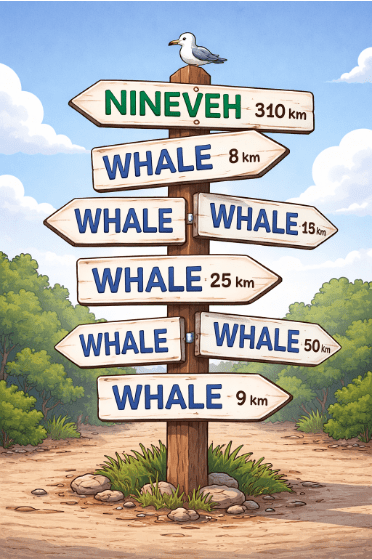
Jonah’s Map of the Whale and Other Poems, by Old Scratch Press member Anthony Doyle, is a 2026 Eric Hoffer Book Award Category Finalist.
Jonah is my first volume of poetry, so it was especially gratifying to look at the list of Category Finalists posted to the Hoffer Award website and see it there in all its glory. Just as parents can instantly spot their own kids in a crowded park full of other children not objectively dissimilar to their own in any real way, my eyes were instantly drawn to that familiar sequence of words: Jonah’s Map of the Whale. Next, of course, I checked my name—you know, just in case there was another Jonah’s Map of the Whale by some not-Anthony—, and then, certified that it was indeed my Jonah, I smiled at the sight of three little words that have come to mean a lot to me: Old Scratch Press.
I am in the process of completing my second volume of poetry, so “Jonah” seems at times like a distant country I once used to live in and hope to return to someday. So I went back to a review poet and critic Billie Mills so kindly wrote about it when it came out last year, just to see it through someone else’s eyes before writing anything about it. The book consists of three sections, each devoted to a different “persona”, which Mills described as “nearer to archetypes than individuals, carrying something of a mythical nature […] narratives, fables, romances, but never anecdotes.” It’s a good description, but that does not mean the book is non- (or im-)personal, because that narrative, mythical, fable-like quality is perhaps the most any of us can aspire to in our best (and worst) moments.
I have a thing about threes, perhaps because three was the last number I can say I ever managed to understand. I get three. I can feel three. Anything from four to the Googolplexian, and I’ll just have to take your word for it. But threes work; threes make sense. So this book, naturally, has three sections.
The first of these is a group of poems about a fictional character named Flounder, sometimes presented as a young man with mental health and addiction issues, other times as a flatfish on the floor of the Irish Sea. So when he’s not a floundering human, he’s a very human flounder, and what tips him one way or the other is how deep he sinks into his overactive, intrusive unconscious self.
The second character, Blundra, is everything Flounder is not. The world likes Blundra, and Blundra knows how to make it give her what she wants. The problem is, what she really, really wants is something this world cannot give. Constantly on the verge of an epiphany that never quite comes, she experiences a frustration that is also a sort of longing. This revelation-in-the-making whispers to her from afar in the form of her dead grandmother’s voice.
The third section of the book, the title poem, is a turn-of-the-21st-century rereading of the Jonah story, and it shares an origin with my speculative novel Hibernaculum (2024 Next Generation Indie Book Awards Science Fiction Category Finalist).
Jonah and Hibernaculum are kindred works, as they were both initially parts of a literary triptych called Three Jonahs. The third panel was the as-yet-unpublished Jestor.
I scrapped the triptych idea when Hibernaculum and Jestor turned into full-length, standalone novels, and “Jonah’s Map of the Whale” found a new home alongside “Blundra” and “Flounder”.
Although the triptych was disbanded in practice, it remains very much together in spirit. There is a Jonah and a whale in each of these works. Jonahs fleeing their own private Ninevehs, whales catching them halfway between one Joppa and another Tarshish. The whale can be a person or entity (Jestor), a process (human hibernation), or it can even be oneself and one’s past, as in “Jonah’s Map of the Whale”.
Personally and collectively, we’re constantly fleeing and being dragged back. It’s part of the cycle of existence. The Jonah tale is pure dialectic (thesis, antithesis, synthesis…repeat), and so is history, so is an individual life.
So what sort of cartography is this “map”? In the book, it’s a two-track reverse chronology: the misadventures of Alex Iden Grey, on one hand, and the turn of the 21st century, on the other. Wrong turns, missed opportunities, and ignored warnings, all seen in retrospect and laid out as cautionary tales. And what is a cautionary tale if not a map in negative, a map that says “the guy who went this way got swallowed by a whale.”
A simple map, really… in hindsight.
That’s what the book is about. It took a long time to write (dewrite, rewrite, repeat…) and now it is what it is, no take-backs, no changes.
And with a cute little golden seal on the cover.

Thank you, Eric Hoffer!
Anthony Doyle
Born in Dublin and raised in Wicklow Town, Anthony Doyle holds a joint honours degree in English and Philosophy and a master’s degree in Philosophy from University College Dublin, Ireland.
He moved to São Paulo, Brazil, in 1999, where he works as a translator from Portuguese to English.
He writes poetry and fiction for adults, teens and children.