Jonah’s Map of the Whale and Other Poems, by Old Scratch Press member Anthony Doyle, is a 2026 Eric Hoffer Book Award Category Finalist. 

Jonah’s Map of the Whale and Other Poems, by Old Scratch Press member Anthony Doyle, is a 2026 Eric Hoffer Book Award Category Finalist. 

Jonah is my first volume of poetry, so it was especially gratifying to look at the list of Category Finalists posted to the Hoffer Award website and see it there in all its glory. Just as parents can instantly spot their own kids in a crowded park full of other children not objectively dissimilar to their own in any real way, my eyes were instantly drawn to that familiar sequence of words: Jonah’s Map of the Whale. Next, of course, I checked my name—you know, just in case there was another Jonah’s Map of the Whale by some not-Anthony—, and then, certified that it was indeed my Jonah, I smiled at the sight of three little words that have come to mean a lot to me: Old Scratch Press. 

I am in the process of completing my second volume of poetry, so “Jonah” seems at times like a distant country I once used to live in and hope to return to someday. So I went back to a review poet and critic Billie Mills so kindly wrote about it when it came out last year, just to see it through someone else’s eyes before writing anything about it. The book consists of three sections, each devoted to a different “persona”, which Mills described as “nearer to archetypes than individuals, carrying something of a mythical nature […] narratives, fables, romances, but never anecdotes.” It’s a good description, but that does not mean the book is non- (or im-)personal, because that narrative, mythical, fable-like quality is perhaps the most any of us can aspire to in our best (and worst) moments. 

I have a thing about threes, perhaps because three was the last number I can say I ever managed to understand. I get three. I can feel three. Anything from four to the Googolplexian, and I’ll just have to take your word for it.  But threes work; threes make sense. So this book, naturally, has three sections.

The first of these is a group of poems about a fictional character named Flounder, sometimes presented as a young man with mental health and addiction issues, other times as a flatfish on the floor of the Irish Sea. So when he’s not a floundering human, he’s a very human flounder, and what tips him one way or the other is how deep he sinks into his overactive, intrusive unconscious self.  

The second character, Blundra, is everything Flounder is not. The world likes Blundra, and Blundra knows how to make it give her what she wants. The problem is, what she really, really wants is something this world cannot give. Constantly on the verge of an epiphany that never quite comes, she experiences a frustration that is also a sort of longing. This revelation-in-the-making whispers to her from afar in the form of her dead grandmother’s voice. 

The third section of the book, the title poem, is a turn-of-the-21st-century rereading of the Jonah story, and it shares an origin with my speculative novel Hibernaculum (2024 Next Generation Indie Book Awards Science Fiction Category Finalist). 

Jonah and Hibernaculum are kindred works, as they were both initially parts of a literary triptych called Three Jonahs. The third panel was the as-yet-unpublished Jestor

I scrapped the triptych idea when Hibernaculum and Jestor turned into full-length, standalone novels, and “Jonah’s Map of the Whale” found a new home alongside “Blundra” and “Flounder”. 

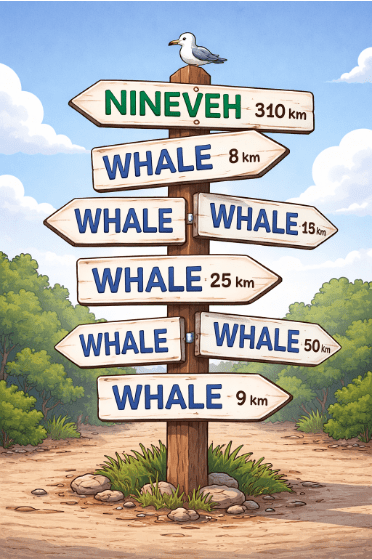
Although the triptych was disbanded in practice, it remains very much together in spirit. There is a Jonah and a whale in each of these works. Jonahs fleeing their own private Ninevehs, whales catching them halfway between one Joppa and another Tarshish. The whale can be a person or entity (Jestor), a process  (human hibernation)or it can even be oneself and one’s past, as in “Jonah’s Map of the Whale”.  

Personally and collectively, we’re constantly fleeing and being dragged back. It’s part of the cycle of existence. The Jonah tale is pure dialectic (thesis, antithesis, synthesis…repeat), and so is history, so is an individual life. 

So what sort of cartography is this “map”? In the book, it’s a two-track reverse chronology: the misadventures of Alex Iden Grey, on one hand, and the turn of the 21st century, on the other. Wrong turns, missed opportunities, and ignored warnings, all seen in retrospect and laid out as cautionary tales. And what is a cautionary tale if not a map in negative, a map that says “the guy who went this way got swallowed by a whale.” 

A simple map, really… in hindsight. 

That’s what the book is about. It took a long time to write  (dewrite, rewrite, repeat…) and now it is what it is, no take-backs, no changes. 

And with a cute little golden seal on the cover.
Thank you, Eric Hoffer!


Anthony Doyle
Born in Dublin and raised in Wicklow Town, Anthony Doyle holds a joint honours degree in English and Philosophy and a master’s degree in Philosophy from University College Dublin, Ireland. 

He moved to São Paulo, Brazil, in 1999, where he works as a translator from Portuguese to English. 

He writes poetry and fiction for adults, teens and children.

Old Scratch Press in miniMAG

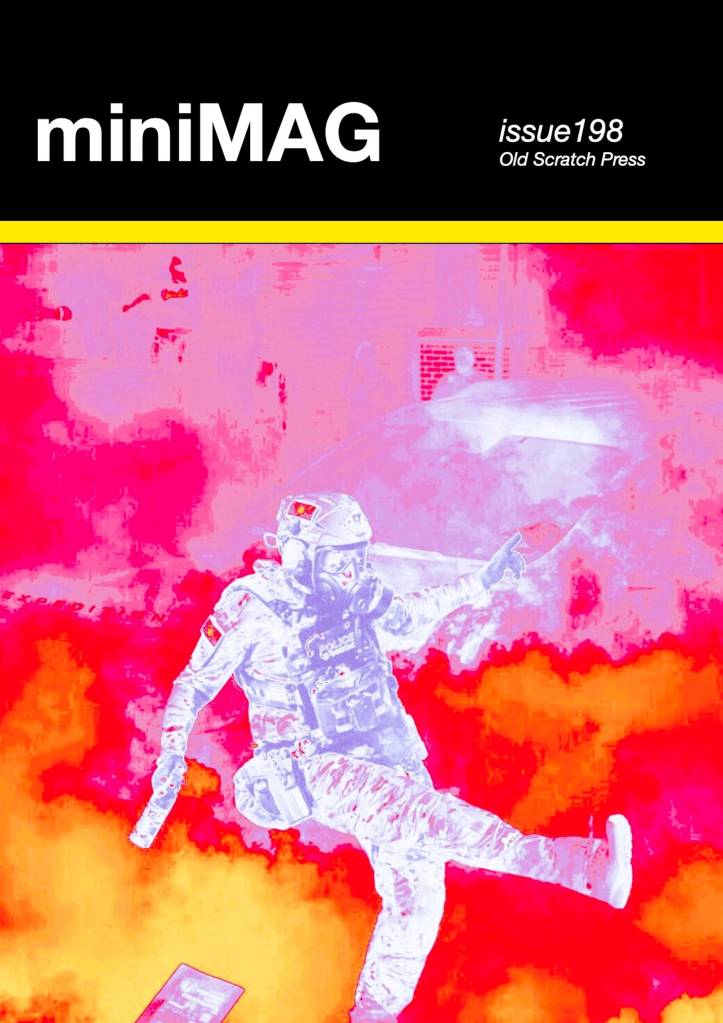
Voted one of the “Best Online Literary Magazines of 2024”, miniMAG lets OSP loose on Issue 198

Intense. Short. Weekly.

That’s how miniMAG describes itself. A short, intense, and weekly literary magazine specializing in short-form poetry, flash fiction, and flash non-fiction that you can rely on to offer a giddy mix of unpredictability and variety. 

Voted one of the Best Online Literary Magazines of 2024, with each issue miniMAG serves up a potent deployment of text and image, a real seed bomb of words and color. A welcome arrival in my inbox for some time now, I loved the concept right from the start. 

There’s something for all tastes in miniMAG, whether it’s punchy, wacky short stories or surrealist poems, intriguing essays or wild flights of fancy, graphic art or pictures drawn with big, thick crayons, delicate line art or great booming splashes of color… miniMAG has it all, set into a slick template that remains reassuringly the same: black pages, white type.

When Alex, miniMAG’s editor, agreed to let Old Scratch Press produce an issue, I was stoked. And it was great fun seeing it all come together. At 30 pages, it’s a little longer than usual, but hopefully just as intense.

And just as multifaceted, seeing as all ten OSP members contributed work:

Robert Fleming supplies much of the art (some of it ICE-themed), including two visual poems. OSP’s newest member, Beatriz Fernandez, contributes two poems and a photo. That most Neapolitan of Californians, Alan Bern, presents two photo-poems, while Virginia Watts provides two poems and a flash-fiction piece titled “War”. Dianne Pearce gives us a taste of what to look forward to from her upcoming poetry collection, “In The Cancer Cafeteria”, with a poem, a short story, and two collages. Gabby Gilliam is also here with a piece called “Reawakening”, while R. David Fulcher turns things spooky with “The Weird of the Water”. Nadja Maril supplies three poems and a photo of the most Napoleonic rooster you’re ever likely to see, while Morgan Golladay brings things to a thoughtful close with her poem “Sky Cast”. As for me, I’ve got two illustrated poems and a piece of flash fiction in there, and a couple of illustrations thrown in to boot.

For a collective work by a short-form collective, I really can’t think of a better vehicle than miniMAG. To read it, visit miniMAG and subscribe, or stop by miniMAG Press While you’re at it, recommend it to some of your friends, or all your friends! And also come visit the OSP members’ Subs too! And if you have a Substack yourself, let us know so we can drop by. 

So, a special thank you to Alex at miniMAG for letting us take on Issue 198. It was a real pleasure, and I hope you’ll have us back in the not-so-distant future!

Poets and Punctuation

In his sonnets, Shakespeare would use end-stops rigorously, with most lines ending in commas, semi-colons, and colons. Sometimes he relied on enjambment or exclamations, but as far as possible, he seemed to save his full stops for the very last line. 

Take Sonnet 18,  “Shall I compare thee…”: six commas, four semi-colons, two colons, one question mark, and one full stop. 

Ezra Pound, on the other hand, would often refuse to use any end-stops at all. 

Take these lines from Canto LII:

The empress offers cocoons to the Son of Heaven

Then goes the Sun into Gemini

Virgo in mid heaven at sunset

indigo must not be cut

No wood burnt into charcoal

gates are all open, no tax on the booths.

No commas, no colons or semi-colons, “midheaven” is split for emphasis or for pause. There’s as little punctuation as possible, down to “gates are all open, no tax on the booths.”  That solitary comma functions almost as a speed bump near an intersection. 

According to Daniel Albright, W.B. Yeats had ‘punctuational quirks’ which he was happy to leave to his editors to sort out.  It was as if those technicalities were above or below the poet, who belonged to another realm of language.  

T.S. Eliot, like his mentor Pound, would sometimes drop punctuation altogether, but then he would go and stick in a full stop just to confound the reader:

On Margate Sands.

I can connect

Nothing with Nothing

(“The Waste Land,” lines 300–302)

Most people read those lines as “On Margate Sands, / I can connect / Nothing with Nothing.” So why the full stop? Some say it’s to heighten the sense of isolation and fragmentation, but it actually spoils the drama rather than intensify it. “I can connect / Nothing with Nothing” is no longer restricted to this moment, here-and-now, on Margate Sands. It steals some of the bombast. Perhaps that was the point, who knows? 

One thing that seems pretty clear is that punctuation plays by different—or fewer—rules in poetry. 

In “Un Coup de Dés,” Mallarmé throws punctuation out the window almost entirely, relying on spaces and font size to convey the necessary pauses and emphases. Punctuation becomes visual and spatial, and all the more effective for it.

Compare that with Sylvia Plath, who was a heavy punctuator:

Clownlike, happiest on your hands,

Feet to the stars, and moon-skulled,

Gilled like a fish. A common-sense

Thumbs-down on the dodo’s mode. 

(Opening lines of “You’re”) 

Apostrophes, hyphens, and commas in all the right places. 

So, the question is: does punctuation really matter in poetry? 

Perhaps it depends on whether it’s intended to be read aloud or read off the page. At a reading, intonation and cadence work magic that is sometimes hard to replicate in print, where that same impact disappears somewhere between too much and too little punctuation. 

I suppose we’ve all got our own punctuational foibles. I often neglect end-stops. I know I shouldn’t, but putting in a comma, semi-colon or colon just feels wrong at the end of some lines. Not all, just some. I could not actually say why. It’s not a rational thing. It’s pure feeling. 

So whether you’re partial to Elizabeth Bishop’s em-dashes or agree with Joyce that quotation marks “are an eyesore,” rules are strange visitors in poetry. You can choose whether to follow them, or which ones to follow, and no one can really complain—except the reader, who will have to read in all the end-stops and what-nots we choose to leave out.

Anthony Doyle is a founding member of Old Scratch Press. He is the author of the novel Hibernaculum and the recently-published Jonah’s Map of the Whale and Other Poems.

Johnny on the Railway…

Anthony Doyle

My grandmother was widowed young, and her sister and brother never married. The three lived together in the same flat in inner-city Dublin. My gran and great-aunt Fran worked at a chocolate factory for a time.  They also cleaned offices and, I think, a cinema.  

Aunt Fanny, as we knew her, was basically another grandmother to us. In fact, grandmother was very much a two-sided coin: May and Fran, Nanny and Fanny. There was also our Great-Aunt Annie, who barely moved or spoke, and spent the last decade or so of her life sitting in an armchair in the corner. She paid attention though, and if I didn’t get some Jaffa cake biscuits, she’d make sure that travesty was set to rights.  That corner of the flat felt irredeemably empty after she died. There may as well have been a hole in the floor. 

Aunt Fran, my mother’s aunt, was an unusual-looking woman. I suspect Roald Dahl would have turned her into a character if he’d ever met her. But she was also one of the kindest-hearted people I’ve ever met, and she had a wicked sense of humor. 

She also loved kids, and she had a good way with them, too; an instinctive knack at communicating with them. There were quite a few cousins on my mother’s side, and when Aunt Fran wasn’t threatening to “gobble” us all up, she’d sit us on her knee and launch into the famous, fabulous, ridiculous “Johnny on the Railway”. My mother didn’t approve, or feigned disapproval (probably the latter). She’d say this wasn’t the sort of thing you should sing to kids, but we all loved it. She’d bounce us on her knee and chant:

Johnny on the railway

picking up stones. 

Along came the engine

and broke all his bones. 

‘Oh’, said Johnny, 

‘that’s not fair!’

‘Oh’, said the engine,

‘I – DON’T – CARE!’

That simple little rhyme, delivered with her theatrical flair, never ceased to end in cackling laughter. 

I have never forgotten it. Funny and, well, cruel. 

Unconsciously, I’m sure its message was installed way back then, but I recently started thinking about it, and I was actually struck by its stark meaning. This evil relative of Thomas the Tank Engine is no simple train, and if you look past the obvious questions as to what the hell Johnny was doing (a) picking up stones and (b) on the railway tracks, of all places, there’s actually a frighteningly wise message here. One that our great-aunt, a woman with little or no formal education, but well-schooled in the ways of the world, thought important enough for us to learn early doors. 

Life is full of trains like this one. 

They run on tracks, so they don’t—wont’, can’t—swerve. They follow their grooves, their natures, and they don’t have fast-acting brakes or the slightest inclination to slow down. They run full-steam ahead, and god help anyone who strays into their path, because they won’t stop. 

Johnny is you, me, my Aunt Fran. Just people going about our business, which may be simple, perhaps even pointless—like picking up stones on rail tracks—but it’s what we do, and we have a right to do it. Rights are words, not shields. They don’t stop trains. Rights only work if they’re respected, and the trains of this world respect nothing and no-one. It could be an actual psychopath or sociopath, or a narcissist who dazzles, then destroys, or a power-drunk boss, beat cop, bureaucrat, a CEO who sees only figures on spreadsheets, or even—who knew?—a president. There are trains for every imaginable set of tracks, just as churches run on beliefs, parties on ideologies, empires on big ideas…Trains one and all. And there’s no point arguing with them, no point complaining about how unfair it is when they mow you down.

Stones and bones—there’s a beautiful parallel there. Stones are the bones of the earth. Bones are the pillars and architraves of the body. We—“bags of bones”, another of Aunt Fanny’s favorites—go looking for stones to fill our bags (because we’re still, in essence, Paleolithic), but when we meet that iron behemoth powered by steam, we get destroyed. All broken. Scissors cuts paper, rock breaks scissors, train breaks the rock, and all Johnny’s bones.    

One thing I’m sure of today, looking back at all the times my Aunt Fran gave us “the Johnny treatment”, is that she probably knew, deep down, perhaps even somewhat unconsciously, that there was more to that ditty than just a funny and slightly wicked rhyme. She knew, I’m sure, that there was a brutal truth in it, a message which no end of idealism should ever gloss over, and which we’d all do well to learn early on:

Stay away from life’s trains, because they will crush you, given half a chance. And no, they will not care.

Anthony Doyle is an Old Scratch Press member, the author of the novel Hibernaculum and the forthcoming poetry book Jonah’s Map of the Whale.

Poems and cockroaches…call the exterminator!

by Anthony Doyle

Pluriplaneta apocalyptica

Poor poetry. Such a bad rep. 

As Ben Lerner says in The Hatred of Poetry, writing a poem is a heroic gesture doomed to failure, because it attempts to do something nigh-impossible: be totally unique whilst speaking to universal experience—and doing all that with song

It’s not hard to be unique (we all are). It’s not hard to speak to universal experience (we’re born contributors). But try doing both at once, and set to a drumbeat made out of syllables… Poetry, he says, “arises from the desire to get beyond the finite and the historical . . . and to reach the transcendent or divine.” What could possibly go wrong? Tilting at fire-breathing windmills…it’s a strange occupation to choose, and a thankless one, too. 

When poets are not being scoffed at for being genuine failures, we can also be derided for being posers (inauthentic failures). That’s largely because being a poet is quite easy to fake. You can appear to be doing it without actually doing it. Just write down pretty much anything, break it up into shorter lines, throw in some indents, give it a catchy title and…voilà: you’re a poet. 

So failure or poser, the poet cannot win; paradoxically, we’re the only thing full of hot air that never actually rises.  

Individually, we’re an inconvenience. Collectively, we’re a plague. An infestation.

Yes, poets are everywhere, and so are our poems. You’ll find us/them on social media, on hand towels, on subway trains, graffitied on underpasses, printed on T-shirts. You’ll find us scrawled on the third tile from the left, three rows up from the floor of the school restroom, just under the leaky sink…

Yes…poems are literature’s cockroaches. Want proof?

  • They teem in their millions
  • They feed on literally anything at all
  • Kill one, ten more take its place
  • You’re never more than a foot away from one, know it or not
  • There are 4,600 different types
  • They will survive a nuclear blast

Okay, that last one is not exactly true. Contrary to popular belief, cockroaches would not survive a nuclear war. Blattaphiles (yes, “roach lovers”) reluctantly acknowledge that the intense heat would put an end to their beloved Gregor Samsas, one and all. 

But poems would survive. Poems will. 

When those post-apocalyptic, bunker-dwelling Adams and Eves re-emerge from underground, minus their smartphones, laptops, tablets, moleskines, poems will begin to appear all over the waste land, scratched into the walls of ruins or etched into rockfaces. Poems will mysteriously turn up on charred ground, like crop circles in corn fields, or old SOSes arranged out of wreckage on dead beaches. There’ll be elegies smeared onto the sides of burnt-out cars; odes scrawled with metal into blackened concrete; sonnets gouged into radioactive mud in some brave new cuneiform. With time, epics will strut triumphantly across abandoned concourses, the flagstones turned to stanzas, daubed, if need be, in human blood.  

If we survive, poems will survive. Because when our vast literature gets blown to pieces along with the badly designed Death Star that is our civilization, it’ll be poetry they take with them into the escape pods. No novels, no plays, just a volume of poems. Condensed poiesis. Poetry is the seed, the source code. An iamb’s all it takes to set the cogs in motion again. 

Perhaps on those long Fallout nights, with no streaming, no social-media feeds, nothing to entertain us, the poet will be appreciated for what Lerner calls our “tragic failures”, and for the occasional bawdy limerick or snide acrostic. Our day will come again. Our star will rise. 

And we still won’t sell, because there won’t be any money.  

As for the cockroaches, not even the anti-Noahs of the exterminating arts will keep them out of those arks. So they, too, will escape the purge. We’ll see them scuttle free alongside us to reclaim the world…with a haiku scribbled on their backs.

Anthony Doyle is the author of the novel Hibernaculum and the poetry book Jonah’s Map of the Whale, coming soon from OSP.