Thank God I’ll Never Be Famous Enough for a Biography.

This week in the New York Times there is an article about Mark Oppenheimer writing Judy Blume’s biography. When he began the project, so he says, she liked him and gave him access to her life and her circle, etc. When he sent her the draft, she no longer liked him or the book he was writing about her. Apparently she sent him quite a big pile of notes, and contact ceased soon after that. He published the book anyway. He, and book’s narrator, Molly Ringwald, feel like Judy has to put up with his book, and that Mark did a fine job. According to the NYT article, Molly said, “There might be moments that Judy doesn’t like or agree with, but overall I think it’s a respectful treatment of her and her literary significance.” And, “If Mark didn’t show Judy’s flaws or humanity, it would be hard to feel invested.”

At what point does your life stop being your own? I might argue it’s when you become a parent. But, eventually they grow up, and you get to pivot back to yourself somewhat. Mark could have written the book with, or without, Judy’s help, and that’s the danger of being that level of author, but the fact that she gave him permission at first, and then was unhappy with what he made of her life, gives me pause. How much do we own our own life story?

The NYT made the main photo of the piece one of Mark sitting in a bunk bed. I don’t like this. He’s not at the age, or in life circumstances where he would actually be the person who sleeps in that bed. To me it is a ploy to make him look more innocent. I don’t think he is. I’m disappointed in Molly. For full disclosure, I read a bit of Judy Blume as a kid, from Margaret to some of the adult books, most of them for the sexy bits, honestly. Hey, I was in middle school. But, with apologies to Judy, I have seldom thought of her since. I tried reading Margaret to my daughter when she was in middle school, and we both found it didn’t age well. Plus, my daughter was not raised with the same religiosity I was. So there’s that for the longevity of the book in my life. And anybody can write a biography of anybody. The trick, like it is with our own books, is to get people to read it.

Still, do Mark, Molly, and his publishing company have the right to own Judy’s story, to make the truth of Judy’s life Mark’s version of the truth?

I say no. I say this is another woman losing agency over her own body, life, and body of work, to a man and a corporation. And it seems her only recourse might be for Judy to write her autobiography, to set the record straight. I cannot imagine anything as boring as writing out my own life story. And believe you me, I’ve had a fascinating life. Ha! Whether I have or I haven’t, I’m not ready to relive it all like I’ve had a near death experience. No, no no.
So, whose life is it anyway?

I would love to hear your thoughts.


Dianne Pearce is the chief editor and bottle washer at Current Words Publishing, and the half-cocked imaginer behind Old Scratch Press and Instant Noodles. Pearce loves helping writers realize the dream of having their work published. I mean she is really crazy about doing that for some reason. To that end, to join in the fray, to look at the thing from the other side, to stand in another’s shoes, and all of those things, she is fully expecting and promising to publish her first collection of poetry, In the Cancer Cafeteria, spring of 2026. Please don’t hold your breath. For very long. Happy 2026!
What Do You Think of That “Poet Voice?” You Know the One.

If you’ve ever been to a poetry reading, you’ve probably heard it. The slow cadence. The dramatic pauses. The slightly mystical tone. The voice that signals: I am now doing Poetry.

In fact, when I think about that sentence read in “poetry voice” it would be read like this:

The voice
that signals
I am now
doing
poetry

And each line would end with an up tone, as if the performer was asking a question.

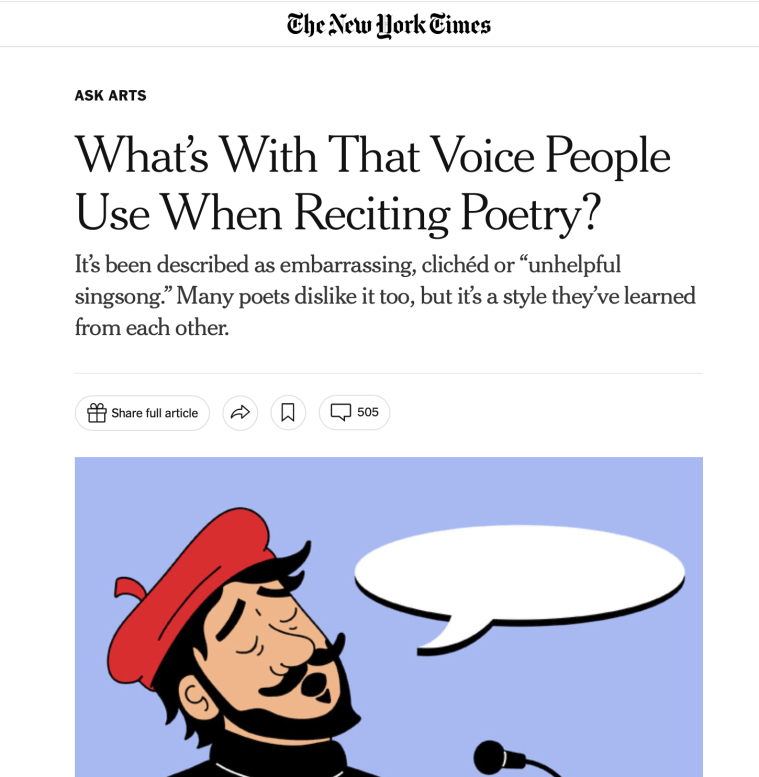
The recent New York Times article digs into this phenomenon, often called the “poet voice,” and asks why many poets fall into the same stylized way of reading their work aloud.

For some listeners, the article says, that way of reading feels comforting and familiar. For others, awkward, distancing, or makes the poem feel like a performance ritual rather than a piece of language meant to connect.

The article points out something important: this isn’t just about aesthetics. It’s about how poetry exists in two worlds at once. On the page, poetry is quiet, private, intimate. Out loud, it becomes physical, embodied, communal. Voice, breath, pacing, silence, and tone all reshape meaning. The same poem can feel completely different depending on how it’s read.

And yet, many readings sound strangely similar.

Why?

There’s also a bigger tension here. Poetry has deep roots in oral tradition. Long before books, poetry lived in voices, memory, and storytelling. But modern literary culture often treats performance and “serious writing” as separate worlds. Spoken word, slam, and performance poetry are seen as different categories entirely, even though they’re doing what poetry has always done: using voice to create meaning. They also might sound different, as performance, when compared to how people read on the performance evenings in your MFA program.

I remember, from the first time I saw poets read aloud, at a bar in Philadelphia in the 1990s, thinking that it was weird that many of them read their work in the same way, and wondering why they did.  When I was in my MFA program, and we would read our work at student readings, us poets, fellow students, often read that way. I remember it as mainly the other white women, and that the students and teachers/established visiting poets, could be people who did it. Not that all of them did it, you understand, but that it happened at times among student readers, teacher readers, and visiting poet readers, and it was, in the main, done by my fellow white women. I don’t remember the guys reading that way. I also remember that the teachers (minus a few) and the students in the poetry track were incredibly serious about the writing and performing of poetry. I don’t know that I ever got quite that serious, which is probably a character flaw. You know I’ve got me some of those.

On Threads people are losing their minds about the article (slow news day?) so, let’s talk about it:

• When you hear poetry read aloud, does it deepen your connection to the work or pull you out of it?
• Do you think “poet voice” is a real thing, or just a stereotype we’ve internalized?
• When you hear poetry read aloud, does it deepen your connection to the work or pull you out of it?
• Have you heard “poet voice?”
• How do you read your own work aloud? Casually, dramatically, flat, musical, conversational?
• Should poetry readings sound like performance, conversation, or something else entirely?
• Is hearing the poet’s voice an added layer of meaning, or an intrusion on the reader’s imagination?

Could you….
drop your thoughts….
in the comments?