Every Fourth of July, Americans revisit familiar symbols: fireworks, flags, parades, and historical speeches. This year, I’d like to suggest revisiting a poem.
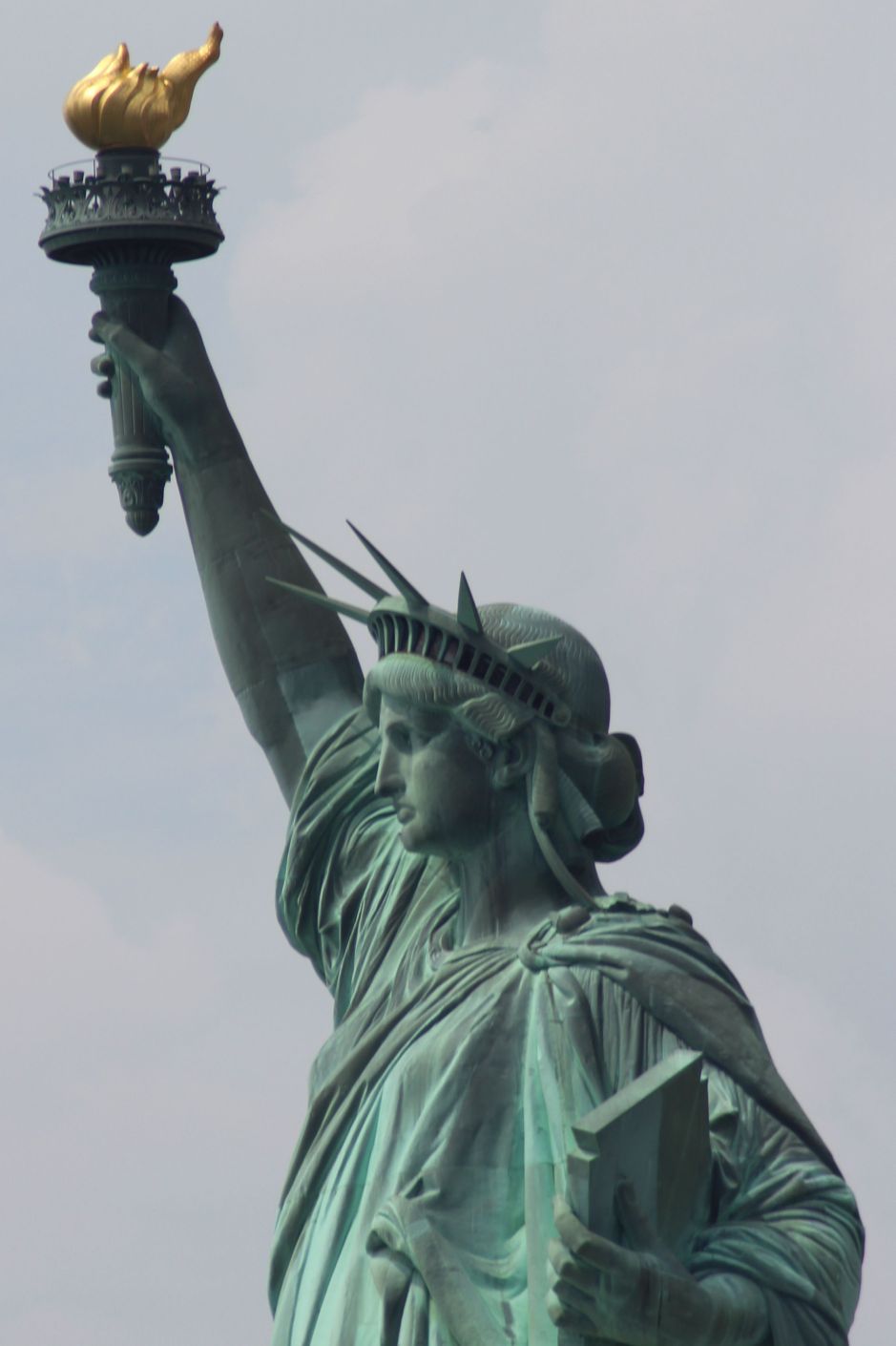
One of the most influential poems in American history is “The New Colossus” by Emma Lazarus. Written in 1883 to help raise funds for the pedestal of the Statue of Liberty, the poem was not originally intended to become famous. In fact, it was largely forgotten for years after it was written.
Most people are surprised to learn that the poem was not originally part of the Statue of Liberty. The statue itself was a gift from France celebrating liberty and democracy. It was only in 1903, sixteen years after Lazarus’s death, that a bronze plaque bearing the poem was installed inside the pedestal.
Today, however, many readers recognize its closing lines, which have become inseparable from the monument itself:
“Give me your tired, your poor, Your huddled masses yearning to breathe free…”
Emma Lazarus
What fascinates me about “The New Colossus” is that it did something very few poems ever accomplish. It changed the way people saw a monument.
The Statue of Liberty was already standing in New York Harbor when Lazarus wrote her poem. Yet over time, her words became so closely associated with the statue that many people now think of the poem and the monument as a single work. A few lines of poetry helped shape how generations of Americans understood one of the country’s most recognizable landmarks.
That’s an extraordinary accomplishment for any writer.
As poets and readers, we sometimes forget how powerful language can be. Most poems will never become part of a national conversation, nor do they need to. Yet “The New Colossus” offers a reminder that poetry can leave a lasting mark on culture in unexpected ways.
I also enjoy the fact that the poem’s influence wasn’t immediate. It wasn’t a viral sensation. It wasn’t an overnight success. It spent years in relative obscurity before eventually finding its place in American history. There is something encouraging about that for writers.
As Independence Day approaches, consider taking a few minutes to read “The New Colossus.” Even if you’ve encountered those famous closing lines before, reading the entire poem offers a new appreciation for what Emma Lazarus accomplished.
More than a century later, people are still discussing her words. That’s not a bad legacy for a poem.
Do you have a favorite poem that feels especially American to you? We’d love to hear about it in the comments.
The New Colossus
BY EMMA LAZARUS
Not like the brazen giant of Greek fame, With conquering limbs astride from land to land; Here at our sea-washed, sunset gates shall stand A mighty woman with a torch, whose flame Is the imprisoned lightning, and her name Mother of Exiles. From her beacon-hand Glows world-wide welcome; her mild eyes command The air-bridged harbor that twin cities frame. “Keep, ancient lands, your storied pomp!” cries she With silent lips. “Give me your tired, your poor, Your huddled masses yearning to breathe free, The wretched refuse of your teeming shore. Send these, the homeless, tempest-tost to me, I lift my lamp beside the golden door!”
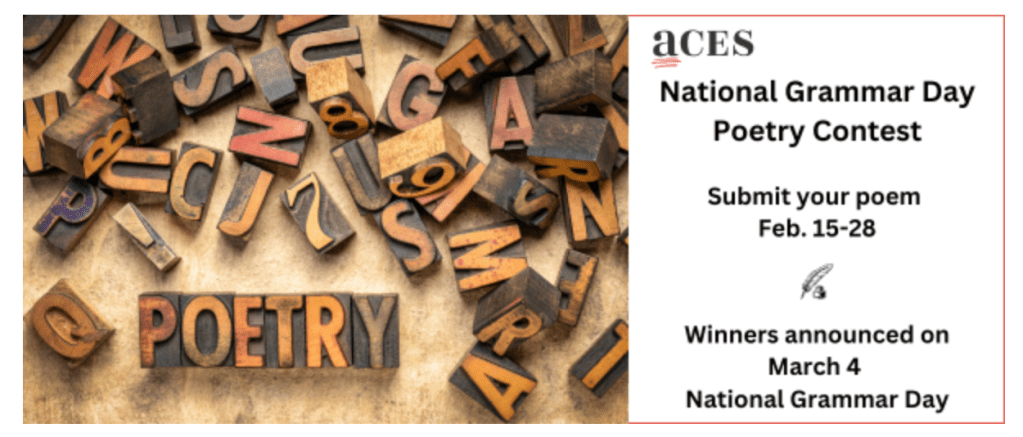
All poems submitted for consideration must be original, unpublished, and short.
Short is key. No epics, please.
Meter, rhyme, free verse? Haiku, limerick, quatrain, sonnet? The choice is yours.
Entries should make a point about language: grammar, usage, typos, writing, editing — whatever inspires you think captures the spirit of National Grammar Day.
Who can enter
Everyone is invited to participate. You do not need to be a member of ACES or work as an editor. The winning entry will be selected by a panel of judges that includes the previous year’s winner, along with language and poetry experts. ACES administers the award; it does not decide the winners.
That said, we encourage you to share your entries on your favorite social media platforms. If you tag #ACES and #GrammarDay we will be able to find you and reshare.
When to submit
The submission form is open Feb. 15-28. The link will be available here during that window.
Learning the results
ACES will announce the winner on, naturally, March 4, in a post on its news channel and in its social media channels. The winning poem will be included in the story, along with the runner-up entries.
Ben’s book is, “A captivating series of short stories, both dramatically and philosophically enthralling.” KIRKUS
“Ben Talbot excels at depicting a world both alien and familiar at the same time.” MIDWEST BOOK REVIEW
Welcome to Periscope City, a place where nothing is quite as it seems. Its citizens are those with no one to love, caught in a paradox of escaping loneliness while clinging to it. Here, human emotion is fleeting, and love is nothing more than a transaction. Each story in this collection delves into the heights and depths of solitude through its characters: a writer torn between seeking validation from fleeting romances and finding comfort in the safety of isolation; a former college football star lost in nostalgia, unable to connect with the present; a young runaway scarred by her past, drawn to this desolate town inhabited by loners and serviced by robots. Prepare for an emotional gut-punch as you enter a strange, unsettling place where the broken-hearted choose to stay broken and prefer to live in solitude. Talbot’s haunting, satirical, and often absurd interconnected tales explore themes of self-destruction and elusive redemption. Periscope City will immerse you in a world where the boundary between reality and fantasy is constantly shifting.
Ben is going to read a little from his book, and then we will open it up for poems, flash fiction/non-fiction to give you a chance to add your voice to the conversation about love and loss and loneliness, and answer the age-old question, “What becomes of the broken-hearted?”
If you’re not a pro at reading, it is imperative that you come and try your luck! What better night? We can be awkward, clumsy, lonely, and literary together!
Hope to see you there, and hear you read. We’ll be sad without you….
In the meantime, enjoy this excerpt from the book!
Periscope City
A sign greeted me at the border: Periscope City: Where the Lonely Go to Live Alone.
It spoke my language, so I crossed in by foot, to the nearest place it took me to. That place was a one-story house with a long driveway called the Institute. There, they asked me dozens of questions about my immediate past and made me take a personality exam. I told them the truth: that I was a thirty-four-year-old loner whose friends had deserted him for marriage or death. They set me up in the Cramden Hotel.
During the first week, I interacted with only housekeeping and the concierge. They were all robots. It was the best the town could do to live up to its tagline.
—
Although I loved loneliness, I was still lonely as hell. After months of wallowing about my life situation, sinking into the lack of fellow humans, there was nothing I wanted more than to mix it up. I thought being lonely among robots was a different lonely as being lonely among humans. The scratch needed to be itched.
The concierge suggested a dating app called Loner, and the concierge said it had the best reputation for keeping the lonesome lonely. I filled out a profile and submitted it to the AI gods for review. It matched me with Raylene, a blonde Puerto Rican who stood over six feet. Her profile said very little about her beyond the fact that she’d moved from Buffalo, New York, and loved pets over people. In her picture, she sat on a snowy park bench and wore a fleece jacket. A French bulldog sat in her lap, and it wore a black-and-white dog poncho. It looked like a staged photo, like something in an L.L. Bean catalog, but where L.L. Bean was trying to pull off cozy, it was a cold, plastic, disconnected photo. I assumed her entire profile was an attempt at sarcasm.
Do you want to meet or not? she wrote.
Because of my lust for tall women, I wrote her back: Yes.
I have tickets to The Late Show, she wrote. Meet me at Geraldine Park at eight. I’ll be at the corner of Alaska and Winter Bear. And don’t be awkward.
—
When I showed up, Raylene was sitting on a snowy park bench in the same jacket as her photo, with her service bulldog in her lap. The dog even wore a black-and-white poncho. Raylene’s smile was all the picture was missing.
“Joe?” she asked.
Her perfume was cedar, or maybe it was the trees. Whatever the case, the scent had found its way to me, and it smelled lovely. The Loner profile was missing a smell.
“Raylene?”
“No,” she said. “Of course it is. How would I know your name was Joe?”
The bulldog barked at me.
“Sheepshead, knock it off,” she said.
Sheepshead? After Raylene fed her a pill, the dog calmed down. The pill must’ve been a fast-acting depressant, which they sold over the counter here in Periscope City. I know because of my own dog, but he didn’t need medication like me.
“You look different from your picture,” she said.
Ditto. Not only did she frown but her hair wasn’t blonde. It was purple. “How so?” I said.
“I thought you were taller,” she said.
I ignored her comment (let’s call it an insult), already being my tallest.
“Ask me something,” she said.
She was testing me, but then I remembered how sarcastic her profile had been attempting to be. The memory of it made me sweat a little with anxiety because I tried to think of something witty to say quickly, so I used a cliché. “If you could have dinner with anyone, who would it be?”
“Come on, dude,” she said. “Ask me something else.”
I gestured out to the surrounding park with my hands as if that were the explanation. “It was all I could think of,” I said.
“I told you, don’t be awkward,” she said. “What about you? Who would you have dinner with?”
I hated the question, too.
“Abraham Lincoln,” I said, and the words tasted like tinned fish.
“Why?”
“He was the first person who came to mind,” I said.
“Lame,” she said. “Now ask me a good question.”
“Okay,” I said. “Why did you name your dog Sheepshead?”
“Sheepshead Bay was the last place where I went with my husband,” she said.
“Did you separate?” I said.
She pressed her beanie down to her eyebrows, and I did the same with my trapper hat. We shared an awkward silence. It was what I got for asking a good question.
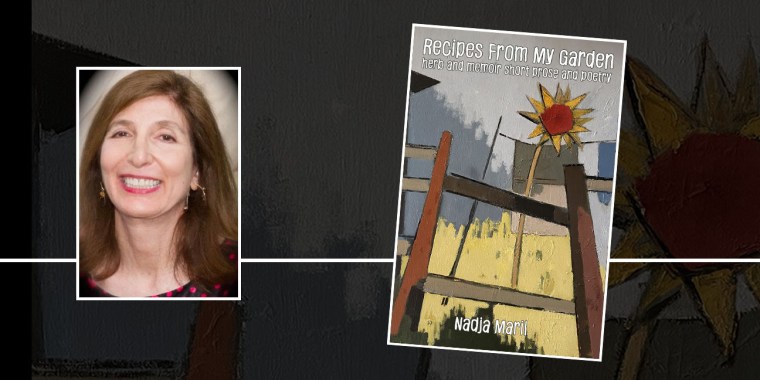
This week author Nadja Maril released her collection of flash prose, poetry, and essays inspired by her kitchen, garden, and family memories. I sat down with Nadja to ask her some questions about the book, and her process. It’s interesting to note that Nadja comes from an artistic background: her late father Herman Maril was an artist, and his painting is the cover of her book. I have enjoyed Nadja’s poetry and flash fiction for many years now, and I am very excited for her book!
Dianne Pearce (Dianne): What inspired you to combine poetry, short form, gardening, and cooking in one book? How did these different forms of expression come together?
Nadja Maril (Nadja): In January 2020 I’d just completed an MFA (masters in fine arts) in creative writing from the low residency Stonecoast Writing Program at the University of Southern Maine and was in the midst of moving into a 100-year-old house. My husband Peter and I were the General Contractors. Both the MFA and the house were two-year projects. I’d been laboring over a complicated literary novel told from multiple viewpoints, and my daughter (the youngest of my three children ) was about to get married. Peter and I were looking forward to having the wedding at our re-built house, with the festivities primarily outside. We scurried to move into the house, plant flowers and shrubs, and revitalize the lawn. Then the pandemic shut everything down.
Want to read more? Pick up the remainder of the piece at AUTHORS ELECTRIC.