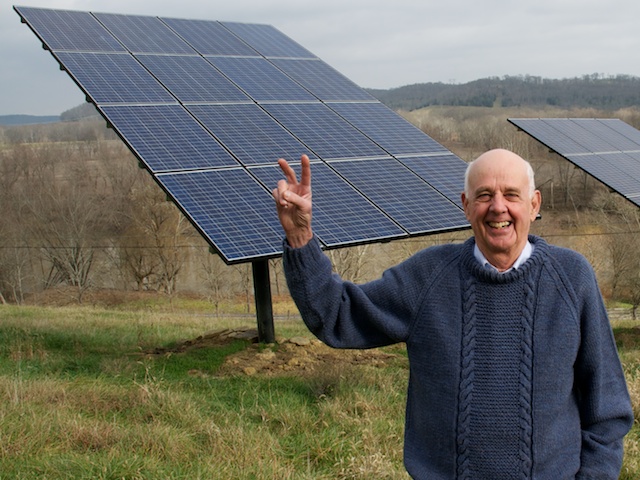
Wendell Berry was a beloved farmer and conversationalist, English professor, forest lover, and writer from the hills of Kentucky. He wrote about land and how mankind must strive to use it ethically. Berry came from a long line of tobacco farmers. His father was famous for cofounding a farming co-op that matched supply and demand. The co-op served the people it was meant to serve: small, hardworking farmers.
During his lifetime, Berry got behind causes he believed in. He protested the Vietnam War and nuclear power. He marched on Washington in 2009 as part of a protest to bring about cleaner emissions. He opposed mountaintop removal mining in Kentucky. He worried about what is lost in modernization. He fought to preserve land, regional economies, and human health in local communities.
His relationship with the University of Kentucky, where he taught, became strained when he withdrew papers he had loaned to the school after the university accepted $7 million from a coal producer.
Berry published over 50 books of poetry, fiction, and essays and received many prestigious honors for his writing, such as the T.S. Eliot Award and the National Humanities Medal. The message in all his work remained clear, essentially that man must live in harmony with the earth. He was against large-scale farming controlled by large corporations that relied on chemical pesticides and fertilizers, promoted soil erosion, depleted aquifers, and drove small farms out of business, destroying local communities in the process. He himself used horses to work his own land and used organic fertilizers and pesticides.
His poetry themes include the countryside, the routines of farm and family, and spirituality found in the natural world. It has been said of Berry that he ennobled the commonplace. Here are two of his most famous poems.
What We Need Is Here by Wendell Berry
Geese appear high over us, pass, and the sky closes. Abandon, as in love or sleep, holds them to their way, clear in the ancient faith: what we need is here. And we pray, not for new earth or heaven, but to be quiet in heart, and in eye, clear. What we need is here.
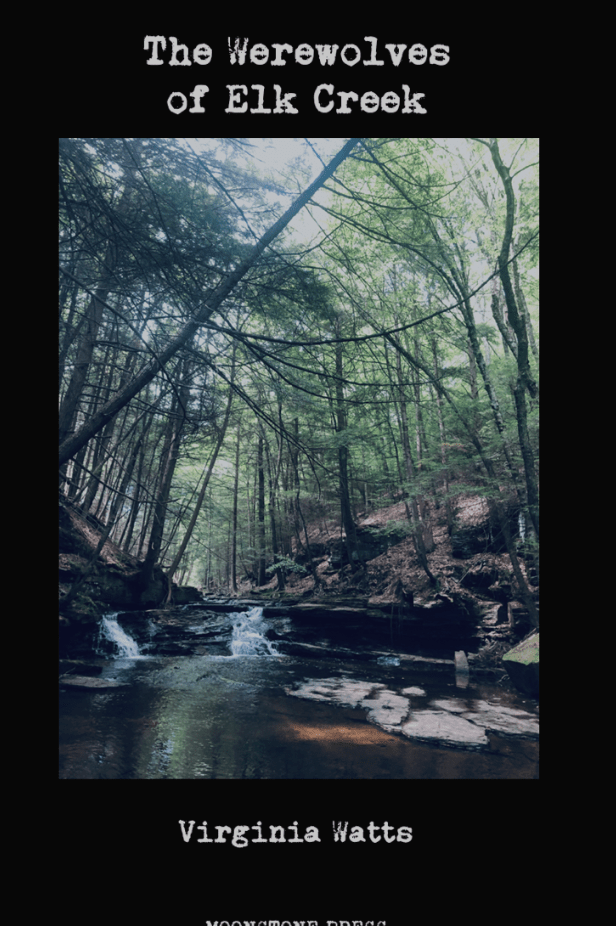
Virginia Watts is the author of poetry and stories found in The MacGuffin, Epiphany,CRAFT, The Florida Review, Reed Magazine, Pithead Chapel, Eclectica Magazine among others. She has been nominated four times for a Pushcart Prize. Her debut short story collection Echoes from the Hocker House was short listed for 2024 Eric Hoffer Grand Prize, selected as one of the Best Indie Books of 2023 by Kirkus Book Reviews, and won third place in the 2024 Feathered Quill Book Awards. Please visit her.
It’s #LitMagWeek, a celebration of the independent literary magazines that give writers a place to take chances, find readers, and get their work out into the world.
Start with our own Instant Noodles Literary Magazine, sponsored by Current Words Publishing and curated by the Old Scratch Press Collective.
Then go exploring! Check out some of our fellow literary magazines celebrating this week:
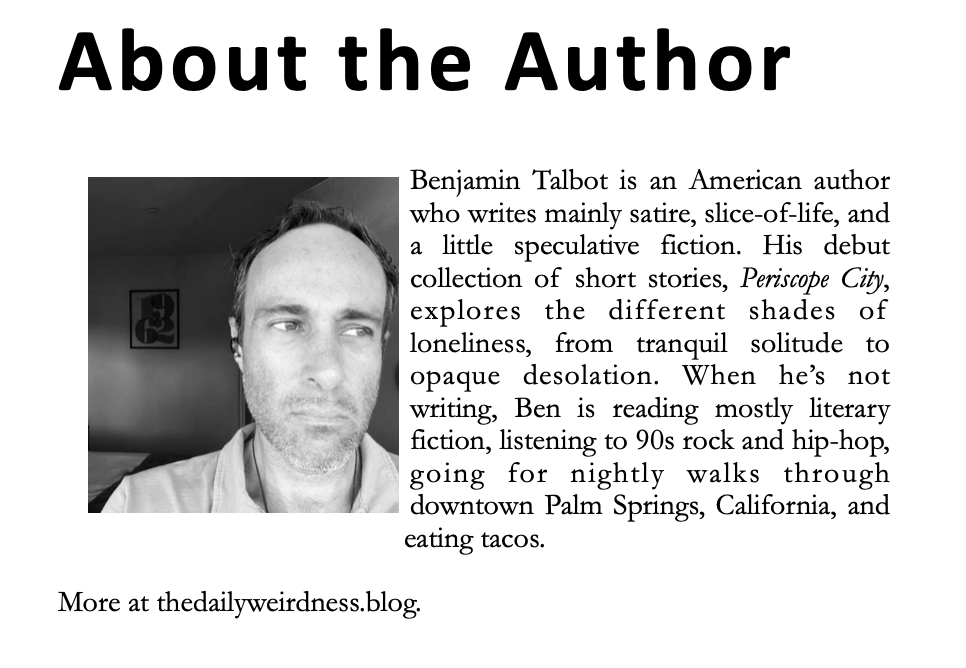
Ben’s book is, “A captivating series of short stories, both dramatically and philosophically enthralling.” KIRKUS
“Ben Talbot excels at depicting a world both alien and familiar at the same time.” MIDWEST BOOK REVIEW
Welcome to Periscope City, a place where nothing is quite as it seems. Its citizens are those with no one to love, caught in a paradox of escaping loneliness while clinging to it. Here, human emotion is fleeting, and love is nothing more than a transaction. Each story in this collection delves into the heights and depths of solitude through its characters: a writer torn between seeking validation from fleeting romances and finding comfort in the safety of isolation; a former college football star lost in nostalgia, unable to connect with the present; a young runaway scarred by her past, drawn to this desolate town inhabited by loners and serviced by robots. Prepare for an emotional gut-punch as you enter a strange, unsettling place where the broken-hearted choose to stay broken and prefer to live in solitude. Talbot’s haunting, satirical, and often absurd interconnected tales explore themes of self-destruction and elusive redemption. Periscope City will immerse you in a world where the boundary between reality and fantasy is constantly shifting.
Ben is going to read a little from his book, and then we will open it up for poems, flash fiction/non-fiction to give you a chance to add your voice to the conversation about love and loss and loneliness, and answer the age-old question, “What becomes of the broken-hearted?”
If you’re not a pro at reading, it is imperative that you come and try your luck! What better night? We can be awkward, clumsy, lonely, and literary together!
Hope to see you there, and hear you read. We’ll be sad without you….
In the meantime, enjoy this excerpt from the book!
Periscope City
A sign greeted me at the border: Periscope City: Where the Lonely Go to Live Alone.
It spoke my language, so I crossed in by foot, to the nearest place it took me to. That place was a one-story house with a long driveway called the Institute. There, they asked me dozens of questions about my immediate past and made me take a personality exam. I told them the truth: that I was a thirty-four-year-old loner whose friends had deserted him for marriage or death. They set me up in the Cramden Hotel.
During the first week, I interacted with only housekeeping and the concierge. They were all robots. It was the best the town could do to live up to its tagline.
—
Although I loved loneliness, I was still lonely as hell. After months of wallowing about my life situation, sinking into the lack of fellow humans, there was nothing I wanted more than to mix it up. I thought being lonely among robots was a different lonely as being lonely among humans. The scratch needed to be itched.
The concierge suggested a dating app called Loner, and the concierge said it had the best reputation for keeping the lonesome lonely. I filled out a profile and submitted it to the AI gods for review. It matched me with Raylene, a blonde Puerto Rican who stood over six feet. Her profile said very little about her beyond the fact that she’d moved from Buffalo, New York, and loved pets over people. In her picture, she sat on a snowy park bench and wore a fleece jacket. A French bulldog sat in her lap, and it wore a black-and-white dog poncho. It looked like a staged photo, like something in an L.L. Bean catalog, but where L.L. Bean was trying to pull off cozy, it was a cold, plastic, disconnected photo. I assumed her entire profile was an attempt at sarcasm.
Do you want to meet or not? she wrote.
Because of my lust for tall women, I wrote her back: Yes.
I have tickets to The Late Show, she wrote. Meet me at Geraldine Park at eight. I’ll be at the corner of Alaska and Winter Bear. And don’t be awkward.
—
When I showed up, Raylene was sitting on a snowy park bench in the same jacket as her photo, with her service bulldog in her lap. The dog even wore a black-and-white poncho. Raylene’s smile was all the picture was missing.
“Joe?” she asked.
Her perfume was cedar, or maybe it was the trees. Whatever the case, the scent had found its way to me, and it smelled lovely. The Loner profile was missing a smell.
“Raylene?”
“No,” she said. “Of course it is. How would I know your name was Joe?”
The bulldog barked at me.
“Sheepshead, knock it off,” she said.
Sheepshead? After Raylene fed her a pill, the dog calmed down. The pill must’ve been a fast-acting depressant, which they sold over the counter here in Periscope City. I know because of my own dog, but he didn’t need medication like me.
“You look different from your picture,” she said.
Ditto. Not only did she frown but her hair wasn’t blonde. It was purple. “How so?” I said.
“I thought you were taller,” she said.
I ignored her comment (let’s call it an insult), already being my tallest.
“Ask me something,” she said.
She was testing me, but then I remembered how sarcastic her profile had been attempting to be. The memory of it made me sweat a little with anxiety because I tried to think of something witty to say quickly, so I used a cliché. “If you could have dinner with anyone, who would it be?”
“Come on, dude,” she said. “Ask me something else.”
I gestured out to the surrounding park with my hands as if that were the explanation. “It was all I could think of,” I said.
“I told you, don’t be awkward,” she said. “What about you? Who would you have dinner with?”
I hated the question, too.
“Abraham Lincoln,” I said, and the words tasted like tinned fish.
“Why?”
“He was the first person who came to mind,” I said.
“Lame,” she said. “Now ask me a good question.”
“Okay,” I said. “Why did you name your dog Sheepshead?”
“Sheepshead Bay was the last place where I went with my husband,” she said.
“Did you separate?” I said.
She pressed her beanie down to her eyebrows, and I did the same with my trapper hat. We shared an awkward silence. It was what I got for asking a good question.
Five major publishing companies pretty much cover the market for books. But it’s the indies that take more risks on new authors, like me and my fellow writers at Old Scratch Press (an imprint of Current Word Publishing {CWP}). We write because we have something to say, not necessarily for fame and fortune (although that certainly wouldn’t hurt).
If you find a book you like, ESPECIALLY if it’s from an indie publisher, give it a review on whatever national website for books that comes up. Just that small bit of verbal support that says “I like this book” means a great deal to the writer, and the publisher. And it doesn’t have to be my book (but it’d be great if it were!).
So let me tell you about my book. There are fifty-five poems, 8 black and white full-page sketches, several smaller sketches, and other material in the book. They are all original I hope you’ll buy it, either in Kindle or print form.
Hot Off the Press: The Song of North Mountain an Amazon Top 100 Bestseller 8/17/24
For those of you who don’t know me, there are a few things that are important. I am 77, and I have retired from two jobs. I started publishing only in late 2019, and this truly is my Very First Book that is by myveryownself. At times I feel like it’s awfully late to start a new career, but then again.
I live in a community where many people move to when they downsize into their own retirements. THIS part is important: there’s no reason to stop just because we’re retired, or older, or more physically limited than we were when we were 35. We still have the ability to create, whether with words, paint and brush, whisks and casserole dishes, pottery wheels, or needle and thread. There really is nothing we can’t do, just some things we may not do as well as when we were younger (like blacksmithing, or crawling under vehicles).
Available here for pre-order on Kindle with delivery May 1st, I hope you like The Song of North Mountain. https://www.amazon.com/dp/B0D1P64FHC soon to be available in softbound print as well.