Hank

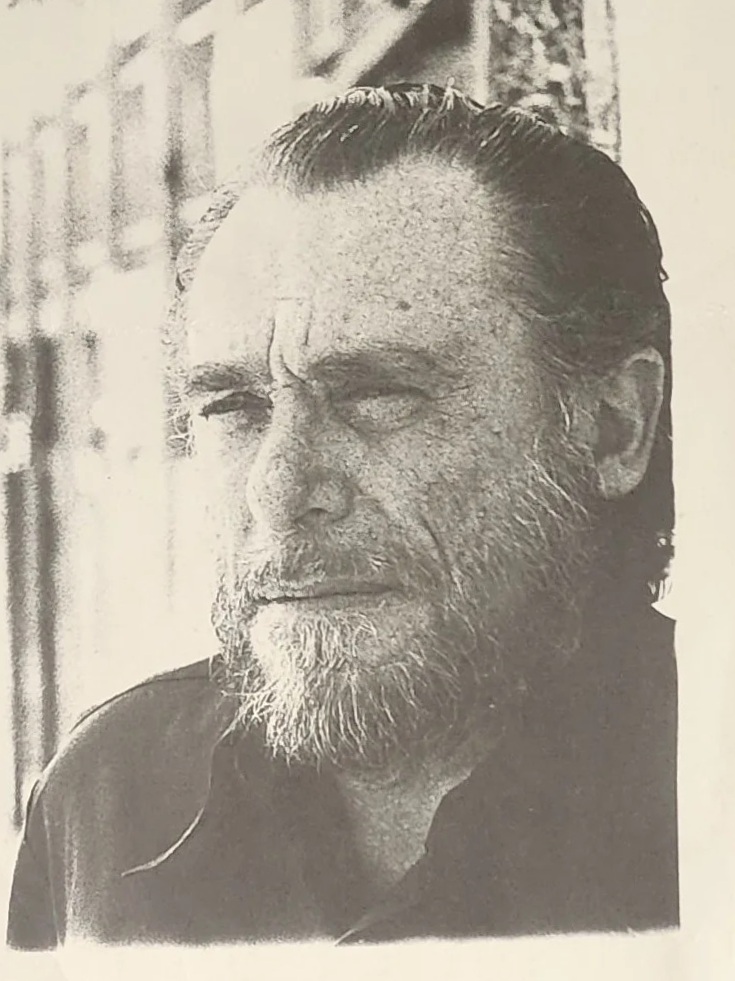
            Charles Bukowski wrote about the gamblers, the rejects, factory workers, his job at the post office, those who had lost their way, his cats, his typewriter, a radio he threw on the roof repeatedly. He drank too much, gambled too much, treated women poorly, treated his wife poorly. He threw away tradition in poetry and aimed straight for the gut with unflinching honesty. His poetry focused on pain and boredom, uselessness and hopelessness, old age, heavy drinking, the underbelly of trying to survive a working-class life or worse. He’s a cult hero. He inspired a counterculture in poetry that lives on and continues around the world. He is one of the unforgettables. 

            Yes, he was unapologetic and rough and crude sometimes. He wasn’t always a good person, but his fan base runs deep. An icon, worshipped by many for how he took the foundations of traditional poetry and stood them on their head. His is one of the most polarizing writers of our time and one of the most inspirational to artists, singers and of course writers. It’s true that his work explores uncomfortable and upsetting things like sexism, racism, homophobia, inebriation. He wanted to write about what life can be and often is whether we like it or not and not try to act otherwise. Like him or not, he will always be seen as leading the way for poetry for the common man. Poetry for people and not for poets. Poetry for the social outcasts. Honesty in poetry. I say YES to all of that. 

            He wrote more than 5000 thousand poems during his lifetime. I am a fan and an admirer of Charles Bukowski. When I read him as a younger writer, I was able to believe that it was okay if I wanted to write about everyday life and nothing else. That even someone like me could have some worth as a writer.  He was not a fan of poets who are overly slick, the conformists, the poets who try to tell us what to do. In other words, there is no right or wrong way to be a poet. There are no subjects that aren’t worthy of a poem. If you are a human being, you can be a poet. Click the photo below to see a favorite of mine by Bukowski:

            There were reasons in his life that led to Bukowski’s style. He suffered as the son of a harsh, abusive father and he also had a disfiguring acne condition. The only way to really appreciated Charles Bukowski is to read a book of his work or several.  Read a lot of poems. In this way, you will see beyond the language, the bravado, the street fighter, the drinker. You will come to know the heart of a complicated man who cared very deeply about his fellow man. He wrote so much about human suffering because he worried about human suffering and not just his own. 

            He was the master of direct language. The hero of not holding back. In any case, you don’t have to like him or how he lived to fall in love with his poetry or at the least learn from it or be inspired by it. Even if you hate it, you’ll feel emotion and I think Hank would say that’s good enough for him. It’s fun to try and write a poem in the Bukowski style too as a poet. As poets we are always learning. Below is a poem I wrote with him in mind. Give it a try!  And read you some Hank as soon as possible!!!

FAIRY DUST
Virginia Watts

I never have anything to say to children 
I’ll do anything to avoid those little shoes
hit the crapper, blow my nose
bones make lovely dust
the white and the wispy clouds
the silver of angel wings peeking
even though I don’t believe in angels
this little tiger lily really cornered me
stuck with a minimum wage dad
like it wasn’t his fault 
scoring a six pack
and some Beam before noon on Sunday 
she got herself up on that stool
I don’t know how without breaking her neck
How old. Four?
set patent toes on the side
of my bar stool and pushed off
Spun that thing
around and around like a pro
when I joined in she giggled the corner
of 9th and Fitzwater Street
down a waterfall and out to sea
he yanked her off that chair so hard
I would have beaten
the bejesus out of him 
if she hadn’t been there


Virginia Watts is the author of poetry and stories found in The MacGuffin, Epiphany, CRAFT, The Florida Review, Reed Magazine, Pithead Chapel, Eclectica Magazine among others. She has been nominated four times for a Pushcart Prize. Her debut short story collection Echoes from the Hocker House was short listed for 2024 Eric Hoffer Grand Prize, selected as one of the Best Indie Books of 2023 by Kirkus Book Reviews, and won third place in the 2024 Feathered Quill Book Awards. Please visit her.

Virginia’s new book is now available from Old Scratch Press:

Her prior poetry chapbooks Shot Full of Holes and The Werewolves of Elk Creek 
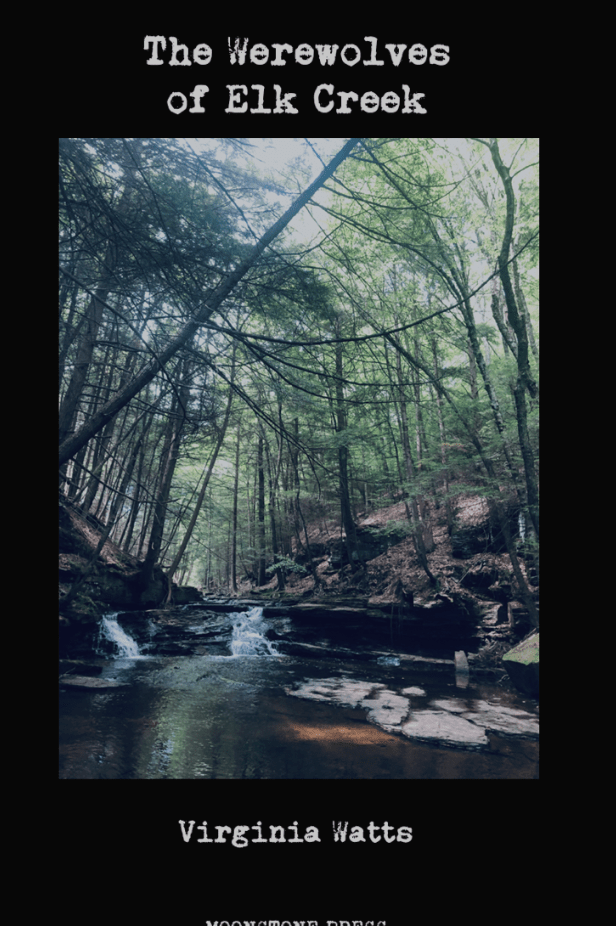
 are available from Moonstone Press. And her debut short story collection Echoes from the Hocker House is not to be missed!

It’s Time for Beach Reading!

I’ve been on a lucky kick lately finding great books to read. I have a group of friends and relatives who love to read as much as I do, and we share book ideas almost every week. I’m not content when I don’t have a good book going. Often, when I am busy running errands, ticking off my list of appointments and other life tasks, in the back of my mind I am thinking: When I am done with all of this, I can go home and read my book! It’s my reward. My joy. My salvation. And I am clearly not alone. Many people love to read and there are some good reasons why. 

            Reading is very good for the health of your brain. Reading expands and strengthens neural pathways. It has been shown to improve memory. People who read regularly are better at retaining complex information. They concentrate better. This is because when you read you must focus your mind. 

            Reading also lowers your stress level and cortisol levels significantly. Even when you read for a short time, your heart rate slows and your muscles relax. Reading is likened to meditation. When you read you step away from your own life and your own unique anxieties.  It’s a true calming of you mind even though your mind is busy. It’s believed to be better at lowering your blood pressure than listening to music or watching tv. If you read before bed, your mind gets the message that it is time to slow down. You are likely to fall asleep faster and sleep more deeply. Reading at night helps you push your own worries away. 

            There have been several studies that have shown that reading regularly provides some protection against cognitive decline and may even delay the onset of conditions such as dementia and Alzheimer’s. Long terms studies also show that reading increases your lifespan.

            Another benefit to regular reading is that it makes us better people. When you read you experience all kinds of characters, lives, and places that improve your knowledge of the world and helps you have a better understanding of people who are different from you. People who have different lives and different beliefs. This makes you more empathetic. This translates into better relationships and social skills. Reading is a bridge to understanding others. Apparently, the most empathy comes from reading literary fiction as opposed to nonfiction. 

            It has also been shown that for people experiencing some forms of mild depression, reading self-help books can assist with recovery. Medical experts can provide a list of recommended books. 

            The world’s most successful and wealthy people are often avid readers with a strong desire for knowledge. Bill Gates. Oprah Winfrey. Elon Musk. Reading can also help with loneliness and social isolation because it often leads to book groups, whether face to face or online. Also, with public libraires and low-cost subscriptions for tablets, reading is not expensive. 

            Here is my recent list of books I would recommend. I enjoyed every word and I hope you do too. Cheers and keep those pages turning!  Ginny

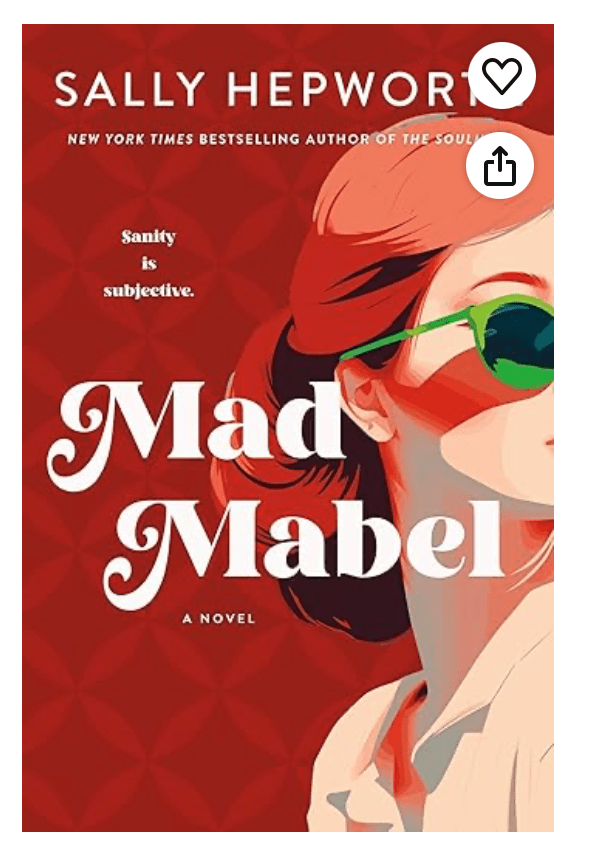
Mad Mable by Sally Hepworth

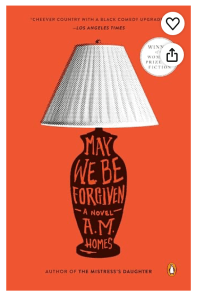
May We Be Forgiven by A.M. Holmes

This Book Will Save Your Life by A.M. Holmes

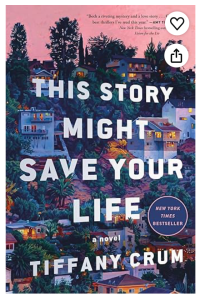
This Story Might Save Your Life by Tiffany Crum

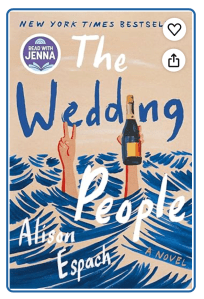
The Wedding People by Alison Espach


Virginia Watts is the author of poetry and stories found in The MacGuffin, Epiphany, CRAFT, The Florida Review, Reed Magazine, Pithead Chapel, Eclectica Magazine among others. She has been nominated four times for a Pushcart Prize. Her debut short story collection Echoes from the Hocker House was short listed for 2024 Eric Hoffer Grand Prize, selected as one of the Best Indie Books of 2023 by Kirkus Book Reviews, and won third place in the 2024 Feathered Quill Book Awards. Please visit her.

Virginia’s new book is now available from Old Scratch Press:

Her prior poetry chapbooks Shot Full of Holes and The Werewolves of Elk Creek 

 are available from Moonstone Press. And her debut short story collection Echoes from the Hocker House is not to be missed!
And the Winner Is…..

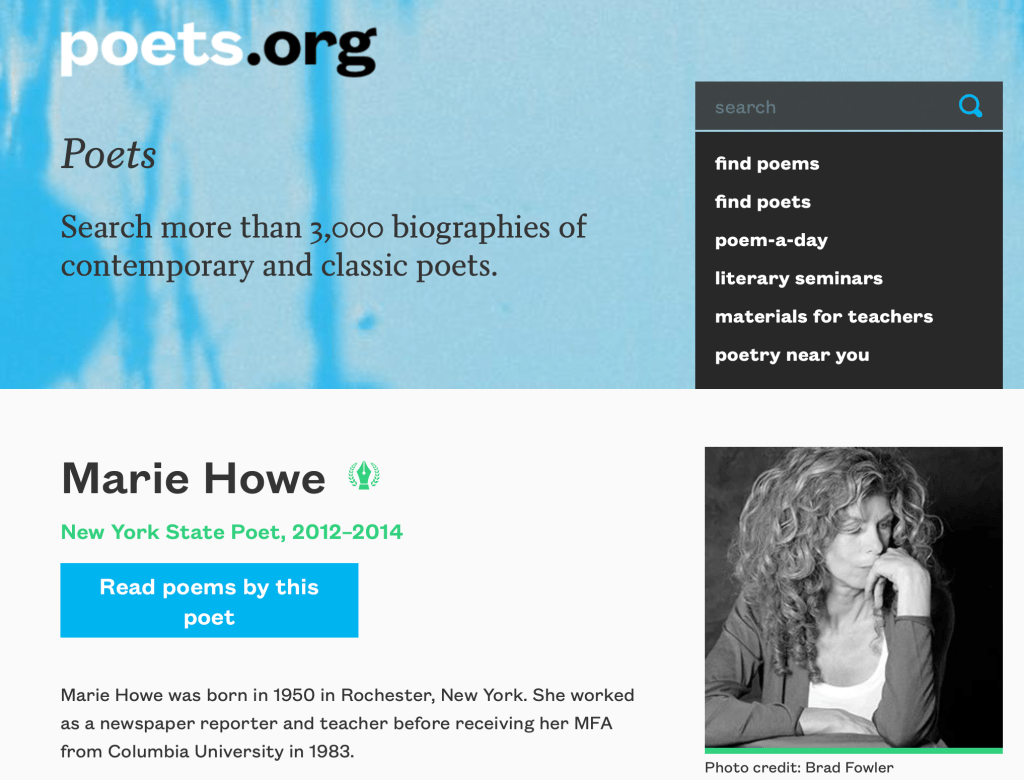
Yes, poetry collections win Pulitzer Prizes too. The 2025 Pulitzer Prize for Poetry has been awarded to Marie Howe’s New and Selected Poems. Howe is known for her observations of everyday life. She explores themes of contemporary womanhood, personal loss, human miracles, sorrow and joy. There are 111 poems in the winning collection. Howe’s direct and honest voice is her trademark. She’s a poet of our time who should not be missed. Some of her most well-known poems involve the loss of her brother in 1989 who died of AIDS-related illnesses. This is what drew me personally to her work many years ago, because I lost a brother about the same time in the same way. Here is one of her poems about this terrible sadness.

What the Living Do

Marie Howe

Johnny, the kitchen sink has been clogged for days, some utensil probably fell down there.
And the Drano won’t work but smells dangerous, and the crusty dishes have piled up

waiting for the plumber I still haven’t called. This is the everyday we spoke of.
It’s winter again: the sky’s a deep, headstrong blue, and the sunlight pours through

the open living-room windows because the heat’s on too high in here and I can’t turn it off.
For weeks now, driving, or dropping a bag of groceries in the street, the bag breaking,

I’ve been thinking: This is what the living do. And yesterday, hurrying along those
wobbly bricks in the Cambridge sidewalk, spilling my coffee down my wrist and sleeve,

I thought it again, and again later, when buying a hairbrush: This is it.
Parking. Slamming the car door shut in the cold. What you called that yearning.

What you finally gave up. We want the spring to come and the winter to pass. We want
whoever to call or not call, a letter, a kiss—we want more and more and then more of it.

But there are moments, walking, when I catch a glimpse of myself in the window glass,
say, the window of the corner video store, and I’m gripped by a cherishing so deep

for my own blowing hair, chapped face, and unbuttoned coat that I’m speechless:
I am living. I remember you.

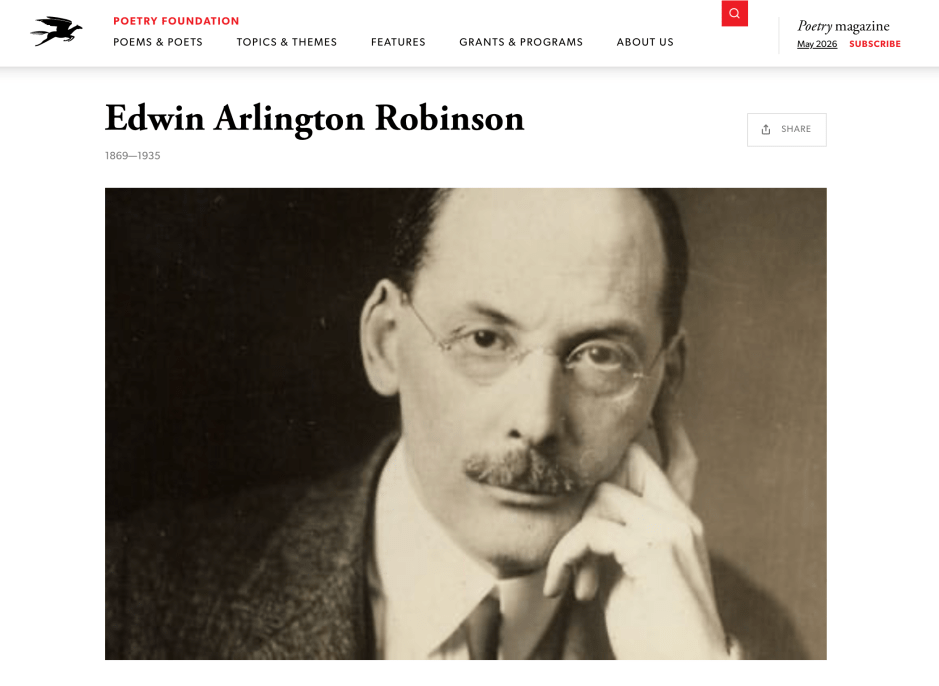
I thought it might be fun to revisit the winner of the first Pulitzer Prize for Poetry. That poet’s name was Edwin Arlington Robinson, and he won the prize two more times after being the first winner. He was known for his narrative skill and psychological depth. Here is what is considered by many to be his most famous poem. It seems a long time ago when he was writing poetry, yet when you read this poem in particular, it seems that he could be writing this poem today. This is because all poetry is about one very complicated subject: humanity.

Richard Cory
Edwin Arlington Robinson

Whenever Richard Cory went down town,

We people on the pavement looked at him:

He was a gentleman from sole to crown,

Clean favored, and imperially slim.

And he was always quietly arrayed,

And he was always human when he talked;

But still he fluttered pulses when he said,

“Good-morning,” and he glittered when he walked.

And he was rich—yes, richer than a king—

And admirably schooled in every grace:

In fine, we thought that he was everything

To make us wish that we were in his place.

So on we worked, and waited for the light,

And went without the meat, and cursed the bread;

And Richard Cory, one calm summer night,

Went home and put a bullet through his head.

Virginia Watts is the author of poetry and stories found in The MacGuffin, Epiphany, CRAFT, The Florida Review, Reed Magazine, Pithead Chapel, Eclectica Magazine among others. She has been nominated four times for a Pushcart Prize. Her debut short story collection Echoes from the Hocker House was short listed for 2024 Eric Hoffer Grand Prize, selected as one of the Best Indie Books of 2023 by Kirkus Book Reviews, and won third place in the 2024 Feathered Quill Book Awards. Please visit her.

Virginia’s new book is now available from Old Scratch Press:

Her prior poetry chapbooks Shot Full of Holes and The Werewolves of Elk Creek 

 are available from Moonstone Press. And her debut short story collection Echoes from the Hocker House is not to be missed!