All poems submitted for consideration must be original, unpublished, and short.
Short is key. No epics, please.
Meter, rhyme, free verse? Haiku, limerick, quatrain, sonnet? The choice is yours.
Entries should make a point about language: grammar, usage, typos, writing, editing — whatever inspires you think captures the spirit of National Grammar Day.
Who can enter
Everyone is invited to participate. You do not need to be a member of ACES or work as an editor. The winning entry will be selected by a panel of judges that includes the previous year’s winner, along with language and poetry experts. ACES administers the award; it does not decide the winners.
That said, we encourage you to share your entries on your favorite social media platforms. If you tag #ACES and #GrammarDay we will be able to find you and reshare.
When to submit
The submission form is open Feb. 15-28. The link will be available here during that window.
Learning the results
ACES will announce the winner on, naturally, March 4, in a post on its news channel and in its social media channels. The winning poem will be included in the story, along with the runner-up entries.
By R. David Fulcher, Old Scratch Press Founding Member
Recently I had the honor of joining the Folkloring podcast. This podcast addresses how we can integrate folklore into our everyday lives, including our writing.
Preparing for this podcast prompted me to reflect upon the influence of folklore, myth and legend on my own writing and was surprised to discover the influence has been quite profound.
Below are some of categories of folklore I came up with in case they could be an inspiration for your writing.
1. Global folklore
By this I mean folklore that originated from a specific geographic location hundreds of years ago, but now is so well known it is generally accepted.
An example of this would be the legend of the vampire from Romania. First something that was very localized, vampires are now so common they now appear on cereal boxes and television series.
I integrate the vampire myth into my writing in several stories in my book The Pumpkin King and Other Tales of Terror in such stories as “The Night Flyer” and “The Watchman’s Web”.
2. Urban Legends/Localized Folklore
In this category would be legends still most popular in specific geographic regions, such as the legend of the New Jersey Devil that haunts the woods of New Jersey, or the infamous Bunny Man of Clifton, Virginia.
The mythology of native Americans is extremely rich and strongly connected to the natural world.
In my book The Cemetery of Hearts, I reference a native American myth from the American Southwest that claims that the majestic canyons and mesas were spun out of a gigantic spider.
In my story “The Land Spider”, a gigantic spider starts swallowing a small town in New Mexico building by building.
These are just a few ideas to get you started, but the world is full of legends and folklore, and weaving them into your writing will enrich your fiction and poetry.
You can learn more about the Folkloring podcasthere
Happy Writing!
R.David Fulcher, Founding Member of Old Scratch Press
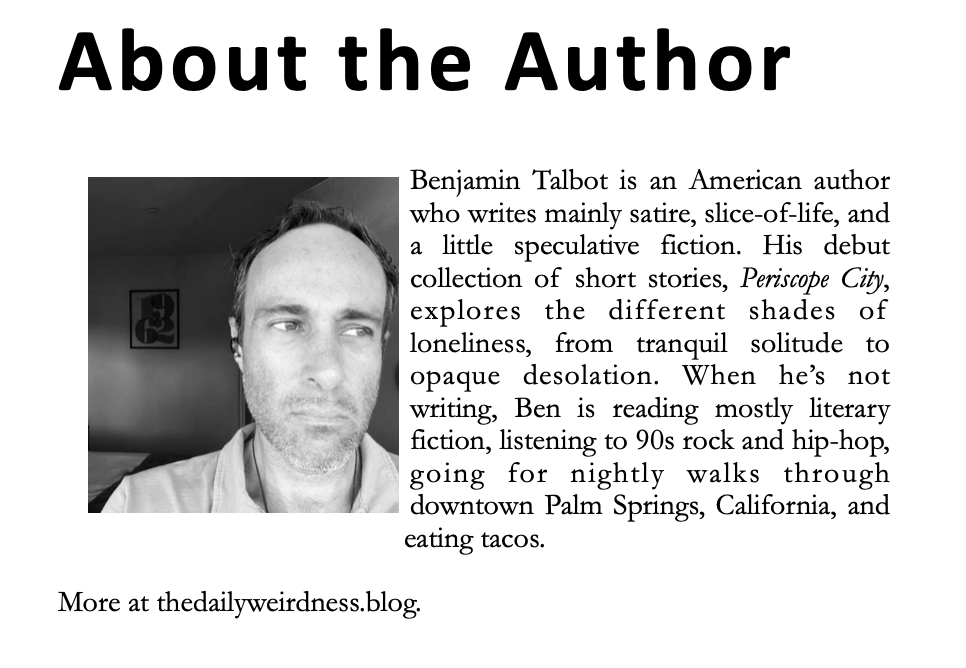
Ben’s book is, “A captivating series of short stories, both dramatically and philosophically enthralling.” KIRKUS
“Ben Talbot excels at depicting a world both alien and familiar at the same time.” MIDWEST BOOK REVIEW
Welcome to Periscope City, a place where nothing is quite as it seems. Its citizens are those with no one to love, caught in a paradox of escaping loneliness while clinging to it. Here, human emotion is fleeting, and love is nothing more than a transaction. Each story in this collection delves into the heights and depths of solitude through its characters: a writer torn between seeking validation from fleeting romances and finding comfort in the safety of isolation; a former college football star lost in nostalgia, unable to connect with the present; a young runaway scarred by her past, drawn to this desolate town inhabited by loners and serviced by robots. Prepare for an emotional gut-punch as you enter a strange, unsettling place where the broken-hearted choose to stay broken and prefer to live in solitude. Talbot’s haunting, satirical, and often absurd interconnected tales explore themes of self-destruction and elusive redemption. Periscope City will immerse you in a world where the boundary between reality and fantasy is constantly shifting.
Ben is going to read a little from his book, and then we will open it up for poems, flash fiction/non-fiction to give you a chance to add your voice to the conversation about love and loss and loneliness, and answer the age-old question, “What becomes of the broken-hearted?”
If you’re not a pro at reading, it is imperative that you come and try your luck! What better night? We can be awkward, clumsy, lonely, and literary together!
Hope to see you there, and hear you read. We’ll be sad without you….
In the meantime, enjoy this excerpt from the book!
Periscope City
A sign greeted me at the border: Periscope City: Where the Lonely Go to Live Alone.
It spoke my language, so I crossed in by foot, to the nearest place it took me to. That place was a one-story house with a long driveway called the Institute. There, they asked me dozens of questions about my immediate past and made me take a personality exam. I told them the truth: that I was a thirty-four-year-old loner whose friends had deserted him for marriage or death. They set me up in the Cramden Hotel.
During the first week, I interacted with only housekeeping and the concierge. They were all robots. It was the best the town could do to live up to its tagline.
—
Although I loved loneliness, I was still lonely as hell. After months of wallowing about my life situation, sinking into the lack of fellow humans, there was nothing I wanted more than to mix it up. I thought being lonely among robots was a different lonely as being lonely among humans. The scratch needed to be itched.
The concierge suggested a dating app called Loner, and the concierge said it had the best reputation for keeping the lonesome lonely. I filled out a profile and submitted it to the AI gods for review. It matched me with Raylene, a blonde Puerto Rican who stood over six feet. Her profile said very little about her beyond the fact that she’d moved from Buffalo, New York, and loved pets over people. In her picture, she sat on a snowy park bench and wore a fleece jacket. A French bulldog sat in her lap, and it wore a black-and-white dog poncho. It looked like a staged photo, like something in an L.L. Bean catalog, but where L.L. Bean was trying to pull off cozy, it was a cold, plastic, disconnected photo. I assumed her entire profile was an attempt at sarcasm.
Do you want to meet or not? she wrote.
Because of my lust for tall women, I wrote her back: Yes.
I have tickets to The Late Show, she wrote. Meet me at Geraldine Park at eight. I’ll be at the corner of Alaska and Winter Bear. And don’t be awkward.
—
When I showed up, Raylene was sitting on a snowy park bench in the same jacket as her photo, with her service bulldog in her lap. The dog even wore a black-and-white poncho. Raylene’s smile was all the picture was missing.
“Joe?” she asked.
Her perfume was cedar, or maybe it was the trees. Whatever the case, the scent had found its way to me, and it smelled lovely. The Loner profile was missing a smell.
“Raylene?”
“No,” she said. “Of course it is. How would I know your name was Joe?”
The bulldog barked at me.
“Sheepshead, knock it off,” she said.
Sheepshead? After Raylene fed her a pill, the dog calmed down. The pill must’ve been a fast-acting depressant, which they sold over the counter here in Periscope City. I know because of my own dog, but he didn’t need medication like me.
“You look different from your picture,” she said.
Ditto. Not only did she frown but her hair wasn’t blonde. It was purple. “How so?” I said.
“I thought you were taller,” she said.
I ignored her comment (let’s call it an insult), already being my tallest.
“Ask me something,” she said.
She was testing me, but then I remembered how sarcastic her profile had been attempting to be. The memory of it made me sweat a little with anxiety because I tried to think of something witty to say quickly, so I used a cliché. “If you could have dinner with anyone, who would it be?”
“Come on, dude,” she said. “Ask me something else.”
I gestured out to the surrounding park with my hands as if that were the explanation. “It was all I could think of,” I said.
“I told you, don’t be awkward,” she said. “What about you? Who would you have dinner with?”
I hated the question, too.
“Abraham Lincoln,” I said, and the words tasted like tinned fish.
“Why?”
“He was the first person who came to mind,” I said.
“Lame,” she said. “Now ask me a good question.”
“Okay,” I said. “Why did you name your dog Sheepshead?”
“Sheepshead Bay was the last place where I went with my husband,” she said.
“Did you separate?” I said.
She pressed her beanie down to her eyebrows, and I did the same with my trapper hat. We shared an awkward silence. It was what I got for asking a good question.
Words have power. In times of injustice, oppression, and uncertainty, words become more than just ink on a page—they become weapons, shields, and bridges. They can challenge unfair systems, inspire people to take action, and bring communities together. Writing and reading for the resistance means using stories, poems, and books to fight injustice and create a better future. Throughout history, people have used words to stand up against oppression—and today, we can do the same.
Writing as a Way to Fight Back
Writing can be a powerful tool in the fight for justice. To write is to document, to bear witness, and to refuse erasure. The act of storytelling itself can be a radical act, especially when it amplifies the voices of those who are silenced. It allows people to share their truths, educate others, and imagine a better world. Writing for the resistance can include:
Telling Untold Stories – Write about important events or people that history books ignore.
Challenging Misinformation – Speak out against lies and rewriting stories that are unfair or incomplete.
Creating New Worlds – Use fiction, poetry, or essays to imagine new possibilities that envision a just world.
Providing a Platform – Elevate marginalized voices, offering them space to share their truths.
Reading as a Form of Resistance
Reading isn’t just about learning—it can be a way to resist oppression. What we read shapes how we see the world, so choosing books wisely is important. Some ways reading can be an act of resistance include:
Reading Banned Books – Books that are censored often contain ideas that challenge powerful systems.
Learning from Activists and Leaders – Reading about people who fought for justice in the past can teach us how to do the same today.
Supporting Diverse Authors – Seek out authors whose voices are often ignored by mainstream publishing. Choosing books by writers from different backgrounds helps bring new voices into the conversation.
Sharing Knowledge – Share books, discuss ideas, and create spaces where literature fuels action. Talking about books with others can spread important ideas and inspire others to act.
How You Can Take Action
If you want to use reading and writing to create change, here are some ways to start:
Join or Start a Book Club – Read books that challenge systems of oppression and discuss them with friends.
Write and Share Your Ideas – Whether through social media, blogs, or poetry, use your words to stand up for what’s right.
Support Independent Bookstores & Libraries – These places often carry books that challenge unfair systems.
Document What’s Happening – Keep a journal, write about current events, or interview people to make sure important stories aren’t forgotten.
Resistance is an ongoing effort, and literature—whether through reading or writing—has always been a vital part of that struggle. Words have changed the world before, and they can do it again. By reading and writing with purpose, we can stand up against injustice and help create a better future.
What books have inspired you to take action? What stories still need to be told? Share your thoughts and let’s keep the conversation going!
Books About the Power of Words & Resistance
For Middle & High School Readers
Stamped: Racism, Antiracism, and You by Jason Reynolds & Ibram X. Kendi – A powerful, engaging look at how racist ideas have shaped history and how we can challenge them.
The Hate U Give by Angie Thomas – A novel about police violence, activism, and finding your voice in the face of injustice.
Internment by Samira Ahmed – A dystopian novel about a near-future America where Muslim Americans are sent to internment camps, and a young girl fights back.
Maus by Art Spiegelman – A graphic novel that tells the story of the Holocaust through the eyes of the author’s father, using animals to represent different groups.
Brown Girl Dreaming by Jacqueline Woodson – A memoir in verse about growing up Black in America and the power of storytelling.
For Adult Readers (But Still Accessible)
The Fire Next Time by James Baldwin – A powerful collection of essays about race and justice in America.
We Should All Be Feminists by Chimamanda Ngozi Adichie – A short but powerful book about gender equality.
1984 by George Orwell – A classic novel about government control, censorship, and the fight for truth.
Their Eyes Were Watching God by Zora Neale Hurston – A story of a Black woman’s journey to find her own voice in a society that tries to silence her.
The Handmaid’s Tale by Margaret Atwood – A dystopian novel about a future where a theocratic government strips women of their rights, reducing them to roles based on reproduction.
Poetry & Essays for Resistance
Citizen: An American Lyric by Claudia Rankine – A mix of poetry and essays that explore race, identity, and resistance.
Milk and Honey by Rupi Kaur – Poetry about survival, resilience, and healing from oppression.
The Hill We Climb by Amanda Gorman – The poem that was read at President Biden’s inauguration, full of hope and resistance.
I Am Alfonso Jones by Tony Medina – A novel in verse about police violence and the impact of activism.
How to Read the Air by Dinaw Mengestu – A novel about identity, immigration, and reclaiming personal and historical narratives.
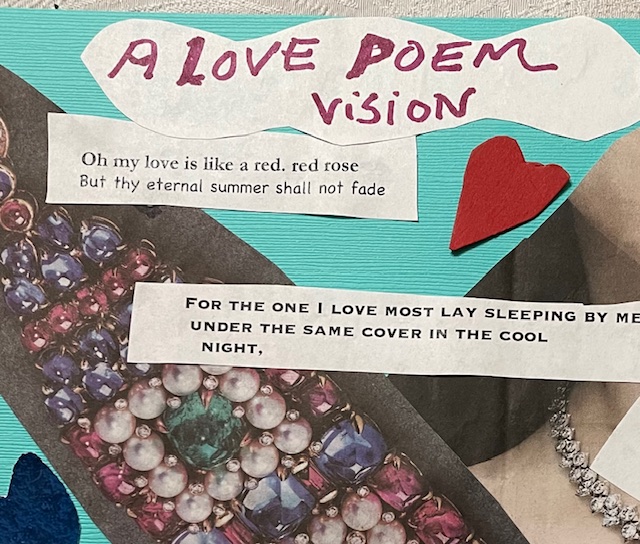
February is Valentine’s Day month. Instead of trying to send everyone Christmas and New Year’s cards, I like to surprise friends with Valentine’s Day cards. My handmade cards feature words as well as images. So why call them cards at all? They are actually Visual Poems. And because they are made from bits and pieces of collected words, colored paper and illustrations glued onto paper, they are also Collage Poems.
Try it. Once you created a few, you may become hooked. Many artists gravitate towards working in more than one medium. Visual art and poetry work well together. If you desire to be published, a market exists for creative work which combines the two mediums of visual art and words. I will providea list of publications at the end of this article. But first, let’s get started with a little inspiration.
Assembling the materials is part of the fun.
Valentine’s Day Origins
The name Valentine comes from Saint Valentine, and there are three men who are recognized as Saints by the Catholic Church. The most popular Valentine story, according to my research, is the one about the priest who performed secret marriages in opposition to Emperor Claudius II who ordered that all his soldiers remain single. Who the actual St. Valentine was is open to debate. Maybe February 14th is the approximate date of one of the martyred St. Valentines’ funerals, but it is remarkably close to the Roman fertility festival Lupercalia, once celebrated on the Ides of February ( February 15th). In some Roman villages it is said that young men and women were matched up as lovers for a year in an effort to produce more children. A day that honored love and passion, in England and France February 14thwas the start of the birds’ mating season.
The tradition of exchanging cards and love tokens is thought to begin in the middle of the 18th century. By the 19th century, the mass production of printed cards made Valentines’ cards even more popular. Gloves and handkerchiefs were two personal items lovers often gave to one another during the Victorian era. Flowers—pressed or fresh, as well as lines of verse given to our Valentine follow the romantic tradition of conveying ardor for those we adore.
Collage Poem by Nadja Maril. This collage takes lines from several well-known poems and integrates them into a collage of images and shapes connected to love.
Collage
The word collage comes from the French verb coller, meaning to paste or glue. In visual art, a collage is comprised of pieces of paper, cloth or other gathered materials arranged and permanently attached to a surface. Old photos, advertising flyers, ticket stubs, magazine illustrations; are some typical collage materials. As a teenager I’d collect shells, dried seaweed, bits of sea glass to glue on to a flat piece of weathered wood; another type of collage. Whether you use buttons, lace, tissue paper, bits of colored plastic, feathers or fur- the possibilities really are infinite.
Now, think of a collage of words. Instead of collecting physical items collect words, phrases, entire articles that resonate with you. While modernist artists in the early 20th century were creating collages of shapes and colors, Avant-garde groups that included Surrealists and Dadaists took the form to another level by including language. Tristan Tzara famously advocated a “cut-up” method of composition, involving cutting out words from a newspaper and pulling them out of a hat to create a poem. Whether you take excerpts from a political speech, a nursery rhyme or a popular song, by incorporating a medley of sources you are creating a collage poem.
Take another step to combine a visual collage with a literary collage and you have a hybrid, a poem that provides a visual and verbal experience. Whether you want to call it a collage poem, a merging of two art forms or an awesome Valentine’s Day Card—that’s up to you.
Publications that Publish Work that Combine Images and Words
If you need a different sort of Valentine’s Day gift, not the typical candy or flowers, considering purchasing a poetry chapbook and sending it to a friend. At Old Scratch Press we have published five chapbooks thus far, all under $9, with more to come. Take some time out of your day for some quiet reflection and share the love. Whoever started the idea of a day celebrating our connection to one another, let’s try and keep it going.
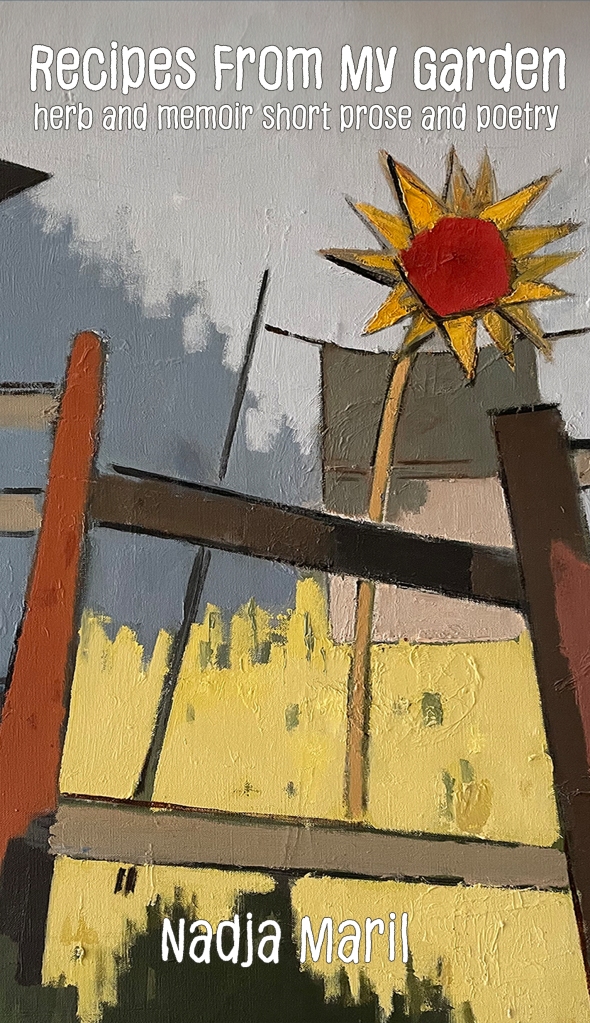
Nadja Maril is the author of Recipes from my Garden, Old Scratch Press, September 2024. Nadja Maril’s short stories, poems and essays have been published in dozens of small online and print literary journals and anthologies including: Lunch Ticket, Spry Literary Journal, Invisible City Literary Review,and The Journal of Compressed Creative Arts.She has an MFA in creative writing from Stonecoast at USM. A former newspaper columnist and magazine editor, she writes a weekly blog and you can visit her website at www.Nadjamaril.com.
Thank you for reading. Please sign up to follow us here on WordPress and on Facebook.
So confused. Isn’t a voice linked to speaking, singing, and screaming? What does a voice have to do with writing? What the fu** Robert?
A “writing voice” refers to the unique style and personality a writer expresses through their writing, which is a combination of their vocabulary, tone, sentence structure, and perspective, essentially how their individual personality comes across on the page.
Most poetry magazine acceptance rates are about 2.4%. In order to increase your chance of publication acceptance success, create a writing voice and then target publications that have published work with your voice within the last two-years.
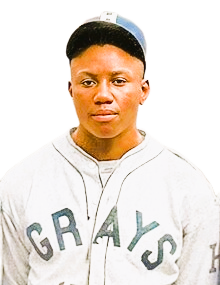
A writing acceptance rate is like a baseball player’s batting average (BA). Josh Gibson’s 1946 BA of 37.2% is the highest career Major League Baseball BA.
Josh Gibson
My poetry voice profile:
Style: experimental
Themes: masculinity, sexual orientation, sin/virtue, dystopia
Forms: visual poetry, free-verse, Japanese Haiku/Mondo, sonnet, and pantoum
Devices: sound (rhyme, alliteration, assonance), duality, homonyms, multiple-word-reversals, and end-titles
CREATING a WRITING VOICE
Oh NO Mr. Robert, an assignment is coming. Sir and madam, it is, I cannot lie.
A sleepless night, 3/14/1996, yours truly obsessed compulsed, to translate four of his favorite poets to a gay style: Robert Frost, William Shakespeare, John Berryman, and Dorothy Parker.
What I did for each poet:
Select a favorite poem
Analyze and document what the poem is (theme, form, devices) and why you like it
Read the poem out loud
Make an audio recording of your reading
Handwrite the poem
Type the poem
Translate the poem to your style
Place the original poem and translation side by side
What was the outcome impact of yours truly doing this exercise:
In 1997, a follow-up creation of a visual poem that translates Dorothy Parker was included in art show in the District of Columbia
Self-discovery that my style is experimental and an integration of one of the poets studied: Robert Frost and another poet: Dr. Seuss
More Voice Discovery guidelines: make diverse selections
Select work written in different time eras: 50% 1,800 or earlier, 50% 1,900 and later
Gender: 50% men, 50% woman
Style (traditional vs experimental): at least 1 experimental
Discover your writing voice and use it!
Yours Truly is:
Robert Fleming, a contributing editor of Old Scratch Press
Thank you for reading. Please sign up to follow us on Facebook and to follow us here on WordPress to expand your knowledge about poetry and short form writing as well as to receive the latest news about publication opportunities.
As we often hear, and know is true, writing is a solitary endeavor. Since I find long stretches of alone-time nourishing, I love that about it. But that doesn’t mean I want to go full-on-hermit. I need human interaction, even if it’s just Tina at the grocery store telling me about her cats.
Specifically, since my need for human interaction is limited, I’ve sought to find ways to find or create a writing community that is a balance of the two. Here are a few things I’ve come up with that might seen outwardly mundane, but with an added introverted twist:
· Online Writing Group: I created Bewilderness Writing, knowing that my role would be as guide, not teacher. Each week I read a poem, offer jump-off lines that folks can choose to use, or not, and then we free write for 10 minutes. Afterwards, each person reads what they’ve written and the group does not offer comment or critique. Sounds ridiculously simple, huh? It is. And what can’t be known beforehand is just how intimate and rich the writing can be within this container. Setting aside all the “writerly benefits”, it fills my need to see and hear others figuring out life using words on the page. There is great comfort there. And the tapestry of styles and voices enriches my own writing life.
There are many “writing alone, together” online opportunities without prompted writing, as well.
· In-Person Writing Group: I created “Writers in Coffee Shops” a few years ago using the social networking website Meetup. I set it up with straightforward parameters from the get-go of “writing alone, together”. We would meet at a local coffee shop, spend a few minutes sharing what we were working on, then get to it. At the end of the hour, we could share about how or what we did for the hour. After that time, folks were welcome to share their work and invite comment or critique.
For awhile, especially in the beginning, I had people who did not get the memo and wanted to chat. With gentle reinforcement those folks either got used to our system or didn’t come back. Eventually, I found a small, committed group, and we came to know our coffee shop time as not only a standing-date commitment to our writing, but a place to commiserate on the writing life. We became friends.
Want something similar?
Shut Up and Write: https://www.shutupwrite.com/While I might prefer my more “demure” group name, this is basically the same format and you can find them, with over 400 chapters all over the place
· Collaborative Writing: Recently, I had a friend and former Bewilderness group member contact me after taking a poetry class that included “renku,” which is a Japanese collective poetry composition of collaborative linked verse. My friend asked if I wanted to give it a try together. She would send me a few lines and I would send a few back. Since we’re just starting this adventure, I can’t tell you the outcome, but I’m hopeful. It is just the right mix of connection and effort for me. It intrigues me to see what might come out of it. Think of your favorite writing form, enlist your favorite writing friend, combine the two, and see what you might come up with!
These writing groups are for messy, first-draft writing where the intention is to get “your butt in the chair” and ideas on the page. While these groups all lack the comment/critique component, I am a big believer in getting other eyes and trusted opinions on your work, and there are plenty of in-person and online opportunities for that. Whichever one is your preference, there is great benefit to having others along for the ride alongside you, and what that looks like is for you to choose.
My first mystery novel, A Fire Circle Mystery: A Witch Awakens, about an amateur sleuth discovering her lineage as an Appalachian Granny Witch, comes out in Spring 2025.
By R. David Fulcher, Founding Member of the Old Scratch Press Poetry and Short Form Collective
Floetry (my definition) a written form of expression combining fiction and poetry.
It is uncommon, but not unheard of, for writers to embrace both fiction and poetry. As one of the writers in this category, I often wonder if this is a benefit or a detriment. To a purist, being competent in both could perhaps mean I’m a master of neither, to echo the old saying “jack of all trades, master of none”.
More recently, I’ve decided being fluent in both fiction and poetry is a definite advantage. To begin with, several of the masters of speculative fiction integrate poetry into their work to great effect. Consider these lines of from Stephen King’s novel The Tommyknockers:
Last night
And the night before,
Tommyknockers, Tommyknockers
Knocking at my door.
And these lines from Ray Bradbury’s novel Something Wicked This Way Comes:
By the pricking of my thumb,
Something wicked this way comes.
These are by no means the only examples. Dean Koontz dives into poetic verse within his many novels, and it can be argued that the fantasy writings of the Irish writer and dramatist Lord Dunsany (a possible influencer or JRR Tolkien, discover more here) read more like poetry rather than prose.
Therefore, having made the case for “floetry”, how do I employ it? Primarily I interweave poetry into my prose in two ways:
As bookends to start and end my books, with the remainder of the book being fiction, and
The Pumpkin King and Other Tales of Terror starts with my poem “Eulogy to E.A. Poe”:
Man of dark musings and opiate visions!
Mind of pits and rats,
Black cats and ancestral corpses!
How is it that love sparkled within those dark recesses, Like diamonds within a bedrock of obsidian— That verse sprang from that ebony hand,
As vibrant and unlikely as lilacs from snow?
Tales of cities under the sea,
Of waves weeping softly, “Annabel Lee!”
Did the bells, the bells, the bells, foretell of your demise, Or was it borne on Raven’s wings, thus falling from the sky?
Could it be that your last vision was your brightest?
Oh, soul of all that is night,
Inspire my pen to wail and to write.
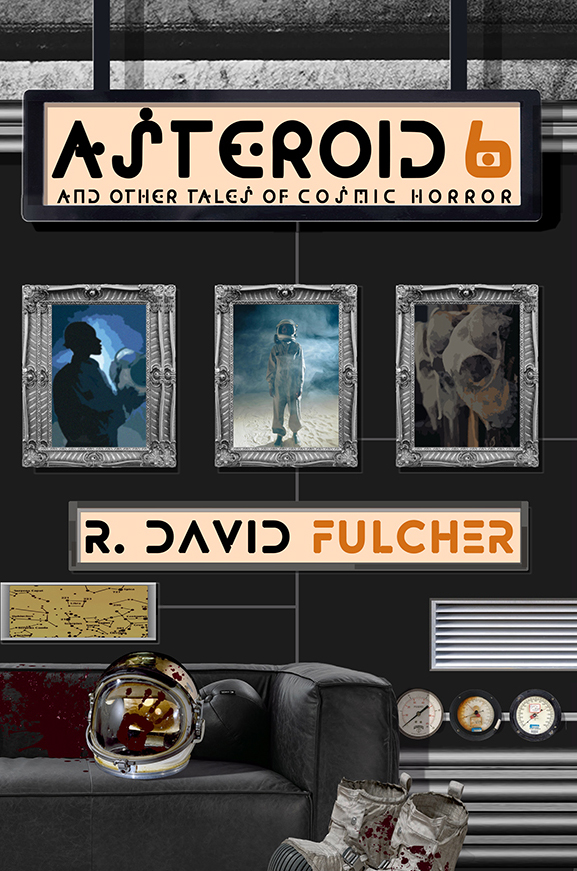
In a similar fashion, my book Asteroid 6 and Other Tales of Cosmic Horror starts with the poem “The Outer Reaches of Unknown Kadaath” (Kadaath is a reference to the works of H.P. Lovecraft):
Rest awhile, friend, for it is clear that you have walked far over hill and valley, and penetrated the wild and strange woods, to have happened upon this long-preserved manuscript beneath the moss-covered rocks.
I came upon this very spot, perhaps many years ago now, as just a lad. Here I took my respite, beckoned by a fair breeze sweeping over the verdant fields and a song sung in dulcet tones far sweeter than any produced by mortal throats. I was weary from hiking many miles, and my body eagerly fell into a deep sleep.
A song floated over my consciousness, sung by a thousand child-like voices:
Weary traveler,
Rest your head,
And sleep awhile
Where the faeries tread.
Weary traveler,
Laugh in kind,
And take deep draughts
Of faerie wine.
Weary traveler,
Spend the night,
Follow the trail
Of the faerie lights!
Additional stanzas of poetry are injected into other parts of the tale, with the intent of lulling the reader into a sleepy, dream-like state.
Final Thoughts
So there you have it – a brief introduction into the concept of “floetry” with several examples of usage.
What do you think?
Can poetry and prose peacefully coexist on the same page?
Please leave your thoughts in the comments!
Thanks for reading,
-R. David Fulcher, Old Scratch Press Founding Member
Thank you for reading. Please sign up to follow us on Facebook and to follow us here on WordPress to expand your knowledge about poetry and short form writing as well as to receive the latest news about publication opportunities.
By Virginia Watts, Founding Member of the Old Scratch Press Collective
Many people have heard of title The United States Poet Laureate, official title Poetry Laureate Consultant in Poetry, but they do not know much about this position. The Poet Laureate serves for an eight-month term running from October to May, elected by The Librarian of Congress. Traditionally a poet will hold this title for two terms. In choosing the recipient of this prestigious title, the Librarian consults with experts in the field of poetry as well as former Poet Laureates. Additionally, suggestions from the general public are accepted.
The Poet Laureate only has two officials duties they must perform, two readings at the beginning and end of their term. The idea is that each Poet Laureate should be given the space and freedom to decide for themselves how they can use their role to encourage people throughout the nation to read, write and develop an appreciation for the art of poetry. The Poet Laureate receives a stipend of $35,000 and $5000 for travel expenses. Prior the 1986, the Poet Laureates were known as Consultants in Poetry. The well known poets Robert Frost and Gwendolyn Brooks were Consultants. Since 1986, there have been 24 Poet Laureates, Louise Gluck and Ted Kooser among them.
So, what have some of our Poet Laureates done during their tenure to spread the love of poetry?
In 1997, Robert Pinsky, the 39th Poet Laureate, put out an open call for people to share their favorite poem. Many Americans sent poems. Poems came flooding in from all ages, all states, from people of diverse backgrounds and interests. Pinsky’s call set off a domino effect leading to reading of favorite poems in hundreds of cities and towns.
Gwendolyn Brooks is well known for her focus on elementary school students. Early learning about poetry and writing it is bound to foster a lifelong love of the art form.
Joseph Brodsky thought the best way to have people experience poetry is for them to find free samples of it in their everyday lives and places, such as airports and hotel rooms.
Billy Collins published an anthology inspired by his time serving as the United State Poet Laureate. “Poetry 180” makes it easy for high school students to read or hear one poem each day during their school year. Collins is often quoted as believing that poetry is a kind of social engagement, that a poem should feel like it reaches out and invites the reader inside.
Rita Dove brought writers with a focus on African diaspora together. Maxine Kumin focused on shining a light on the works of women writers and Joy Harjo, the 23rd United States Poet Laureate, was the first Native American to hold this honor.
Our current Poet Laureate is Ada Limon. She is from a Mexican American background and grew up in California. As part of her position, she penned a poem dedicated to NASA’s Europa Clipper Mission. Her poem is engraved in her handwriting on a metal plate aboard the Europa Clipper spacecraft. This spacecraft launched in 2024 and will enter the Juniper system in 2030. Here is Limon’s gorgeous piece. She is one of the must-read poets of our times, well deserving of the title of United States Poet Laureate.
“In Praise of Mystery” by Ada Limón was released at the Library of Congress on June 1, 2023, in celebration of the poem’s engraving on NASA’s Europa Clipper, scheduled to launch in October of 2024. Copyright Ada Limón, 2023. All rights reserved. The reproduction of this poem may in no way be used for financial gain.
About the author: Virginia Watts is the author of poetry and stories found in Epiphany, CRAFT, The Florida Review, Reed Magazine, Pithead Chapel, Words & Whispers, Sky Island Journal among others. She has been nominated four times for a Pushcart Prize and four times for Best of the Net. Her debut short story collection Echoes from The Hocker House won third place in the 2024 Feathered Quill Book Awards.
Virginia Watts grew up in Hershey, Pennsylvania and spent summer vacations in the Endless Mountains of Sullivan County with her Quaker grandparents. Many of her stories and poems revolve around small town life and rural roadways that are not always what they seem.
Thank you for reading. Please sign up to follow us on Facebook and to follow us here on WordPress to expand your knowledge about poetry and short form writing as well as to receive the latest news about publication opportunities.
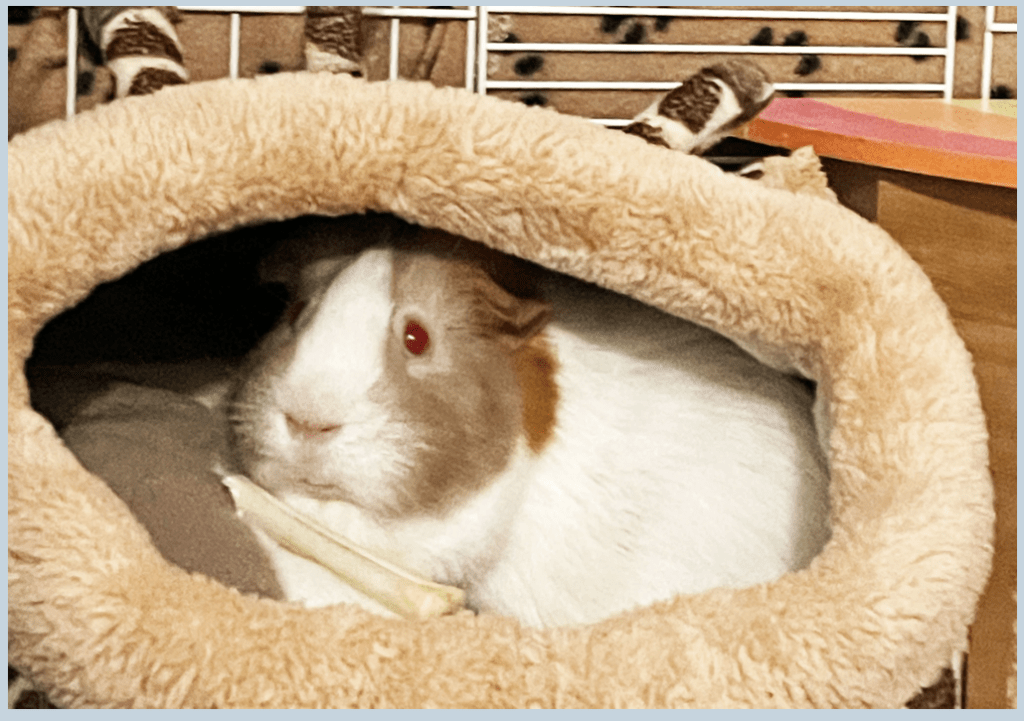
Just before the pandemic (the 2020s I feel the need to say for when we all are history), we were in search of a better situation for our daughter, and we moved her to a private school. She went from a class of 30 to a class of 12, and her academics improved immediately, though our finances did not! As a part of her classroom they had an animal student, the lovely Miss Addie pictured above lounging in her hidey with a tasty piece of bamboo. The school asked for a volunteer family to take her home over the Christmas break, and we volunteered. Addie and I bonded immediately (I am the pet-whisperer), and I must admit I delayed sending her back to school in January by almost a full week. When the school was shut down over Covid in March they asked me again if I would take her, and I eagerly said yes. She moved in with us, and by May the lovely school announced it was going out of business. Addie became family. During the stay-home days our daughter took courses on Outschool (highly recommend) where she learned female guinea pigs preferred to be in pairs. We then adopted Baby from a pet store. It turned out that Addie did not prefer to be in pairs, but eventually a tolerance developed.
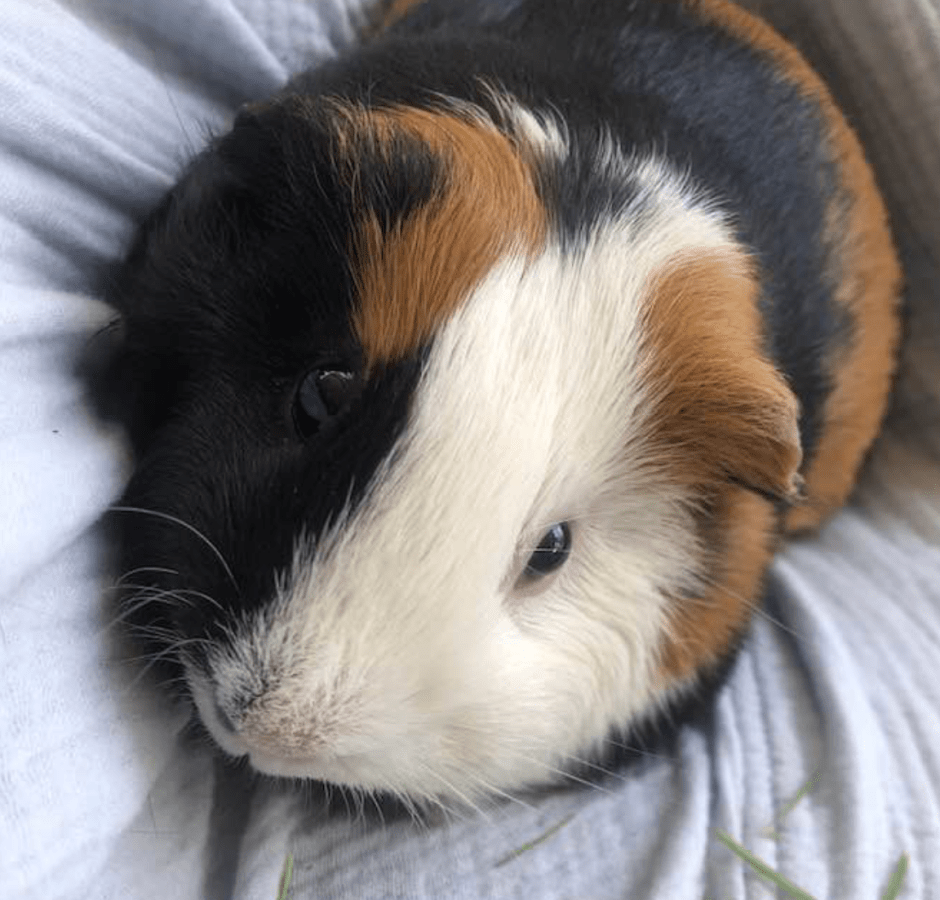
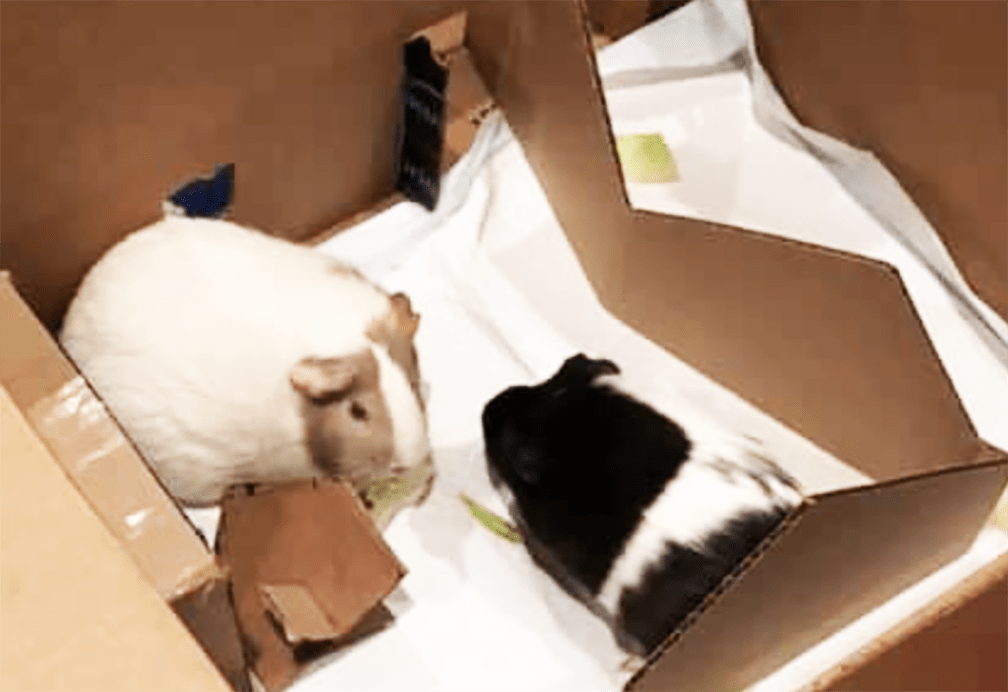
When we moved back to California, again for a better school experience for our daughter, we drove across with two cats, two guinea pigs, and one dog. About a year after we settled in, I woke up a few days before Christmas to find Addie had left us. Baby, it turned out, was desperate not to be alone, and went on a hunger strike. After a forcing some food into her for two days (guinea pigs must eat constantly or they die), we adopted Punky (who looks a bit like a pumpkin). This past summer Baby followed Addie to Valhalla, and I saw, stretched before me, a long line of guinea pig adoptions for the rest of my life. I waited with bated breath until, lo and behold, it seemed Punky took after Addie, bless her. She seemed very interested in checking out Baby’s viewing and memorial, but then she was fine to have all the snacks and seed balls and pigetti (corn silk) to herself. She moves, in her luxuriously large cage, from hidey to hidey during the day, alternatively napping and yapping. She has a lot to say to me, and we perform a call and response between us where I say, “Woooo, Punkus!” and she chirps away back at me, whooping louder and louder until I bring her some fantastic treat.
The guinea pigs, as much as I don’t want to have a long line of them stretching to the end of my life in front of me, are part of my life’s rituals, and I love the job, and someday I know I will mourn the loss of it, as I mourn both the beautiful, pink-eyed Addie, and Baby, who looked like a tiny Holstein. Every other morning, without fail, I awake before the sun and the rest of my family, chat away with Punky as I remove all her bedding (I use cloth bedding, nice fluffy fleece pads), and all her hay, and all her snacks and poops, and I clean out the cage. All the linens go into the washer for a hot wash and an extra rinse, and the cage is refitted with clean bedding from my ample supply. Then I top off the snack bin (hay rings, seed balls, vitamin C chews), put in fresh hay, and add in some salad (lettuce, peppers, fresh baby corn, that sort of thing) and set Punky up for her new day. It takes me about 40 minutes (not counting the laundry time) and during that time I do not have to think what move to make next, and my conversation (Wooo Punkus!) pretty much doesn’t change, and is not the most thought provoking. That gives me some early-morning time to freshen up my brain as I freshen up Punky’s cage. We both enjoy it. For me it is both calming, and nurturing as I nurture my little Punky, and there is a clear sense of accomplishment in looking at the “beautiful once again” cage.
Of course, you might think, that’s a lot of work, lady, for a kid’s pet, work that the kid should be doing. My daughter and I traded years ago because, when Addie first moved in, my daughter was too short to clean the cage, and not very quick or proficient at it. I offered to trade emptying the dishwasher (a chore I despise). She agreed. So now she’s stuck with it! And I get the meditative and soothing time with Punky.
I want to address this next paragraph to my fellow non-believers out there, or, perhaps, non-conventional believers is a better term. I was raised really immersed in a traditional Christian church, but, as long as I can remember, though I didn’t really balk against going until late into my HS years, it had no effect on me. I didn’t click into the whole thing. I often read the Bible in church from boredom during the long services, but it came across as fairy tale to me, and the emotions I saw people experience in church were not there for me. Even during my beloved grandmom’s funeral, who loved her church dearly, what I remember feeling, aside from loss, was that I would have preferred to be somewhere else, somewhere emotionally warm, to hold her in my thoughts. I have no doubt that my delight of a grandma is somewhere, in some form, still being a delight, but hooking it into her own religious beliefs is beyond me. So, there are two points I want to make here about that based on my experiences in life: ritual, which is done so well by churches/temples/mosques, and their like, is not owned by them. And life needs ritual for space to process and to get in touch with emotions. We are all different, and some of us need more ritual in life than others, and that ritual can be as simple as how we decorate for holidays, certain meals we make at certain times, celebrating our own birthdays (of course! I’m glad I was born!). Ritual is, really, meditation, and for me it is more profound when it is a natural thing in my life rather than what I would view as a forced, arbitrary movement. The guinea pigs are a delight too. Their personalities remind me of my chubby grandma in many ways. She often whooped, and loved eating too. There’s no reason they should not be connected in my heart and in my thoughts. I love the ritual that they are.
And during the “mundane chore” of cleaning the guinea pig cage I get a lot of writing done (in my mind, not on my computer!). It’s a reset for me as well. There’s no pressure for perfection, and the thoughts roll in and out like a calm tide.
Of course Princess Punky will not outlast me (I am optimistic enough to assume). And I want to just mention my second very early morning ritual that will ride with me to the bitter end. OHHHHHHH…….
All I want is a proper cup of coffee
Made in a proper copper coffee pot
I may be off my dot but I want a proper coffee
In a proper copper pot
Iron coffee pots and tin coffee pots
They are no use to me
If I can't have a proper cup of coffee
In a proper copper coffee pot, I'll have a cup of tea!
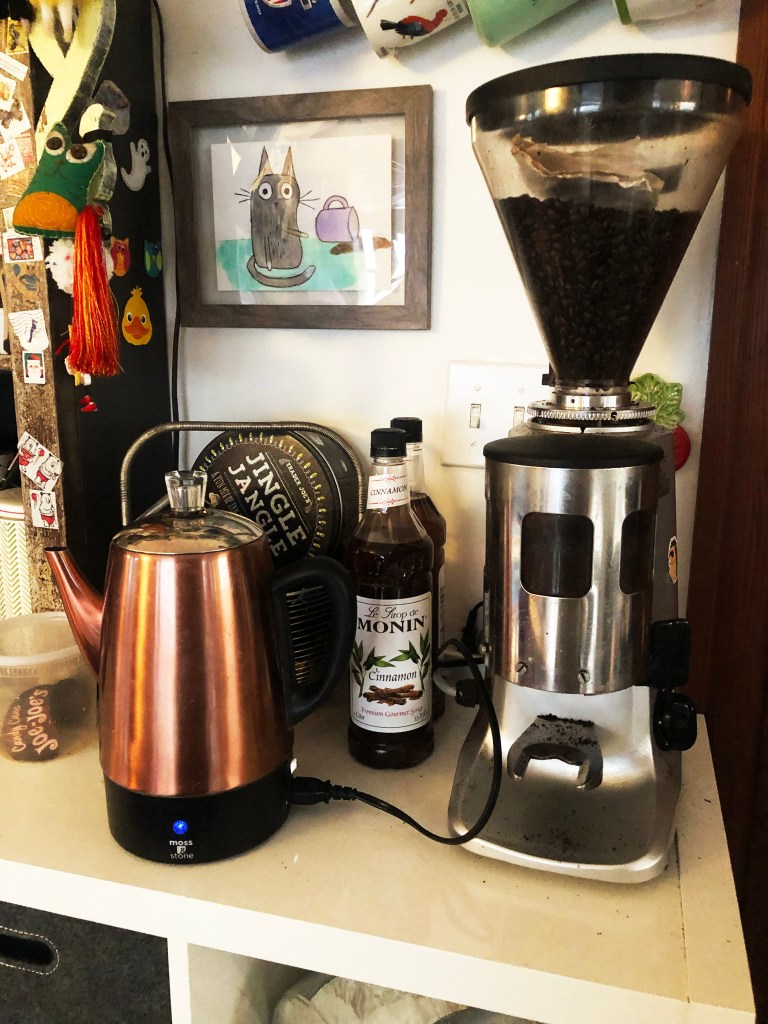
Gaze upon my magnificent second morning ritual… coffee made in a proper copper coffee percolator! A percolator has several ritual benefits: there are a few parts to take apart and clean; there is a prescribed way to put it back together, and when it is back together it moans suggestively and bubbles, and scents the air with perfume Chanel should be envious of. It is another opportunity for me to do labor that requires no brain power, that pleases me and affects me directly while also giving benefit to someone else (my spouse), and doing the “chore” brings about visible results that please me. It also offers me a hot cup to sip and enjoy as I slowly move from meditation to sitting down and writing out this post, or some other writing project.
Websters says that a blessing, as a noun, is grace (the thing said before meals), approval or encouragement, or a thing conducive to happiness or welfare (by which I take it Websters means well-being). Rituals are a blessing. And, for me, a lot of my blessings are my routines. I exhort you not to deny yourself of the blessing of your routines, even if they are “chores” (such a dirty word!). Slow them down a bit; use them to slow your thoughts, and plum the richness of repetition, a moment with no planning and no management needed, a moment on autopilot. There are so many writing gems to be found there, as well as quite a lot of balm for the nervous system. Enjoy that walk with your dog, scritches for kitty, a hot cup of coffee, or, if you can’t have a proper cup of coffee, a hot cup of tea. 😉 Whoop whoop!