“Pink Dress” from the Forthcoming ~ In the Cancer Cafeteria~


Happy Saturday everyone.

I’m working on bringing out my poetry collection this year, and I thought I’d share one of my poems with you.
For the past year I’ve been traveling with my little sister to her cancer appointments. Luckily I do not have cancer, but I am cancer-adjacent, and that has its own challenges. When I want to say worrying things, when I read case studies, which I do, when I am by myself as she naps through a treatment and I wait, when I drive in and out of West Hollywood alone, sometimes in the threes and fours in the morning depending on treatment time, and I ruminate, I try to put it on paper, rather than on my sister. I’m also a clothes lover and a people watcher from back in junior high with my then boyfriend and bestie Joe Perna. We called ourselves the fashion police in 7th grade, like we were such good dressers. Joe and I observed details, and made guesses based on what we saw. In general the thing I am most curious about is the lives of other people. I think I am (possibly) overly empathetic, and I imagine stories for strangers all day long. I also tend to notice the small things happening around me. As I sit and wait for my sister, or drive alone, or struggle to make small talk (as I do without cancer! I have never been good at it), my brain is humming away wondering about people, and making stories to go with them, and wondering if their cancer is curable and how it will all play out. Most people I see only once, even though we go the same time and day quite often. It is my curse to want to know everything, and to never be able to know, purely because I am a nosy so-and-so. When cancer comes to town your ability to be quiet in the never-knowing is mightily tested.

I also don’t want this to be a totally maudlin book about being upset about my sister. I don’t want it to be a book about my sister. Though I love her dearly, her story is hers, and I don’t want to steal it, which would add, in my view, insult to injury. It’s important when you write about real-live people who are not famous people that you be considerate and kind. I am not able to do that when talking if a joke comes to mind. If I think of something funny about something you’ve said or how you look, etc., it’s coming out unfiltered, that second, and I’m going to laugh. Yeah. Kind of a shitty trait, but what do they say, “At least all the trauma made me hysterical.” Yup. But when I write about anyone who I will see again, it is important to me to serve my needs while not disregarding theirs. There are compromises. My sister may not want me announcing she has cancer, for example, but she has told the people in her life, and I need to be able to discuss it too, so she loses that bit of control, just another thing cancer steals, privacy. For that she has to allow me the book as a coping mechanism. Sorry sis.

Another thing to note, as I assume most people who read this blog are authors: you have to be careful where you put your work before you publish your book. I am publishing my book through OSP, so I can put this poem here, and OSP will not disallow it from the book. If another publisher was publishing my book, they might not be happy for me to stick a poem out in public on a blog. They may or may not be happy for me to publish a poem somewhere in advance, because that anthology or lit mag where the poem is published may hold rights that conflict with the publishing company then using the poem when publishing my book. So there’s that. You have to be careful. You can always post a question here, and one of us will try to answer it. In fact, I’ll run a monthly post that offers a chance for you to ask questions, and reminds you that you can do it.

This book has a theme that runs through the whole book. Some collections do have a theme, but often the theme is that all the poems are written by the same person. The theme in my book is cancer, but, more drilled down, my reactions to cancer, my observations on the cancer experience, which I am holding together in the idea of the cafeteria at the clinic. People who are going through cancer as patients or support are often in the cafeteria as a place to stop being wrapped up in the cancer events and procedures. It’s the downtime place, and, because of that, people drop their masks a bit there. I am not telling anyone’s secrets as much as I am interpreting what I see, which changes the observation from what it is, to what I see. There is much intrusion from observers, so don’t worry that I am revealing anyone’s truths besides my own.

I have trouble tapping a poem with my scepter and declaring it complete. I expect many poets are the same. Sometimes a poem comes out almost fully-formed, but most still have growing and shrinking to do.

I write longer poems. I write narrative poems. I tend to write personal poems. Sometimes my poems are true, and sometimes they are true in the sense that they are true, for me. That doesn’t mean they would qualify as legally true. If the person was a brunette, and brunette doesn’t work, guess what, red hair is what I am going to write.

This poem, “Pink Dress,” is pretty much done. I will say it is an uncorrected proof here, as I may change it a bit before it hits the book galley. But it feels good to me as it is, and I was able to read it aloud to myself without having major anxiety, so I feel like it is okay.

The OSP group has become my friends as well as my colleagues, and, based on schedules and etc., we often ask each other to look at each other’s work. That’s part of the deal with this collective. So far I have shared some of my writing for this book with Robert, Anthony, Gabby, and Ginny. I cannot express how much I have appreciated them and their taking the time to give me really helpful, kind, and actionable feedback.

Here, without further ado, is one of the poems destined to be released later this year in the collection, In the Cancer Cafeteria.

Pink Dress

Her pink dress is too tight too short
the old sneakers don’t go
hair twisted up and split
two rolls of mussed-up teddy ears.

He is all belly 
under his big and tall polo 
up top tangled hair needs 
a brush run through
but beard is spun silk. 
He is the one who gets up
moves around
paces because he’s in the cancer cafeteria and who doesn’t pace?

She doesn’t.
She smiles at the screen in her hands.

Whenever he gets up 
he runs his finger down her bicep. 
Her chubby thighs
twitch back at him against the tight pink hem.
The dress is a mini
I can see her cotton crotch and I don’t tell her
because each time he slides his finger down her arm 
her smile goes wicked at the corners 
for a second
as her thighs twitch
call and response
and it’s not my song to sing.

I shut up I pretend I don’t see.

When he manages to sit 
his chair is up against instead of across from
his long tangled curls try to nestle under her neck
wheedle around her earlobes. 
I can’t tell for certain who is victim
who is victim support.
Some secrets are not for me to know.

He needs to move again 
gets up abrupt 
clumsy all the other chairs 
tables reach for his legs
stepping around best he can into the hall
gazing in confusion at the baby grand 
sitting there
playing “Wichita Lineman” by itself
from 1968 
a year him and his girl know only as a number, and not real.

He stares at the piano
rocks on his heels in his shoes as he has rocked since he was five years old 
knees bend out to the sides 
a boy just learning how legs work
walking through a day’s same endless agenda
treatment, wait, consultation, wait, scan, wait. 

Head nodding at Jimmy Webb’s F major D major
he tries to find his way to the tune
gives up, moves back to her
comes in for a landing 
finger trails down and up
bare meaty skin. 
She ripples in response. 
Appearing now on all her bare places
languishing goose pimples 
long only to be released 
to go home 
so two may unzip the tight pink dress together. 


Dianne Pearce is the chief editor and bottle washer at Current Words Publishing, and the half-cocked imaginer behind Old Scratch Press and Instant Noodles. Pearce loves helping writers realize the dream of having their work published. I mean she is really crazy about doing that for some reason. To that end, to join in the fray, to look at the thing from the other side, to stand in another’s shoes, and all of those things, she is fully expecting and promising to publish her first collection of poetry, In the Cancer Cafeteria, spring of 2026. Please don’t hold your breath. For very long. Happy 2026!

Compiling My Collection

Clearly the owner of that journal is not doing a good job of compiling her collection because on her journal is a slice of orange she is attempting to dry out, three crystals, and a paintbrush. The book is open and written in with a pencil, not good for preserving writing as (being a teacher for one-zillions years I can tell you) pencil smudges overtime to become indecipherable. She’s also got a pile of vintage mail (definitely older and already been mailed to her, to someone), which is deliciously tantalizing, and reading is much easier and more fun than writing.

Who is this mess of a woman? That’s a stock photo, but it could easily be my desk, with a few dozen highlighters and yesterday’s coffee added to the milieu.

It’s difficult for me to have a clean desk, no lie there. It’s difficult for me to spend time cleaning my desk, and not because I am not a neat person, but because I push my own things back. In fact, though I think of myself as a generally nice and “in a good mood” sort of person, I can get snappy when I feel tooo squeezed out.

I feel thin, sort of stretched, like butter scraped over too much bread.

JRR Tolkien, The Fellowship of the Ring (The Lord of the Rings, #1)

What a great bit of writing that is!

So I have made the bold assertion that I will publish my collection of poetry through Old Scratch Press in 2026. There. I said it to the group, and now I said it to you. I swear I’m gonna do it. I am going to occasionally clean my desk, and push in some room to get my collection together by pushing other things back (other things probably being sleep! Ha!). I just took on a new tutoring student, a few pro bono editing projects (my daughter’s school has a non-profit component to it, and I donated some editing to the auction, and it got bought!), a half dozen or so sample edits, in addition to the regular amount of edits, which is many hundreds of pages per month, and I signed up for a singing course with a friend, have a relative needing assistance for cancer treatments, a teen in need of a lot of “staying on track” help with school work and she is also involved in some theater projects her dad or I need to be the transportation for (and, in general, making sure she eats, remembers her glasses, etc.), and a business to run and a home and family, in addition to trying to squeeze in a daily run. I would love to run well enough to participate in a 5K, and I have been thinking of joining a thing in my neighborhood where I could get a running trainer. Of all of those things I am doing there is nothing I do not want to be doing, except for wishing my relative didn’t have cancer, of course. One friend had told me recently she was stepping back from a project, and I had anticipated it about four months earlier, actually, and I completely get it. My relative, who is staying with me this week and last for her treatments, woke up today and told me she is spending the last few days she needs to be local for her tests at a friend’s because she needs a change of scenery. I had expected that too, and I had prepared a to-go coffee for her before she woke up. However I have a HS friend on FB who is every bit as engaged in politics as I am, and worried about the general state of what we see as the slide into authoritarianism, and another HS classmate said to him, “We liked it better when you just wrote about your kids and scouting. You don’t have a lot of chapters (she actually wrote chapters!) left; don’t waste them on this.” and I could not agree less. Age, chapter of life, has nothing to do with wanting to accomplish things and caring about things outside of ourselves, so, no, I do not think he should stop fighting the good fight. Yet I feel that I do have an understanding that we literally cannot do it all, and don’t want to, and I respect it, and think it is a good thing, and I flatter myself that I am especially good at reading the room, and can see when change is coming. But, I’m not good at, “No.” I’m not good at giving up on something I’ve begun, even if it does not realize my own dream. It’s an obstacle because in order to publish one of my many projects, I assumed I would have to come up with a good, firm, “No.” And I simply can’t. So I have decided instead to come up with a good, slightly quavering, “Yes.” I’m outing myself that I am going to put my damn book out. I am saying it, and affirming it, and treating it, as much as possible, as a done deal. I think if I normalize it, the way I normalize all the other things, I will simply do it because it has a due-date, or a do-date. Both!

And so, here is my question to you:

If you have been writing short stories, short non-fiction, flash, poetry, for some time now (I’m not going to say I’ve been writing for decades, but at least since the synth-pop craze and the resurgence of skinny ties (the best kind of ties)), how do you choose what to include, and what to leave behind, resting, forever lost in a permanent dream state in the “my writing” file on your desktop? Though the synth-pop craze wasn’t what I would describe as a serious time in the world, I was a serious writer; I took myself very seriously, and I think that “me” has somehow stuck around, and I judge that writing to be more profound, when in reality for pretty much all of us our early writing is awful. I remember writing a poem laden with love and portent that was about a page long and contained only the word “baby” written over and over again in different combinations with possessive pronouns and a few sappy adjectives. Songs, when sung, can add meaning through cadence, tone, etc., but, with that “baby” experiment I learned that mere words on a page cannot do that. It was a piece of absolute dreck. I do not regret deleting it!

So, those old pieces hold special meaning for me, but most are not very good (I confess I still think some of them are genius!), and almost all are not even remotely relevant to who I am now. Though I am still a whiny liberal with a moral bent, and that still is there, even in the new pieces.

And this is it, my one chance to publish my poetry, to put it out there in the world. When I was in my MA and MFA programs I knew who the “it” poets were in the world of poets who published, and I wanted to join them, to earn their respect. And as I tried I very much felt borne farther away from them. Primarily by life circumstances and that inability to say no, that pushing back of my own things, more than anything else. And that very much was a tell (an inadvertent behavior or mannerism that betrays) that I didn’t belong among them. Writers who are successful (and success looks different for a poet than a novelist, or self-help book author, etc.) almost all have a modicum of selfishness that allows them to push things away that don’t serve them, and also leads them to self-preserve. They’re not going to be dumb enough to share their “baby” poem with their thesis advisor. Selfishness belongs on the seven deadly sins list, IMHO. But success almost needs it, like a plant needs water, to survive.

So, for better or for worse, committing a deadly sin or not, I am going to get this thing done as if it is not even my thing, so I will not be being selfish; I will simply be doing another job on the list.

But, again, I have this question: if you could put together a collection of your writing (or publish one of your novels, if you write long-form) how do you choose? How do you group? How do you look back over your body of work and say, “This goes; this doesn’t?” And if you could have your book published next year, what would you want on your cover, and why? While working with OSP one thing that has continually surprised me is that the authors seem to know what the cover needs to be. How in the heck….?

So, what about you? Would you know? I’m super curious to hear! Drop me a comment below!

🙂 Dianne

Let’s Get Titular

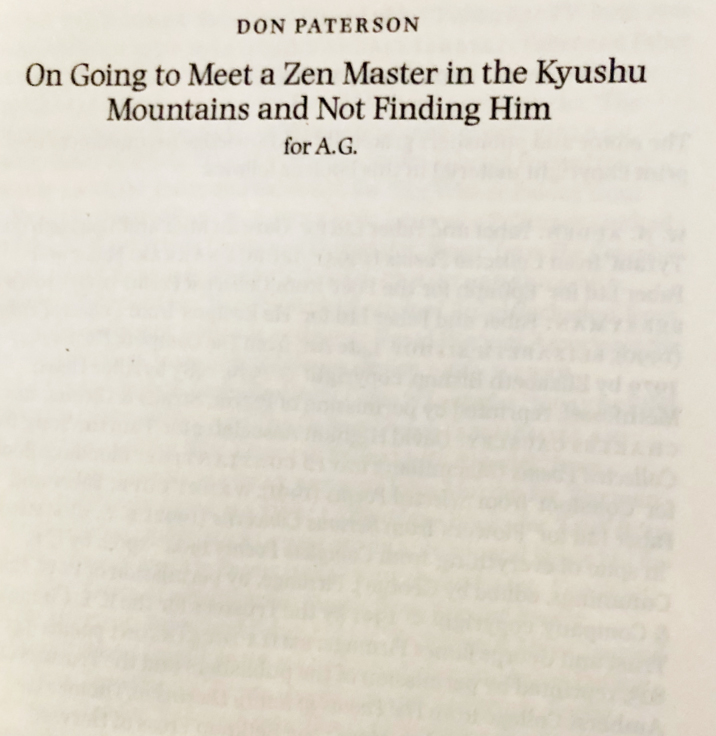
Above you see Don Paterson’s take on the titular poem, with a poem where the title is the whole poem.

A titular poem is a poem where the title is part of the poem, a line in it. In my own poetry I have really liked using this device, and often use my titles as the last line of the poem, the conclusion to the whole action of the poem. I have been described by my teachers as a narrative and magical realist poet. In my defense against these allegations I will let you know that I grew up listening to songs like “Jolene,” by Dolly Parton, “Ruby,” by Kenny Rodgers, “The Wreck of the Edmund Fitzgerald,” by Gordon Lightfoot, “Dark Lady” by Cher, and the oddest one of all, “Angie Baby,” by Helen Reddy. My formative years were two-to-three decades of songs with strange narratives in them. It isn’t my fault!

I have written many titular poems, some remarkably more successful than others, but I will share with you today one that is probably my personal favorite. This was written when I was in graduate school for my first writing degree. I had moved back in with my family. My house was helmed by two working parents, both too ready to have a drink, both too generous with money and not much else, and both not great at respecting boundaries. But I was able to go to school for my Master’s Degree and teach at the school part time, which pretty much took up 10 hours of each day, but made about one third of what a person needed for rent in those days, so, without my old room, I never could have done it. There were a lot of challenges though, one of which was a mother who was threatened by education, and really tried to impede it even as she envied it. My most repeated story, and least believed, was the one where I went up to my room to work on a paper due the next day that had to be twenty-five pages. My mother burst in to the room, my dad in tow, and began to lay out sheets of wallpaper over my (yes, I’m not kidding) word processor and desk. “We’re wallpapering the bathroom,” my mother announced.
“What, now? Tonight? It’s seven,” I said in disbelief.
“We have to do it now,” she said. “Right Vince?” My dad looked at me and shrugged. What could I do? I went downstairs, and waited. They finished a little after eleven, and I finished the paper a little after four the next morning. Yes, I should have probably written it sooner, but that aside, who competes with their kid with wallpaper? Sigh. No one I shared my graduation program with ever believed my stories. So, one day I wrote this poem to see if it could explain it to my fellow authors that my stories were true. As you read the poem remember… this is a titular poem, so see if you can understand how the title works as the title, and also as the last line of the poem. Yes, there are obscenities in the poem that some may find offensive. I’m a salty old girl, and, once, I was a salty young one.

A Few Dry Old Peas Rattling Around In A Waxed Paper Dixie Cup

Jesus fucking Christ goes through my mind as I sit here,
trying to read the poems from my poetry workshop,
and my brother, who doesn’t live here,
appears suddenly at the front window
like an unwelcome trio of Jehova’s Witnesses,
causing my dog,
who had just been whining at my leg for my bagel
to bark loudly and repeatedly at the window as
the phone rings, making me jump like a bean,
and I answer it,
all the while looking in exasperation at my beloved bother of a brother,
who is unaware that I am here,
and if he comes in the house will joke,
as if he were the opening act for the Jerry Lewis Telethon,
“Still in your pajamas? Ah you and that school racket,”
while I say, “Hello” the the phone with my voice
trying to sound
pointed
and
pissed
and my mother’s voice says,
“Read me what the calendar says my dentist appointment is,”
and says,
“I know you’d like nothing better than to put my wash
in the dryer—how ’bout it?”
and says,
“Don’t just sit around; do your windows,”
and says,
“You’re home todays so I won’t be home to let the dogs out,”
although she wants to be
’cause she thinks I don’t do it right,
and tells me again how to do it before she hangs up,
but my brother has not come in, has disappeared, so I go back to reading
for two seonds because here comes the dog again,
whine whine bagel bagel scratch me, and I stamp at her;
she looks at me—Big whoop—says her scroungy toothless expression,
and I hear a loud banging, so I look up and a strange truck,
a truck that would have turned up the noses
of Sanford and Son
and a man who obviously was designed with the truck in mind,
are in the driveway,
and he is pulling a gigundous lawnmower
off the truck while I try to think and come up with
Jesus, shit! Don’t unload that! Did I ask for that thing?!
and Who the fuck is this toothless guy? and wonder
for a scared second
if he’s a relative I don’t recognize
which is usual for me,
when I see my brother coming ’round the side of the truck
and I run upstairs thinking, What the hell is that guy here for?
Bill is going to bring this strange man to see me
in my pajamas
, and the dog is lifting off the floor now
in little hydraulic barks—I am thinking
Christ Bill, now you’re going to wake Lee and I
am giving up on reading poetry; I’ll write some instead,

and I retreat to my room and start typing trying
to ignore the barking of slamming truck parts and lawnmowers out front,
but I am right,
my brother does wake my sister, and when she gets up,
by opening her door she releases another dog to bark,
and it runs downstairs to join in, eager to catch up,
while my sister
walks into the bathroom and pees loudly with the door open,
and does not flush,
puts on striped spandex, and goes tour-de-fourcing
down the stairs where, like a swift grifter,
she switches out the tape in the VCR for an aerobics tape and turns it
up
up
“Lift ’em up! That’s grrrreat! You can do it!”
but I can’t do it
because I can still hear my brother and Mister May-Be-A-Relative,
so I am able to hear another voice added to theirs
as my mother says, “Oh, I wondered if you’d be here.
I just came home to let the dogs out,” and my friends wonder
why I’m tense and why I never want to visit the zoo,
and I think,
Dad must be coming home any minute to tell us all the jokes
he’s heard today, like, “Duck walks into a pharmacist,
says gimmee a Chapstick and put it on my bill,”
or the one about the Avon lady who farts in a elevator,
after which he will laugh that long, wheeze, Lou Costello laugh
“Hey Abbott”

and somehow,
in this rapidly escalating cacophony,
a small sound,
like a maraca gently shaken,
is in my ears
pulling me to it,
causing me to think one final thought at the end of my morning study time,
because,
pricklingly familiar,
I think I’ve heard that small hollow sound before, and I think
I now know exactly what my brain is like.

Did you make it to the end? Could you see how the titular title ended the poem? I must admit I’ve always felt that the title must work as the title, of course, but should also resonate at the end of a poem, because our eyes, having reached the end, especially of a long poem, will zip back up to the top to refresh, remind us of what we were reading in the first place.

Have you ever written a titular poem? If so, I’d love to have you share it in the comments. Have you ever read one that you especially liked, or that flummoxed you? Let me know.

All these years later, through many different rounds of education at many schools, through being a life-long adjunct: always running place-to-place, through infertility and a trip to China to become a mother, through a few trips back and forth across the country with a full car and a moving van, through working with so many different and wildly talented authors, I do still feel a bit like I’m a plate-spinner with a brain that might like a long vacation on a deserted island.
Thanks for reading! I hope you’ll share back something titular.~ Dianne

Dianne Pearce is the publisher and main editor at Current Words Publishing. She also designs and formats each issue of INSTANT NOODLES LIT MAG, and had to learn how to work computers to do it!

Don’t miss the second submission period for INSTANT NOODLES 2025. Submit today!