As we often hear, and know is true, writing is a solitary endeavor. Since I find long stretches of alone-time nourishing, I love that about it. But that doesn’t mean I want to go full-on-hermit. I need human interaction, even if it’s just Tina at the grocery store telling me about her cats.
Specifically, since my need for human interaction is limited, I’ve sought to find ways to find or create a writing community that is a balance of the two. Here are a few things I’ve come up with that might seen outwardly mundane, but with an added introverted twist:
· Online Writing Group: I created Bewilderness Writing, knowing that my role would be as guide, not teacher. Each week I read a poem, offer jump-off lines that folks can choose to use, or not, and then we free write for 10 minutes. Afterwards, each person reads what they’ve written and the group does not offer comment or critique. Sounds ridiculously simple, huh? It is. And what can’t be known beforehand is just how intimate and rich the writing can be within this container. Setting aside all the “writerly benefits”, it fills my need to see and hear others figuring out life using words on the page. There is great comfort there. And the tapestry of styles and voices enriches my own writing life.
There are many “writing alone, together” online opportunities without prompted writing, as well.
· In-Person Writing Group: I created “Writers in Coffee Shops” a few years ago using the social networking website Meetup. I set it up with straightforward parameters from the get-go of “writing alone, together”. We would meet at a local coffee shop, spend a few minutes sharing what we were working on, then get to it. At the end of the hour, we could share about how or what we did for the hour. After that time, folks were welcome to share their work and invite comment or critique.
For awhile, especially in the beginning, I had people who did not get the memo and wanted to chat. With gentle reinforcement those folks either got used to our system or didn’t come back. Eventually, I found a small, committed group, and we came to know our coffee shop time as not only a standing-date commitment to our writing, but a place to commiserate on the writing life. We became friends.
Want something similar?
Shut Up and Write: https://www.shutupwrite.com/While I might prefer my more “demure” group name, this is basically the same format and you can find them, with over 400 chapters all over the place
· Collaborative Writing: Recently, I had a friend and former Bewilderness group member contact me after taking a poetry class that included “renku,” which is a Japanese collective poetry composition of collaborative linked verse. My friend asked if I wanted to give it a try together. She would send me a few lines and I would send a few back. Since we’re just starting this adventure, I can’t tell you the outcome, but I’m hopeful. It is just the right mix of connection and effort for me. It intrigues me to see what might come out of it. Think of your favorite writing form, enlist your favorite writing friend, combine the two, and see what you might come up with!
These writing groups are for messy, first-draft writing where the intention is to get “your butt in the chair” and ideas on the page. While these groups all lack the comment/critique component, I am a big believer in getting other eyes and trusted opinions on your work, and there are plenty of in-person and online opportunities for that. Whichever one is your preference, there is great benefit to having others along for the ride alongside you, and what that looks like is for you to choose.
My first mystery novel, A Fire Circle Mystery: A Witch Awakens, about an amateur sleuth discovering her lineage as an Appalachian Granny Witch, comes out in Spring 2025.
By R. David Fulcher, Founding Member of the Old Scratch Press Poetry and Short Form Collective
Floetry (my definition) a written form of expression combining fiction and poetry.
It is uncommon, but not unheard of, for writers to embrace both fiction and poetry. As one of the writers in this category, I often wonder if this is a benefit or a detriment. To a purist, being competent in both could perhaps mean I’m a master of neither, to echo the old saying “jack of all trades, master of none”.
More recently, I’ve decided being fluent in both fiction and poetry is a definite advantage. To begin with, several of the masters of speculative fiction integrate poetry into their work to great effect. Consider these lines of from Stephen King’s novel The Tommyknockers:
Last night
And the night before,
Tommyknockers, Tommyknockers
Knocking at my door.
And these lines from Ray Bradbury’s novel Something Wicked This Way Comes:
By the pricking of my thumb,
Something wicked this way comes.
These are by no means the only examples. Dean Koontz dives into poetic verse within his many novels, and it can be argued that the fantasy writings of the Irish writer and dramatist Lord Dunsany (a possible influencer or JRR Tolkien, discover more here) read more like poetry rather than prose.
Therefore, having made the case for “floetry”, how do I employ it? Primarily I interweave poetry into my prose in two ways:
As bookends to start and end my books, with the remainder of the book being fiction, and
The Pumpkin King and Other Tales of Terror starts with my poem “Eulogy to E.A. Poe”:
Man of dark musings and opiate visions!
Mind of pits and rats,
Black cats and ancestral corpses!
How is it that love sparkled within those dark recesses, Like diamonds within a bedrock of obsidian— That verse sprang from that ebony hand,
As vibrant and unlikely as lilacs from snow?
Tales of cities under the sea,
Of waves weeping softly, “Annabel Lee!”
Did the bells, the bells, the bells, foretell of your demise, Or was it borne on Raven’s wings, thus falling from the sky?
Could it be that your last vision was your brightest?
Oh, soul of all that is night,
Inspire my pen to wail and to write.
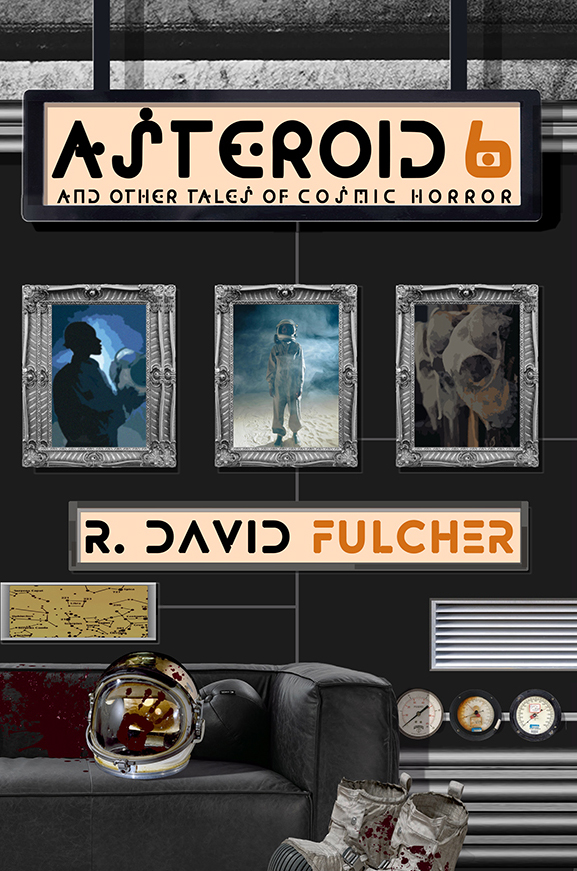
In a similar fashion, my book Asteroid 6 and Other Tales of Cosmic Horror starts with the poem “The Outer Reaches of Unknown Kadaath” (Kadaath is a reference to the works of H.P. Lovecraft):
Rest awhile, friend, for it is clear that you have walked far over hill and valley, and penetrated the wild and strange woods, to have happened upon this long-preserved manuscript beneath the moss-covered rocks.
I came upon this very spot, perhaps many years ago now, as just a lad. Here I took my respite, beckoned by a fair breeze sweeping over the verdant fields and a song sung in dulcet tones far sweeter than any produced by mortal throats. I was weary from hiking many miles, and my body eagerly fell into a deep sleep.
A song floated over my consciousness, sung by a thousand child-like voices:
Weary traveler,
Rest your head,
And sleep awhile
Where the faeries tread.
Weary traveler,
Laugh in kind,
And take deep draughts
Of faerie wine.
Weary traveler,
Spend the night,
Follow the trail
Of the faerie lights!
Additional stanzas of poetry are injected into other parts of the tale, with the intent of lulling the reader into a sleepy, dream-like state.
Final Thoughts
So there you have it – a brief introduction into the concept of “floetry” with several examples of usage.
What do you think?
Can poetry and prose peacefully coexist on the same page?
Please leave your thoughts in the comments!
Thanks for reading,
-R. David Fulcher, Old Scratch Press Founding Member
Thank you for reading. Please sign up to follow us on Facebook and to follow us here on WordPress to expand your knowledge about poetry and short form writing as well as to receive the latest news about publication opportunities.
By Virginia Watts, Founding Member of the Old Scratch Press Collective
Many people have heard of title The United States Poet Laureate, official title Poetry Laureate Consultant in Poetry, but they do not know much about this position. The Poet Laureate serves for an eight-month term running from October to May, elected by The Librarian of Congress. Traditionally a poet will hold this title for two terms. In choosing the recipient of this prestigious title, the Librarian consults with experts in the field of poetry as well as former Poet Laureates. Additionally, suggestions from the general public are accepted.
The Poet Laureate only has two officials duties they must perform, two readings at the beginning and end of their term. The idea is that each Poet Laureate should be given the space and freedom to decide for themselves how they can use their role to encourage people throughout the nation to read, write and develop an appreciation for the art of poetry. The Poet Laureate receives a stipend of $35,000 and $5000 for travel expenses. Prior the 1986, the Poet Laureates were known as Consultants in Poetry. The well known poets Robert Frost and Gwendolyn Brooks were Consultants. Since 1986, there have been 24 Poet Laureates, Louise Gluck and Ted Kooser among them.
So, what have some of our Poet Laureates done during their tenure to spread the love of poetry?
In 1997, Robert Pinsky, the 39th Poet Laureate, put out an open call for people to share their favorite poem. Many Americans sent poems. Poems came flooding in from all ages, all states, from people of diverse backgrounds and interests. Pinsky’s call set off a domino effect leading to reading of favorite poems in hundreds of cities and towns.
Gwendolyn Brooks is well known for her focus on elementary school students. Early learning about poetry and writing it is bound to foster a lifelong love of the art form.
Joseph Brodsky thought the best way to have people experience poetry is for them to find free samples of it in their everyday lives and places, such as airports and hotel rooms.
Billy Collins published an anthology inspired by his time serving as the United State Poet Laureate. “Poetry 180” makes it easy for high school students to read or hear one poem each day during their school year. Collins is often quoted as believing that poetry is a kind of social engagement, that a poem should feel like it reaches out and invites the reader inside.
Rita Dove brought writers with a focus on African diaspora together. Maxine Kumin focused on shining a light on the works of women writers and Joy Harjo, the 23rd United States Poet Laureate, was the first Native American to hold this honor.
Our current Poet Laureate is Ada Limon. She is from a Mexican American background and grew up in California. As part of her position, she penned a poem dedicated to NASA’s Europa Clipper Mission. Her poem is engraved in her handwriting on a metal plate aboard the Europa Clipper spacecraft. This spacecraft launched in 2024 and will enter the Juniper system in 2030. Here is Limon’s gorgeous piece. She is one of the must-read poets of our times, well deserving of the title of United States Poet Laureate.
“In Praise of Mystery” by Ada Limón was released at the Library of Congress on June 1, 2023, in celebration of the poem’s engraving on NASA’s Europa Clipper, scheduled to launch in October of 2024. Copyright Ada Limón, 2023. All rights reserved. The reproduction of this poem may in no way be used for financial gain.
About the author: Virginia Watts is the author of poetry and stories found in Epiphany, CRAFT, The Florida Review, Reed Magazine, Pithead Chapel, Words & Whispers, Sky Island Journal among others. She has been nominated four times for a Pushcart Prize and four times for Best of the Net. Her debut short story collection Echoes from The Hocker House won third place in the 2024 Feathered Quill Book Awards.
Virginia Watts grew up in Hershey, Pennsylvania and spent summer vacations in the Endless Mountains of Sullivan County with her Quaker grandparents. Many of her stories and poems revolve around small town life and rural roadways that are not always what they seem.
Thank you for reading. Please sign up to follow us on Facebook and to follow us here on WordPress to expand your knowledge about poetry and short form writing as well as to receive the latest news about publication opportunities.
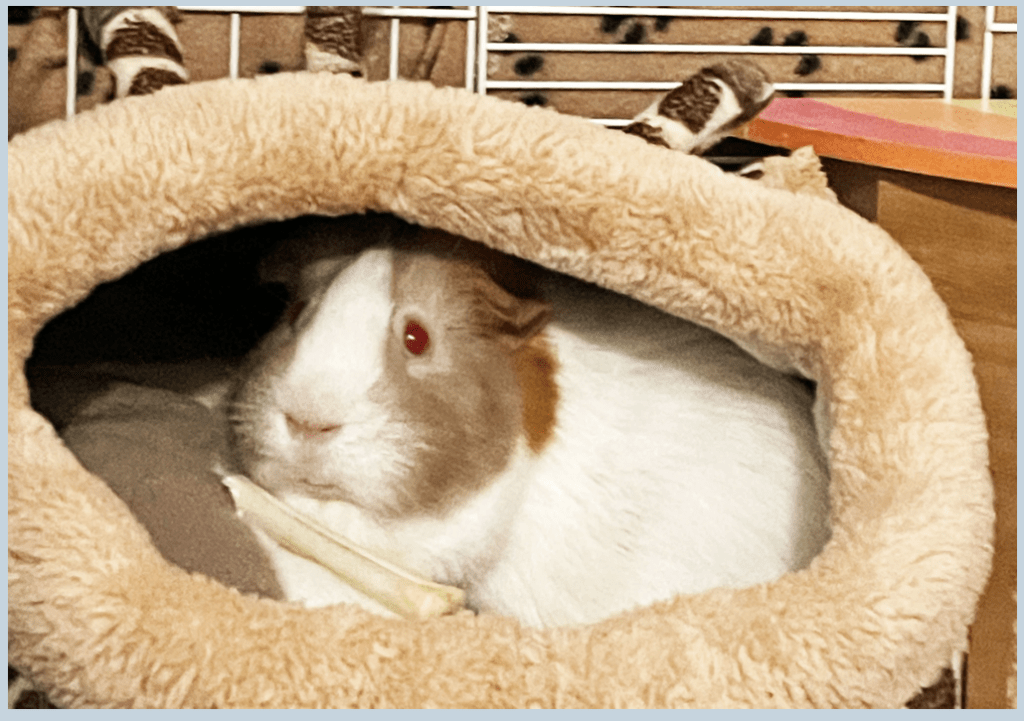
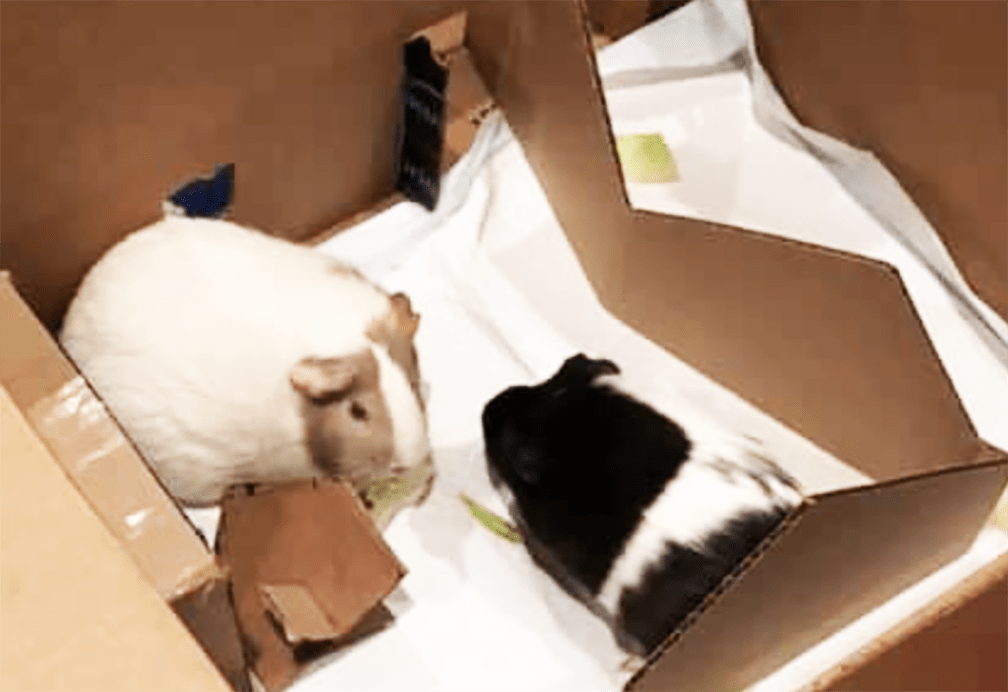
Just before the pandemic (the 2020s I feel the need to say for when we all are history), we were in search of a better situation for our daughter, and we moved her to a private school. She went from a class of 30 to a class of 12, and her academics improved immediately, though our finances did not! As a part of her classroom they had an animal student, the lovely Miss Addie pictured above lounging in her hidey with a tasty piece of bamboo. The school asked for a volunteer family to take her home over the Christmas break, and we volunteered. Addie and I bonded immediately (I am the pet-whisperer), and I must admit I delayed sending her back to school in January by almost a full week. When the school was shut down over Covid in March they asked me again if I would take her, and I eagerly said yes. She moved in with us, and by May the lovely school announced it was going out of business. Addie became family. During the stay-home days our daughter took courses on Outschool (highly recommend) where she learned female guinea pigs preferred to be in pairs. We then adopted Baby from a pet store. It turned out that Addie did not prefer to be in pairs, but eventually a tolerance developed.
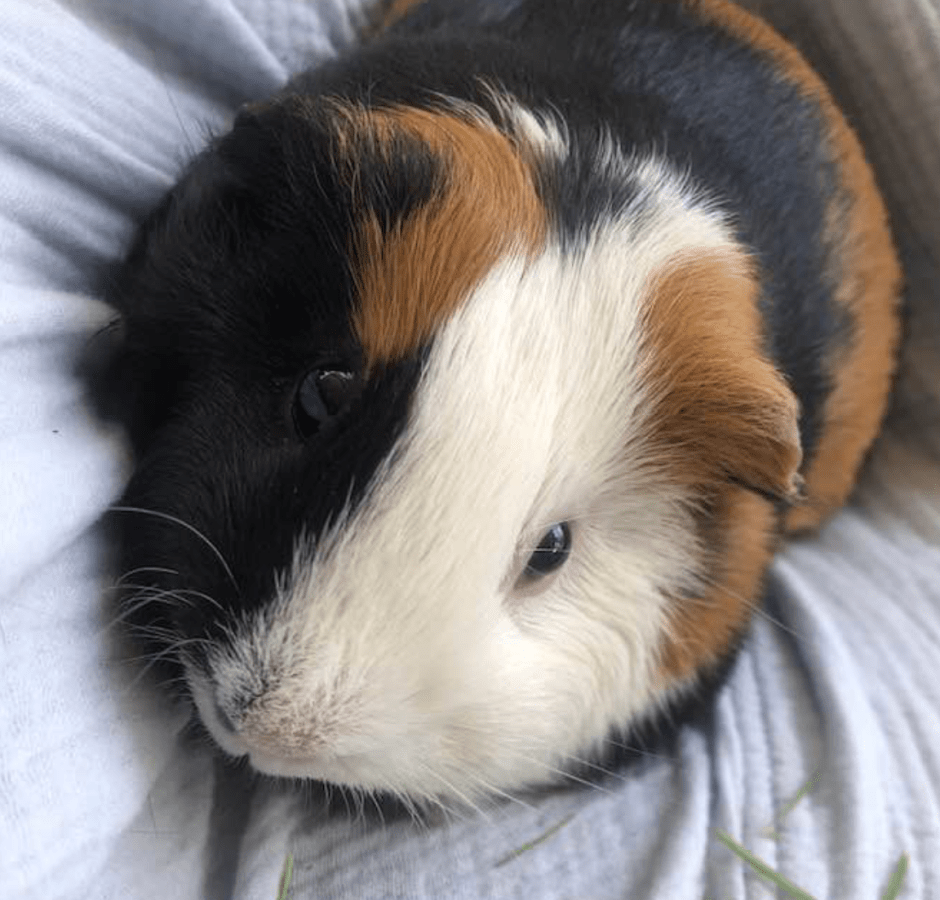
When we moved back to California, again for a better school experience for our daughter, we drove across with two cats, two guinea pigs, and one dog. About a year after we settled in, I woke up a few days before Christmas to find Addie had left us. Baby, it turned out, was desperate not to be alone, and went on a hunger strike. After a forcing some food into her for two days (guinea pigs must eat constantly or they die), we adopted Punky (who looks a bit like a pumpkin). This past summer Baby followed Addie to Valhalla, and I saw, stretched before me, a long line of guinea pig adoptions for the rest of my life. I waited with bated breath until, lo and behold, it seemed Punky took after Addie, bless her. She seemed very interested in checking out Baby’s viewing and memorial, but then she was fine to have all the snacks and seed balls and pigetti (corn silk) to herself. She moves, in her luxuriously large cage, from hidey to hidey during the day, alternatively napping and yapping. She has a lot to say to me, and we perform a call and response between us where I say, “Woooo, Punkus!” and she chirps away back at me, whooping louder and louder until I bring her some fantastic treat.
The guinea pigs, as much as I don’t want to have a long line of them stretching to the end of my life in front of me, are part of my life’s rituals, and I love the job, and someday I know I will mourn the loss of it, as I mourn both the beautiful, pink-eyed Addie, and Baby, who looked like a tiny Holstein. Every other morning, without fail, I awake before the sun and the rest of my family, chat away with Punky as I remove all her bedding (I use cloth bedding, nice fluffy fleece pads), and all her hay, and all her snacks and poops, and I clean out the cage. All the linens go into the washer for a hot wash and an extra rinse, and the cage is refitted with clean bedding from my ample supply. Then I top off the snack bin (hay rings, seed balls, vitamin C chews), put in fresh hay, and add in some salad (lettuce, peppers, fresh baby corn, that sort of thing) and set Punky up for her new day. It takes me about 40 minutes (not counting the laundry time) and during that time I do not have to think what move to make next, and my conversation (Wooo Punkus!) pretty much doesn’t change, and is not the most thought provoking. That gives me some early-morning time to freshen up my brain as I freshen up Punky’s cage. We both enjoy it. For me it is both calming, and nurturing as I nurture my little Punky, and there is a clear sense of accomplishment in looking at the “beautiful once again” cage.
Of course, you might think, that’s a lot of work, lady, for a kid’s pet, work that the kid should be doing. My daughter and I traded years ago because, when Addie first moved in, my daughter was too short to clean the cage, and not very quick or proficient at it. I offered to trade emptying the dishwasher (a chore I despise). She agreed. So now she’s stuck with it! And I get the meditative and soothing time with Punky.
I want to address this next paragraph to my fellow non-believers out there, or, perhaps, non-conventional believers is a better term. I was raised really immersed in a traditional Christian church, but, as long as I can remember, though I didn’t really balk against going until late into my HS years, it had no effect on me. I didn’t click into the whole thing. I often read the Bible in church from boredom during the long services, but it came across as fairy tale to me, and the emotions I saw people experience in church were not there for me. Even during my beloved grandmom’s funeral, who loved her church dearly, what I remember feeling, aside from loss, was that I would have preferred to be somewhere else, somewhere emotionally warm, to hold her in my thoughts. I have no doubt that my delight of a grandma is somewhere, in some form, still being a delight, but hooking it into her own religious beliefs is beyond me. So, there are two points I want to make here about that based on my experiences in life: ritual, which is done so well by churches/temples/mosques, and their like, is not owned by them. And life needs ritual for space to process and to get in touch with emotions. We are all different, and some of us need more ritual in life than others, and that ritual can be as simple as how we decorate for holidays, certain meals we make at certain times, celebrating our own birthdays (of course! I’m glad I was born!). Ritual is, really, meditation, and for me it is more profound when it is a natural thing in my life rather than what I would view as a forced, arbitrary movement. The guinea pigs are a delight too. Their personalities remind me of my chubby grandma in many ways. She often whooped, and loved eating too. There’s no reason they should not be connected in my heart and in my thoughts. I love the ritual that they are.
And during the “mundane chore” of cleaning the guinea pig cage I get a lot of writing done (in my mind, not on my computer!). It’s a reset for me as well. There’s no pressure for perfection, and the thoughts roll in and out like a calm tide.
Of course Princess Punky will not outlast me (I am optimistic enough to assume). And I want to just mention my second very early morning ritual that will ride with me to the bitter end. OHHHHHHH…….
All I want is a proper cup of coffee
Made in a proper copper coffee pot
I may be off my dot but I want a proper coffee
In a proper copper pot
Iron coffee pots and tin coffee pots
They are no use to me
If I can't have a proper cup of coffee
In a proper copper coffee pot, I'll have a cup of tea!
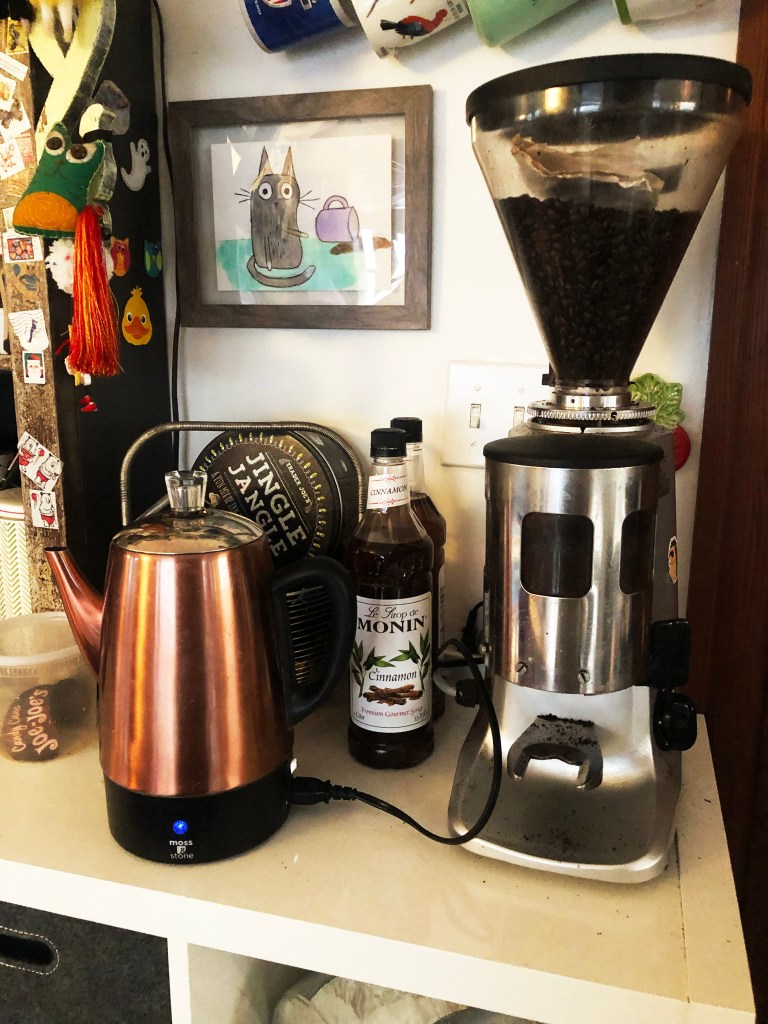
Gaze upon my magnificent second morning ritual… coffee made in a proper copper coffee percolator! A percolator has several ritual benefits: there are a few parts to take apart and clean; there is a prescribed way to put it back together, and when it is back together it moans suggestively and bubbles, and scents the air with perfume Chanel should be envious of. It is another opportunity for me to do labor that requires no brain power, that pleases me and affects me directly while also giving benefit to someone else (my spouse), and doing the “chore” brings about visible results that please me. It also offers me a hot cup to sip and enjoy as I slowly move from meditation to sitting down and writing out this post, or some other writing project.
Websters says that a blessing, as a noun, is grace (the thing said before meals), approval or encouragement, or a thing conducive to happiness or welfare (by which I take it Websters means well-being). Rituals are a blessing. And, for me, a lot of my blessings are my routines. I exhort you not to deny yourself of the blessing of your routines, even if they are “chores” (such a dirty word!). Slow them down a bit; use them to slow your thoughts, and plum the richness of repetition, a moment with no planning and no management needed, a moment on autopilot. There are so many writing gems to be found there, as well as quite a lot of balm for the nervous system. Enjoy that walk with your dog, scritches for kitty, a hot cup of coffee, or, if you can’t have a proper cup of coffee, a hot cup of tea. 😉 Whoop whoop!
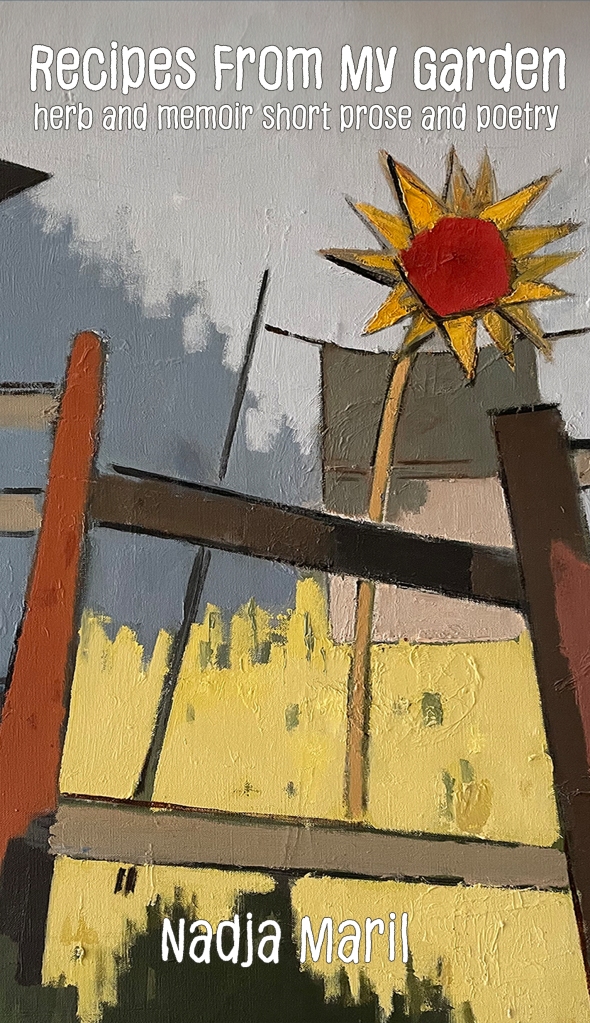
Nadja Maril, author of RECIPES FROM MY GARDEN, is one of the founders of Old Scratch Press
The Editors of Instant Noodles Literary Review, published three times a year, have announced the themes for 2025: Current, Sanctuary and Gravy.
Edited by members of the Old Scratch Short Form Collective who have volunteered their time, submissions are free. The Instant Noodles submission box which you can access through Duotrope is filling up fast.
While artists and writers selected for publication receive no financial renumeration, the publishers and editors do their utmost to promote the work in each issue. Instant Noodles nominates for industry prizes, Best of the Net and the Pushcart Prize. One of the magazine’s promotions is a zoom reading, giving contributors around the world a chance to meet.
Published three times a year, the magazine is posted online for everyone to read. One of the biggest reasons work gets rejected, is that writers don’t follow submission guidelines and familiarize themselves with the publication.
In addition to Visual Art and Multimedia Creations, the magazine publishes Prose & Poetry
Instant Noodles focuses on SHORT pieces. Short work 500 and 750 words in length can be powerful. If you are submitting prose, whether is it hybrid, nonfiction, or fiction, the word limit is 1000 words or less.
All work must be original and must belong to the author. Works that have been previously published will not be considered. Stories must be complete and self-contained (i.e., do not submit chapters of a larger work).
NOTE: Accepted works will be published as submitted without editing; as such, in addition to the originality of the work itself, we are looking for manuscripts that are clean and press ready. Be sure to review your grammar, spelling, tenses, proper punctuation, and other general rules of the written word before hitting “Send.” Work should be submitted through Duotrope as a Microsoft Word file (when it is poetry, drama, NF or fiction) as 12-point New Times Roman, double-spaced (single-spaced for poetry submissions). All other types of work have details as to their file types on the Duotrope page.
Connect to the Theme
The Editors request that submissions should have a connection to one of the themes for which they were submitted: Current, Sanctuary and Gravy—and labelled as such.
They are looking for more submissions in the categories of creative nonfiction, drama, multimedia and visual art.
“When I’m reading poetry submissions for Instant Noodles,” Says contributing Poetry Editor Gabby Gilliam, “I’m looking for poems that concisely fit our theme and resonate. I want lines that linger in my mind long after I’m finished reading.
As a contributing editor, I suggest it is never too early to start contemplating ideas associated with our spring theme, current, as well as the subsequent themes that follow. What ideas does the word current evoke for you? Are you thinking about being hip, cool and up on “current” events or are you traveling on an air “current.” Where does the word take you?
Try writing a story about yourself, something you observed, or something entirely imaginary. Create a video, a picture, combine two mediums.
Work should be publication ready
Do not submit until your piece is ready. Have you read your piece out loud and checked for misspellings and grammar mistakes? Does it fit the theme and are you ready to share it with the world?
The deadline for the spring issue with the theme Current is March 16th. We look forward to reading your work!
When I was a little boy, my father would assemble a huge train table in our living room next to the Christmas tree. The table was easily ten feet wide by ten feet long, and three feet high. In addition to the tiny figures of the villagers, quaint tiny homes and buildings, working street lights, fake trees and assorted trains that adorned the table, crepe paper in a red brick pattern was attached to all sides of the table. The paper ran from the sides of the table all the way down to the carpet, creating the illusion that the table was supported by brick walls all around.
Or from my point of view, the perfect fort wherein I could hide.
The strategy was to sneak underneath the table after my parents had gone to sleep and wait for Santa to place the presents under the tree. I actually made it to my secret hiding place each year, carefully separating the folds of the brick crepe paper back in place behind me so that nothing looked out of place.
And like clock work, every year I would promptly fall asleep before sighting Santa.
So that is the memory, suspended in time for more than forty years, like an image trapped within an icicle that never melts.
The reality is starkly different.
The old house was sold many years ago, the train table dismantled and perhaps rotting in some unknown wood pile, and the assorted engines, passenger cars, and cabooses stored away in bubble wrap for another generation.
Things are different with my wonderful parents as well. Mom passed away in 2022, and Dad is struggling every day in a memory care unit.
Despite all of these life changes, I still hold on to this memory, this specific icicle of time has not yet eluded my grasp.
My attempt to preserve this memory in poetry appears below. The poem is called “Christmas Eve from Under the Train Table” and first appeared in The Hot-Buttered Holidays Issue of Instant Noodles in 2021.
I hope you can find something special in my memory as well.
Happy Holidays,
-R. David Fulcher
CHRISTMAS EVE FROM UNDER THE TRAIN TABLE
There I was, and there I would remain, Expectant and curled-up beneath the great trains which had whistles and steam and a radio tower that lit up. The trains were sleeping, but my breath replaced their din, Escaping my lips like an anxious child.
It is not the darkness I fear. I fear that my mischievous breath will plume forth and collect Itself into a crystal ball, and then roll out from under the brick-red crepe paper, a great red marble full of my embarrassment.
The clock clangs midnight. I can hear my parents through the walls, their secret laughter like soft explosions accompanied by the faint swish and whisper of wrapping paper.
Now I can their slippered arrival. My heart pummels in my chest with incessant fluttering, sick of this distant observation, insane with the knowledge that all this espionage is for me.
I have a trove of old New Yorker cartoons I’ve saved in a folder since forever. The premise of this one (from the fabulous cartoonist Roz Chast) is the romanticized version of Thoreau’s life vs. the reality. My argument was always “of course he can simplify. He has no kids, no partner, and his mom does his laundry.”
I think we also can hold that same romanticized ideal for writing.
“I WON’T BE COMING IN TODAY. I’M JUST NOT FEELING IT”
…was the text my friend received, canceling their appointment together 15 minutes before it was to start. What bravado, I thought. What mixture of honesty, courage, chutzpah, and downright rudeness is this?
And how many times have I felt like saying the exact same thing? Especially when it came to staying motivated to finish, organize, edit, submit separate poems, and find a publisher for my poetry collection. Not today. I’m just not feelin’ it.
The option is to feel it. Even when you really, really don’t want to. There are so many other demands on our time, and I am easily overwhelmed if I only look at the long game. I have to break it all down into bite-size “feelable” pieces.
What that looks like for me is:
1. I can sit here for 10 minutes and freewrite with one of the 500 prompts I find and keep and never do anything with.
2. I can spend 10 minutes on the website Duotrope to find 5 more places to submit my poems.
3. I can print out all these poems, spread them out on the bed, and figure out how they make sense together.
4. I can spend 5 minutes on an email to “make the ask” of a trusted someone to read my work.
5. I can take a break from it all and not beat myself up about it.
6. I can “manage the myth” that my work is valuable and someone, somewhere will love it, until it becomes the truth.
7. I can submit the poetry collection to contests of all shapes and sizes.
8. I can make an effort to forge connections in the writing world. I can join writing groups, create writing groups, take classes and workshops, reach out for help, or join a collective. You never know when you might meet the right person that could lead to your book publication (like I did!).
9. I can endure countless rejections, knowing the subjectiveness inherent in the game, and know to never take anything personally.
10. Do it again and again. Hang in there, until what’s foreign becomes familiar and the stars align, because you kept at it. And as for the end result, sometimes knowing whatever you have done is enough.
And what a divine feeling that is, indeed.
By Ellis Elliott—Thanks for Reading! Join me at https://bewildernesswriting.com/ Find my poetry collection, Break in the Field, from Old Scratch Press, on Amazon. My new cozy mystery fiction novel, Fire Circle Mysteries: A Witch Awakens will be available in Spring 2025.
One of the things I like best about poetry is its ability to capture the beauty of a single moment, even if it’s not something that would normally be seen as beautiful. At its heart, poetry is emotional storytelling. A moment becomes significant when it is infused with feeling—joy, sorrow, nostalgia, or wonder
Last year, I edited an issue of Instant Noodles with the theme of ‘instant.’ I was looking for poems that captured that exact essence of poetry that appeals so much to me. I wanted the beauty of the grief or the joy of a single moment captured in a poem. It’s probably my favorite issue of Instant Noodles that I’ve edited to date. I think the poems we published in that issue were the kind that will resonate long after reading them because every reader shares that moment with the poet.
That issue of Instant Noodles can be read for free here . I highly recommend giving it a look.
Life is filled with fleeting moments—those golden, mundane, or bittersweet slices of time that often pass unnoticed. But poetry has the unique ability to crystallize these moments, transforming them into something timeless and profound. Capturing moments in poetry is about taking the ephemeral and making it eternal.
Here’s a poem of mine that captures the moment when I held my son for the first time. It appeared in the Instant issue of Instant Noodles.
Contraction
After hours of flesh seizing muscles finally relaxed and I cradled a fresh universe in my arms, puckered face already rooting for food.
My world imploded, contracting until nothing existed but this one tiny fist raised at the audacity
of the air to be so dry the lights so bright the scream that replaced the rhythm of my familiar heartbeat
and I traced constellations across freckled skin as I eased into a new center of gravity.
The Power of Specificity
Great poetry thrives on specificity. Think of a single red leaf falling on a crisp autumn afternoon or the smell of fresh bread wafting through an open window. These details evoke emotions and anchor the reader in the poet’s world. Poetry doesn’t need grand metaphors to capture the essence of a moment. Sometimes, a simple, honest line is more powerful than elaborate language.
Share Your Moments
Because life is poetry, everyone is a poet. You can write about your own moments and shape your memories into poems. Then, you’re sharing that moment with others. Your words let them feel what you felt and maybe even remind them of their own special memories.
Poetry helps us slow down and notice what’s around us. It takes the little things that we might normally ignore and makes them important. So grab a notebook, start noticing the world, and turn your moments into poems that last forever.
Founding member Robert Fleming share his insights on How to be successful at publishing your first creative writing work
You’ve put it on your bucket list to be a published author. Well done. Who are you doing this for: yourself, others, or both?
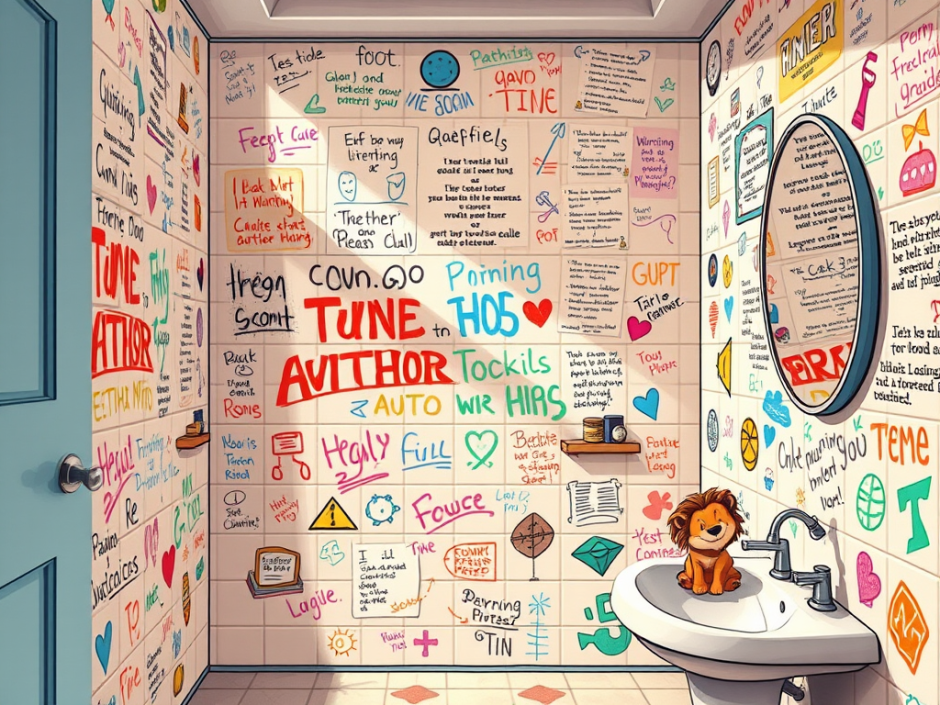
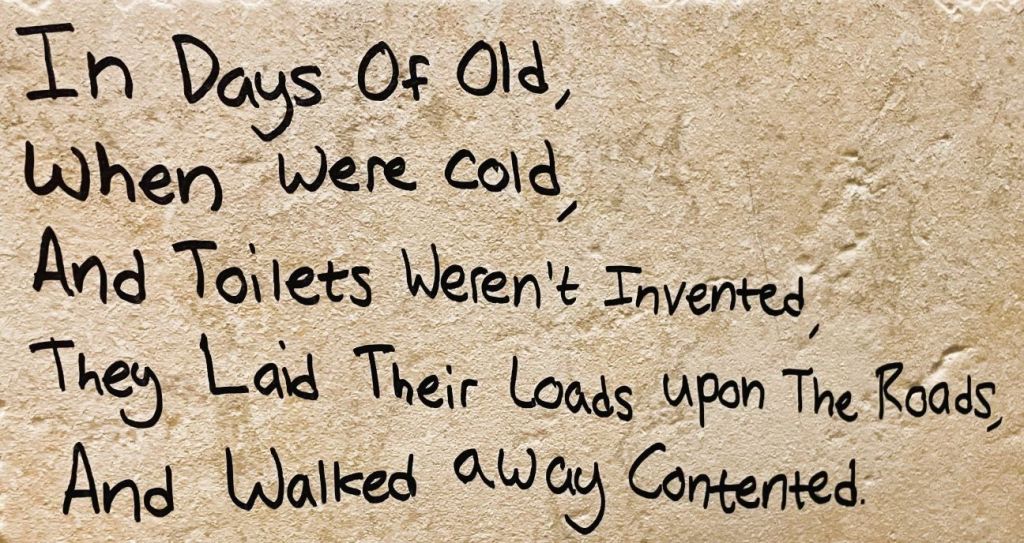
Yours truly, without even knowing, wanted to be published. In 1973, at age ten, I published text on the bathroom brick wall of Roslyn Elementary School in Westmount, Montreal, Quebec. My work looked like the work following but also had curse words and genitalia graffiti.
Bathroom Wall Poem
This talented toilet author made choices: what topic to write about (poo poo), what language to use (English), where to publish (on the bathroom on brick), who the publisher is (self), what genre (poetry), what poetry devices to use (rhyme, humor, 5-lines), and to not disclose the author name (anonymous).
Where you target your publication is guided by your confidence (courageous or timidity) about having other human see and judge your work. If you are feeling timid like the Cowardly Lion, publish your writing in your personal diary. Be sure to select a diary with a lock and attach the key to your necklace that you wear even when you shower.
Cowardly Lion from movie Wizard of Oz
If you get a little courage, self-publish your work on social media (Facebook), like I did in the following work. On Facebook, other humans will see your work, but you will not experience the review/selection of a judge who accepts or rejects your work.
If you find the courage of Joan of Arc, send your work to a publication where work is selected by an editor.
Joan of Arc
Tips for setting yourself up for your best chance of publication acceptance • For your first publication, select a publication that has a fifty-percent or greater acceptance rate like vanity press where you will have to buy a book that could cost $50, an organization newsletter like a religious one you are a member of or a school you are an alumni of. • Read the target publication and only submit to them if they publish work similar to yours (genre: poetry, theme: love) • Read the submission directions and follow them: sometimes there is a theme like love. When there is a theme only submit work that is the theme requested.
Ready? Take a bid breath in, hold three seconds, exhale. What is your publication confidence: timid or courageous. Go forth.















 OLD SCRATCH PRESS