The Sounds of Home: A Writer’s Connection to the Beach

By Nadja Maril, a Founding member of Old Scratch Writing Collective

The dog is digging a hole in the sand. After chasing and fetching her ball numerous times, she has decided to bury it. It’s a game of make it disappear and find it again, a game she can play all by herself while I sit and listen to the waves slapping against the shore. I love this sound. It doesn’t matter where I am, if I’m near water coastline I’ll find a beach. The sounds of water soothe me. And I’m not alone in craving water sounds. A babbling brook, the torrent of a waterfall, the crash of ocean waves: are sounds that both inspire and invigorate.

Of the five senses—sight, smell, touch, sound, taste— one of the five will often be more prominently experienced than the other four. And this can change, depending on the situation. I find, when I tap into my memory bank, that sound is most frequently my touchstone. I think of a scene and I hear it. The rise and fall of the voices, crickets chirping, the sputter of an outboard motor, heavy breathing.

WRITING PROMPT

A classic writing exercise is to describe the place you call home.  If you are truly honest with yourself, the exercise will force you to select the place you long for, if you’re not already living there.  In order to describe it, you’ll be choosing the details that pop out in your mind.  The exercise provides a short cut, so to speak, to grasp what you value most.

Flash Fiction writers, you can use this prompt to channel you directly into the characters you create. Where do they feel most secure? It can tell you a lot about a person.

For me, home is the beach. It’s a happy place where I can walk for miles, build sand castles, swim in the waves and float on my back with the sun in my face. During childhood it was the Provincetown beach at the end of Kendall Lane. Today it is Cornhill beach in Truro a few miles away. The first glimpse of water and sand, the sound of the waves pushing into the shore, the smells of salt and seaweed, the wind against my face; I am home. From both beaches, if I look eastward I see the very tip of the Cape Cod peninsula curving around, creating a sheltered harbor. Out across the bay is Long Point Light Station.

When following a writing prompt or exercise, allow your thoughts to freely flow. Do not self-censor while writing. Once, you’re finished you can cut words, sentences or entire paragraphs. But if you analyze every word you select, you won’t get very far.

The subsequent step after spending twenty to thirty minutes writing a description of “home” is to read what you’ve written and look for patterns. Does one sense, such as smell, dominate the prose. Are there duplications of the same idea that cloud the focus? Challenge yourself to deepen the scene by adding action or dialogue.

Whenever I’m “stuck” and looking for a fresh something to write about. I challenge myself by creating a prompt or borrowing a prompt idea from another writer. The ideas are out there, you just need to make the time and have fun with what you create.

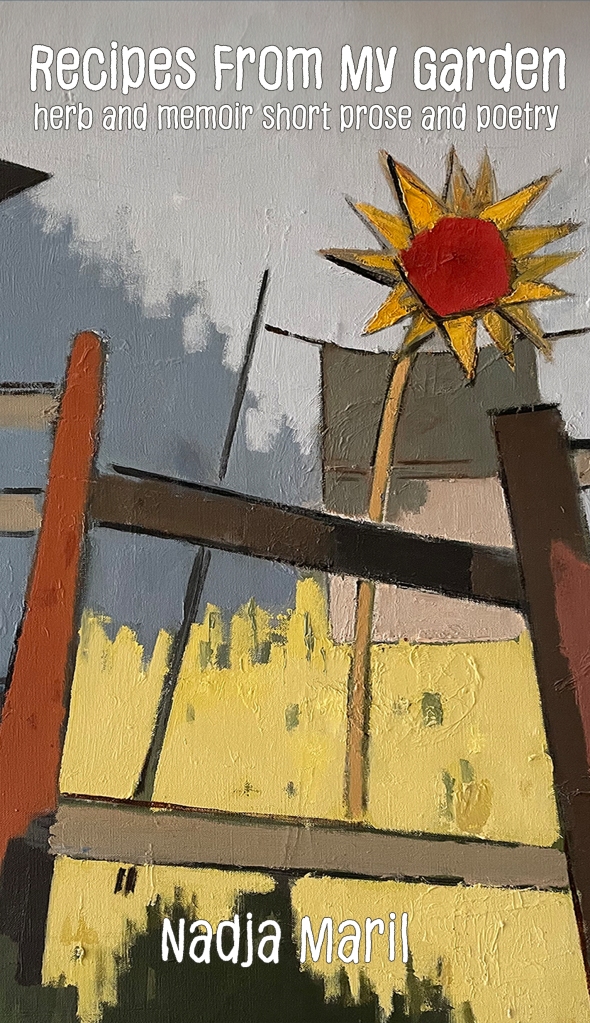
THANK YOU for reading. Have fun. And please, if you like my writing, you can support my efforts by buying a copy of my chapbook RECIPES FROM MY GARDEN– Poetry, Flash CNF and Short Essays (Old Scratch Press Sept. 2024) a great gift to yourself and for friends at $8.95. My chapbook is just one of the many fine books published by the imprint Old Scratch Press.

Secrets to Publishing Your First Creative Work

Founding member Robert Fleming share his insights on How to be successful at publishing your first creative writing work

You’ve put it on your bucket list to be a published author. Well done. Who are you doing this for: yourself, others, or both?

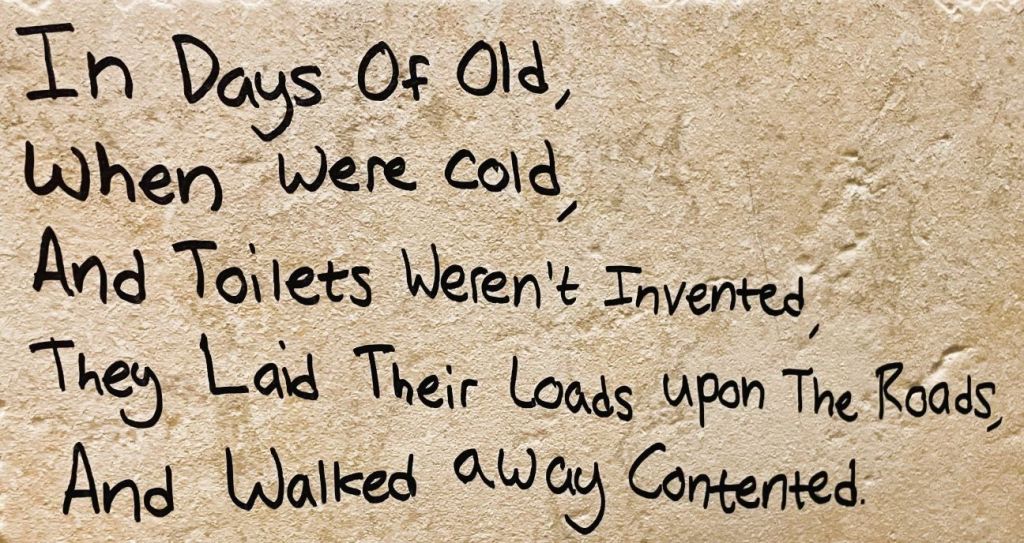
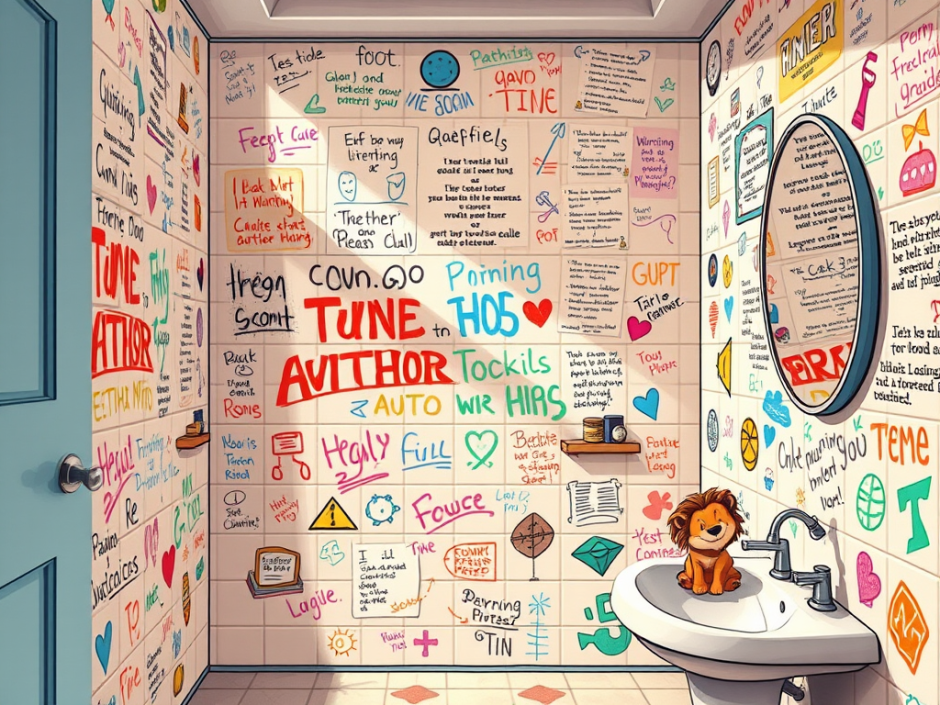
Yours truly, without even knowing, wanted to be published. In 1973, at age ten, I published text on the bathroom brick wall of Roslyn Elementary School in Westmount, Montreal, Quebec. My work looked like the work following but also had curse words and genitalia graffiti.

Bathroom Wall Poem

This talented toilet author made choices: what topic to write about (poo poo), what language to use (English), where to publish (on the bathroom on brick), who the publisher is (self), what genre (poetry), what poetry devices to use (rhyme, humor, 5-lines), and to not disclose the author name (anonymous).

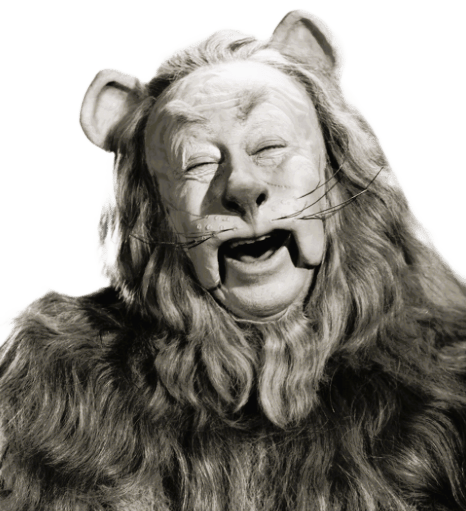
Where you target your publication is guided by your confidence (courageous or timidity) about having other human see and judge your work. If you are feeling timid like the Cowardly Lion, publish your writing in your personal diary. Be sure to select a diary with a lock and attach the key to your necklace that you wear even when you shower.

Cowardly Lion from movie Wizard of Oz

If you get a little courage, self-publish your work on social media (Facebook), like I did in the following work.
On Facebook, other humans will see your work, but you will not experience the review/selection of a judge who accepts or rejects your work.

https://fourfeatherspress.blogspot.com/2024/09/40-poets-being-published-in-doors-of.html

If you find the courage of Joan of Arc, send your work to a publication where work is selected by an editor.

Joan of Arc

Tips for setting yourself up for your best chance of publication acceptance
• For your first publication, select a publication that has a fifty-percent or greater acceptance rate like vanity press where you will have to buy a book that could cost $50, an organization newsletter like a religious one you are a member of or a school you are an alumni of.
• Read the target publication and only submit to them if they publish work similar to yours (genre: poetry, theme: love)
• Read the submission directions and follow them: sometimes there is a theme like love. When there is a theme only submit work that is the theme requested.

Ready? Take a bid breath in, hold three seconds, exhale. What is your publication confidence: timid or courageous. Go forth.


Yours Truly is:

Robert Fleming, a contributing editor of Old Scratch Press.

Who published an Amazon best seller visual poetry book: White Noir.

an editor of the digital magazine Instant Noodles

and the creator of an upcoming magazine cover for Tell-Tale Inklings #7, to be released Autumn, 2024. Visit Tell-Tale Chapbooks on Facebook.

Exploring the Art of Haiku Poetry

By Virginia Watts

Many people are familiar with the haiku, an unrhymed form of poetry that dates to 17th Century Japan. It consists of three lines and observes a strict five, seven, five syllable count. Traditionally this form of poetry was about nature, often seasonal change captured in a moment of time. Matsu Basho is considered the be the haiku master who brought haiku into its place as a serious poetic form.

Here is one of his well know poems.

An old silent pond . . .

A frog jumps into the pond,

splash! Silence again.

People may be less aware of Western or American haiku which is often not as strict in form but nevertheless mirrors the traditional haiku. The reason for a more relaxed rule on syllable count is that the syllables in Japanese don transfer smoothly to English. Some famous poets known for American haiku are Amy Lowell, Sonia Sanchez and Ezra Pound.

Jack Kerousc

Then there is Jack Kerouac who wrote thousands of haiku and often included them in his correspondence and novels. Kerouac was a serious Buddhist who credited composing haiku with sharpening his mind. He was drawn to the idea of keeping poetry simple without trickery. Here is Jack Kerouac reading some of his Western haiku: https://www.youtube.com/watch?v=WMwAtOom7CA

The allure of the haiku form rests in showing the beauty in the ordinary, in the belief that simple moments should be captured and preserved. It’s fun to draft haiku. People are often surprised by how much they enjoy it. Some tips: Keep a notebook with you to jot down observations, ideas, those little, unexpected life events that none of us can predict. When you have something you want to write about, do it. Don’t worry if your idea seems silly. Write about what inspires you and don’t look back or question the inspiration. For a first drafting session, try grouping words in a loose 5 -7-5 format. Don’t try to be perfect or overthink this part. Go for flow, rhyme secondary to an honest reflection of what inspired you. The next step is to put your draft on the back burner. This helps with all forms of writing. After drafting, put a temporary distance between you and your draft.  As Jack says:

Nightfall—

too dark to read the page,

Too cold. 

—Jack Kerouac

In a day or two return and rework as necessary. Look for awkward syllables or weak word choices. Most of all, trust your gut. If the haiku represents what you wanted to capture and keep then you’ve done it!  Bravo! Drafting haiku is wonderfully addicting and rewarding. It’s like a bag of chips. You won’t stop at one.

Virginia Watts is a member of the Old Scratch Press Poetry and Short Form Collective and the author of Echoes from the Hocker House.

Exploring the Intersection of Sports and Poetry

October is a sports lover’s dream. Most of the major leagues are in full swing, from the NBA, NFL to the NHL. There are college football games every weekend, and even the crisp Fall air makes it feel like football weather.

So what does this have to do with poetry?

There are some cases, perhaps uncommon, where sports and poetry intersect. While in school, I was introduced to the excellent baseball-related poem “Casey at the Bat” by the poet Ernest Lawrence Thayer. From the roar of the crowd to the “Strike!” being called by the umpire, Thayer does a remarkable job of transporting the reader to that fateful match in Mudville. The poem culminates with perhaps its most famous line: “But there is no joy in Mudville—mighty Casey has struck out.”

In college my friends and I would play pickup basketball on the courts on campus. These were disorganized gatherings with teams hastily assembled at the last moment, but these were some of my favorite memories from my college years.

My poem below is an attempt to recapture some of those moments. Unlike “Casey at the Bat”, there was much joy to be found in College Park during those amateur games.

This was written during my college years, and I don’t know if I could write this today, or even should write something like this today, as this poem is full of rough edges and not overflowing with beautiful language.

However, that is what I think I love about it. Much like our simple attempts at basketball all those years ago, the poem is pure and raw, even somewhat unfinished. Ah, the folly of youth!

Photo by Pixabay on Pexels.com

So without further introduction, I hope you enjoy my poem “Hoops”.

Hoops

It wasn’t the easy, fluid style of play you see on TV,
It was the jerky, nervous style of amateurs
played on asphalt several feet away from where I was sitting.
My shorts had ripped horrendously down the back during the last game,
but that really didn’t matter in the big scheme of things,
and besides, the jocky guy Chris would have never
picked me to play after screwing up the last game so badly.
An observer watched the game from the other side of the court, grinning to himself secretly.
Perhaps he was happy to see the different bodies working so well together, Van, the Vietnamese guy; Joy, the Indian; Greg the African American and Danny the Anglo; or perhaps that was just what I wanted to see.

Chris the jock made a three-pointer, and murmurs of approval such as, “Good shot, man” or “Nice one, Chris” fill the air, replacing the sound of the tennis shoes against the pavement.
I never questioned Chris’ basketball prowess.
It was his attitude that puzzled me.
I wanted to shake him and say, “Hey, Chris! Listen to what I’m saying, man! You’re just a pebble in the stream, man! Just a lowly grain of salt! This shot won’t change the world, dig?”
But you can’t tell a guy like Chris something that big.
He would just laugh it off and call you a stinkin’ liberal hippie, and go about his business of shooting politically correct jump shots, while I would go about my business of trying to change the things that couldn’t be changed.

-R. David Fulcher, OSP Founding Member

The Legacy of Edna St. Vincent Millay

By Nadja Maril

As a writer and a poet, I do a lot of reading. Sometimes I read a poem that resonates with me so strongly, I read it several times. Sometimes I commit a poem or favorite passage to memory to make it easier to revisit. One of those poems is

“Recuerdo”

by Edna St. Vincent Millay 

(February 22, 1892 – October 19, 1950)

It starts out

We were very tired, we were very merry—

We had gone back and forth all night on the ferry.

It was bare and bright, and smelled like a stable—

But we looked into a fire, we leaned across a table,

Composed of three stanzas, each containing three couplets, you can read the rest of the poem courtesy of the Poetry Foundation here.

Maybe it’s the rhythm, that mirrors for me the rocking of a ferry boat, the repetition of the line “We were very tired, we were very merry” that begins each stanza or the way she captures the exuberance of youth and the generous spirit of the poet and her companions, but I’ve always loved that particular poem.

Surprising, is how many people are unfamiliar with the name Edna St. Vincent Millay. The very first woman to win the Pulitzer Prize for poetry (1923), she was one of the most famous and successful American writers of the mid 20th century. Millay broke sales records and was a cultural celebrity who traveled across the United States giving captivating poetry readings to sold-out crowds.

A feminist, who openly loved both women and men, she was a prominent member of the literary community writing plays, publishing an opera libretto, as well as magazine articles under a pseudonym as well as publishing more than one dozen poetry collections. Her prize-winning poem “The Ballad of the Harp-Weaver” was dedicated to her mother. The poem tells a story of a penniless, self-sacrificing mother who spends Christmas Eve weaving for her son “wonderful things” on the strings of a harp, “the clothes of a king’s son.”

Raised in Maine by a single mother who elected to leave her husband during an era when divorce was not widely accepted, Millay was the eldest of three girls who largely had to take care of themselves while their mother would be absent from the house working as a homecare nurse. Surrounded by poetry, music and literature, Millay began writing her own poems at a young age.

WHERE TO LEARN MORE ABOUT EDNA ST. VINCENT MILLAY

To learn more about her complicated life, I highly recommend Nancy Milford’s biography, Savage Beauty; The Life of Edna St. Vincent Millay. Over 500 pages in length, it was comprehensively researched with the cooperation of Millay’s sister Norma, sole heir to the Edna St. Vincent Millay estate. and contains excerpts of Millay’s letters and poetry.

Here are two more poems to whet your appetite for Millay’s poetry.

“What lips my lips have kissed, and where, and why”

By Edna St. Vincent Millay

What lips my lips have kissed, and where, and why,

I have forgotten, and what arms have lain

Under my head till morning; but the rain

Is full of ghosts tonight, that tap and sigh

Upon the glass and listen for reply,

And in my heart there stirs a quiet pain

For unremembered lads that not again

Will turn to me at midnight with a cry.

Thus in the winter stands the lonely tree,

Nor knows what birds have vanished one by one,

Yet knows its boughs more silent than before:

I cannot say what loves have come and gone,

I only know that summer sang in me

A little while, that in me sings no more.

Vanity Fair 1920

“I shall go back again to the bleak shore”

By Edna St. Vincent Millay

I shall go back again to the bleak shore

And build a little shanty on the sand,

In such a way that the extremest band

Of brittle seaweed will escape my door

But by a yard or two; and nevermore

Shall I return to take you by the hand;

I shall be gone to what I understand,

And happier than I ever was before.

The love that stood a moment in your eyes,

The words that lay a moment on your tongue,

Are one with all that in a moment dies,

A little under-said and over-sung.

But I shall find the sullen rocks and skies

Unchanged from what they were when I was young.

To learn more about her life and times, information is available from the Edna St. Vincent Millay Society. https://millay.org/

The author of this blogpost, Nadja Maril, has been published in dozens of publications including, Defunkt Magazine), Lunch Ticket, The Compressed Journal of Creative Arts, BarBar and Across the Margin. A former journalist and magazine editor, Nadja has an MFA in Creative Writing from the Stonecoast Program at the University of Southern Maine. She recently published a collection of

poems and short essays: RECIPES FROM MY GARDEN– (Old Scratch Press Sept. 2024) a great gift to yourself and for friends at $8.95. To learn more about Nadja’s writing visit Nadjamaril.com

The Power of Poetry Workshops

By Virginia Watts ( a member of the Old Scratch Press Collective)

Several years ago, I was in an online poetry workshop with a woman called Joan. Even seated far away from each other in the real world and only together in the great, cold world of the internet, I felt a connection to her. What was it exactly. Her beautiful, novel, highly creative, arresting, heart rendered poetry for sure, but it was more than that. I appreciated how much thought she put into her critique of the other poetry in the group. I could tell she had taken a great deal of time to read and reread, to think and rethink, as I do when I am involved in writing critique groups, and I have and am a part of quite a few of those. I take my role as a fellow writer offering critique very seriously. Here’s the thing. No one can critique their own writing. It’s impossible. What you need to be the best you can be as a writer are fellow writers who give it their all when reading your work. People who are willing to always comment honestly on the work you circulate. In other works, you need people like Joan.

            So, imagine how thrilled I was when Joan emailed me after the online workshop ended to see if I would be interested in joining a Sunday morning critique group of six other poets. I couldn’t say yes fast enough and that started years of the best morning of the week on my calendar. We are a group of diverse styles living in different east coast states. Currently four men and four woman because another has joined our group. Each Sunday, we take turns reading our draft poem and then the floor opens up to comments. Titles that don’t do enough work are called out. Areas that are confusing, messages that seem weak or not fully realized. How the poem looks on the page. Whole stanzas that sometimes just don’t need to be there. All things poetry and how to make it better. Every single Sunday I sign off and look at my poem as revised by the group and think. There is absolutely no way I could have written this poem in the final best form it can be without them.

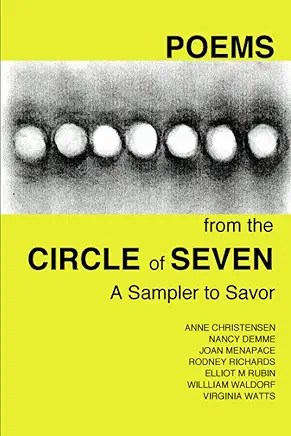
            A few years ago, the group put together a cooperative collection of poems available on Amazon called Poems from the Circle of Seven. A Sampler to Savor. One of the members’ sons kindly assisted us with our cover art which turned out beautifully. It was special and moving to see ourselves all together on the page inside the cover of one unified book.  Special because something special happens every Sunday morning that I don’t think we can explain exactly. Call it chemistry. Call if magic. We have eight now, so I am sure at some point we’ll put together another collection.

            And of course, while our writing brings us together, something we all care about, love to do and literally need in our lives, now we have a group friendship too. I can speak for myself in saying that less than a year ago I had open heart surgery and seeing the faces and hearing the words of encouragement before and after as I recovered meant a great deal to me. One of our members has a seriously ill spouse and we all grieve this. One has been going through the process of retiring and moving. On the flipside we have shared countless laughs about the ups and downs of real life. We have also heard about great adventures. Recently one member went skydiving. That made for an unforgettable poem. So, to writers everywhere, if you have the chance and are lucky enough to enter a circle of fellow writers sprint there and take your seat. It will uplift you and bring the greatest joy to your writing process.

Hard Learned Lessons Regarding a Writer’s Glamorous Life

By R. David Fulcher

Collective member R. David Fulcher opines about Writing and “the Process”

Reprinted by permission from one of his blog posts available at Davidfulcher.com

When I was young, before I had written a word of fiction, I believed that all writers lived a glamorous life. Ernest Hemingway in particular seemed to embody this image – traveling on safari, sport fishing in the Gulf of Mexico, drinking whiskey as if he were a fish himself – doing almost everything except writing.

The writer Ernest Hemingway in his later years.

Now that I  am older and wiser, I know that Hemingway wrote for hours each day, making him one of the more disciplined writers of his time.  But the larger-than-life Hemingway was a more appealing character to imagine, and therefore the one my younger self gravitated towards.

So, I am writing this post to the new breed of writers out there to let them know some of the disciplines they will find useful in their writing lives, and leaving the catching of Marlins to Salt Water Sportsman Magazine.

Bait the hook and try to catch something big. It’s more difficult than you think.

What Writing is Really Like…Computer Programming

Computer Programming is all about language and syntax, and so is writing.  I know something of this as programming is my day job.  I have often spent hours debugging some code, only to find that a misplaced semi-colon or comma was the culprit.  Writers also will find themselves laboring over the usage and placement of punctuation, understanding that punctuation in the wrong place can change the entire meaning of a sentence.

What Writing is Really Like…Project Management

Project Managers track task and project status, in addition to schedule, budget and other project elements.  As your writing career grows, you will quickly find yourself in need of a spreadsheet, database or other tool to know what you’ve submitted where, when to send a query letter, relevant contact information for publishers and publications, etc.  You will also need to track readings, book fairs, online interviews, etc. on your Outlook or Google calendar.  These demands will intensify as your writing becomes a fulltime occupation, and as you began to spend more time collaborating with others.

What Writing is Really Like…Marketing Executive

While the big publishing houses have marketing resources of their own, new writers trying to make a name for themselves in small independent presses will find themselves on their own to promote their work.  You will be faced with questions like which social media channels reach the biggest (or more importantly, the most relevant) reading audiences, and does it make sense to subscribe to marketing service to promote your books.  Additional considerations involve creating your own author’s website and blog, all of which may require you to acquire new skill sets. Your ability to effectively promote your work becomes even more critical if your work is self-published.

What Writing is Really Like…Accountant

While writing is an art and not a science, sooner or later you will be focused with financial decisionsand issues related to your writing.  These may be simple decisions such as whether to enter a writing contest that charges a fee, or whether to hire an independent designer to design your author’s web site.  Other more complicated issues will involve reporting any book sale royalties on your income taxes or tracking the sales tax to be submitted from cash sales at a book fair.  And when you’re finally ready to take the leap and go fulltime, the big financial question:  how much will I have to make on my writing to make a living? 

What Writing is Really Like…Lawyer

Finally, you will be faced with legal issues during your writing career.  I’ll give you a real-life example.  Unbeknownst to me, a designer at one of the publishing companies used an image on my book cover that was copyrighted.  Several years later, I was contacted by the copyright holder demanding a correction, and I referred him to my publisher.  The publisher finally admitted the mistake, and at their expense, corrected the cover.  Other examples include understanding reprint rights for your previously published stories and interpreting contractual agreements with publishers when you begin to get your first professional sales of your stories and novels.

So, there you have it – instead of being glamorous, the above disciplines can be tedious, if not downright boring.  However, these skills will propel your writing career much further than your ability to bait a hook.

You can read more of David Fulcher’s posts and learn about his books here.

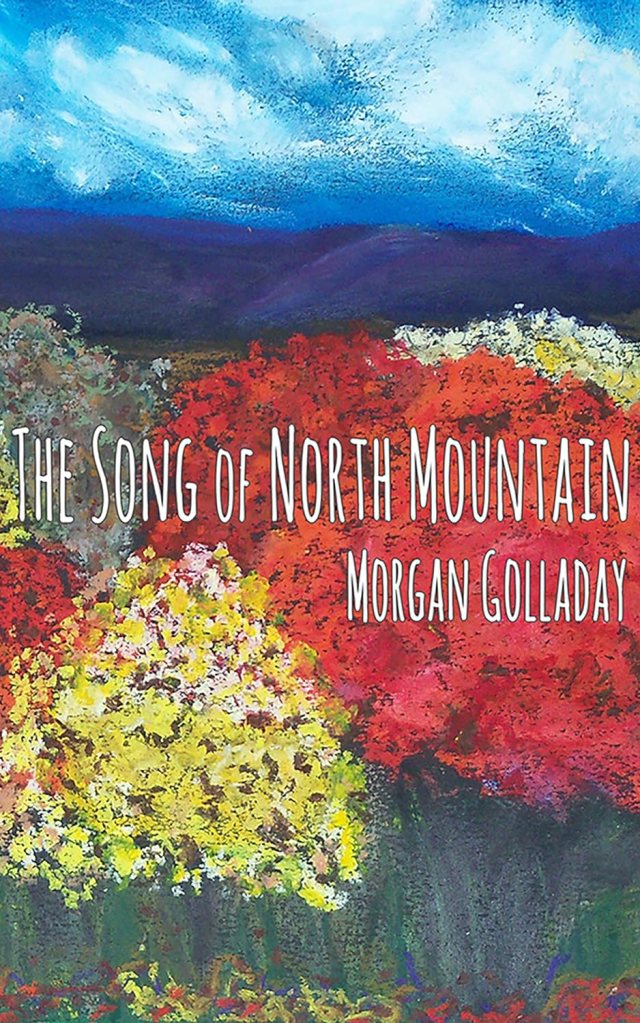
To learn more about the latest Old Scratch Press publications click here. The Song of North Mountain by prizewinning author Morgan Golladay is just one of several exciting new chapbooks! To learn more about Old Scratch Press and our poetry an short form collective follow us on WordPress at Oldscratchpress.comDav

Golladay Grabs Second Place in the Nationals!

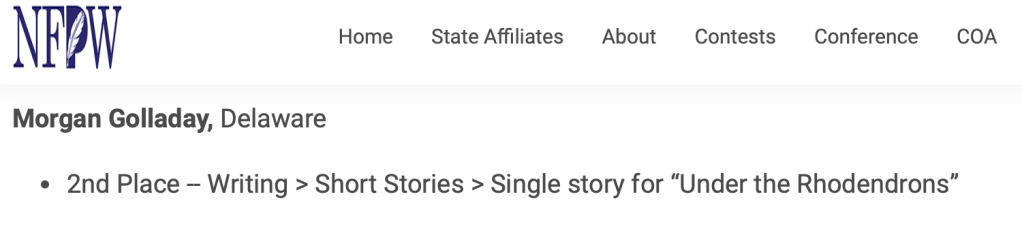
Big shoutout to Morgan Golladay! Her short story “Under the Rhododendrons,” featured in HALLOWEEN PARTY ’23 (Gravelight Press), snagged second place in the National Federation of Press Women’s national short story competition.

Morgan also just wrote, illustrated, and released her first poetry book, THE SONG OF NORTH MOUNTAIN, which is up for a National Book Award!

The good news just keeps rolling in for Morgan!

Want to know how she does what she does? Check out her blog, FB, and don’t miss this in-depth interview with her.

Way to go, Morgan! We’re so thrilled for your success!

Meet Poet Morgan Golladay at Causey Mansion | Milford Delaware Event

Causey Mansion where Morgan Golladay reading/ booksigning will be held.

Causey Mansion in Milford Delaware is a beautiful spot to meet and greet poet/artist Morgan Golladay, author of the Song of North Mountain. Learn more about the historic mansion here. The event will be held in the gardens from 1-3 p.m.. Purchase your copies in advance online or purchase one at the event. Either way, Morgan will be there to autograph! The location is 2 Causey Avenue, Milford Delaware 19463

Editorial praise is just beginning. Here are a few samples:

“Sometimes stark, but always beautiful, these free verse celebrations of North Mountain introduce a seasonal sense of environmental transitions to the observer and reader’s eye, with time’s passage changing everything and nothing…Aside from a personal visit to North Mountain, there is no better way of appreciating its beauty, impact, and presence over the eons than through The Song of North Mountain.”
MIDWEST BOOK REVIEW

Ellis Elliott

5.0 out of 5 stars Mountain Mary OliverReviewed in the United States on May 28, 2024

Verified Purchase

This book is a praise-song of poetry and art for Golladay’s beloved mountains. With an eye for detail and ease of language, her poems revere and embrace the elements and seasons of nature. Accompanying her poetry, her art further conjures the scenes we are taken to. From Vincents Wood to the Devils Throne, the writer takes us along, like all good poetry, until we feel as if we, too, have been there. I think I’d do well to heed what the writer says:
Look too soon
and you miss the mystery

Alan Bern

5.0 out of 5 stars A wonderful poetic love song to where she grew up, “the Shenandoah Valley of Virginia.”Reviewed in the United States on May 7, 2024

Morgan Golladay’s The Song of North Mountain is a wonderful love song to where she grew up, “to the hills, rivers, and ridges of the Shenandoah Valley of Virginia.” And Golladay is the perfect guide for this voyage, perceptive, kind, and empathic. I urge you to purchase her fine book that also contains her own fine original artwork: sit back in a comfortable chair and travel with her to this most beautiful part of our country. As Golladay invites the reader to accompany her and writes in “Back in the Woods” (p. 69),

I experienced the magic and awe of
a creation larger than I could imagine.

“Rest with us,” whispered the granite.
“Breathe with us,” crooned the breeze.
“Stay with us,” encouraged the trees.

Learn more about Morgan and her poetry here. And don’t forget to follow Old Scratch Press on Facebook. Thank you for reading.

Update from Alan Bern

Hello Friends,

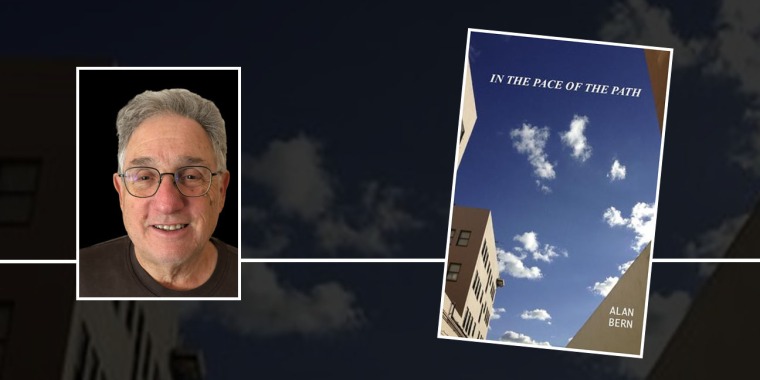
If you’re in the Berkely (California) area please join us at Pegasus Books Downtown on Thursday, June 27th for an evening of music, text, and storytelling with me, Alan Bern, Berkeley-based storyteller, performer, author of IN THE PACE OF THE PATH. Bern’s reading will be accompanied by music from cellist Gael Alcock. Recently released by UnCollected Press, IN THE PACE OF THE PATH is a hybrid work of poetry, prose, and photos that charts my life in my hometown of Berkeley and my career at the Berkeley Public Library.

From 6:30-7pm, browse books and enjoy Bach’s Cello Suite #4 performed by Alcock, in memory of Larry Bensky, host of KPFA’s ‘Sunday Salon’ and ‘Piano’.” Reading and conversation with me will follow, at 7pm. Copies of the book will be available for purchase and signing at the reading.

Alan Bern’s IN THE PACE OF THE PATH walks the border between poetry and prose, between the surreal and the realism where surrealism spawns, between the past and future which is the pace of the moment by moment of a life. I have learned from Bern’s clarity in poetry and prose to walk the edges of my homeland and step out into the unknown, while carrying the life I have lived within me. This is such an important work to read now and reread as we move through our lives.

—Rusty Morrison, Co-Publisher of Omnidawn—

Enjoy a video by L. Scott Jones of Wrapped in Ruins, a gallery piece and the most recent performance of PACES: dance & poetry fit to the space, a collaboration with other artists of dancer/choreographer Lucinda Weaver and me:

I will also present an art piece near the end of:

FREE LIVE EVENT: INSTANT NOODLES LAUNCH AND LIVE AUTHOR READING.

DATE: June 20, 2024
TIME: 4:30 PM PT  | 7:30 PM ET
Join us in celebrating the release of the newest issue of INSTANT NOODLES, the online literary magazine that features original poetry, art, and short fiction. Meet the authors and listen in as they perform their work live. This online event is open to the public. Click below to register.

https://us06web.zoom.us/meeting/register/tZUlfumprTgsE93vS-zfSLwlM-Mf-Vvyy-KU#/registration

There is wonderful writing in this issue of Instant Noodles, and I hope you can attend!

Thanks so much for your interest in the work of the authors of Old Scratch Press!

—Alan