Poets and Punctuation

In his sonnets, Shakespeare would use end-stops rigorously, with most lines ending in commas, semi-colons, and colons. Sometimes he relied on enjambment or exclamations, but as far as possible, he seemed to save his full stops for the very last line. 

Take Sonnet 18,  “Shall I compare thee…”: six commas, four semi-colons, two colons, one question mark, and one full stop. 

Ezra Pound, on the other hand, would often refuse to use any end-stops at all. 

Take these lines from Canto LII:

The empress offers cocoons to the Son of Heaven

Then goes the Sun into Gemini

Virgo in mid heaven at sunset

indigo must not be cut

No wood burnt into charcoal

gates are all open, no tax on the booths.

No commas, no colons or semi-colons, “midheaven” is split for emphasis or for pause. There’s as little punctuation as possible, down to “gates are all open, no tax on the booths.”  That solitary comma functions almost as a speed bump near an intersection. 

According to Daniel Albright, W.B. Yeats had ‘punctuational quirks’ which he was happy to leave to his editors to sort out.  It was as if those technicalities were above or below the poet, who belonged to another realm of language.  

T.S. Eliot, like his mentor Pound, would sometimes drop punctuation altogether, but then he would go and stick in a full stop just to confound the reader:

On Margate Sands.

I can connect

Nothing with Nothing

(“The Waste Land,” lines 300–302)

Most people read those lines as “On Margate Sands, / I can connect / Nothing with Nothing.” So why the full stop? Some say it’s to heighten the sense of isolation and fragmentation, but it actually spoils the drama rather than intensify it. “I can connect / Nothing with Nothing” is no longer restricted to this moment, here-and-now, on Margate Sands. It steals some of the bombast. Perhaps that was the point, who knows? 

One thing that seems pretty clear is that punctuation plays by different—or fewer—rules in poetry. 

In “Un Coup de Dés,” Mallarmé throws punctuation out the window almost entirely, relying on spaces and font size to convey the necessary pauses and emphases. Punctuation becomes visual and spatial, and all the more effective for it.

Compare that with Sylvia Plath, who was a heavy punctuator:

Clownlike, happiest on your hands,

Feet to the stars, and moon-skulled,

Gilled like a fish. A common-sense

Thumbs-down on the dodo’s mode. 

(Opening lines of “You’re”) 

Apostrophes, hyphens, and commas in all the right places. 

So, the question is: does punctuation really matter in poetry? 

Perhaps it depends on whether it’s intended to be read aloud or read off the page. At a reading, intonation and cadence work magic that is sometimes hard to replicate in print, where that same impact disappears somewhere between too much and too little punctuation. 

I suppose we’ve all got our own punctuational foibles. I often neglect end-stops. I know I shouldn’t, but putting in a comma, semi-colon or colon just feels wrong at the end of some lines. Not all, just some. I could not actually say why. It’s not a rational thing. It’s pure feeling. 

So whether you’re partial to Elizabeth Bishop’s em-dashes or agree with Joyce that quotation marks “are an eyesore,” rules are strange visitors in poetry. You can choose whether to follow them, or which ones to follow, and no one can really complain—except the reader, who will have to read in all the end-stops and what-nots we choose to leave out.

Anthony Doyle is a founding member of Old Scratch Press. He is the author of the novel Hibernaculum and the recently-published Jonah’s Map of the Whale and Other Poems.

Independent Reading

Are you finding it difficult to get into the holiday spirit this Independence Day? Artists have been exploring the concepts of freedom and independence through their art for ages. While fireworks light up the sky and flags wave proudly on July 4th, it’s also the perfect time to spark something else: a love of reading. Independence Day is about more than history—it’s about the ideals that shape our country: freedom, courage, justice, and hope. What better way to explore these themes than through reading?

Whether you’re holiday plans include relaxing at the beach, enjoying a backyard BBQ, or cooling off indoors, there are many ways you can bring some great reading with you.

Art can remind us where we came from, challenge us to think critically about the present, and inspire us to shape a better future.

Here is a poem by Langston Hughes that explores how he felt about America.

Or you might try an Abecedarian by Varsha Saraiya-Shah.

And if you want to stir your patriotism and spark some hope, try this poem by Carlos Bulosan.

This July 4th, don’t just celebrate with fireworks—celebrate with a poem or story.

If you’re a writer, there are some places looking for work on American themes.

WWPH is looking for American themed haiku. Submissions run through July 6.

Gnashing Teeth publishing is also looking for American themed poems, but their submissions close today, so you’ll have to write fast!

Missed the deadline? No problem! You can still enjoy reading their selections tomorrow!

Anthony Doyle’s New Release Earns #1 Spot!

Anthony, you hit a number one. Congratulations! Although Anthony’s poetry is written in English, not Spanish, it does seem that his adopted cultures are loving his work. To read any of Anthony’s work is to know he is an extremely talented author, and now Amazon agrees! I hope readers in the US and in his home country of Ireland agree, and that this will bring readers to Anthony’s work from all over the world, because I really am a fan. And, apprently, so is book reviewer Emma Lee who says:

Jonah’s Map of the Whale is an exploration of self, self-identity and how much personhood is formed by external circumstances, through three different characters. One is pushed along by external pressure and lacks agency. One has agency but fears she carries a hollowness. One is faced by a life-changing experience that he can sink or swim from. Each character feels fully-developed. Anthony Doyle has created a quirky look at a set of beings tackling very different philosophical and physical circumstances, prompting readings to consider who might survive, who might thrive and which one reflects the reader best. It’s a map worth reading.

See Emma Lee’s full review for more!

And don’t forget about Anthony’s dystopian novel, HIBERNACULUM!

If you don’t know him by now, it’s time to. Find Anthony Doyle

Join Us! You Know You Want To!

Celebrating Pride Month Through Reading

June is Pride Month! It’s a time to recognize and celebrate people in the LGBTQ+ community. Pride Month is about love, acceptance, and being proud of who you are. One great way to celebrate is by reading books that share LGBTQ+ voices and stories.

Books help us understand each other. For LGBTQ+ people, reading stories with characters like them can help them feel seen and accepted. For others, reading these stories builds empathy and helps us learn more about people who may be different from us.

Books can also teach us about LGBTQ+ history, struggles, and victories. Reading is a powerful way to show support during Pride Month, especially when you buy books written by LGBTQ+ authors.

If you’re looking to add some pride to your bookshelf, we have two authors at Old Scratch Press who recently published books of poetry that would be great additions to your to-be-read list!

On May 1, Morgan was awarded Second Place in the Delaware Press Association Communications Awards for her book, The Song of North Mountain which was released by Old Scratch Press in May 2024. Not only did Morgan write the poems in this collection, she also did the interior artwork and illustrated the book’s cover. North Mountain is part of a 55-mile mountain ridge in the northern Shenandoah Valley in Virginia. Morgan says her collection of poems is a love song to that ridge.

Here is her poem, Ghost Light, which won also won Second Place in the DPAC Awards in its category.

Ghost Light

Looking back along the ridge
a thin rib of light briefly
illuminates the forest floor
and silhouettes trees stark against winter sky.
Look too soon
and you miss the mystery
of Dillon’s Mountain’s brief farewell
to nightsky and stars and sweet Venus.
Look too late
and the slumbering giant
lumbers slowly
into its ordinary dayspring.
But if you should,
by chance or intent,
catch the moment,
you will see life
and hope
renewed
in a sudden shaft of dawnbreak.

You can follow Morgan on Facebook and Instagram or visit her website.

Robert Fleming is a gay man who writes and creates art about gay, transgender, and universal themes. After coming-out, he published in LGBTQ magazines. He says that when he” stopped obsessing about being gay”, he realized that his sexual orientation is only one part of who he is. This enabled him to write on universal human themes and crossover into publishing in straight magazines.

For pride, one his favorite poems is one he wrote, Passed Over , that was published in 2020 in Trees In A Garden Of Ashes by Local Gems Press. Robert is grateful to James Wagner, the editor of Local Gems Press, who published many of his gay and transgender works.

For pride 2025, Robert recommends to submit to publish in Oddball magazine that has categories in nonsexual orientation and pride (LGBTQ). You can find submission guidelines here.

Robert is the author of the Amazon best-selling visual poetry book, White Noir.

Here is a link to his visual artist profile.

Follow Robert at Facebook

Chuffed!

Here I am with Linwood Jackson, President of the Delaware Press Association.

On May 1, I was awarded a Second Place in the Delaware Press Association Communications Awards for my book, The Song of North Mountain. This was my veryfirstever book released solely under my name, and the award presentation was exactly one year after the book hit publication.

I am quoting the judge, whose name I don’t know, in their comments regarding the award. “This is a beautifully crafted collection of poems that takes readers on a journey through nature, personal reflection, and the deep connection between the land and the human sprit. With vivid imagery and emotional insight, You (sic) capture the essence of the North Mountain landscape, blending personal growth, exploration, and the rhythms of life. The poems are rich with sensory details and metaphor, drawing readers into the natural world where every “rustle of leaves, shift of light, and breath of wind carries meaning.” I find that your writing, both introspective and outward-looking, intertwines the inner and outer worlds, exploring themes of solitude, contemplation, and the passage of time with tenderness and reverence, giving the collection a meditative quality.”

Many of us, particularly of my generation, suffer from imposter syndrome, that feeling that we’re really just pretending to be . . . smart, kind, good at what we do, talented, strong, etc. I’ve been writing since I was a teenager. Mostly doggerel, lines about angst, loss, imaginary friends, and wry observations. As I’ve aged and matured, so has my writing. I’ve discovered poets other than those I was raised on (Longfellow, Holmes, Browning) and many who write in rhymed and metered verse.

College introduced me to more complicated poetry – Ferlinghetti, Hopkins, Stevens, Auden, Eliot, Yeats. And then, foreign writers, like Rumi, whose ideas were so very different from those I had been immersed in.

So, I still wrote, but still privately, only sharing sparingly, for I still did not consider myself a “good” poet.

Well, I guess I am now. This anonymous judge really liked my work! The DPA, in their wisdom, selected judges that were not from Delaware. Delaware, being such a small state, is one where everyone knows everyone else, especially in communications and writing. So all I know about this anonymous judge is that he or she is not from around here. And, they liked my work.

Being a creator, whether in writing, arts, crafts, or just about anything, we have the angels and devils on our shoulders. One says, “Perfect. Absolutely PERFECT. Don’t change a thing!”

The other angel is the voice of the imposter. “Really? You expect anyone to like this? What balderdash! This is ROTTEN!” So we hide our creation away, or simply refuse to edit it.

I think we’ve all been there. The fact is, creating is a matter of taking risks. Making changes. Wondering if what we have written can be said better. And having the courage to play with it. Editing. Changing the recipe. Adding a stroke of color. 

I can certainly attest that every single poem and sketch in this book was analyzed, edited, and reworked (and rethought) at least 5 times.

Ghost Light, the poem I included in my last blog, was awarded a Second Place, also. This judge commented that “Your evocative, photographic-like details set the ghost-like mood and scene from the beginning. . . .” And, ‘the last stanza is particularly well-turned — “by chance or intent,/ catch the moment, . . . in a sudden shaft of dawnbreak.’”

The judge noticed. They noticed the internal rhyme, the alliteration, the combining of words to create a new meaning. These are ‘tools’ I labored over, hoping the reader would listen to these words and how they created an atmosphere, a feeling, a response.

We all too often hesitate to read out loud, to ourselves or to anyone else. But it is important. Whether we read to a child, or are read to, there is a chance for us to escape into the word picture created by the author. That’s what I try to do — create word pictures for you to explore.

You can find The Song of North Mountain on Amazon and other retailers, and my author page on Amazon. Follow me on social media at Facebook as Morgan Golladay, Writer and Artist, in Instagram as morgangi13, and please FOLLOW my blog too.

If you have a copy of The Song of North Mountain, please leave a review. Thank you! I appreciate it!

May 15, 2025

Pick up a copy!

Powell’s Books
Paperback
eBook

Audio (no subscription: download to your device)

The best books are free books

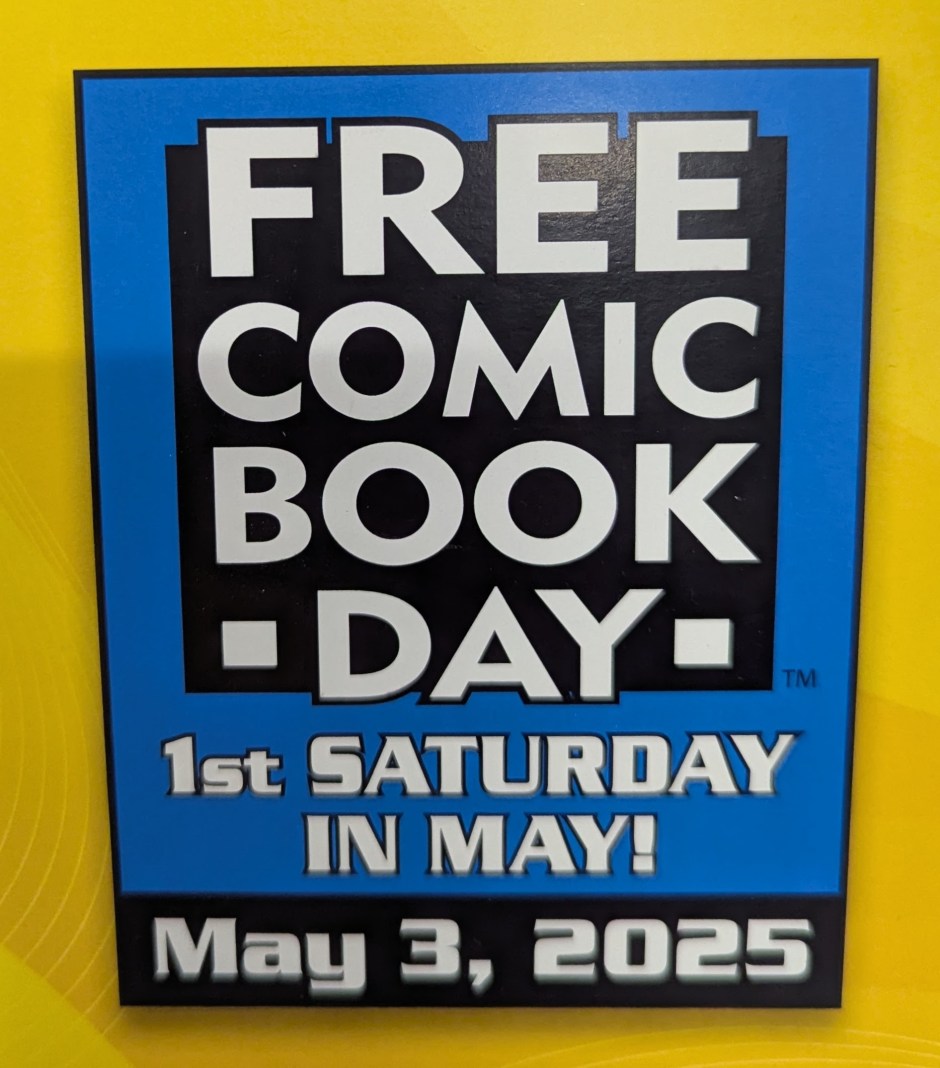
What is Free Comic Book Day?

Every year on the first Saturday of May, comic shops across the country come alive with excitement, color, and creativity—because it’s Free Comic Book Day (FCBD)! Whether you’re a lifelong comic enthusiast, a casual reader, or someone looking to dive into the world of graphic storytelling for the first time, this day is all about celebrating comics, community, and the joy of reading.

Started in 2002, Free Comic Book Day is a promotional effort by the comic book industry to attract new readers. Participating comic book stores give away specially printed copies of free comics—completely free of charge. The event includes a wide variety of titles from major publishers like Marvel, DC, Dark Horse, Image, and smaller independent presses, offering something for every age group and interest.

Why It Matters

The world could use more heroes and happy endings. Comics aren’t just about superheroes (though there’s plenty of that if you’re into it!). They span genres—from fantasy and horror to history, science, and slice-of-life stories. They’re also a powerful tool for literacy and education, helping readers of all levels improve comprehension, vocabulary, and visual literacy.

For younger readers especially, comics can be a gateway into the joy of reading. The mix of artwork and text makes stories more accessible and engaging, which is especially beneficial for reluctant readers or multilingual learners.

How to Celebrate

  • Visit a Local Comic Shop: Use https://www.freecomicbookday.com/StoreLocator to find a participating shop near you.
  • Explore New Titles: Try something outside your usual favorites. You might find a new series or genre you love!
  • Bring the Family: Many stores host family-friendly events like signings, costume contests, games, and raffles.
  • Support Local Creators: Some stores use the day to highlight local artists and writers—don’t miss the chance to discover original voices.

My local comic book store had a local graphic novelist as well as comic artists in the shop signing autographs. They also work with local food pantries and offer an extra free comic for each can of food donated to the store. I always come away with comics I’ve never heard of that I end up enjoying once I get home and read them.

While free books are always amazing, Free Comic Book Day is more than just picking up a stack of comics—it’s about celebrating imagination, storytelling, and the communities that form around them. Whether you’re 8 or 80, there’s a comic out there for you. So mark your calendar, grab your friends or family, and make your way to your local shop. You never know what new world you’ll step into!

Celebrate National Poetry Month: Read a Poem a Day!

April is National Poetry Month, which makes it a great time to enjoy the beauty and power of words! Whether you love poetry or are just starting to explore it, reading a poem each day is a wonderful way to celebrate the art of the poem.

Why Read a Poem a Day?

Poetry helps us express feelings, tell stories, and learn new words. Reading one poem a day can:

  • Improve Reading Skills – Poems use creative language that helps build vocabulary and understanding.
  • Inspire Creativity – Poetry makes us think in new ways and see the world differently.
  • Help You Relax – The rhythm and emotions in poetry can be calming and enjoyable.
  • Grow Empathy – Poems share different experiences and feelings, helping us understand others better.

Easy Ways to Add Poetry to Your Day

  1. Start Your Morning with a Poem – Read a short poem to begin your day with inspiration.
  2. Read Poetry with Friends and Family – Share a poem out loud and talk about it together.
  3. Use Online Poetry Resources – Websites like Poets.org and Poetry Foundation offer daily poems.
  4. Write About What You Read – Keep a journal to jot down thoughts or even try writing your own poems!

Poets and other resources to Check Out

If you’re not sure where to start, here are some poets you might enjoy:

Join the Fun!

National Poetry Month is the perfect time to enjoy poetry. Challenge yourself to read a poem each day, share your favorites, or even try writing your own! Celebrate the power of poetry—one poem at a time.

What’s your favorite poem? Share it in the comments below!