The Writer’s Brain: Creativity and Neurodivergence

From my collage notebook

There’s a certain stereotype about writers: distracted, dreamy, maybe a little moody, often lost in their own heads. Then there are those of us whose third-grade teacher writes on her report card, “Ellis is very sensitive. She says she doesn’t feel good when she doesn’t want to participate and sometimes puts her hands over her ears.”

What we don’t always name is that many of us identify with something more specific—ADHD, anxiety, depression, OCD, autism, bipolar disorder. In other words, neurodivergence.

Far from being a barrier, these brain patterns often come hand-in-hand with creativity. Our ability to notice connections others overlook, to hyper-focus on a project for hours, or to sense language at a heightened level can all be part of what makes us writers. (Doesn’t everyone have a list of words they hate simply because the way the word feels in their mouth?)

The Double-Edged Sword

Of course, the same brain that gifts us with creative leaps can also work against us. ADHD can make finishing projects feel like climbing Everest. Anxiety can whisper that nothing we write is ever good enough. Depression can steal the life-force necessary to even begin. The very sensitivity that makes us attuned to metaphor and meaning can leave us overwhelmed by the noise of the world.

Reframing the Narrative

Instead of treating neurodivergence as something to battle, what if we reframed it as part of the writer’s toolkit?

  • Hyperfocus can become a superpower for deep revision. Or help you finish the book!
  • Restless energy can fuel bursts of freewriting that break past creative blocks. That, and dance breaks.
  • Heightened sensitivity can deepen character work, dialogue, and description. As long as you remember to take breaks.

The key is learning how to manage the edges—finding rest, support, and strategies so that the gift doesn’t become a burden.

Practical Ways to Support Your Creative Brain

  1. Chunk your writing time. Short, timed sessions (15–25 minutes) can harness focus without overwhelming you.
  2. Write rituals, not rules. A small ritual (lighting a candle, stretching, a playlist) helps train your brain to enter writing mode.
  3. Name the inner critic. Literally give it a name or persona so it loses power over you.
  4. Seek community. Writing groups, workshops, or even online spaces help balance the solitary nature of the work.
  5. Honor rest. Brains that run hot need recovery time. Pushing the pause-button isn’t failing—it’s part of the process.

Why It Matters

When we share openly about the link between writing and neurodivergence, we create permission for others. Permission to stop beating themselves up for struggling with deadlines. Permission to see their “quirks” as part of their artistry. Permission to make choices others might not understand. Permission to write anyway.


Do you identify as a neurodivergent writer? How does it show up in your creative process—both the gifts and the challenges?

Ellis Elliott

Founding member Old Scratch Press Poetry Collective

Author of Break in the Field poetry collection and A Witch Awakens: A Fire Circle Mystery.

https://a.co/d/eMSe9up

https://a.co/d/7J1ra9x

http://bewildernesswriting.com

Unlocking Your Writing Through Movement

In high school I watched the clock in last period, because I knew as soon as the bell rang I was heading straight to dance class, and all the teen angst and hormonal folderal of the day would be disappear once I got there.

I’ve taught dance for over forty years now, and that was the beginning of a lifetime of learning how the mind/body connection affects my creativity and well-being.

We’re taught early on that writing is supposed to come from the neck up—brain first, fingers second. We believe the words live in our head. But I’ve come to understand this: the stories I care about—the ones that ache and sing—live in my body. And if I want to write them honestly, I have to move.

Movement Makes Space for Story

When I’m stuck on a line in a poem or in a scene, walking often is my default means to address it. It might just be a walk around the block that allows my shoulders to drop and my breath to even out.

There’s something about the gentle rhythm of walking—or swaying, or stretching—that stirs the sediment at the bottom of the creative well. It shakes loose a phrase, a memory, an emotion I hadn’t thought to name.

We say “I’m working it out,” and often we mean emotionally—but there’s a physical truth there, too.

“ But I do believe very strongly that the best poetry is rooted in bodily experience. We experience reality through our bodies and senses, and truth, to the extent that it is apprehensible.”      -Poet Rebecca Foust

The Dance Between Emotion and Motion

As someone who grew up dancing, I know I carry emotion in my body, and in order to gain access I have to move. In order for the reader to feel what I am writing about, I must first feel it myself, and that is not going to happen if I stay entirely in my head.

Movement helps me feel it. And when it’s a big feeling—grief, rage, shame, heartbreak—moving my body helps metabolize it. When we experience trauma or hold strong emotions, our bodies remember. They contract around those memories. Notice how we hold our breath or the body tenses up. If we don’t move them, we risk writing around the truth instead of into it. And I don’t have to run a marathon or take up kickboxing. I can simply take a deep breath, raise and lower my arms a few times, twist gently side to side–all in my deskchair.

Moving lets the emotion pass through me so it can move onto the page.
Otherwise, it stays stuck in the pipes.

Stillness Is Its Own Kind of Movement

Sometimes, the writing calls for the opposite.
Stillness. Not scrolling or skimming or daydreaming—but deliberate, open stillness.
The kind that invites something deeper in. The kind that looks like staring out the window.

This is the space where I can hear the quieter parts of my story—the voice of a child I’d forgotten to listen to, or the image I saw in a dream but brushed off. Lying still and staring at the ceiling can be just as powerful as dancing. For me, it is my meditation practice. It’s all part of the same body-based practice.

Final Thought: You Are the Instrument
Your body is not a machine that carries your brain to your desk.
I tell my students of both writing and dance that the body is an instrument that vibrates with memory, story, longing, and truth.
When you write from your whole body, your work carries a different kind of resonance.
So move.
Let the story or poem move with you.
And then write like your body remembers something your mind forgot.

Click this link for a quick 5-minute seated stretch to get the body moving and the words flowing: https://youtu.be/n0VlNd3nLFw


Ellis Elliott
Bewilderness Writing
https://bewildernesswriting.com/
Old Scratch Press Founding Member
https://oldscratchpress.com/
Author: Break in the Field poetry collection
and A Fire Circle Mystery: A Witch Awakens coming this May

POP CHAT LIVE FEATURES ELLIS ELLIOTT

Thanks to Annette Tarpley for choosing to highlight Ellis on her program! Ellis reads some of her book and has a nice long chat with Annette. Stop by and watch!

Welcome to Break in the Field

Old Scratch Press (OSP) was formed as a way to help poets get their poetry out there. It is our hope that someday we will offer many opportunities for poets. Our first mission, though, was to see if we could publish the books of the group members, as a way to see if we could support each other, function well as a cohesive group, etc., before we took on other people and their poetry or short-form dreams.

And so the first OSP book has been released: Break in the Field by Ellis Elliott. Why is Ellis’ book first? She won the coin-toss, or, in our virtual case, the random-#-generator-toss.

However, that luck of the draw does not lesson the beauty of the book. It’s a beautiful book, and the poetry is accessible and so relatable. I have a daughter with a disability, and I found this, really, meditation on mothering and parenting, so moving and important. I also worked for years in group homes and etc. for people with disabilities, and the book really speaks to me because it humanizes people with disabilities, and, too often, their disabilities make them so unable to make good contact with those of us of average capabilities, that we never stop to imagine their needs or feelings or think that they even have desires. Ellis’ book tackles that notion of supplying the concept of being human from the outside in, to a person who can seem like an object more than a person. I struggled, in my years as a staff trainer, to help the staff I trained to come around to that more full view of the people we took care of, but it was a tough sell, sadly, to some of the staff. Ellis’ makes it something we don’t learn, but we feel and know in our bones. I love this book for that.

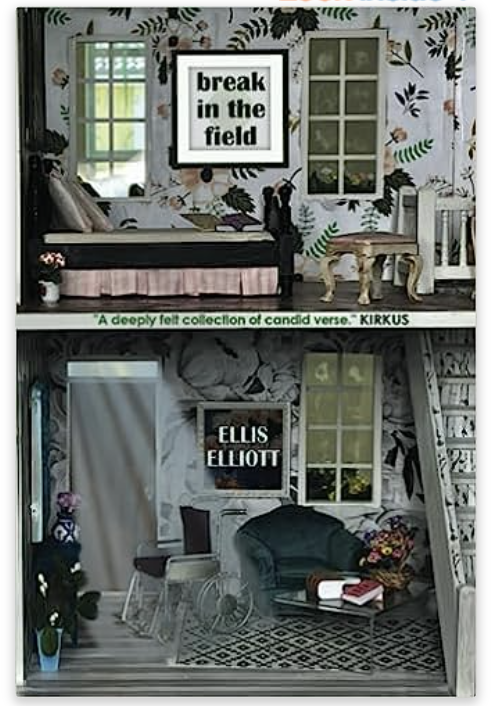
The cover is a photo of one of the dollhouses Ellis rehabs as one of her artistic outlets. On her blog she has a very lovely post explaining how she came to want to have that as her cover, and I think you’d enjoy that too. Ellis is also in process on a cozy mystery series, and I highly suggest you follow her on her very interesting blog, especially if you are an author, or an aspiring author, as she offers lots of writing tips.

I earned my MFA as a poet, something I never expected to get into when I decided to further study writing, and I’ve always really loved poetry (my own included…. lol) and I am so very happy that we can publish poetry. The book was put together by the Devil’s Party Press crew of two, but also proofread and dusted and cleaned by volunteers from the collective. There is no way at all, though, that I, or Dave and I, could have done it without all of the OSP members: Nadja, Ellis, Anthony, David, Ginny, Gabby, Janet, Alan, Morgan, and stalwart meeting leader, Robert, may the poetry gods bless him for always remembering to hit record, among other things. These folks are volunteering their time to show up to Saturday morning meetings, to take minutes (the ultimate sacrifice) at these meetings, to edit each others’ books, and working to promote each others’ books, and that is what every author needs, a team of supporters. Poets are not TikTok influencers, racking up 10,000 likes, but poetry is more important. I think that poetry makes the unexplainable able to be shared; that’s how I would sum it up. I’m not sure which of the members volunteered to do an edit and proofread for Ellis, but all of the members are helping OSP in general, to grow.

Back in 1989 when I was putting a poem and two dollar bills in an envelope with an SASE and sending it off in the mail, I almost never even found out if the poem had reached its destination, but when it did make it, I always received a request back, in my SASE, to please subscribe to the Zine. I never did, because I made about 60/week, and most of that went on bus fare, and, frankly, I didn’t care about other people’s poetry. I cared about mine. But, that was wrong. I mean, I couldn’t help the financial situation back then, and, though that hasn’t much changed now (lol), when I have a friend put out a poetry collection, or a poet I don’t know but admire puts out a new collection, I buy it. I usually buy two, actually, and give one as a gift. Without people doing that, poetry will fade from view, and we’ll lose something that is all magic. Magic is rare. Poetry is one way to hold magic.

The collective is going to curate the holiday/end-of-year issue of Instant Noodles, and choose the theme for next year’s issues, and we are in talks to see what other opportunities we can provide for poetry readers and writers, so follow us, and see what we bring to the world of poetry and short-form writing, and, if we make it. We could end up as a fabulous poetry cooperative, or as the modern, poetic version of the Donner Party, or anything in between. This is still an experiment. So far, I think we can feel quite proud, all of us in the group, of our first book.

And I am really excited for the next book too: White Noir, by Robert Fleming. It’s very different from Break in the Field, and I like the diversity of movement from one book to the next, and that our group has such variety of style. It is very exciting. White Noir should be up for pre-order in the coming months…. hopefully sooner than later, but there hasn’t been an author, from a single story or poem, to a whole book, who hasn’t had to be patient waiting for DPP to get caught up. 🙂 We appreciate the patience, and we hope you’ll follow along on the great experiment of OSP.

Thank you for supporting these wonderful authors, and independent publishing, and authors over 40, and late bloomers, and poetry, art, words as art…. It means so much to me.

Congratulations, Old Scratch Press, on a book successfully and collaboratively done.

Congratulation Ellis, on your wonderful book of poetry.

Thanks for reading everyone.

Love~

Dianne

Favorite Poem Series Continues with Emily Dickinson

By Ellis Elliot

When Old Scratch Poetry Collective Members were asked to write about a favorite poem, I knew my choice would be my first poem love affair. Before this poem, which I was introduced to in college, I had a healthy love of words, and a newfound interest in poetry, but it was more about my intrigue with the craft of it. I liked learning how things like rhyme and meter, form and pattern, didn’t need to hit you over the head. The tools of poetry were more like puzzle pieces that you both created, took apart, then put together again. But then came Emily.

Ample Make This Bed

by Emily Dickinson

Ample make this bed.
Make this bed with awe;
In it wait till judgment break
Excellent and fair.

Be its mattress straight,
Be its pillow round;
Let no sunrise’ yellow noise
Interrupt this ground.

I can’t explain exactly what alchemical combination occurred to cause me to fall for this particular poem by Emily Dickinson. I know it had to do mostly with the way the lines, “Let no sunrise’ yellow noise/Interrupt this ground” made me feel. I was blown away by two lines. The image of the “noise” of a sunrise, the choice of the word “interrupt”, the idea of this sacred “ground”. All of it. Who knows how or why such a thing speaks to you?

Much like falling in love, the factors that come together to create the feeling are a mystery. I know it was a combination of the known entity of craft mixed with the necessary ingredient of emotion. I had no need to do a critical exorcism of the poem, or analyze each syllable in every word, to know how the poem made me feel.

Dickinson scholar Marta Warner says that “she (Dickinson) is a constant summons to think about language and its preciseness. And not only its preciseness, but its power”. Dickinson was prolific, writing over 1800 poems, and while her image is as a recluse, she was actually quite social in her younger years. She lived in the mid-1800’s, and her poetry was practically unknown during her lifetime. It certainly was not a time of female literary empowerment (has that happened yet?). Dickinson would go on to become a “beacon of verbal power”, and I know her light certainly led me to a lifelong love of poetry.

***

Old Scratch Press is delighted to be publishing Ellis’s first chapbook, a collection of poems entitled A Break in the Field. In her poetic statement about herself on her Bewilderness Writing website, Ellis says,

“I am a perennial student of nature, inner realms, and the wisdom of the body, and write to bear witness and disentangle the world as I perceive it.”

Approximately fifty pages in length, the poems in A Break in the Field grapple with the concept of how human perception can change, depending on the vantage point. You can pre-order the book by clicking on the link in the previous sentence.

ABOUT THE AUTHOR:

Ellis Elliott is a writer, ballet teacher, and facilitator of online writing groups called Bewilderness Writing. She has a blended family of six grown sons and splits her time between Juno Beach, FL., and the mountains of Crozet, VA. She has an MFA from Queens University, is a contributing writer for the Southern Review of Books, and an editor/workshop teacher for The Dewdrop contemplative journal. She has been published in Signal Mountain Review, Ignation Literary Magazine, Literary Mama, OPEN: Journal of Arts and Letter, Plainsongs Poetry Magazine/Award Poem, Sierra Nevada Review, Women of Appalachia Project Anthology, Delmarva Review, The Rail, Spotlong Review, Euphony Journal, and others. 

Introducing Collective Member Ellis ElLiot

Ten dedicated writer poets comprise the Old Scratch Short Form Collective, with the goal of working with the Devil’s Party Press, a small independent publisher, to bring to fruition the concept of publishing chapbooks of poetry and short form prose under the imprint Old Scratch Press.

To launch, we’ll be introducing the contributing editors, member of the collective, one by one each week.

MEET ELLIS ELLIOT

Ellis Elliott is a writer, ballet teacher, and facilitator of online writing groups called Bewilderness Writing. She has a blended family of six grown sons and splits her time between Juno Beach, FL., and the mountains of Crozet, VA. She has an MFA from Queens University, is a contributing writer for the Southern Review of Books, and an editor/workshop teacher for The Dewdrop contemplative journal. She has been published in Signal Mountain Review, Ignation Literary Magazine, Literary Mama, OPEN: Journal of Arts and Letter, Plainsongs Poetry Magazine/Award Poem, Sierra Nevada Review, Women of Appalachia Project Anthology, Delmarva Review, The Rail, Spotlong Review, Euphony Journal, and others. 

Old Scratch Press is delighted to be publishing Ellis’s first chapbook, a collection of poems entitled A Break in the Field. In her poetic statement about herself on her Bewilderness Writing website, Ellis says,

“I am a perennial student of nature, inner realms, and the wisdom of the body, and write to bear witness and disentangle the world as I perceive it.”

Approximately fifty pages in length, the poems in A Break in the Field grapple with the concept of how human perception can change, depending on the vantage point. Target month for the book’s release will be June 2023.

In the upcoming weeks we’ll be introducing the other members of the group
Alan Bern
Anthony Doyle
Gabby Gilliam
Janet Holmes Uchendu
Morgan Golladay
Nadja Maril
R. David Fulcher
Robert Fleming
Virginia Watts

And we’ll be sharing favorite poems and pieces we admire along with writing prompts, thoughts and musing about poetry, short form prose and other hybrid forms.

Have something you’d like to read about in this space, let us know. Follow us on Facebook, Twitter, and Instagram.

Old Scratch Press Logo