Exploring Creative Nonfiction: Truth Through Memory

By Nadja Maril, a Founding Member of the Old Scratch Short Form and Poetry Collective

How we portray ourselves and others, is something memoirists grapple with.

We call it “Creative Nonfiction” when a writer presents truth in a creative format that can take the form of anything from a lyrical essay to a crossword puzzle. A selection of word artifacts can weave an interesting narrative inviting the reader to fill in the blanks, anything from a grouping of letters, the transcription of a phone call, or a photograph with a caption.

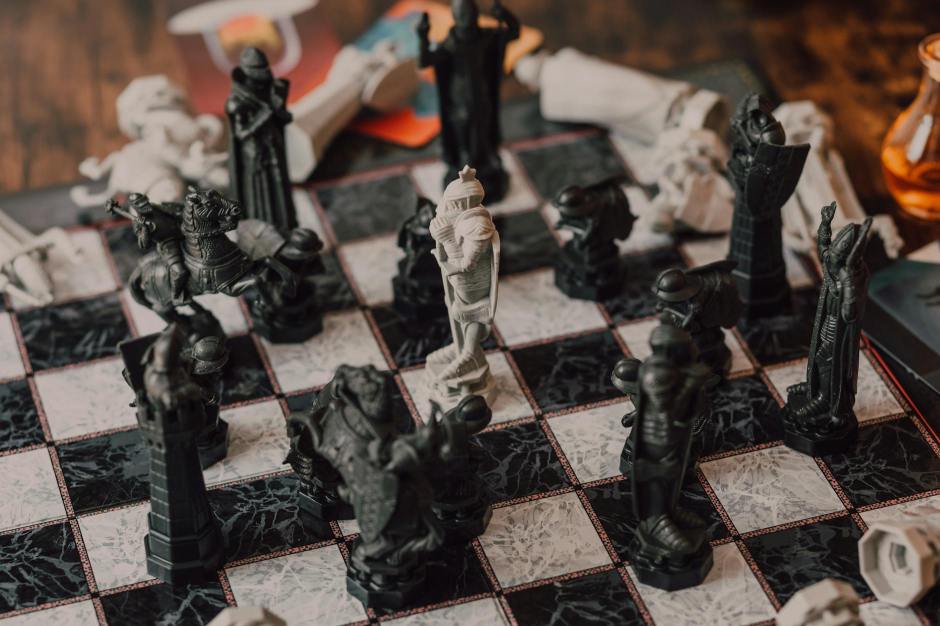
The words in a game or puzzle can inspire a short work of creative nonfiction.

 In fiction, the writer shapes the story to create pacing and tension. In nonfiction, the writer selects and amplifies truth to produce a compelling piece they hope others will want to read.

The nonfiction writer often relies on memory. Memory and research. The research often draws on the memories and writings of others.

How accurate are those memories?  According to the work of late 19th century German scientist Hermann Ebbinghaus’s research, graphed as a forgetting curve, much of what people experience each day is quickly forgotten.  In the May 20th 2024 issue of The New Yorker, writer Jerome Groopman, discusses in a book review the recently released book Why We Remember by Charan Ranganath.

Ranganath is a neuropsychologist at U.C. Davis and in his book, he discusses memory and how we may be looking at memory the wrong way. Memory, he conjectures, more likely functions as an adaptive trait to keep humans alive.  Selectively we remember some things and forget others. Perhaps the forgetting is as important as the remembering.

Photos may help prompt our memories, but sometimes what others tell us about a photo my influence our recollection.

From a writer’s point of view, I find it fascinating to hear how people’s memories of the same event can be slightly different. What do those differences reveal about each person?

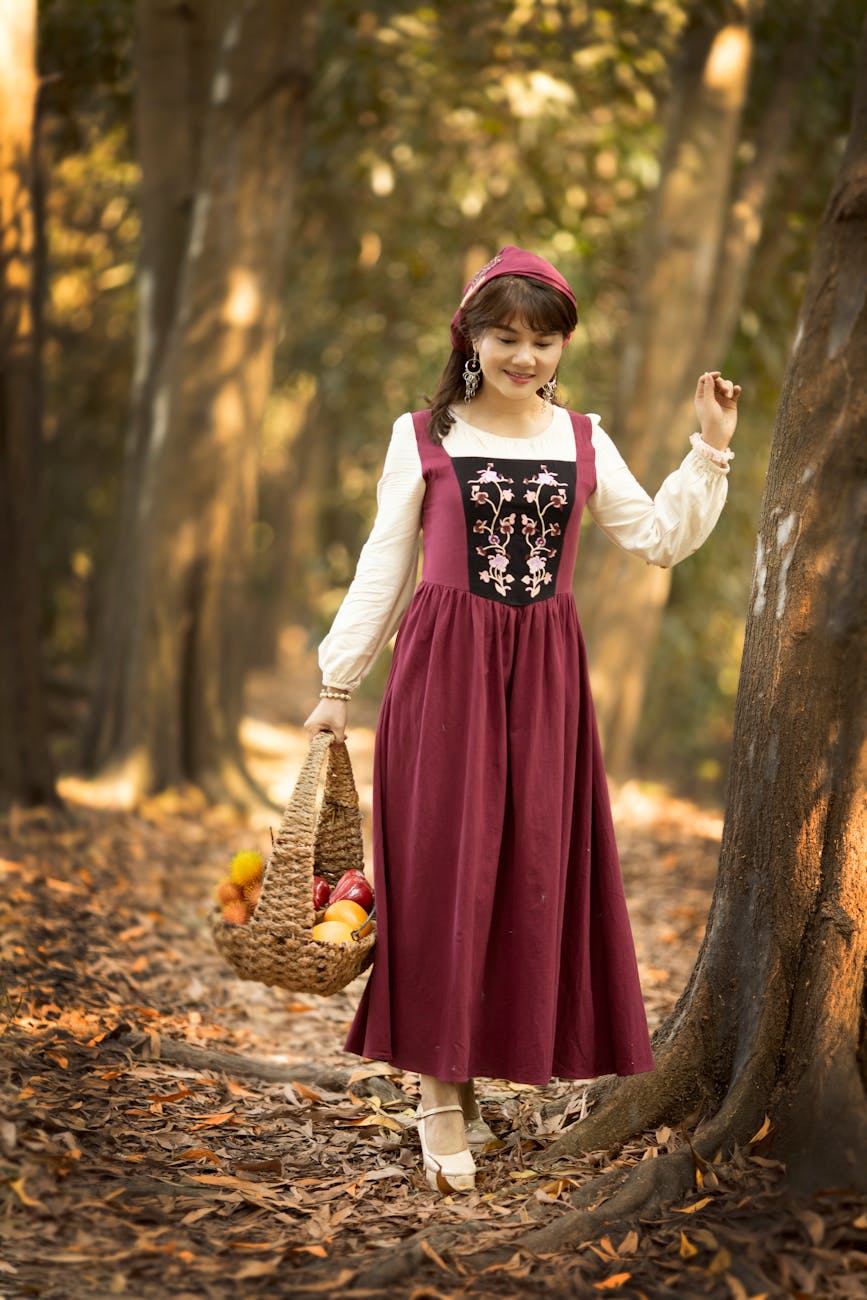
Folk tales and fairy tales clearly demonstrate how the same story can be adjusted to reflect the story teller’s preferences. In some versions of little Red Riding Hood, grandmother is locked in a closet in another she is swallowed by the wolf. In a family, one sister may remember beloved pet that was hit by a car and another may forget the pet because the memory is too painful.

Photo by Son Dang on Pexels.com

Prior to a trip to Ireland last year, I started reading the book, The Irish Assassins; Conspiracy, Revenge and the Phoenix Park Murders that Stunned England by Julie Kavanagh, to gain some understanding of Irish history. The three hundred plus page nonfiction narrative reads like a novel, but dialogue and descriptions are all based on meticulous research. The book has sixty pages of end notes and footnotes. 

But the sources themselves: diaries, letters, newspaper articles, trial transcriptions all have their bias—according to who wrote them. And Kavanagh reveals in many instances, the ulterior motives and prejudices some of the parties may have possessed in how they reacted to the events that took place.

Writing a short nonfiction piece, based on a personal experience can take the form of a letter, diary or puzzle. Part of the writing adventure is trying new things.

If we acknowledge our memories are always shapeshifting, I think it can give us a certain amount of freedom to experiment. Playing with episodic memory, using a trigger such as music, smell or taste, can provide a means to travel back to a previous episode in your life and re-examine it.

Photo by cottonbro studio on Pexels.com

WRITING PROMPT: A smell you love or a smell you hate. If you have the item around, use it as a trigger, if not try to remember it. What comes to mind. A person you were fond of? A party you attended? If you write something you like, put it away and revisit it the following week to review and edit. If the piece has power refine until it is ready and then if you want to share it, submit it to potential publishers.

About the author:

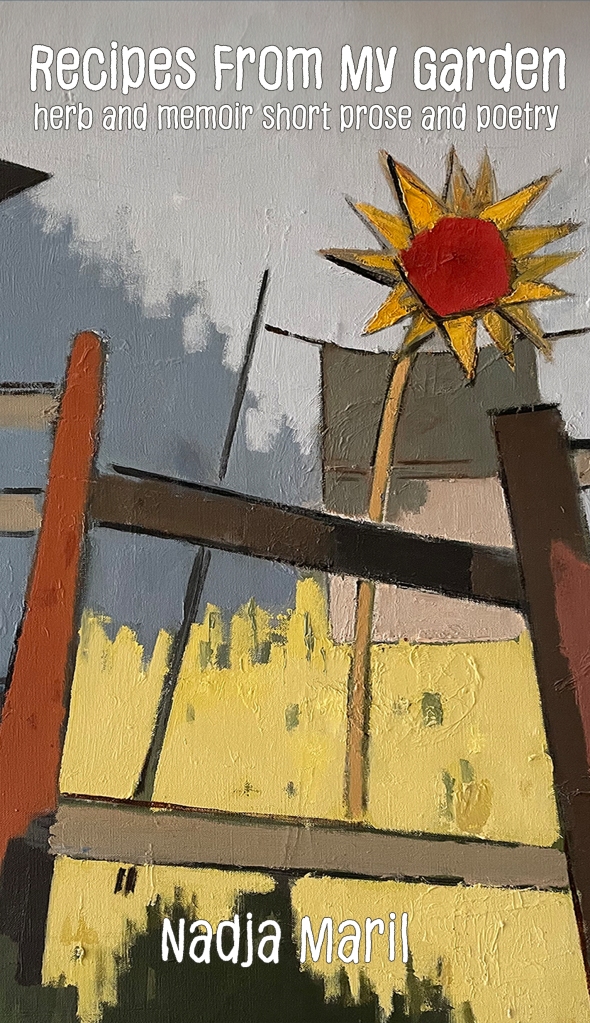
Nadja Maril is the author of Recipes from my Garden, Old Scratch Press, September 2024. Nadja Maril’s short stories, poems and essays have been published in dozens of small online and print literary journals and anthologies including: Lunch Ticket, Spry Literary Journal, Invisible City Literary Review, and The Journal of Compressed Creative Arts.She has an MFA in creative writing from Stonecoast at USM. A former newspaper columnist and magazine editor, she writes a weekly blog and you can visit her website at www.Nadjamaril.com.
Thank you for reading. Please sign up to follow us here on WordPress and on Facebook.

Creative Valentine’s Day Collage Poems

By Nadja Maril, a Founding Member of the Old Scratch Short Form and Poetry Collective

February is Valentine’s Day month. Instead of trying to send everyone Christmas and New Year’s cards, I like to surprise friends with Valentine’s Day cards. My handmade cards feature words as well as images. So why call them cards at all? They are actually Visual Poems. And because they are made from bits and pieces of collected words, colored paper and illustrations glued onto paper, they are also Collage Poems.

Try it. Once you created a few, you may become hooked. Many artists gravitate towards working in more than one medium. Visual art and poetry work well together. If you desire to be published, a market exists for creative work which combines the two mediums of visual art and words. I will providea list of publications at the end of this article. But first, let’s get started with a little inspiration.

Assembling the materials is part of the fun.

Valentine’s Day Origins

The name Valentine comes from Saint Valentine, and there are three men who are recognized as Saints by the Catholic Church. The most popular Valentine story, according to my research, is the one about the priest who performed secret marriages in opposition to Emperor Claudius II who ordered that all his soldiers remain single. Who the actual St. Valentine was is open to debate.  Maybe February 14th is the approximate date of one of the martyred  St. Valentines’ funerals, but it is remarkably close to the Roman fertility festival Lupercalia, once celebrated on the Ides of February ( February 15th).  In some Roman villages it is said that young men and women were matched up as lovers for a year in an effort to produce more children. A day that honored love and passion, in England and France February 14thwas the start of the birds’ mating season. 

The tradition of exchanging cards and love tokens is thought to begin in the middle of the 18th century. By the 19th century, the mass production of printed cards made Valentines’ cards even more popular. Gloves and handkerchiefs were two personal items lovers often gave to one another during the Victorian era. Flowers—pressed or fresh, as well as lines of verse given to our Valentine follow the romantic tradition of conveying ardor for those we adore. 

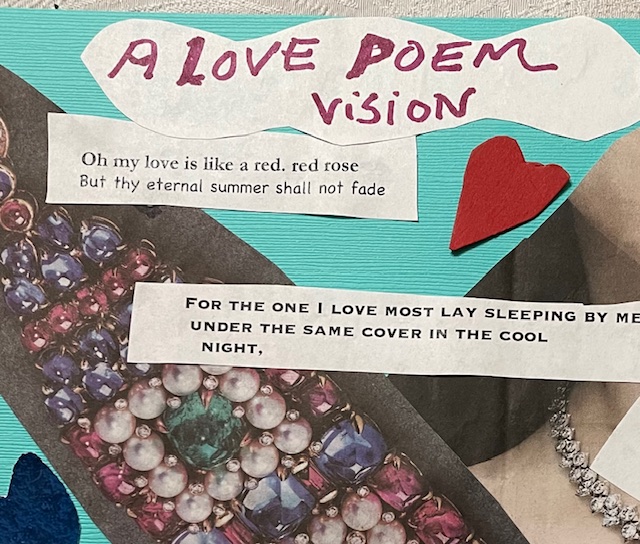
Collage Poem by Nadja Maril. This collage takes lines from several well-known poems and integrates them into a collage of images and shapes connected to love.

Collage

The word collage comes from the French verb coller, meaning to paste or glue. In visual art, a collage is comprised of pieces of paper, cloth or other gathered materials arranged and permanently attached to a surface. Old photos, advertising flyers, ticket stubs, magazine illustrations; are some typical collage materials. As a teenager I’d collect shells, dried seaweed, bits of sea glass to glue on to a flat piece of weathered wood; another type of collage. Whether you use buttons, lace, tissue paper, bits of colored plastic, feathers or fur- the possibilities really are infinite.

Now, think of a collage of words. Instead of collecting physical items collect words, phrases, entire articles that resonate with you. While modernist artists in the early 20th century were creating collages of shapes and colors, Avant-garde groups that included Surrealists and Dadaists took the form to another level by including language. Tristan Tzara famously advocated a “cut-up” method of composition, involving cutting out words from a newspaper and pulling them out of a hat to create a poem. Whether you take excerpts from a political speech, a nursery rhyme or a popular song, by incorporating a medley of sources you are creating a collage poem.

Take another step to combine a visual collage with a literary collage and you have a hybrid, a poem that provides a visual and verbal experience. Whether you want to call it a collage poem, a merging of two art forms or an awesome Valentine’s Day Card—that’s up to you.

Publications that Publish Work that Combine Images and Words

These are just a few to get you started.

A Velvet Giant

https://www.avelvetgiant.com/

ctrl +v

https://www.ctrlvjournal.com/

Diagram

https://thediagram.com/

Dream Pop Journal

https://www.dreampoppress.net/

Ghost Proposal

https://ghostproposal.com/

Instant Noodles Literary Review

The Offing

https://theoffingmag.com/

Timber

https://timberjournal.org/

If you need a different sort of Valentine’s Day gift, not the typical candy or flowers, considering purchasing a poetry chapbook and sending it to a friend. At Old Scratch Press we have published five chapbooks thus far, all under $9, with more to come.  Take some time out of your day for some quiet reflection and share the love. Whoever started the idea of a day celebrating our connection to one another, let’s try and keep it going.

Nadja Maril is the author of Recipes from my Garden, Old Scratch Press, September 2024. Nadja Maril’s short stories, poems and essays have been published in dozens of small online and print literary journals and anthologies including: Lunch Ticket, Spry Literary Journal, Invisible City Literary Review, and The Journal of Compressed Creative Arts.She has an MFA in creative writing from Stonecoast at USM. A former newspaper columnist and magazine editor, she writes a weekly blog and you can visit her website at www.Nadjamaril.com.

Thank you for reading. Please sign up to follow us here on WordPress and on Facebook.

Exploring the Role of the U.S. Poet Laureate

By Virginia Watts, Founding Member of the Old Scratch Press Collective

Many people have heard of title The United States Poet Laureate, official title Poetry Laureate Consultant in Poetry, but they do not know much about this position. The Poet Laureate serves for an eight-month term running from October to May, elected by The Librarian of Congress. Traditionally a poet will hold this title for two terms. In choosing the recipient of this prestigious title, the Librarian consults with experts in the field of poetry as well as former Poet Laureates. Additionally, suggestions from the general public are accepted.

The Poet Laureate only has two officials duties they must perform, two readings at the beginning and end of their term. The idea is that each Poet Laureate should be given the space and freedom to decide for themselves how they can use their role to encourage people throughout the nation to read, write and develop an appreciation for the art of poetry. The Poet Laureate receives a stipend of $35,000 and $5000 for travel expenses. Prior the 1986, the Poet Laureates were known as Consultants in Poetry. The well known poets Robert Frost and Gwendolyn Brooks were Consultants. Since 1986, there have been 24 Poet Laureates, Louise Gluck and Ted Kooser among them.

So, what have some of our Poet Laureates done during their tenure to spread the love of poetry?

In 1997, Robert Pinsky, the 39th Poet Laureate, put out an open call for people to share their favorite poem. Many Americans sent poems. Poems came flooding in from all ages, all states, from people of diverse backgrounds and interests. Pinsky’s call set off a domino effect leading to reading of favorite poems in hundreds of cities and towns.

Gwendolyn Brooks is well known for her focus on elementary school students. Early learning about poetry and writing it is bound to foster a lifelong love of the art form.

 Joseph Brodsky thought the best way to have people experience poetry is for them to find free samples of it in their everyday lives and places, such as airports and hotel rooms.

Billy Collins published an anthology inspired by his time serving as the United State Poet Laureate. “Poetry 180” makes it easy for high school students to read or hear one poem each day during their school year. Collins is often quoted as believing that poetry is a kind of social engagement, that a poem should feel like it reaches out and invites the reader inside.

Rita Dove brought writers with a focus on African diaspora together. Maxine Kumin focused on shining a light on the works of women writers and Joy Harjo, the 23rd United States Poet Laureate, was the first Native American to hold this honor.

Our current Poet Laureate is Ada Limon. She is from a Mexican American background and grew up in California. As part of her position, she penned a poem dedicated to NASA’s Europa Clipper Mission. Her poem is engraved in her handwriting on a metal plate aboard the Europa Clipper spacecraft. This spacecraft launched in 2024 and will enter the Juniper system in 2030.  Here is Limon’s gorgeous piece. She is one of the must-read poets of our times, well deserving of the title of United States Poet Laureate.

In Praise of Mystery: A Poem for Europa

Ada Limón

1976 –

Arching under the night sky inky
with black expansiveness, we point
to the planets we know, we

pin quick wishes on stars. From earth,
we read the sky as if it is an unerring book
of the universe, expert and evident.

Still, there are mysteries below our sky:
the whale song, the songbird singing
its call in the bough of a wind-shaken tree.

We are creatures of constant awe,
curious at beauty, at leaf and blossom,
at grief and pleasure, sun and shadow.

And it is not darkness that unites us,
not the cold distance of space, but
the offering of water, each drop of rain,

each rivulet, each pulse, each vein.
O second moon, we, too, are made
of water, of vast and beckoning seas.

We, too, are made of wonders, of great
and ordinary loves, of small invisible worlds,
of a need to call out through the dark.

Photo by David Kopacz on Pexels.com

“In Praise of Mystery” by Ada Limón was released at the Library of Congress on June 1, 2023, in celebration of the poem’s engraving on NASA’s Europa Clipper, scheduled to launch in October of 2024. Copyright Ada Limón, 2023. All rights reserved. The reproduction of this poem may in no way be used for financial gain.

About the author: Virginia Watts is the author of poetry and stories found in Epiphany, CRAFT, The Florida Review, Reed Magazine, Pithead Chapel, Words & Whispers, Sky Island Journal among others. She has been nominated four times for a Pushcart Prize and four times for Best of the Net. Her debut short story collection Echoes from The Hocker House won third place in the 2024 Feathered Quill Book Awards.

Virginia Watts grew up in Hershey, Pennsylvania and spent summer vacations in the Endless Mountains of Sullivan County with her Quaker grandparents. Many of her stories and poems revolve around small town life and rural roadways that are not always what they seem.

Thank you for reading. Please sign up to follow us on Facebook and to follow us here on WordPress to expand your knowledge about poetry and short form writing as well as to receive the latest news about publication opportunities.

Calls for Submissions: Instant Noodles Literary Review 2025

Nadja Maril, author of RECIPES FROM MY GARDEN, is one of the founders of Old Scratch Press

The Editors of Instant Noodles Literary Review, published three times a year, have announced the themes for 2025: Current, Sanctuary and Gravy.

Edited by members of the Old Scratch Short Form Collective who have volunteered their time, submissions are free. The Instant Noodles submission box which you can access through Duotrope is filling up fast.

While artists and writers selected for publication receive no financial renumeration, the publishers and editors do their utmost to promote the work in each issue. Instant Noodles nominates for industry prizes, Best of the Net and the Pushcart Prize. One of the magazine’s promotions is a zoom reading, giving contributors around the world a chance to meet.

Published three times a year, the magazine is posted online for everyone to read. One of the biggest reasons work gets rejected, is that writers don’t follow submission guidelines and familiarize themselves with the publication.

In addition to Visual Art and Multimedia Creations, the magazine publishes Prose & Poetry

Photo by Anni Roenkae on Pexels.com

Instant Noodles focuses on SHORT pieces. Short work 500 and 750 words in length can be powerful. If you are submitting prose, whether is it hybrid, nonfiction, or fiction, the word limit is 1000 words or less. 

All work must be original and must belong to the author. Works that have been previously published will not be considered. Stories must be complete and self-contained (i.e., do not submit chapters of a larger work). 

NOTE: Accepted works will be published as submitted without editing; as such, in addition to the originality of the work itself, we are looking for manuscripts that are clean and press ready. Be sure to review your grammar, spelling, tenses, proper punctuation, and other general rules of the written word before hitting “Send.” Work should be submitted through Duotrope as a Microsoft Word file (when it is poetry, drama, NF or fiction) as 12-point New Times Roman, double-spaced (single-spaced for poetry submissions). All other types of work have details as to their file types on the Duotrope page.

Connect to the Theme

The Editors request that submissions should have a connection to one of the themes for which they were submitted:  Current, Sanctuary and Gravy—and labelled as such.

They are looking for more submissions in the categories of creative nonfiction, drama, multimedia and visual art.

“When I’m reading poetry submissions for Instant Noodles,” Says contributing Poetry Editor Gabby Gilliam, “I’m looking for poems that concisely fit our theme and resonate. I want lines that linger in my mind long after I’m finished reading.

As a contributing editor, I suggest it is never too early to start contemplating ideas associated with our spring theme, current, as well as the subsequent themes that follow. What ideas does the word current evoke for you? Are you thinking about being hip, cool and up on “current” events or are you traveling on an air “current.”  Where does the word take you?

Try writing a story about yourself, something you observed, or something entirely imaginary. Create a video, a picture, combine two mediums.

Work should be publication ready

Do not submit until your piece is ready. Have you read your piece out loud and checked for misspellings and grammar mistakes? Does it fit the theme and are you ready to share it with the world?

The deadline for the spring issue with the theme Current is March 16th.  We look forward to reading your work!

Nadja Maril is the author of Recipes from my Garden, Old Scratch Press, September 2024.

Thank you for reading. Please sign up to follow us here on WordPress and on Facebook.

The Sounds of Home: A Writer’s Connection to the Beach

By Nadja Maril, a Founding member of Old Scratch Writing Collective

The dog is digging a hole in the sand. After chasing and fetching her ball numerous times, she has decided to bury it. It’s a game of make it disappear and find it again, a game she can play all by herself while I sit and listen to the waves slapping against the shore. I love this sound. It doesn’t matter where I am, if I’m near water coastline I’ll find a beach. The sounds of water soothe me. And I’m not alone in craving water sounds. A babbling brook, the torrent of a waterfall, the crash of ocean waves: are sounds that both inspire and invigorate.

Of the five senses—sight, smell, touch, sound, taste— one of the five will often be more prominently experienced than the other four. And this can change, depending on the situation. I find, when I tap into my memory bank, that sound is most frequently my touchstone. I think of a scene and I hear it. The rise and fall of the voices, crickets chirping, the sputter of an outboard motor, heavy breathing.

WRITING PROMPT

A classic writing exercise is to describe the place you call home.  If you are truly honest with yourself, the exercise will force you to select the place you long for, if you’re not already living there.  In order to describe it, you’ll be choosing the details that pop out in your mind.  The exercise provides a short cut, so to speak, to grasp what you value most.

Flash Fiction writers, you can use this prompt to channel you directly into the characters you create. Where do they feel most secure? It can tell you a lot about a person.

For me, home is the beach. It’s a happy place where I can walk for miles, build sand castles, swim in the waves and float on my back with the sun in my face. During childhood it was the Provincetown beach at the end of Kendall Lane. Today it is Cornhill beach in Truro a few miles away. The first glimpse of water and sand, the sound of the waves pushing into the shore, the smells of salt and seaweed, the wind against my face; I am home. From both beaches, if I look eastward I see the very tip of the Cape Cod peninsula curving around, creating a sheltered harbor. Out across the bay is Long Point Light Station.

When following a writing prompt or exercise, allow your thoughts to freely flow. Do not self-censor while writing. Once, you’re finished you can cut words, sentences or entire paragraphs. But if you analyze every word you select, you won’t get very far.

The subsequent step after spending twenty to thirty minutes writing a description of “home” is to read what you’ve written and look for patterns. Does one sense, such as smell, dominate the prose. Are there duplications of the same idea that cloud the focus? Challenge yourself to deepen the scene by adding action or dialogue.

Whenever I’m “stuck” and looking for a fresh something to write about. I challenge myself by creating a prompt or borrowing a prompt idea from another writer. The ideas are out there, you just need to make the time and have fun with what you create.

THANK YOU for reading. Have fun. And please, if you like my writing, you can support my efforts by buying a copy of my chapbook RECIPES FROM MY GARDEN– Poetry, Flash CNF and Short Essays (Old Scratch Press Sept. 2024) a great gift to yourself and for friends at $8.95. My chapbook is just one of the many fine books published by the imprint Old Scratch Press.

Exploring the Art of Haiku Poetry

By Virginia Watts

Many people are familiar with the haiku, an unrhymed form of poetry that dates to 17th Century Japan. It consists of three lines and observes a strict five, seven, five syllable count. Traditionally this form of poetry was about nature, often seasonal change captured in a moment of time. Matsu Basho is considered the be the haiku master who brought haiku into its place as a serious poetic form.

Here is one of his well know poems.

An old silent pond . . .

A frog jumps into the pond,

splash! Silence again.

People may be less aware of Western or American haiku which is often not as strict in form but nevertheless mirrors the traditional haiku. The reason for a more relaxed rule on syllable count is that the syllables in Japanese don transfer smoothly to English. Some famous poets known for American haiku are Amy Lowell, Sonia Sanchez and Ezra Pound.

Jack Kerousc

Then there is Jack Kerouac who wrote thousands of haiku and often included them in his correspondence and novels. Kerouac was a serious Buddhist who credited composing haiku with sharpening his mind. He was drawn to the idea of keeping poetry simple without trickery. Here is Jack Kerouac reading some of his Western haiku: https://www.youtube.com/watch?v=WMwAtOom7CA

The allure of the haiku form rests in showing the beauty in the ordinary, in the belief that simple moments should be captured and preserved. It’s fun to draft haiku. People are often surprised by how much they enjoy it. Some tips: Keep a notebook with you to jot down observations, ideas, those little, unexpected life events that none of us can predict. When you have something you want to write about, do it. Don’t worry if your idea seems silly. Write about what inspires you and don’t look back or question the inspiration. For a first drafting session, try grouping words in a loose 5 -7-5 format. Don’t try to be perfect or overthink this part. Go for flow, rhyme secondary to an honest reflection of what inspired you. The next step is to put your draft on the back burner. This helps with all forms of writing. After drafting, put a temporary distance between you and your draft.  As Jack says:

Nightfall—

too dark to read the page,

Too cold. 

—Jack Kerouac

In a day or two return and rework as necessary. Look for awkward syllables or weak word choices. Most of all, trust your gut. If the haiku represents what you wanted to capture and keep then you’ve done it!  Bravo! Drafting haiku is wonderfully addicting and rewarding. It’s like a bag of chips. You won’t stop at one.

Virginia Watts is a member of the Old Scratch Press Poetry and Short Form Collective and the author of Echoes from the Hocker House.

The Legacy of Edna St. Vincent Millay

By Nadja Maril

As a writer and a poet, I do a lot of reading. Sometimes I read a poem that resonates with me so strongly, I read it several times. Sometimes I commit a poem or favorite passage to memory to make it easier to revisit. One of those poems is

“Recuerdo”

by Edna St. Vincent Millay 

(February 22, 1892 – October 19, 1950)

It starts out

We were very tired, we were very merry—

We had gone back and forth all night on the ferry.

It was bare and bright, and smelled like a stable—

But we looked into a fire, we leaned across a table,

Composed of three stanzas, each containing three couplets, you can read the rest of the poem courtesy of the Poetry Foundation here.

Maybe it’s the rhythm, that mirrors for me the rocking of a ferry boat, the repetition of the line “We were very tired, we were very merry” that begins each stanza or the way she captures the exuberance of youth and the generous spirit of the poet and her companions, but I’ve always loved that particular poem.

Surprising, is how many people are unfamiliar with the name Edna St. Vincent Millay. The very first woman to win the Pulitzer Prize for poetry (1923), she was one of the most famous and successful American writers of the mid 20th century. Millay broke sales records and was a cultural celebrity who traveled across the United States giving captivating poetry readings to sold-out crowds.

A feminist, who openly loved both women and men, she was a prominent member of the literary community writing plays, publishing an opera libretto, as well as magazine articles under a pseudonym as well as publishing more than one dozen poetry collections. Her prize-winning poem “The Ballad of the Harp-Weaver” was dedicated to her mother. The poem tells a story of a penniless, self-sacrificing mother who spends Christmas Eve weaving for her son “wonderful things” on the strings of a harp, “the clothes of a king’s son.”

Raised in Maine by a single mother who elected to leave her husband during an era when divorce was not widely accepted, Millay was the eldest of three girls who largely had to take care of themselves while their mother would be absent from the house working as a homecare nurse. Surrounded by poetry, music and literature, Millay began writing her own poems at a young age.

WHERE TO LEARN MORE ABOUT EDNA ST. VINCENT MILLAY

To learn more about her complicated life, I highly recommend Nancy Milford’s biography, Savage Beauty; The Life of Edna St. Vincent Millay. Over 500 pages in length, it was comprehensively researched with the cooperation of Millay’s sister Norma, sole heir to the Edna St. Vincent Millay estate. and contains excerpts of Millay’s letters and poetry.

Here are two more poems to whet your appetite for Millay’s poetry.

“What lips my lips have kissed, and where, and why”

By Edna St. Vincent Millay

What lips my lips have kissed, and where, and why,

I have forgotten, and what arms have lain

Under my head till morning; but the rain

Is full of ghosts tonight, that tap and sigh

Upon the glass and listen for reply,

And in my heart there stirs a quiet pain

For unremembered lads that not again

Will turn to me at midnight with a cry.

Thus in the winter stands the lonely tree,

Nor knows what birds have vanished one by one,

Yet knows its boughs more silent than before:

I cannot say what loves have come and gone,

I only know that summer sang in me

A little while, that in me sings no more.

Vanity Fair 1920

“I shall go back again to the bleak shore”

By Edna St. Vincent Millay

I shall go back again to the bleak shore

And build a little shanty on the sand,

In such a way that the extremest band

Of brittle seaweed will escape my door

But by a yard or two; and nevermore

Shall I return to take you by the hand;

I shall be gone to what I understand,

And happier than I ever was before.

The love that stood a moment in your eyes,

The words that lay a moment on your tongue,

Are one with all that in a moment dies,

A little under-said and over-sung.

But I shall find the sullen rocks and skies

Unchanged from what they were when I was young.

To learn more about her life and times, information is available from the Edna St. Vincent Millay Society. https://millay.org/

The author of this blogpost, Nadja Maril, has been published in dozens of publications including, Defunkt Magazine), Lunch Ticket, The Compressed Journal of Creative Arts, BarBar and Across the Margin. A former journalist and magazine editor, Nadja has an MFA in Creative Writing from the Stonecoast Program at the University of Southern Maine. She recently published a collection of

poems and short essays: RECIPES FROM MY GARDEN– (Old Scratch Press Sept. 2024) a great gift to yourself and for friends at $8.95. To learn more about Nadja’s writing visit Nadjamaril.com

Step-by-Step Guide to Making Digital Monsters

By Robert Fleming

For Halloween what are digital graphic artists doing? Yours truly, is making digital images of monsters. Oops! Oh NO, I came out as a digital graphics artist. I will show you how, to make monsters.

My inspiration for monsters is the novel Frankenstein by Mary Shelley first published 1/1/1818. Since Mary died 2/1/1851 and Frankenstein sells 40,000 copies a year, who is collecting Mary’s royalties? Hmm?

Mary Shelley’s beautiful neckline     


Frankenstein, Mary’s first monster child

HOW TO MAKE YOUR OWN MONSTER

One of the computer software tools I use to create digital graphics is Canva which has a free and paid version.  Home – Canva.  To create a monster:

  1. access a device with www access
  2. choose your image which could be a photograph you took or an image which is free (in public domain) on the www
  3. cut away the parts you don’t want by cropping the image which is like using an electronic scissors
  4. if the image background has a border frame (like white) you don’t want, you can remove it by using computer software to remove background like Adobe Express Free Image Background Remover | Adobe Express
  5. on the www go to Canva
  6. in Canva create a Design
  7. upload your image(s) into Canva (toolbar to the left of your image)
  8. copy/move your uploaded image to your design page
  9. click on the image
  10. duplicate the image page (so you will have the original), toolbar on the top right of the image, click on the +
  11. move your curser to the duplicate image
  12. click on edit, toolbar above your image, left side
  13. on left side of image, click on apps “see all”
  14. click on Liquify (4th row, far right)
  15. click on Flow (2d row, far right)
  16. set the flow options: melt amount 1 / melt scale 1/ woble amount 1 /woble scale 1
  17. if you like the image, click on “save”
Original Image
Edited Monster Image

ADD COLOR

if you are confidant and feeling adventurous, then add color to the image
click on the image

click on edit

click on the app ColorMix

click on the parakeet (2nd row, far right)

if you like the image, click on save

Monster image with different color.

Another example: Transforming a photograph using a funhouse technique.

Original Image

       edited monster image like mirror in fun house
 

DIRECTIONS

return to Liquify

Click on Melt (1st row, 2nd column)

set the melt options: melt amount .5 / melt scale .5

if you like the image, click save

I send you courage to make your own digital graphics monsters.

Yours Truly is:

Robert Fleming, a contributing editor of Old Scratch Press

OLD SCRATCH PRESS – a poetry/short-form collective | estd. 2023

who published an Amazon best seller visual poetry book: White Noir

white noir: Fleming, Robert: 9781957224183: Amazon.com: Books

an editor of the digital magazine Instant Noodles

About – INSTANT NOODLES

the creator of an upcoming horrorthon banner for Oddball Magazine, to be released +-10/27/2024

The 2024 Horrorthon: A Call for Submissions – oddball magazine

and the creator of an upcoming magazine cover for Tell-Tale Inklings #7, to be released Autumn, 2024

(1) Tell-Tale Chapbooks | Facebook

THANK YOU FOR READING. Follow Old Scratch Press on Facebook. https://www.facebook.com/OLDSCRATCHPRESS/      

The Healing Power of Poetry

By Virginia Watts

Poetry is an old art form dating back to ancient Greece. Why has it been with mankind so long? For one thing, writing and reading poetry is good for us. It allows us to manage our emotions which in today’s complicated and divided world can be an overwhelming task. During the recent pandemic many literary journals called for submissions about their experiences during the pandemic. Many poets answered the call, and no doubt felt better for it.

During the months of lockdown, people all over the world lost many things. We were suffering. Some of us lost loved ones, some of us were very ill ourselves. We all lost our normal sense of community, isolated as we were. Humans aren’t meant for isolation. Many people were lonely. Things we enjoyed such as travel, comradery in an office or school setting, had to be put on hold. Writing poetry and sharing poems created a bond among people when it was sorely needed.

 As it turns out, poetry can be a powerful healer. Rhythmic language is soothing. Think of a lullaby. Poetry also helps us contemplate and reflect our lives back to us. Through poetry, we learn about different cultures and histories which helps us to stop focusing on ourselves and leads to a better understanding among peoples.

 Through poetry we can stop to appreciate and experience what is beautiful in our world or share a poet’s experience with something we are also struggling with. This improves our mood. Poetry is often read to hospitalized children to reduce their fears and worries. Additionally, reading poetry out loud has been shown to slow breathing and help a person relax.

            So, three cheers for all the healthy things poetry does for the human body and spirit. During the pandemic I remember reading this famous poem by Maggie Smith. It has stayed with me.

Maggie Smith, poet

Good Bones

By Maggie Smith

Life is short, though I keep this from my children.

Life is short, and I’ve shortened mine

in a thousand delicious, ill-advised ways,

a thousand deliciously ill-advised ways

I’ll keep from my children. The world is at least

fifty percent terrible, and that’s a conservative

estimate, though I keep this from my children.

For every bird there is a stone thrown at a bird.

For every loved child, a child broken, bagged,

sunk in a lake. Life is short and the world

is at least half terrible, and for every kind

stranger, there is one who would break you,

though I keep this from my children. I am trying

to sell them the world. Any decent realtor,

walking you through a real shithole, chirps on

about good bones: This place could be beautiful,

right? You could make this place beautiful.

Copyright Credit:
Maggie Smith, “Good Bones” from Waxwing.  Copyright © 2016 by Maggie Smith.  Reprinted by permission of Waxwing magazine
 

Source: Waxwing magazine (Issue IX, Summer 2016) (2016)

To learn more about the writer/poet Virginia Watts, check out her short story collection https://www.amazon.com/Echoes-Hocker-House-Virginia-Watts/dp/1957224177/

Exploring Horror Writing: A Q&A with R. David Fulcher

We learn from asking questions, and what better way to explore the craft of writing than through an engaging Q&A with an author! This month the author I’m interviewing is R. David Fulcher who happens to be a member of the Old Scratch Press Poetry and Short Form Collective.

R. David Fulcher is a talented author with multiple books to his name. His most recent work, a captivating short story collection titled THE PUMPKIN KING AND OTHER TALES OF TERROR, showcases his passion for storytelling. A writer of both poetry and prose, he deeply loves speculative fiction, particularly science fiction and horror. You can explore more of his work on his blog at Rdavidfulcher.com.

This is the perfect month—the season of ghosts and goblins—to delve into the exciting craft of writing horror. Most of my questions in this post will focus on the intriguing insights from THE PUMPKIN KING AND OTHER TALES OF TERROR. Let’s celebrate the art of writing together!

Q: Question

R: Response

R. David Fulcher

Q: As a writer, what is your primary goal when interacting with your readers?

R: As a horror writer, I have two primary goals: 1) Establish an “eerie” atmosphere; and 2) Elicit a physical response in the reader. Yes, I hope to stimulate the readers’ minds as well, but I primarily want to elicit fear – a racing pulse, the small hairs standing up on the back of your neck, a shiver in your spine – only good horror tales have this effect.

Q: Was there a specific moment you remember, perhaps an experience that spurred you on to want to write this particular book?

R: The Pumpkin King and Other Tales of Terror (and the follow-up volume “Asteroid 6 and Other Tales of Cosmic Horror”) is sort of a “greatest hits” collection of my short stories, so unlike a traditional novel the stories were developed over many years and inspired by many moments and experiences throughout my life.

To give a sense of the age of some of the stories, the title story “The Pumpkin King” first appeared in a small press magazine entitled Mausoleum back in 2001!  Of course, all the stories have been heavily revised in the new book.

To provide an experience that spurred me to write a particular story, “Castle Marienburg” was inspired by a tour of that very castle during a visit to Germany in college.

Q: As both a horror writer and a poet, how has Edgar Allen Poe influenced your work?

R: In a way, Edgar Allen Poe led me to my genre. My high school English teacher taught a semester on Poe, and I was hooked.  I started writing dark, gothic short stories that day after school and submitting them to small press magazines shortly thereafter.

Q: Writing poetry and writing prose, how has the two different types of genres influenced each other in your writing?

R: My love for both poetry and prose has caused me to experiment with inserting sequences of poetry into my fiction.  Some examples of my stories that include embedded poems are “A Night Out with Mr. Bones”, “The Faerie Lights”, and “All Across the Mountain”.

Q: Did you work alone or did you rely on some feedback from others?

R: I initially write on my own, but I really enjoy it when people close to me review my work and give feedback on it.  For example, my brother Dale helped proofread the manuscript for The Pumpkin King and Other Tales of Terror, and after reading my short story “Asteroid 6” my wife Lisa was really impressed with the tale, so I was inspired to title my second volume coming out this Fall as “Asteroid 6 and Other Tales of Cosmic Horror”.

Of course, my publishers David and Dianne are also tremendous editors and their feedback has been essential to my work.

Q:Do you imagine you are writing for a specific person or a certain audience?

R: No specific audience. I will say that my writing is almost always in the realm of the fantastic, so fans of my work must be able to “suspend their disbelief” and just go along for the ride, trusting me to take them to a magical, almost unbelievable ending, even if all the facts don’t line up with reality. I think fans of hard science-fiction (Isaac Asimov, etc.) will have a hard time enjoying my work.

Q: How do you approach revision?

R:This goes back to things I’d tell my former self.  I used to put down the pen (yes, I write my stories out long-hand!) after a long, intense burst of writing (sometimes an entire story in a single sitting), push the manuscript back on the desk with a smile, and say “Perfect!”

I would then immediately submit the tale for publication, only to receive rejection after rejection, never understanding why.

I’ve finally learned that being a professional writer means spending almost twice the amount of time revising your work as you spent writing it in the first place.  So I approach it like work. I allocate time for editing/proofreading, I set deadlines, and I hold myself to them. The difference between my original manuscript written after a burst of artistic inspiration and the manuscript after several rounds of revision is often night and day.

Q: If you could give advice to your younger self, what would you want to tell them?

R: I’d remind my younger self that the success of a book is up to me. I used to self-publish with AuthorHouse (formerly 1st Books) and believed that getting my book on Amazon and buying the publisher’s “marketing kit” would instantly propel me to fame and the bestseller’s list.  I have learned the hard way over the years this is not the case. Publishing the book is just Step 1.  The real work is in the marking and promotion.

Q: How did you find your publisher or did they find you?

R: David and Dianne of Devil’s Party Press (now Current Words Publishing) met at the Indie Lit Fest at Frostburg State University in Frostburg, MD.  At the time they were accepting submissions for one of their Halloween Party anthologies and provided me with the information.  I submitted and was accepted. The rest as they say is history! 

Q: Do you have a specific horror story favorite you’ve read?

R: Several novels by modern horror writers have had a tremendous influence on my writing.  They include “Something Wicked This Way Comes” by Ray Bradbury, “The Tommyknockers” by Stephen King, and “HIdeaway” by Dean Koontz.

In your own portfolio, a story you are particularly proud of?

R: I have a few favorites among my stories that don’t always correlate to fan favorites.  The first is “Castle Marienburg”, which was originally titled “Eyes in the Night”. A horror editor in the small press called it one of the best horror stories he had ever read, which was very satisfying. Others include “Spectra’s Masterpiece”, a science fiction story about AI published back in the early 2000’s well before AI became a commonplace topic, and “The Land Spider” in the way that it incorporates native American mythology.

Q: Do you have a “day job” to help pay for your writing habit, and it so, has it impacted in any way your writing?

R: During my day job I work as an IT Contractor.  My work with computers has spilled into my fiction with my stories “ELECTRIC”, where a boy becomes one with his home computer, and “The Witch Toaster,” where a group of programmers within an IT Department must battle supernatural forces.

Thank you for reading and visit the Old Scratch Press Website to learn more about our authors and upcoming publications.