Join the Masquerade! Writing Persona Poetry

If you’ve never written a poem in any voice but your own, you might want to try writing a persona poem—it may lead you down unexplored paths of creativity!

The Academy of American Poets defines a persona poem thus:

“A persona poem is a poem in which the poet speaks through an assumed voice….Also known as a dramatic monologue, this poetic form shares many characteristics with a theatrical monologue: an audience is implied; there is no dialogue; and the poet takes on the voice of a character, a fictional identity, or a persona.”

The voice you adopt when you write a persona poem can be a fictional, imaginary or historical character, an animal, an inanimate object, a collective such as a country, or even an omniscient god-like voice.  This is when the fun begins!

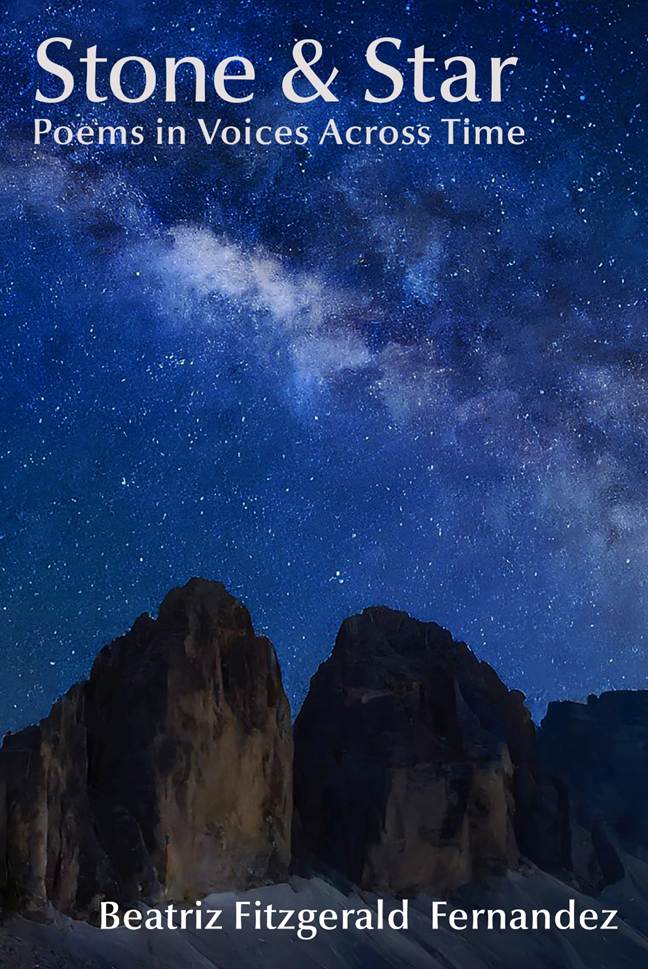
In “Richard the Lionheart’s Mummified Heart Examined,” a poem inspired by a true story and reprinted in my latest collection, Stone & Star: Poems in Voices Across Time, I alternately adopt the voice of the King’s Minstrel, the Royal surgeon, Richard I, his wife Berengaria of Navarre, the heart itself, and the forensic scientists who examined the heart in modern times.  Needless to say, this was a fun poem to write and the voices seemed to meld seamlessly to tell the story.
In psychological terms, Jung described persona as a social mask that conceals “the true nature of the individual.”  The term originates from the theater in ancient Greece where actual masks were worn by actors on stage to represent different points of view.

However, I find that writing persona poetry rather than concealing, frees the writer to reveal their subjective truths to the reader without the constraints of their own personality. 

Writing persona poetry is the closest I will ever come to acting, and I find it incredibly liberating.  I first found my own voice via persona poetry and it is still my favorite poetical form to use.

When writing as a historical character, I do some research and try to read letters written by that person if they are available, to pick up some of their personal vocabulary.  The way they address and sign their letters, their general tone, their “voice” is usually apparent and I use that to guide my own writing of the poem. 

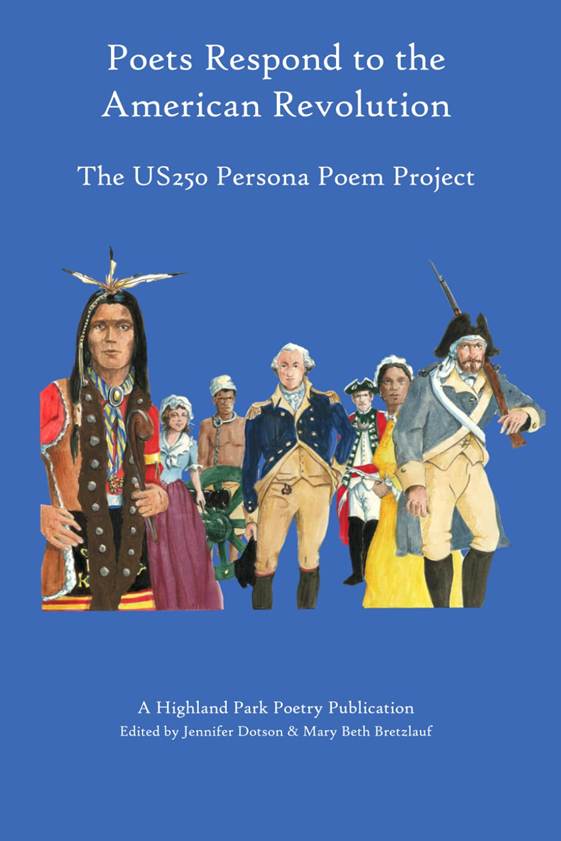
Recently, my poem “Lafayette Gingerbread” was published in an anthology,  Poets Respond to the American Revolution: The US250 Persona Poem Project by Highland Park Poetry, which was devoted entirely to persona poetry about U.S. history from 1765-1800, leading up the American Revolution. 

We were asked to write from the point of view of fictional or historical persons, animals or objects:  one poet wrote from the perspective of Brown Beauty, the horse Paul Revere rode, some wrote from the perspective of symbols such as the Tree of Liberty or the Liberty Bell.
When writing as a fictional character, I try to stay within the confines of the work they appeared in, and use vocabulary suited to the time period of the novel.  I have fun imagining what some fictional characters would say, given a chance, especially when in the original work they were not given much dialogue.  In this spirit, I’ve given voice to Weena, the Time Traveler’s mostly mute companion in H.G. Well’s The Time Machine, and Nova, the beautiful mute heroine in the original 1968 Planet of the Apes film. 

I find most of the persona poems I write are emotional in nature, speaking from the heart in a more direct and universal way than I could write from my own limited experience. Some writers may feel uncomfortable putting words into another’s mouth, so to speak. Unlike novelists or playwrights, who regularly write dialogue for fictional and in some cases historical characters, poets are used to thinking of their writing as highly personal and not open to other’s voices. But isn’t most poetry persona poetry, in a way?  Because whenever we write, we almost unconsciously adopt a persona, a writing voice, that is not our everyday voice, but which nonetheless reflects our authentic and true nature.

Beatriz F. Fernandez is a poet and short fiction writer. Join me for my November 1st reading (along with Miguel Mitchell) as part of the Speculative Sunday Reading series!  Presented and moderated by Akua Lezlie Hope. Readings are live on Zoom and tickets are free via the Eventbrite link.

Thank you for reading and please follow us here and on Facebook:  https://www.facebook.com/OLDSCRATCHPRESS/

Old Scratch Press’s latest publications: Old Scratch Press Catalog
APRIL is National Poetry Month. Time to Start Celebrating and Sharing Our Favorite Poems!

April is almost here, time for National Poetry Month, an entire month to celebrate poetry. Do you have a favorite poem or poet? Let us know and we’ll try to post a story about the poet or the poem on the Old Scratch Press website.

National Poetry Month was launched in 1996 by the Academy of American Poets as a way to promote educational events that encourage students to interact with poets and poetry.

Photo by Andrea Piacquadio on Pexels.com

One of these programs sponsored by the Academy of American Poets is called Dear Poet. Designed for students in grades five through twelve, participating students can write letters in response to poems this year ( 2024)  read online by Patricia Smith, Ed Roberston, Mara Pastor, John James, Nikky Finney, Nicole Cecillia Delgado, Marilyn Chin, and Chen Chen.The submission period for Dear Poet 2024 is now open until April 22, 2024.

If asked, who is my favorite poet it really very much depends on the time of year, time of day, and my mood because I was lucky to have grown up in a household filled with poetry books.

My mom was an English major and she enjoyed reading me her favorites. At a young age I listened to Gerald Manley Hopkins, T.S. Elliot, Robert Frost and Emily DIckinson.

Children love repetition, and when they discover a favorite story they like to have it read to them over and over again. Many Many times I’d ask to be read my two favorite poetry books in pre-school: A.A. Milne’s When We Were Very Young and Robert Louis Stevenson’s, A Child’s Garden  of Verses.

I remember reading to myself “The Swing” at age eight.

The Swing

Photo by Ksenia Chernaya on Pexels.com

By Robert Louis Stevenson (1850-1894)

How do you like to go up in a swing,

             Up in the air so blue?

Oh, I do think it the pleasantest thing

             Ever a child can do!

Up in the air and over the wall,

             Till I can see so wide,

River and trees and cattle and all

             Over the countryside—

Till I look down on the garden green,

              Down on the roof so brown—

Up in the air I go flying again,

              Up in the air and down!

I found all the poems in When We Were Very Young to be irresistible, but my constant favorite was the one about that difficult girl named Mary Jane.

Rice Pudding

By A.A. Milne ( 1882-1956)

What is the matter with Mary Jane?
She’s crying with all her might and main,
And she won’t eat her dinner – rice pudding again –
What is the matter with Mary Jane?

What is the matter with Mary Jane?
I’ve promised her dolls and a daisy-chain,
And a book about animals – all in vain –
What is the matter with Mary Jane?

What is the matter with Mary Jane?
She’s perfectly well, and she hasn’t a pain;
But, look at her, now she’s beginning again! –
What is the matter with Mary Jane?

What is the matter with Mary Jane?
I’ve promised her sweets and a ride in the train,
And I’ve begged her to stop for a bit and explain –
What is the matter with Mary Jane?

What is the matter with Mary Jane?
She’s perfectly well and she hasn’t a pain,
And it’s lovely rice pudding for dinner again!
What is the matter with Mary Jane?

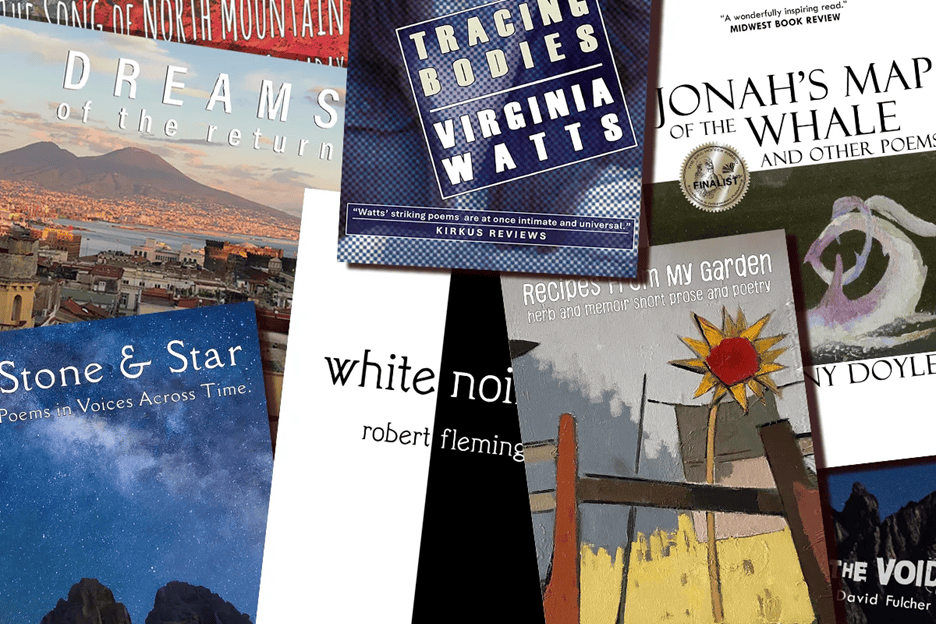
If you have school children, don’t forget to check out all the poetry programs this month and whatever your age make a point of reading a poem a day. The Old Scratch Press is trying to make new poetry more available by publishing several chapbooks each year, so check out what’s in our catalogue and what is about to be released by following us here as well as following our Facebook page. Thank you for reading.

National Poetry Month A Time For Reading-Out- Loud

April is the month for poetry, and in the part of the United States where I live, I’m fortunate to have a hiking trail where years ago small signs were posted with quotes from poetry. What a delight, to only hear the sounds of my shoes crunching into the dirt and the twitter of birds and insects, blue sky overhead, surrounded by green. I pause and read the poem painted on a wooden sign. If I am with a friend, I read it to them aloud. If I am alone, I still read it out loud to myself, because poetry is meant to be heard.

National Poetry Month was established in 1996 by the Academy of American Poets. According to the Academy, it is the largest literary celebration in the world. Listening to a poet read their own work is a treat. Click on the previous link to see and hear Joy Harjo read one of her exquisite poems.

One of the earliest poets I was introduced to in school was William Shakespeare. Today, due to the evolution of the English language, his works are not as frequently read. Some of the words and phrasing may seem “odd” to your modern ear, but listen to the phrasing and the selection of vowel sounds and consonants. Read him aloud and his work may start to grow on you.

Discovering new poets and rediscovering forgotten favorites, is part of the fun of National Poetry Month.

Writer and Artist Morgan Golladay, a founding member of the Old Scratch Poetry and Short Form Collective, created this beautiful piece of artwork featuring a flower found in many spring gardens, Impatiens.

Sonnet 98: From You Have I Been Absent in the Spring

BY WILLIAM SHAKESPEARE

From you have I been absent in the spring,

When proud-pied April, dressed in all his trim,

Hath put a spirit of youth in everything,

That heavy Saturn laughed and leaped with him.

Yet nor the lays of birds, nor the sweet smell

Of different flowers in odour and in hue,

Could make me any summer’s story tell,

Or from their proud lap pluck them where they grew:

Nor did I wonder at the lily’s white,

Nor praise the deep vermilion in the rose;

They were but sweet, but figures of delight

Drawn after you, – you pattern of all those.

    Yet seem’d it winter still, and, you away,

    As with your shadow I with these did play.

IF you have a favorite poet or poem you’d like to share, let us know. Follow us on WordPress, Facebook, and Twitter.

Thank you for reading.