YIKES! Don’t Publish That!

One of the perks of running Old Scratch Press (OSP) and Instant Noodles Lit Mag (IN) is that I (we, OSP) get to belong the Community of Literary Magazines and Presses. They are incredibly helpful, and have so many resources we can use, including the ability to ask the other presses questions through the LISTSERV.

This week I listened to a webinar from a bit back on what you can and cannot use from others’ work in your work… spoiler alert, nope. nope, nope, you cannot use those Taylor Swift lyrics, no matter how perfect they are for your piece. Why? Because Taylor wrote them, for her piece. Cry me a small stream (see what I did there?) but you gotta write your own!

One form the webinar really did not recommend was Cento. And from the looks of my very unscientific Google search, there are a lot of them:

Well, why not?

As in the Taylor Swift example, those poets wrote those lines in their poems, to express their thoughts, and that doesn’t mean you can co-opt them, even though it is a fun writing exercise to try to knit them together. They also recommend against publishing Golden Shovels.

The webinar, for CLMP members, was helmed by Jeffrey Levine (a lawyer and Publisher of Tupelo Press) and Fred Courtright (President of The Permissions Company). And I was shocked to find out how many instances there are where authors should be getting permission, but maybe aren’t.

Copyright is, very basically, attached to intellectual property, so something we cannot touch with our fingers, even if those ideas are pressed into an LP, or printed in a book, or applied to watercolor paper. It’s the imaginings, the wordplay, the artistic or editorial or even advertising verbiage, or the design, creation, work of another artist. And we can’t use what isn’t ours without permission from its creator, or, and maybe more likely, its rights holder. Frankly, and this is where some writers disagree with me, this makes perfect sense to me if I think about someone taking my work, and using it in their own piece, and it also makes sense to me as an artist. I want so badly to use the lyrics to songs that I imbue with this meaning and emotion that only they can have, and it’s tougher to come up with my own “pretend” song, but I really need to push my writing to the next level, and do it. You don’t have to register your work with US Copyright to be protected, but we do copyright all books we publish as a matter of course.

What does copyright leave out? It does not apply to material that is not truly original, to anything already in the public domain, or to broad concepts such as ideas, systems, processes, or methods. Those belong more to patent and trademark, which overlap only in small ways that I’m not expert enough on to explain, so investigate. Copyright also does not cover names, titles, slogans, or very short phrases. In literary settings, though, it is usually safer to treat even brief lines as if they might be protected, simply to avoid trouble. How long does copyright protection remain in place? In most cases it lasts for the lifetime of the author plus an additional seventy years. For anonymous work or work created as a work for hire, the term is different. It lasts either ninety five years from the date it was first published or one hundred twenty years from the date it was created, and it ends when the earlier of those two periods runs out.

The publisher never takes copyright. The copyright remains with the author. The publisher only licenses the copyright, meaning the publisher has the right to print (or otherwise make available) or produce the work for some (limited) period of time. But if you publish a poem, for example, with a publisher, and you sign a contract, that poem may “belong” to the publisher for the duration of the contract. We’ve never held back an author from taking a work back or using it somewhere else, but I cannot speak for all publishers, so, though it should not be a problem to include in your chapbook a poem you published somewhere else, you may have to obtain permission to reprint it in another place. Do you have time to do that?

Another really interesting point the webinar brought up was that if a work is in the public domain, you do not need permission to use it. Fair use is a grey area, and so I would never recommend deciding on your own that something is fair use. I would suggest you contact Fred.

If you want to use an old poem in its original language, a piece that is long out of copyright, you can quote it freely. But if you want to use a modern translation of that same piece, the translation is probably under copyright. If you want to use something that is still in copyright, you might need permission from the copyright holder and also the holder of the copyright of the translation, and suddenly you’re in the weeds. And a lot of this costs money, to track down the copyright, and to pay for use. The webinar recommended the Watch File at the Harry Ransom Center as a good place to start. One person on the call said she often would ask bands directly, on their social media, if she could use their music or lyrics, but the presenters pointed out that while the band may (may, important distinction) hold copyright, someone else may hold the rights, and those folks could have very good “bots” looking for it on the internet, and show up with a big bill for you.

Even internet memes, tweets, etc., could belong to the person who posted them, and there could be consequences (of the financial kind is what we’re talking here) for you if you use them. And I liked that they made it clear that attribution (taken from “Friend of the Devil” by the Grateful Dead) does not give you permission: you can still find yourself on the hook for a lot of money. Yikes! And just because the author of a poem holds the copyright this doesn’t mean they’re not in a publishing deal where the publisher might own the reprint rights. You have to check it out to be sure.

The advice out there can differ greatly, and even The Poetry Foundation may have advice about fair use that the federal courts would not agree with, so the webinar strongly recommended that you either get permission, using someone like Fred, or skip it.

What do you think? Have you been playing with licensing fire? I am always encouraging authors to start an editing and publishing fund, but you may need a violation fund too! I hope not!

So friends I hope that you can sees
"fair use" doesn't grow like leaves
and poets and other fools like me
as much as you would like it free
accept that permission has a fee
and you can't pick from another's tree.

Dianne Pearce is the chief editor and bottle washer at Current Words Publishing, and the half-cocked imaginer behind Old Scratch Press and Instant Noodles. Pearce loves helping writers realize the dream of having their work published. I mean she is really crazy about doing that for some reason. To that end, to join in the fray, to look at the thing from the other side, to stand in another’s shoes, and all of those things, she is fully expecting and promising to publish her first collection of poetry, In the Cancer Cafeteria, spring of 2026. Please don’t hold your breath. For very long. Happy Holidays!

Motorcycle Betrayal Poems

When I was in school studying writing, I had some just lovely, encouraging professors. One of them was Christopher Buckley.

Chris was always telling me other poets I reminded him of. One of those was Charles Simic, and another was Diane Wakowski. Chris was so wonderful, in fact, that he had studied with Diane, and he helped me organize for her to come and do a reading on campus, from Michigan to West Chester, Pennsylvania. It was a little bit strange, meeting Diane, because I had imagined her to be like if Twiggy and Patti Smith were merged into a single person who wrote kick-ass poetry. In reality she was a tiny thing, and a little prickly around the edges. I was star-struck and shy. I had read (lord knows how, as we didn’t have the internet, maybe in one of her poems) that she was a huge fan of freshwater pearls, and I bought a necklace and bracelet to give to her. She didn’t open the gift in my presence, and I never heard from her to hear if she liked them. But, in my very young mind, I thought she was everything I wanted to be: full-time professor, writing poetry all the time, and just generally badass, which, I guess, included being a little prickly and unfriendly. As introverted as I am, I am also a people-pleaser, so though I don’t want to talk in situations where I don’t know everyone, I do talk, because I am worried about not being nice enough to everyone else. And then I am exhausted after. Maybe Diane had already learned the art of taking care of herself. She was born the year after my dad, so she was well into middle-age when I met her.

The book I have pictured at the start of this post is the one that made me love her: The Motorcycle Betrayal Poems. I mean, she got on motorcycles. My sister (younger than me by 8 years) once had a motorcycle boyfriend, in fact he was a sweet guy, and we’re all still friends with him, and he once let me climb on behind him so that he could drive me around Sea Isle City on his motorcycle. But, to stay on behind a rider, you have to hold on to the rider’s body, and Reuel (the boyfriend) was incredibly fit and hot, like Brad Pitt in Thelma and Louise hot. I felt so afraid of falling off and dying and so wrong for gripping onto his body for dear life that I cut the ride short. Diane would not have cut the ride short even if it was with her sister’s hot boyfriend. Diane has always seemed to me like a woman who knows who she is and what she wants, and gets what she wants. She might have been the Taylor Swift of the 1970s, because to date her, and to break up with her, was to have a vicious poem written about you.

Dedication in the original The Motorcycle Betrayal Poems

At that point in my life I thought I had all possibilities ahead of me, as young optimistic people do. I thought I could become a thin woman who rode on the back of motorcycles and penned vicious poems about love. Diane also seemed… horny, which, raised by a very Methodist mother who got pregnant as a teenager, I was not allowed to be, so that seemed very flash and exciting to me too.

Honestly, you may think it silly yo say, because poetry is just poems, no big deal, but being a poet was such a monumental thing to me that I’m still trying to give myself permission to do it. Permission Diane never seemed to need, but Dianne definitely needs, to this very day.

If Diane was a sort of a hero, but not the warmest or nicest hero, why bring her up to you? Why not just let her, and her work, slide into obscurity?

I think because she is an unapologetic woman; she is who she is, lusty, strong, angry, successful (even if success did mean getting stuck in Michigan!), and felt no need to be mushy with a grad student who idolized her. No grad students have idolized me, but I expect it could be annoying as well as nice.

I told my sister last week that we’ve lost two Diane’s this year, Keaton and Ladd, both single Ns, unlike my double. Wakowski is up there, and also a single N. I don’t know if I can lose another one this year, so I hope she’s not on a motorcycle these days. And, then again, I kinda hope she is.

“She digs her teeth into the slaveries of woman, she cries them aloud with such fulminating energy that the chains begin to melt of themselves. Reaching into the hive of her angers, she plucks out images of fear and delight that are transparent yet loaded with the darknesses of life. Diane Wakoski is an important and moving poet.”–The New York Times

In 1971, Diane Wakoski published The Motorcycle Betrayal Poems to tremendous acclaim. Relevant, moving–at times shocking–it is Wakoski’s honesty and bravery as an artist that continues to astonish, delight, inspire, and liberate readers.

Wakoski responds to betrayal in a variety of ways including fantasies such as drilling bullet holes into the bodies of unfaithful lovers. But even her anger can be winking, as in the book’s sly dedication to “all those men who betrayed me at one time or another, in hopes they will fall off their motorcycles and break their necks.”

“The Bouquet”

“I Have Had to Learn to Live with My Face”

Have you heard of Diane Wakowski? What do you think of her? If you found any links to video of her, send it this way!

LAST CHANCE!

Last Chance to get published this year!
SUBMISSIONS FOR 2025 ARE OPEN THROUGH 11.02.25.

The Old Scratch Press team asks that all fiction/non-fiction pieces adhere to a word count of 500 words or less.

Topics/themes for 2025

GRAVY is our 2025 winter holiday theme. Give us your best holiday gravy fails, mishaps, ridiculous gravy encounters (any December holiday, from Hanukkah, to Solstice, to NYE, etc.) or your best funny work about gravy, in general. The point of the end-of-year issue is to be light-hearted to downright silly.

Submissions close NOVEMBER 2, 2025; the issue will publish DECEMBER 1, 2025.

SUBMIT!

You know you want to!

It’s Not Too Late for Gravy

The holiday/end of year issue of INSTANT NOODLES, the issue where we always ask people to try for humor. Do you have what it takes to make us smile?

Submissions for 2025 are open through November 2, 2025.

The Old Scratch Press team asks that all fiction/non-fiction pieces adhere to a word count of 1,000 words or less. 

2025 Themes and Topics

GRAVY is our 2025 winter holiday theme. Give us your best holiday gravy fails, mishaps, ridiculous gravy encounters (any December holiday, from Hannukah, to Solstice, to NYE, etc.) or your best wry work about gravy, in general. The point of the end-of-year issue is always to be light-hearted to downright silly. Submissions for GRAVY are open through NOVEMBER 2, 2025; the issue will publish on DECEMBER 1, 2025. Please CLICK HERE to submit. We’re looking for short fiction, non-fiction, poetry, drama, art, and multi-media.

INSTANT NOODLES is always free to submit to, and free to read. We’re about to announce the pieces that were published that we’re submitting to BEST OF THE NET and PUSHCART, so stay tuned to this station!

Thanks for being an INSTANT NOODLES participant and/or fan! We appreciate you giving indie authors a place to get read!

Compiling My Collection

Clearly the owner of that journal is not doing a good job of compiling her collection because on her journal is a slice of orange she is attempting to dry out, three crystals, and a paintbrush. The book is open and written in with a pencil, not good for preserving writing as (being a teacher for one-zillions years I can tell you) pencil smudges overtime to become indecipherable. She’s also got a pile of vintage mail (definitely older and already been mailed to her, to someone), which is deliciously tantalizing, and reading is much easier and more fun than writing.

Who is this mess of a woman? That’s a stock photo, but it could easily be my desk, with a few dozen highlighters and yesterday’s coffee added to the milieu.

It’s difficult for me to have a clean desk, no lie there. It’s difficult for me to spend time cleaning my desk, and not because I am not a neat person, but because I push my own things back. In fact, though I think of myself as a generally nice and “in a good mood” sort of person, I can get snappy when I feel tooo squeezed out.

I feel thin, sort of stretched, like butter scraped over too much bread.

JRR Tolkien, The Fellowship of the Ring (The Lord of the Rings, #1)

What a great bit of writing that is!

So I have made the bold assertion that I will publish my collection of poetry through Old Scratch Press in 2026. There. I said it to the group, and now I said it to you. I swear I’m gonna do it. I am going to occasionally clean my desk, and push in some room to get my collection together by pushing other things back (other things probably being sleep! Ha!). I just took on a new tutoring student, a few pro bono editing projects (my daughter’s school has a non-profit component to it, and I donated some editing to the auction, and it got bought!), a half dozen or so sample edits, in addition to the regular amount of edits, which is many hundreds of pages per month, and I signed up for a singing course with a friend, have a relative needing assistance for cancer treatments, a teen in need of a lot of “staying on track” help with school work and she is also involved in some theater projects her dad or I need to be the transportation for (and, in general, making sure she eats, remembers her glasses, etc.), and a business to run and a home and family, in addition to trying to squeeze in a daily run. I would love to run well enough to participate in a 5K, and I have been thinking of joining a thing in my neighborhood where I could get a running trainer. Of all of those things I am doing there is nothing I do not want to be doing, except for wishing my relative didn’t have cancer, of course. One friend had told me recently she was stepping back from a project, and I had anticipated it about four months earlier, actually, and I completely get it. My relative, who is staying with me this week and last for her treatments, woke up today and told me she is spending the last few days she needs to be local for her tests at a friend’s because she needs a change of scenery. I had expected that too, and I had prepared a to-go coffee for her before she woke up. However I have a HS friend on FB who is every bit as engaged in politics as I am, and worried about the general state of what we see as the slide into authoritarianism, and another HS classmate said to him, “We liked it better when you just wrote about your kids and scouting. You don’t have a lot of chapters (she actually wrote chapters!) left; don’t waste them on this.” and I could not agree less. Age, chapter of life, has nothing to do with wanting to accomplish things and caring about things outside of ourselves, so, no, I do not think he should stop fighting the good fight. Yet I feel that I do have an understanding that we literally cannot do it all, and don’t want to, and I respect it, and think it is a good thing, and I flatter myself that I am especially good at reading the room, and can see when change is coming. But, I’m not good at, “No.” I’m not good at giving up on something I’ve begun, even if it does not realize my own dream. It’s an obstacle because in order to publish one of my many projects, I assumed I would have to come up with a good, firm, “No.” And I simply can’t. So I have decided instead to come up with a good, slightly quavering, “Yes.” I’m outing myself that I am going to put my damn book out. I am saying it, and affirming it, and treating it, as much as possible, as a done deal. I think if I normalize it, the way I normalize all the other things, I will simply do it because it has a due-date, or a do-date. Both!

And so, here is my question to you:

If you have been writing short stories, short non-fiction, flash, poetry, for some time now (I’m not going to say I’ve been writing for decades, but at least since the synth-pop craze and the resurgence of skinny ties (the best kind of ties)), how do you choose what to include, and what to leave behind, resting, forever lost in a permanent dream state in the “my writing” file on your desktop? Though the synth-pop craze wasn’t what I would describe as a serious time in the world, I was a serious writer; I took myself very seriously, and I think that “me” has somehow stuck around, and I judge that writing to be more profound, when in reality for pretty much all of us our early writing is awful. I remember writing a poem laden with love and portent that was about a page long and contained only the word “baby” written over and over again in different combinations with possessive pronouns and a few sappy adjectives. Songs, when sung, can add meaning through cadence, tone, etc., but, with that “baby” experiment I learned that mere words on a page cannot do that. It was a piece of absolute dreck. I do not regret deleting it!

So, those old pieces hold special meaning for me, but most are not very good (I confess I still think some of them are genius!), and almost all are not even remotely relevant to who I am now. Though I am still a whiny liberal with a moral bent, and that still is there, even in the new pieces.

And this is it, my one chance to publish my poetry, to put it out there in the world. When I was in my MA and MFA programs I knew who the “it” poets were in the world of poets who published, and I wanted to join them, to earn their respect. And as I tried I very much felt borne farther away from them. Primarily by life circumstances and that inability to say no, that pushing back of my own things, more than anything else. And that very much was a tell (an inadvertent behavior or mannerism that betrays) that I didn’t belong among them. Writers who are successful (and success looks different for a poet than a novelist, or self-help book author, etc.) almost all have a modicum of selfishness that allows them to push things away that don’t serve them, and also leads them to self-preserve. They’re not going to be dumb enough to share their “baby” poem with their thesis advisor. Selfishness belongs on the seven deadly sins list, IMHO. But success almost needs it, like a plant needs water, to survive.

So, for better or for worse, committing a deadly sin or not, I am going to get this thing done as if it is not even my thing, so I will not be being selfish; I will simply be doing another job on the list.

But, again, I have this question: if you could put together a collection of your writing (or publish one of your novels, if you write long-form) how do you choose? How do you group? How do you look back over your body of work and say, “This goes; this doesn’t?” And if you could have your book published next year, what would you want on your cover, and why? While working with OSP one thing that has continually surprised me is that the authors seem to know what the cover needs to be. How in the heck….?

So, what about you? Would you know? I’m super curious to hear! Drop me a comment below!

🙂 Dianne

Like a blot from the blue: Are you reading your work?

Recently Robert Fleming was nice enough to get Old Scratch Press booked on Like a blot from the blue. Robert Fleming, Gabby Gilliam, Anthony Doyle, Alan Bern, Virginia (Ginny) Watts, and I showed up. I gave a little information on Old Scratch Press; Gabby gave some information Instant Noodles, and Anthony and Ginny read from their new books. Being there and presenting to an international audience was a fantastic opportunity for us, and the folks there were great.

What I liked even more were the other people who showed up.

I’m going to guess that there were about 30 people who showed up who were not us, one of whom was Fin Hall, the blot-in-chief. It was clear that many of these folks had been attending regularly for quite some time. One at a time, in turn, based on when they signed up, Fin called on each person, and the author read 1-3 poems, depending on length.

When I was in my twenties and thirties, which, sadly, I am not any more, I used to read at LIP (live, in person) open mics all the time, and I would often have to hang in until midnight to get my chance. Usually these were held in bars in Philadelphia, or in West Chester, Pennsylvania. I did my best to dress as “punk rock” as possible, and my general aim, if I’m honest, was to get laid. It’s frankly shocking how few times that happened, when that was clearly my intent. I usually had on a mini skirt and was showing cleavage, but, in truth, people who knew me then told me then, and will reiterate the very same thing today, that me punked-out and showing cleavage was, somehow, still giving Julie Andrews when what I was going for was Grace Slick. Ah well.

In any case, the thrill of reading, and the thrill of possibly getting lucky, and the location (always bars) also meant that, in all likelihood, by the time they got to me on the sign-up list, I was hella drunk. I was a smoker (Benson and Hedges 100s back then), but because I was also a poser: at those events I came with a pack of Dunhill Blue.

Waaaay too expensive to smoke all the time, but on open mic nights I always stopped at the news agent’s (Philadelphia had news agents!) to get a pack beforehand.

A few times/year the venues would ask me to be the featured reader, and I think that was because I was also volunteering with a little Zine called Magic Bullet (run by Andrew Craig, wherever he is today), which I had quite a few publications in, and, who knows, maybe I was good.

I was working my way through an MA and then an MFA from my twenties into my thirties, and my professors seemed to think I was good, as well, and I won the student awards each year, so maybe. When I read at the school events I was not drunk, but neither was I nervous, perhaps because my professors made me feel gifted.

And then, sometime around the end of my last degree, life took a turn. My very long relationship went very south. Another relationship pooped too quickly, and flamed out just as fast, and I remember I felt, while I was still prolific as a poet, that I had somehow lost at life. I wanted, you see, to become a published poet and a professor, and a spouse, and a parent, and I wanted all four things to work out perfectly, and just none of them did.

My life, then, became a series of edits. If it didn’t work to have the man with the red hair, then cut him from the piece, and write in another man, one with cheap beer on his lips. It was so time-consuming to send out work, one poem here, and one there, through the mail, keeping track of where it went, and keeping a lookout for the SASE to bring it back, and seeing if it was in decent enough condition to be mailed back out again, and I remember for awhile I was printing on onion skin to save money (who knows what that is?), and digging up the two dollars or eight quarters to send the piece of onion skin back out, and waiting for the SASE again to return, and each time writing a letter of introduction, sometimes including letters of introduction from my professors who were consistently and kindly encouraging. I remember two of them, who seemed to think my writing was the bee’s knees, were flummoxed that my poems weren’t getting entry, but maybe the long narrative style went out with Wordsworth. And life became more about driving from 9-5 job to college job to relationship, to moving out, to moving over there, to trying again, to keep on trying, to being, frankly, trying.

Little by little, returned SASE by SASE, edited dream by edited dream, the writing dribbled to a stop. Drip, drip, dr—

It was so quiet in my head.

Well, in the poetry part of my head at least.

And a decade and a half ran through my fingers.

And then I started writing again. Not only poetry, and not the plays I wrote in my twenties, but fiction, and memoir, which is, I guess, what this is.

I found myself in a place where the place, the locale, was so small and local, it felt small enough that I dared to go to a reading again.

But over the intervening years something just awful seemed to have happened. When I showed up to read at the open mics, even when I went with friends, I could not make it through a single poem without devolving into tears. And maybe there’s a reason for this shocking behavior, and maybe there isn’t, but it seems as inevitable to me as hair going grey, and as unavoidable as the red dot from a sniper’s gun in one of those movies with snipers.

And yet, at the simple evening with Blot from the blue I felt encouraged. The readers were great, and seemed normal (for the most part… I mean, poets, right?), and kindly, and on Zoom my head is no bigger than a Cerignola olive, so I am going to say I felt safe. I think it would be quite okay to join in, and I asked him later, and Fin said yes, folks can join. And folks could mean me, or you.

So what the hell, let’s try it!

Find out about Blot here.

And use this email to express interest likeablotfromtheblue@gmail.com.

And if you show up, be a goooood listener first, and a good reader second.

I’m not much of a drinker these days, so if I show up it will probably be very sober, and there hasn’t been any nicotine in these lungs for a long spell. I will, however, be caffeinated. And that’s at least something. The poem I am thinking of reading has some sound effects in it, which is probably ill-advised. But after I read, and make whatever sort of a fool of myself I am destined to be, I can write a new poem: Pearce With Her Pants Fallen Down.

Nadja often finishes her posts with a writing prompt, so here is me, stealing that excellent idea:

Think of an “edit” you made in your own life, by choice or by force. How did it work out for you?

Or

Have you ever read at an open mic? Write a flash memoir piece describing your experience.

Thanks for reading!

Dianne

Final Two Meet and Greets for New Members

Are you a flash fiction, poetry, or short memoir writer with a finished manuscript—or one nearly ready to go? Old Scratch Press, a collaborative collective supported by Current Words Publishing, is now accepting applications for two new members to join us in 2026.

We’re a tight-knit, skill-sharing group that publishes each other’s books, runs the lit mag Instant Noodles, and supports each other with editing, design, marketing, and community.

We are hosting meet and greets on August 6th and August 13. To be invited you have to send a small sample. There are no fees to submit, and there are no fees to join, and there are no fees to publish your collection. There are no fees. Who else you gonna find to collaborate with who dedicates an entire issue of a literary magazine to that most magical of elixirs… gravy?
If you’re eager to grow as a writer and be part of something creative and weird and wonderful, we’d love to meet you.

👉 Apply with a sample here:
https://duotrope.com/duosuma/submit/form.aspx?id=6idG3Mj-O0jFm-15Y7r2p

Spots are limited. Let’s make good things together.

It’s Awkward

That’s a photo of my local Trader Joe’s, where I was yesterday buying dog treats and ice cream and flowers and frozen gnocchi. I like Trader Joes. I like it because it is small, and what I mean by small is there are limited choices. I can easily super-overload a cart because I am curious… Ooo, what’s that fruit? I should buy six of those! I like Trader Joe’s because it saves me from that. BUT, I hate checking out there. I HATE IT. Why? It challenges all the introvert things about me. Their checkers are trained? told? naturally? forced to be? chatty!

I am horrible at small talk. I am awkward, and dorky. And I am exhausted afterwards (mentally). I am more a fan of self-checkout, but I do feel like I’m taking someone’s job every time I use one. I long for the A&P days, where the checker was (usually) a woman, and she was too tired on her feet to talk, though she’d smile, and be efficient.

Yesterday the TJ’s was fairly empty, so there was no need for a bagger at my check-out, and I always will bag, but the extra person helps diffuse the awkwardness, because then there’s two people to make annoying small talk with. Usually I end up pulling out my phone to show them a photo of my dog, and they pretend to care. My dog is extra cute though, but I still know we’re all pretending.

Oliver… The Trader Joe’s display photo.

Yesterday the guy checking me out was trying to talk to me, and I was rapidly bagging (I bring huge bags, and try to organize by FREEZER, FRIDGE, PANTRY, but I’ll get desperate to keep up and be done talking, and just start chucking stuff in.). He was trying to talk, but his heart wasn’t in it, and neither was mine because, that checker, he kinda looked like this:

He looked quite a bit like that photo, which is a photo of my brother circa 1978 or so.

That TJs checker looked so much like my brother. A little taller, but otherwise spot on, and I have been checked out by him before, but yesterday it was the light or something, or the quiet between us. I know people not in California think TJs are tripping hazards here, and they’re not. They’re usually a good 20-40 minutes apart, so I kinda wish this guy would get another job. You know what I’m saying? Because there isn’t another TJs close by, and because that checker looks like my brother circa 1978.

My brother died in 2020, in June or July I don’t really want to remember the date. I found out he was dying hours before he did. He was up in a hospital in PA while I was two hours south in DE. Covid was raging, so they were not going to let us come see him. He didn’t have Covid, He had gangrene, probably from a bladder infection he had never fully recovered from, and he didn’t like doctors because they made him feel mortal and dumb, and he hadn’t gone to one for about five months while everything in his body was probably going bananas, and when Covid hit he was really afraid of dying from it, and probably feeling pretty sick most days anyway. My sister-in-law didn’t force him to do anything about it, probably because he was grumpy, and she is an avoider, and they both were potheads and pill heads and whatever when they could get it. They both had a tendency to approach family gatherings with something in their systems to take the edge off of my mother, and, I sometimes think, maybe that is the best way to approach her. Maybe I missed something great about coping there. Which makes me laugh to think of, and would have made my brother laugh his butt off.

My brother was very funny. He raised me to love George Carlin and The Three Stooges. One of the times he most liked in our history together was when he was visiting us in Los Angeles, and I got us all singing narcissistic songs. You take any song that is about romance/lust, etc. and you turn it into a song about yourself. So, Gladys Knight’s classic, “Best Thing That Ever Happened to Me” becomes [I’M the] “Best Thing That Every Happened to Me.” Divinyls’ “I Touch Myself” becomes [When I think about ME] “I Touch Myself.” Get it? We laughed our butts off, and he always talked about it, and we often tried to recreate it, but sometimes with humor the success is situational (you had to be there), and that perfect night was like that. And maybe he was a little high too, and I didn’t know it.

You can’t recreate those perfect moments in life, and trying often leaves you cold. My brother was a great practitioner of trying to recreate the things he loved, trying to hold onto vapor.

Here is his band in the early ’70s:

Bill is in the front right.

So cute. And here they are in the late 2010s:

Bill is in the front left.

Bill is gone, but the ones who are still here are still playing together at the bars local to Ridley Park, Pennsylvania. Most of those guys, living and dead, never got their shit quite all the way together. They could always play, and play well, but they were still partying like the Rolling Stones circa 1968. And maybe still being able to get out there and rock the house is a sort of having it together that’s just a bit different from how I would define it.

I miss my brother, and it’s awkward to have a checker at TJs remind me of him so completely that it renders me unable to make small talk or even flash the photo of my dog. My brother had a lope-y way of walking not unlike Shaggy in Scooby Doo, and this guy moves like that. It’s awkward because grief is awkward and comes casually loping up behind you at the most unexpected times. Someone told me grief is a metal ball in the glass jar of your life, and as you move away from the time of your loss the jar gets bigger, but the ball is permanently there, and rolls around, bumping up against everything, sometimes quietly, sometimes banging the glass hard enough that you think it will crack. Poetry is a very helpful receptacle for grief. I think poetry works well because it is often short, and emotional, and vague, not pinning grief down to a specific grief style or emotion or reason. Poetry might move the ball away from the glass, or give you a little breathing room when your lungs have constricted so much you feel like your ribs have laced up extra tight around them. My favorite brother poem has long been this one, and was so even before my brother winked so quickly out of existence.

But today I found another one. It loosens up the tight ribs too, if by loosening them you mean jabbing an ice pick in there. But ice pick or not, it does what it’s supposed to do, connects you directly to the pain, so you can feel it, instead of dodging it all the time. Then you can move on with your life, even as the brother you miss cannot move on with his, which feels supremely unfair to me, and I really value being fair, so there’s that. But for that day, that moment, at least, you can get back to what you were doing that you are doing because your life is still going. This poem is by William E. Stafford, and is called “Brother.”

We’re so lucky The Poetry Foundation exists, and has this database of poems just waiting to tend to our needs.

If someone gave you some paper, scissors, glue, rocks, crayons, clay, wire, papier-mâché, bowling balls, aluminum foil, fabric scraps, paint, sea glass, what would you create? What would your sculpture of grief look like? What medium would you use? What shape would you make? If you were only allowed eight words, one for each day in a week and one extra just in case, what words would you write? How would you arrange them? Would they be poetry, lyrics, a string of obscenities lobbed at the world, or a short burst of prose? Would they be quiet, loud, or snap, crackle, and pop? And would you want them to tighten up your ribs, or let them loose? Could you share it with the world or would it be too awkward for prime time?

Some of us come to that hard, clinking, lurking ball-bearing version of grief mercifully later in life than others. The less time you have to carry it the better: it means you had a longer shot at joy. But it finds us all eventually. I think that when we’re younger we grieve for ourselves: all the things we haven’t put into place yet that we long for, all the things we want to be that we just haven’t attained. As we get older, from any point in space because we all live at our own pace, we grieve more for others, and our missed opportunities to be with them. But Bill was. He lived. I had a brother.

Anthony Doyle’s New Release Earns #1 Spot!

Anthony, you hit a number one. Congratulations! Although Anthony’s poetry is written in English, not Spanish, it does seem that his adopted cultures are loving his work. To read any of Anthony’s work is to know he is an extremely talented author, and now Amazon agrees! I hope readers in the US and in his home country of Ireland agree, and that this will bring readers to Anthony’s work from all over the world, because I really am a fan. And, apprently, so is book reviewer Emma Lee who says:

Jonah’s Map of the Whale is an exploration of self, self-identity and how much personhood is formed by external circumstances, through three different characters. One is pushed along by external pressure and lacks agency. One has agency but fears she carries a hollowness. One is faced by a life-changing experience that he can sink or swim from. Each character feels fully-developed. Anthony Doyle has created a quirky look at a set of beings tackling very different philosophical and physical circumstances, prompting readings to consider who might survive, who might thrive and which one reflects the reader best. It’s a map worth reading.

See Emma Lee’s full review for more!

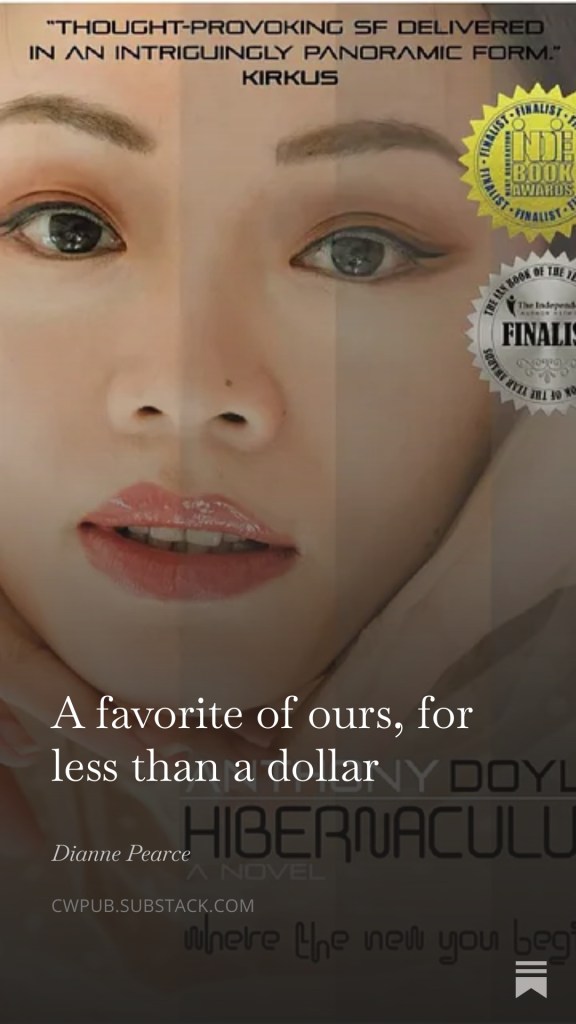
And don’t forget about Anthony’s dystopian novel, HIBERNACULUM!

If you don’t know him by now, it’s time to. Find Anthony Doyle