
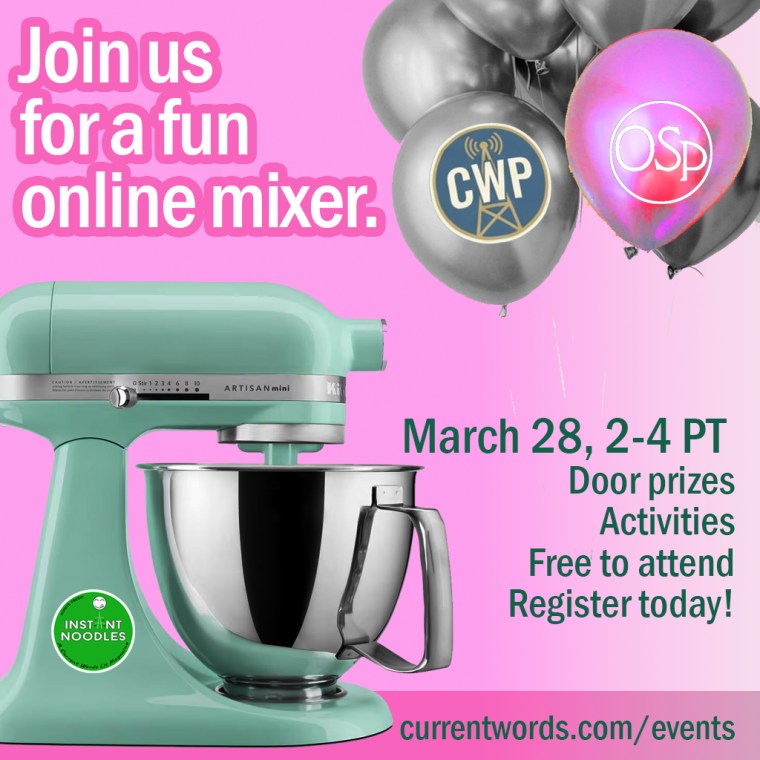

We’ve got some free goodies to give away too! Hope to see you there!
REGISTER to attend.
🙂
Dianne
by ROBERT FLEMING, Founding member of OLD SCRATCH PRESS – a poetry/short-form collective | estd. 2023
In January, 2024 I wrote a blog on Hybrid Poetry which is an integration of two or more art forms, where one form is text.
If you create a hybrid work, who should you collaborate with? If you choose another person you will have to coordinate with them and all their peculiarities. Such a Drag! Why not collaborate with yourself? Only have to deal with when you are in a good or bad mood.
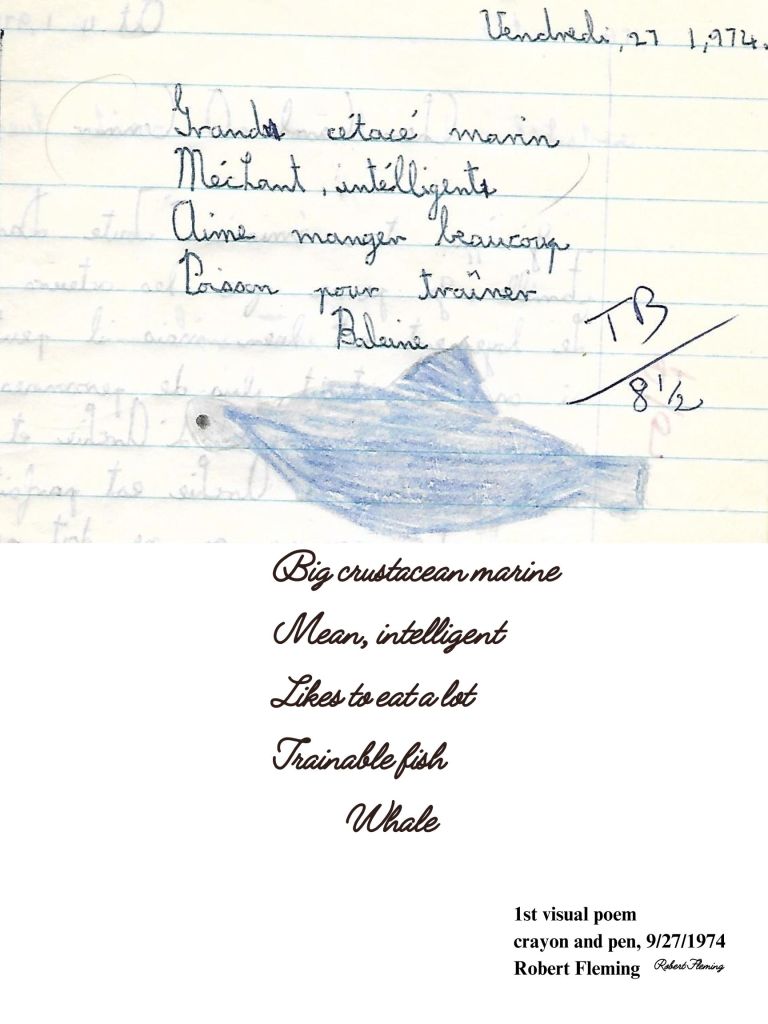
My hybrid blog showed my first visual poem, at age 11, I integrated poetry and visual drawing with crayons.
Figure 1.
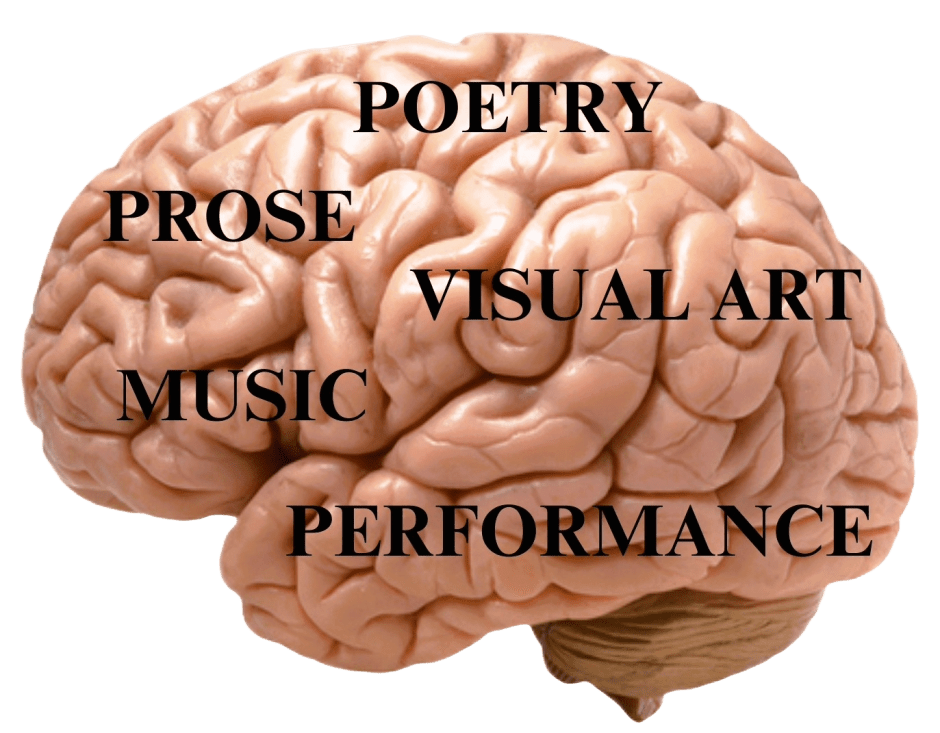
Do you have two or more skills that can be integrated? Pick them from this list.
When you join two skills, it might have been given a name:
If you have integrated two skills before:
In deciding whether to collaborate with yourself:
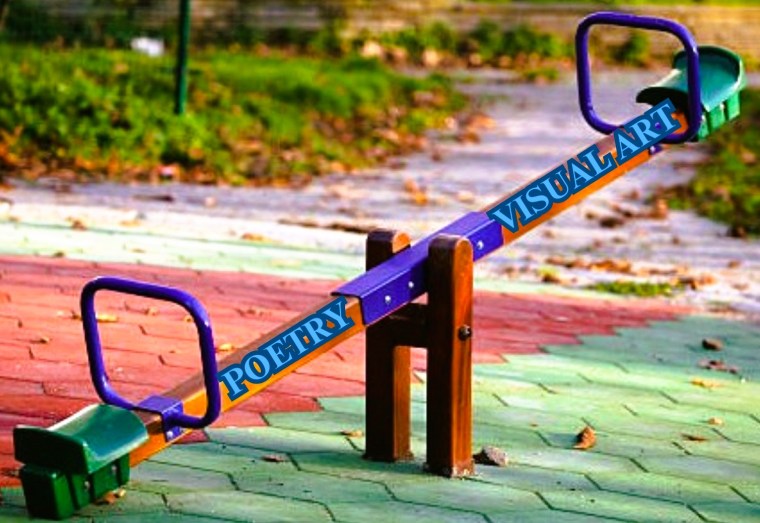
What’s it going to be?
Collaborate with yourself?
Collaborate with others? Read Robert’s upcoming blog.
Robert Fleming, a contributing editor of Old Scratch Press
OLD SCRATCH PRESS – a poetry/short-form collective | estd. 2023
who published an Amazon best seller visual poetry book: White Noir
an editor of the digital magazine Instant Noodles
Recent Robert Fleming publications and art
Follow Robert on Facebook
Thank you for reading. Please sign up to follow us on Facebook and to follow us here on WordPress to expand your knowledge about poetry and short form writing as well as to receive the latest news about publication opportunities.
by Robert Fleming
Best of the Net Nominees
Visual Art selections by Robert Fleming and Alan Bern
Janina Karpinska, VENUS
Jordan Veres, LASTLY DELIRIUM AND ON THE NEXT OCCASION
Edward Supranowicz, THE WALTX OF LIFE AND DEATH
Creative Non-Fiction selections by Nadja Maril
Fendy Tulodo, Time and Tide
story / flash fiction selections by Dianne Pearce
GABBY GILLIAM, AN UNEXPECTED INVITATION
JAN LEE, THE REPAIR SHOP
poetry selections by Dianne Pearce
RYAN LACANILAO, SNOW DEVIL
Robert Fleming, HAMLET AT THE DRIVE-THROUGH WINDOW
PIXIE BRUNER, THE COOKIES WE ALWAYS MAKE FROM OLD SCRATCH
PAUL HOSTOVSKY, NEW YEAR’S EVE SPAGHETTI
GEORGE SHUSTER, Mahicanituk
GABBY GILLIAM, ON THIS 823RD DAY OF JANUARY WE’VE BOTH GOT WORK TO DO
********************************************************************************************
2025 Pushcart Nominees selections by Dianne Pearce, Robert Fleming, and Nadja Maril
Benjamin Talbot, Periscope City: chapter-Poor Advice
Fendy Tulodo, Time and Tide
GEORGE SHUSTER, Mahicanituk
GABBY GILLIAM, ON THIS 823RD DAY OF JANUARY WE’VE BOTH GOT WORK TO DO
Alexander Penney, Bedroom Curtains
Pat Roe, Love me Some Gravy
********************************************************************************************
Yours Truly is:

Robert Fleming, a contributing editor of Old Scratch Press
who published an Amazon best seller visual poetry book: White Noir
an editor of the digital magazine Instant Noodles
Thank you for reading. Please sign up to follow us on Facebook and to follow us here on WordPress to expand your knowledge about poetry and short form writing as well as to receive the latest news about publication opportunities.

Last Chance to get published this year!
SUBMISSIONS FOR 2025 ARE OPEN THROUGH 11.02.25.
The Old Scratch Press team asks that all fiction/non-fiction pieces adhere to a word count of 500 words or less.
Topics/themes for 2025
GRAVY is our 2025 winter holiday theme. Give us your best holiday gravy fails, mishaps, ridiculous gravy encounters (any December holiday, from Hanukkah, to Solstice, to NYE, etc.) or your best funny work about gravy, in general. The point of the end-of-year issue is to be light-hearted to downright silly.
Submissions close NOVEMBER 2, 2025; the issue will publish DECEMBER 1, 2025.
You know you want to!


Recently Robert Fleming was nice enough to get Old Scratch Press booked on Like a blot from the blue. Robert Fleming, Gabby Gilliam, Anthony Doyle, Alan Bern, Virginia (Ginny) Watts, and I showed up. I gave a little information on Old Scratch Press; Gabby gave some information Instant Noodles, and Anthony and Ginny read from their new books. Being there and presenting to an international audience was a fantastic opportunity for us, and the folks there were great.
What I liked even more were the other people who showed up.
I’m going to guess that there were about 30 people who showed up who were not us, one of whom was Fin Hall, the blot-in-chief. It was clear that many of these folks had been attending regularly for quite some time. One at a time, in turn, based on when they signed up, Fin called on each person, and the author read 1-3 poems, depending on length.
When I was in my twenties and thirties, which, sadly, I am not any more, I used to read at LIP (live, in person) open mics all the time, and I would often have to hang in until midnight to get my chance. Usually these were held in bars in Philadelphia, or in West Chester, Pennsylvania. I did my best to dress as “punk rock” as possible, and my general aim, if I’m honest, was to get laid. It’s frankly shocking how few times that happened, when that was clearly my intent. I usually had on a mini skirt and was showing cleavage, but, in truth, people who knew me then told me then, and will reiterate the very same thing today, that me punked-out and showing cleavage was, somehow, still giving Julie Andrews when what I was going for was Grace Slick. Ah well.
In any case, the thrill of reading, and the thrill of possibly getting lucky, and the location (always bars) also meant that, in all likelihood, by the time they got to me on the sign-up list, I was hella drunk. I was a smoker (Benson and Hedges 100s back then), but because I was also a poser: at those events I came with a pack of Dunhill Blue.

Waaaay too expensive to smoke all the time, but on open mic nights I always stopped at the news agent’s (Philadelphia had news agents!) to get a pack beforehand.
A few times/year the venues would ask me to be the featured reader, and I think that was because I was also volunteering with a little Zine called Magic Bullet (run by Andrew Craig, wherever he is today), which I had quite a few publications in, and, who knows, maybe I was good.
I was working my way through an MA and then an MFA from my twenties into my thirties, and my professors seemed to think I was good, as well, and I won the student awards each year, so maybe. When I read at the school events I was not drunk, but neither was I nervous, perhaps because my professors made me feel gifted.
And then, sometime around the end of my last degree, life took a turn. My very long relationship went very south. Another relationship pooped too quickly, and flamed out just as fast, and I remember I felt, while I was still prolific as a poet, that I had somehow lost at life. I wanted, you see, to become a published poet and a professor, and a spouse, and a parent, and I wanted all four things to work out perfectly, and just none of them did.
My life, then, became a series of edits. If it didn’t work to have the man with the red hair, then cut him from the piece, and write in another man, one with cheap beer on his lips. It was so time-consuming to send out work, one poem here, and one there, through the mail, keeping track of where it went, and keeping a lookout for the SASE to bring it back, and seeing if it was in decent enough condition to be mailed back out again, and I remember for awhile I was printing on onion skin to save money (who knows what that is?), and digging up the two dollars or eight quarters to send the piece of onion skin back out, and waiting for the SASE again to return, and each time writing a letter of introduction, sometimes including letters of introduction from my professors who were consistently and kindly encouraging. I remember two of them, who seemed to think my writing was the bee’s knees, were flummoxed that my poems weren’t getting entry, but maybe the long narrative style went out with Wordsworth. And life became more about driving from 9-5 job to college job to relationship, to moving out, to moving over there, to trying again, to keep on trying, to being, frankly, trying.
Little by little, returned SASE by SASE, edited dream by edited dream, the writing dribbled to a stop. Drip, drip, dr—
It was so quiet in my head.
Well, in the poetry part of my head at least.
And a decade and a half ran through my fingers.
And then I started writing again. Not only poetry, and not the plays I wrote in my twenties, but fiction, and memoir, which is, I guess, what this is.
I found myself in a place where the place, the locale, was so small and local, it felt small enough that I dared to go to a reading again.
But over the intervening years something just awful seemed to have happened. When I showed up to read at the open mics, even when I went with friends, I could not make it through a single poem without devolving into tears. And maybe there’s a reason for this shocking behavior, and maybe there isn’t, but it seems as inevitable to me as hair going grey, and as unavoidable as the red dot from a sniper’s gun in one of those movies with snipers.
And yet, at the simple evening with Blot from the blue I felt encouraged. The readers were great, and seemed normal (for the most part… I mean, poets, right?), and kindly, and on Zoom my head is no bigger than a Cerignola olive, so I am going to say I felt safe. I think it would be quite okay to join in, and I asked him later, and Fin said yes, folks can join. And folks could mean me, or you.
So what the hell, let’s try it!
And use this email to express interest likeablotfromtheblue@gmail.com.
And if you show up, be a goooood listener first, and a good reader second.
I’m not much of a drinker these days, so if I show up it will probably be very sober, and there hasn’t been any nicotine in these lungs for a long spell. I will, however, be caffeinated. And that’s at least something. The poem I am thinking of reading has some sound effects in it, which is probably ill-advised. But after I read, and make whatever sort of a fool of myself I am destined to be, I can write a new poem: Pearce With Her Pants Fallen Down.
Nadja often finishes her posts with a writing prompt, so here is me, stealing that excellent idea:
Think of an “edit” you made in your own life, by choice or by force. How did it work out for you?
Or
Have you ever read at an open mic? Write a flash memoir piece describing your experience.
Thanks for reading!
Dianne


Are you a flash fiction, poetry, or short memoir writer with a finished manuscript—or one nearly ready to go? Old Scratch Press, a collaborative collective supported by Current Words Publishing, is now accepting applications for two new members to join us in 2026.
We’re a tight-knit, skill-sharing group that publishes each other’s books, runs the lit mag Instant Noodles, and supports each other with editing, design, marketing, and community.
We are hosting meet and greets on August 6th and August 13. To be invited you have to send a small sample. There are no fees to submit, and there are no fees to join, and there are no fees to publish your collection. There are no fees. Who else you gonna find to collaborate with who dedicates an entire issue of a literary magazine to that most magical of elixirs… gravy?
If you’re eager to grow as a writer and be part of something creative and weird and wonderful, we’d love to meet you.
👉 Apply with a sample here:
https://duotrope.com/duosuma/submit/form.aspx?id=6idG3Mj-O0jFm-15Y7r2p
Spots are limited. Let’s make good things together.


June is Pride Month! It’s a time to recognize and celebrate people in the LGBTQ+ community. Pride Month is about love, acceptance, and being proud of who you are. One great way to celebrate is by reading books that share LGBTQ+ voices and stories.
Books help us understand each other. For LGBTQ+ people, reading stories with characters like them can help them feel seen and accepted. For others, reading these stories builds empathy and helps us learn more about people who may be different from us.
Books can also teach us about LGBTQ+ history, struggles, and victories. Reading is a powerful way to show support during Pride Month, especially when you buy books written by LGBTQ+ authors.
If you’re looking to add some pride to your bookshelf, we have two authors at Old Scratch Press who recently published books of poetry that would be great additions to your to-be-read list!

On May 1, Morgan was awarded Second Place in the Delaware Press Association Communications Awards for her book, The Song of North Mountain which was released by Old Scratch Press in May 2024. Not only did Morgan write the poems in this collection, she also did the interior artwork and illustrated the book’s cover. North Mountain is part of a 55-mile mountain ridge in the northern Shenandoah Valley in Virginia. Morgan says her collection of poems is a love song to that ridge.
Here is her poem, Ghost Light, which won also won Second Place in the DPAC Awards in its category.
Ghost Light
Looking back along the ridge
a thin rib of light briefly
illuminates the forest floor
and silhouettes trees stark against winter sky.
Look too soon
and you miss the mystery
of Dillon’s Mountain’s brief farewell
to nightsky and stars and sweet Venus.
Look too late
and the slumbering giant
lumbers slowly
into its ordinary dayspring.
But if you should,
by chance or intent,
catch the moment,
you will see life
and hope
renewed
in a sudden shaft of dawnbreak.
You can follow Morgan on Facebook and Instagram or visit her website.

Robert Fleming is a gay man who writes and creates art about gay, transgender, and universal themes. After coming-out, he published in LGBTQ magazines. He says that when he” stopped obsessing about being gay”, he realized that his sexual orientation is only one part of who he is. This enabled him to write on universal human themes and crossover into publishing in straight magazines.
For pride, one his favorite poems is one he wrote, Passed Over , that was published in 2020 in Trees In A Garden Of Ashes by Local Gems Press. Robert is grateful to James Wagner, the editor of Local Gems Press, who published many of his gay and transgender works.

For pride 2025, Robert recommends to submit to publish in Oddball magazine that has categories in nonsexual orientation and pride (LGBTQ). You can find submission guidelines here.
Robert is the author of the Amazon best-selling visual poetry book, White Noir.
Here is a link to his visual artist profile.
Follow Robert at Facebook


Hi All~
We’re looking to add members to Old Scratch Press!
Here’s the deets:
Old Scratch Press (OSP), a poetry and short-form collective sponsored by Current Words Publishing, is seeking two new members to join us starting at the end of 2025. Your book would be slated for publication in 2026–2027, pending a successful trial period.
OSP is a collaborative, grassroots press focused on uplifting fresh, bold voices in poetry, flash fiction, and creative non-fiction. We publish three books per year, along with Instant Noodles Lit Mag (3 issues/year), which is curated and edited by our members. To learn more about our work, we invite you to explore past editions of Instant Noodles https://instantnoodleslitmag.com/ and OSP-published books https://oldscratchpress.com/catalog/.
As a member of OSP, you will:
Members who are kind, reliable, and team-oriented.
Writers with a completed or nearly completed manuscript ready for publication in 2026–2027.
People who can commit to at least two years of active participation.
Writers who reflect diversity in identity, perspective, or experience—including (but not limited to) people of color, LGBTQ+ writers, disabled writers, and others underrepresented in publishing.
Applicants who are not full-time creative writing faculty. We aim to support writers who do not already have institutional resources or access.
Writers who have a track record of publication (a few poems, flash pieces, essays, etc.), and a clear desire to communicate something meaningful through their work—someone we can respect as a fellow writer and collaborator.
New members will begin with a six-month trial period before we formally commit to publishing your book. This ensures a good fit and gives everyone time to build rapport, share work, and participate in OSP activities.
Please send the following:
Applications will be reviewed collectively by current OSP members. Finalists will be invited for a short conversation via Zoom.
If this sounds like your kind of creative home, we’d love to hear from you!
Apply, as usual, through Duotrope~

by ROBERT FLEMING, Founding member of OLD SCRATCH PRESS – a poetry/short-form collective | estd. 2023
So confused. Isn’t a voice linked to speaking, singing, and screaming? What does a voice have to do with writing? What the fu** Robert?
A “writing voice” refers to the unique style and personality a writer expresses through their writing, which is a combination of their vocabulary, tone, sentence structure, and perspective, essentially how their individual personality comes across on the page.
what is a writing voice – Google Search
For poetry, yours truly, defines a voice profile:
CREATE A VOICE to INCREASE PUBLICATION SUCCESS
Most poetry magazine acceptance rates are about 2.4%. In order to increase your chance of publication acceptance success, create a writing voice and then target publications that have published work with your voice within the last two-years.
A writing acceptance rate is like a baseball player’s batting average (BA). Josh Gibson’s 1946 BA of 37.2% is the highest career Major League Baseball BA.
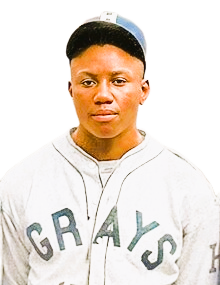
Josh Gibson
My poetry voice profile:
CREATING a WRITING VOICE
Oh NO Mr. Robert, an assignment is coming. Sir and madam, it is, I cannot lie.
A sleepless night, 3/14/1996, yours truly obsessed compulsed, to translate four of his favorite poets to a gay style: Robert Frost, William Shakespeare, John Berryman, and Dorothy Parker.
What I did for each poet:
What was the outcome impact of yours truly doing this exercise:

More Voice Discovery guidelines: make diverse selections
Discover your writing voice and use it!
Yours Truly is:
Robert Fleming, a contributing editor of Old Scratch Press
OLD SCRATCH PRESS – a poetry/short-form collective | estd. 2023
who published an Amazon best seller visual poetry book: White Noir
white noir: Fleming, Robert: 9781957224183: Amazon.com: Books
an editor of the digital magazine Instant Noodles
Thank you for reading. Please sign up to follow us on Facebook and to follow us here on WordPress to expand your knowledge about poetry and short form writing as well as to receive the latest news about publication opportunities.
 OLD SCRATCH PRESS