You know when it happens. The story has been built up in just the right way. You are fully invested with the characters and the plot. You keep reading “just one more chapter”. That’s when you know you’ve found a good mystery book.
Before I started writing my first cozy mystery novel, I had been a longtime fan of all types of mysteries, but I knew I needed to better understand the nuts and bolts of what goes into a mystery plot. What is happening behind the scenes to create that magic?
Here are five essential craft elements that keep a mystery ticking:
🔧 1. Tension and Pacing A good mystery walks the tightrope between suspense and reveal. You want to feel the pressure build—chapter by chapter—as secrets unravel. Tension isn’t just about danger. It’s also emotional: suspicion, urgency, grief, even humor can turn the screws.
🔍 2. A Compelling Question At the heart of every mystery is a question that demands an answer: What happened? Who did it? Why? This central mystery is what pulls the reader through the story. Subplots may swirl around it, but that core question is the lighthouse.
🧠 3. Misdirection and Fair Play Mystery readers love a challenge. They want to guess the killer but be surprised too. The trick is layering in clues that are “fair” (not cheats), while also planting red herrings. It’s a dance between revealing and concealing—just enough to keep readers guessing.
💔 4. Emotional Stakes The best mysteries aren’t just puzzles—they’re stories that matter. Maybe the sleuth is seeking justice for a friend, or the town’s peace is at risk. There’s something personal on the line. Emotion gives the mystery depth and resonance beyond the crime.
🎭 5. Character and Voice In cozy mysteries especially, voice is everything. Readers come back for the sleuth as much as the sleuthing. A quirky, determined, or vulnerable main character gives us someone to root for—and keeps the story grounded even when the plot twists like mountain roads.
What are some of your favorite mystery books? Can you identify these elements within them? Are you reading because you like the puzzle or is it more about the characters?
We’re looking to add members to Old Scratch Press! Here’s the deets: Old Scratch Press (OSP), a poetry and short-form collective sponsored by Current Words Publishing, is seeking two new members to join us starting at the end of 2025. Your book would be slated for publication in 2026–2027, pending a successful trial period.
OSP is a collaborative, grassroots press focused on uplifting fresh, bold voices in poetry, flash fiction, and creative non-fiction. We publish three books per year, along with Instant Noodles Lit Mag (3 issues/year), which is curated and edited by our members. To learn more about our work, we invite you to explore past editions of Instant Noodleshttps://instantnoodleslitmag.com/ and OSP-published books https://oldscratchpress.com/catalog/.
As a member of OSP, you will:
Receive a free publication of your manuscript (poetry, short prose, hybrid, or a mix of writing and art).
Get 10 free copies of your book and keep 100% of your royalties.
Participate in monthly OSP meetings (except December and August).
Proofread and support fellow members’ books and contribute to blog and promo efforts.
Be invited to monthly marketing meetings hosted by Current Words Publishing.
Join a supportive community of working writers committed to mutual aid, creativity, and literary growth.
We’re looking for:
Members who are kind, reliable, and team-oriented.
Writers with a completed or nearly completed manuscript ready for publication in 2026–2027.
People who can commit to at least two years of active participation.
Writers who reflect diversity in identity, perspective, or experience—including (but not limited to) people of color, LGBTQ+ writers, disabled writers, and others underrepresented in publishing.
Applicants who are not full-time creative writing faculty. We aim to support writers who do not already have institutional resources or access.
Writers who have a track record of publication (a few poems, flash pieces, essays, etc.), and a clear desire to communicate something meaningful through their work—someone we can respect as a fellow writer and collaborator.
A note about our trial period:
New members will begin with a six-month trial period before we formally commit to publishing your book. This ensures a good fit and gives everyone time to build rapport, share work, and participate in OSP activities.
To apply:
Please send the following:
A brief cover letter introducing yourself, why you’re interested in joining OSP, and how you’d contribute to the group.
A short author bio (3–5 sentences).
A brief personal essay (500–750 words) about your writing journey. Feel free to include publication history (with links or footnotes) and anything you’d like to share about the manuscript you hope to publish.
A sample of your manuscript-in-progress (up to 10 pages).
Applications will be reviewed collectively by current OSP members. Finalists will be invited for a short conversation via Zoom.
If this sounds like your kind of creative home, we’d love to hear from you!
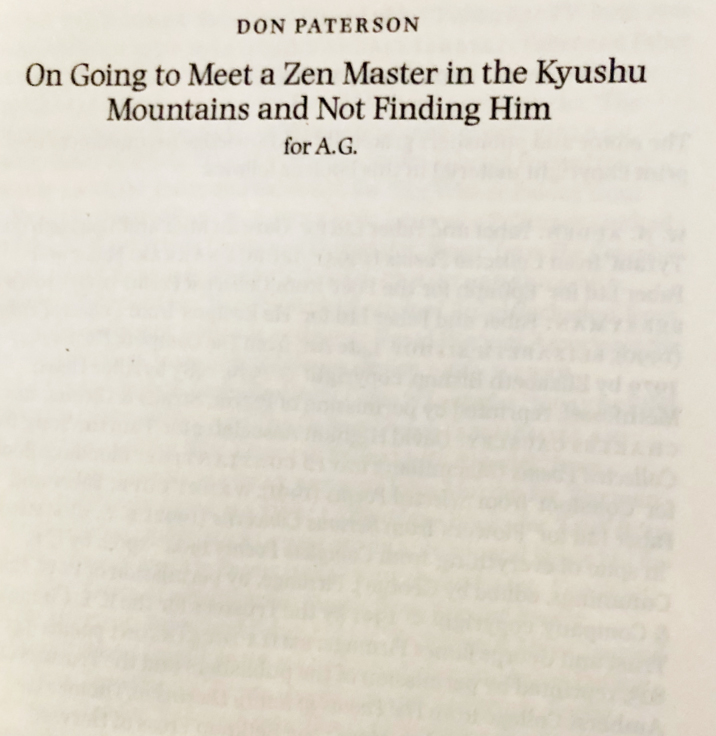
Above you see Don Paterson’s take on the titular poem, with a poem where the title is the whole poem.
A titular poem is a poem where the title is part of the poem, a line in it. In my own poetry I have really liked using this device, and often use my titles as the last line of the poem, the conclusion to the whole action of the poem. I have been described by my teachers as a narrative and magical realist poet. In my defense against these allegations I will let you know that I grew up listening to songs like “Jolene,” by Dolly Parton, “Ruby,” by Kenny Rodgers, “The Wreck of the Edmund Fitzgerald,” by Gordon Lightfoot, “Dark Lady” by Cher, and the oddest one of all, “Angie Baby,” by Helen Reddy. My formative years were two-to-three decades of songs with strange narratives in them. It isn’t my fault!
I have written many titular poems, some remarkably more successful than others, but I will share with you today one that is probably my personal favorite. This was written when I was in graduate school for my first writing degree. I had moved back in with my family. My house was helmed by two working parents, both too ready to have a drink, both too generous with money and not much else, and both not great at respecting boundaries. But I was able to go to school for my Master’s Degree and teach at the school part time, which pretty much took up 10 hours of each day, but made about one third of what a person needed for rent in those days, so, without my old room, I never could have done it. There were a lot of challenges though, one of which was a mother who was threatened by education, and really tried to impede it even as she envied it. My most repeated story, and least believed, was the one where I went up to my room to work on a paper due the next day that had to be twenty-five pages. My mother burst in to the room, my dad in tow, and began to lay out sheets of wallpaper over my (yes, I’m not kidding) word processor and desk. “We’re wallpapering the bathroom,” my mother announced. “What, now? Tonight? It’s seven,” I said in disbelief. “We have to do it now,” she said. “Right Vince?” My dad looked at me and shrugged. What could I do? I went downstairs, and waited. They finished a little after eleven, and I finished the paper a little after four the next morning. Yes, I should have probably written it sooner, but that aside, who competes with their kid with wallpaper? Sigh. No one I shared my graduation program with ever believed my stories. So, one day I wrote this poem to see if it could explain it to my fellow authors that my stories were true. As you read the poem remember… this is a titular poem, so see if you can understand how the title works as the title, and also as the last line of the poem. Yes, there are obscenities in the poem that some may find offensive. I’m a salty old girl, and, once, I was a salty young one.
A Few Dry Old Peas Rattling Around In A Waxed Paper Dixie Cup
Jesus fucking Christ goes through my mind as I sit here, trying to read the poems from my poetry workshop, and my brother, who doesn’t live here, appears suddenly at the front window like an unwelcome trio of Jehova’s Witnesses, causing my dog, who had just been whining at my leg for my bagel to bark loudly and repeatedly at the window as the phone rings, making me jump like a bean, and I answer it, all the while looking in exasperation at my beloved bother of a brother, who is unaware that I am here, and if he comes in the house will joke, as if he were the opening act for the Jerry Lewis Telethon, “Still in your pajamas? Ah you and that school racket,” while I say, “Hello” the the phone with my voice trying to sound pointed and pissed and my mother’s voice says, “Read me what the calendar says my dentist appointment is,” and says, “I know you’d like nothing better than to put my wash in the dryer—how ’bout it?” and says, “Don’t just sit around; do your windows,” and says, “You’re home todays so I won’t be home to let the dogs out,” although she wants to be ’cause she thinks I don’t do it right, and tells me again how to do it before she hangs up, but my brother has not come in, has disappeared, so I go back to reading for two seonds because here comes the dog again, whine whine bagel bagel scratch me, and I stamp at her; she looks at me—Big whoop—says her scroungy toothless expression, and I hear a loud banging, so I look up and a strange truck, a truck that would have turned up the noses of Sanford and Son and a man who obviously was designed with the truck in mind, are in the driveway, and he is pulling a gigundous lawnmower off the truck while I try to think and come up with Jesus, shit! Don’t unload that! Did I ask for that thing?! and Who the fuck is this toothless guy? and wonder for a scared second if he’s a relative I don’t recognize which is usual for me, when I see my brother coming ’round the side of the truck and I run upstairs thinking, What the hell is that guy here for? Bill is going to bring this strange man to see me in my pajamas, and the dog is lifting off the floor now in little hydraulic barks—I am thinking Christ Bill, now you’re going to wake Lee and I am giving up on reading poetry; I’ll write some instead, and I retreat to my room and start typing trying to ignore the barking of slamming truck parts and lawnmowers out front, but I am right, my brother does wake my sister, and when she gets up, by opening her door she releases another dog to bark, and it runs downstairs to join in, eager to catch up, while my sister walks into the bathroom and pees loudly with the door open, and does not flush, puts on striped spandex, and goes tour-de-fourcing down the stairs where, like a swift grifter, she switches out the tape in the VCR for an aerobics tape and turns it up up “Lift ’em up! That’s grrrreat! You can do it!” but I can’t do it because I can still hear my brother and Mister May-Be-A-Relative, so I am able to hear another voice added to theirs as my mother says, “Oh, I wondered if you’d be here. I just came home to let the dogs out,” and my friends wonder why I’m tense and why I never want to visit the zoo, and I think, Dad must be coming home any minute to tell us all the jokes he’s heard today, like, “Duck walks into a pharmacist, says gimmee a Chapstick and put it on my bill,” or the one about the Avon lady who farts in a elevator, after which he will laugh that long, wheeze, Lou Costello laugh “Hey Abbott” and somehow, in this rapidly escalating cacophony, a small sound, like a maraca gently shaken, is in my ears pulling me to it, causing me to think one final thought at the end of my morning study time, because, pricklingly familiar, I think I’ve heard that small hollow sound before, and I think I now know exactly what my brain is like.
Did you make it to the end? Could you see how the titular title ended the poem? I must admit I’ve always felt that the title must work as the title, of course, but should also resonate at the end of a poem, because our eyes, having reached the end, especially of a long poem, will zip back up to the top to refresh, remind us of what we were reading in the first place.
Have you ever written a titular poem? If so, I’d love to have you share it in the comments. Have you ever read one that you especially liked, or that flummoxed you? Let me know.
All these years later, through many different rounds of education at many schools, through being a life-long adjunct: always running place-to-place, through infertility and a trip to China to become a mother, through a few trips back and forth across the country with a full car and a moving van, through working with so many different and wildly talented authors, I do still feel a bit like I’m a plate-spinner with a brain that might like a long vacation on a deserted island. Thanks for reading! I hope you’ll share back something titular.~ Dianne
Dianne Pearce is the publisher and main editor at Current Words Publishing. She also designs and formats each issue of INSTANT NOODLES LIT MAG, and had to learn how to work computers to do it!
Don’t miss the second submission period for INSTANT NOODLES 2025. Submit today!
I have participated in quite a few of writing critique groups for many years now, and I can say that the feedback I have received from fellow writers has been critical to my success in publishing my work. It is true that if you remain with the same group over an extended period, there will be certain people that you will agree with more than others for suggestions for editing your work. There is nothing wrong with that. After all, everyone has different tastes and preferences. That being said, it is important to read and consider all comments you receive. Here are a few tips to guide you in getting the most from the process of critique.
Decide what you are honestly looking for before you submit a manuscript. If you just want to know if the story is worth working on at all, then submitting a very rough draft might make sense but I never do that. My approach is to put in all the time necessary to complete a short story or poem and make it the best I can. This means, for me, several months of writing and many edits. I probably edit a piece fifty times or more before I feel I have done all that I can for it. I prefer to circulate what I believe is “a finished story.”
During the critique, just sit quietly and listen. In the groups I attend, I will receive written comment, so I don’t have to write notes during the oral critique. You can learn a lot by listening to colleagues discuss and debates questions or concerns they may have about your writing. Above all, don’t say anything as the writer. You aren’t there to explain your work and above all, you are not there to defend it. You don’t want people to feel that they cannot give you honest and open feedback. That’s what you are there for and as writers, that is what we all need.
Try not to feel hurt about “negative” comments about your writing. At first, for most writers, we do feel hurt but in time, this goes away as you realize that critique is an honest exchange of creative suggestions meant only to help you decide what final edits you wish to make. We cannot read our own work in a way that will make it the best it can be. We don’t have the distance to be able to do this. In short, we need each other. Of course, the critique should be done in a constructive, professional way. I have always had good group leaders who have insisted upon this.
At the end of a critique, I always make sure to thank everyone for taking the time to read and critique my work. I know it takes time and effort, because when I read for others, I give it my all too. It is the greatest gift we can give to each other as writers.
So now that you have your critiques, it is very important to set everything aside for a minimum of a month before you return to make edits. Early on I made the mistake of making edits too quickly and they were knee jerk and not good. You need time to let things sink in and percolate. Give it a rest.
When I do edit, I go through each written critique and fix all mechanical edits first, such as spelling errors. While doing that, I keep a running list of more involved edits that I will look at more carefully to see if I agree with them. This might be things such as a section of unrealistic dialogue, an ending that needs less or more, a character that lacks some necessary background.
I have never not changed a story or a poem based on professional feedback. Some more than others, but all have been edited because of ideas or suggestions or questions raised by writing colleagues and I can honestly say that my work has been improved immeasurably by the critique process. I am so grateful for my writing colleagues and friends. I do have one writing friend who I give my final edited pieces to for one final read. And another tip for writers. Seek out readers of all ages to critique your work. You will get different perspectives that will improve your final product.
An important final comment about writing groups. Over the years. I have made such wonderful, close friendships with the people I have met in these groups. It’s funny how life works. You go looking for something and you come away with something so much more valuable than you expected.
Good luck with your writing and enjoy all of the process, including critique and editing in response to critique. I promise you that you will find it rewarding to not only give critique but also to receive it. It is part of our art form.
Enjoy your group!
~Ginny
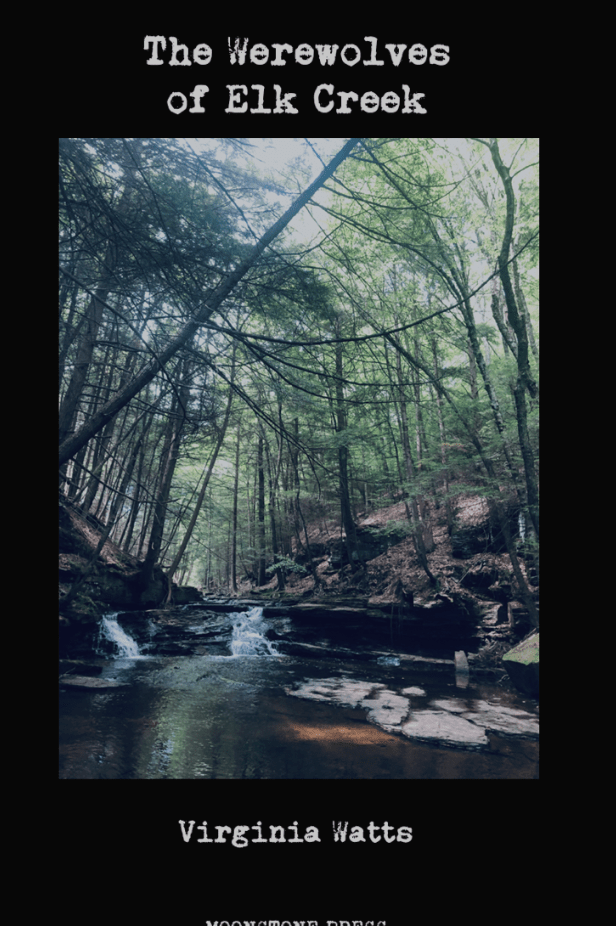
Virginia Watts has been fortunate to have published nearly 100 pieces in literary magazines including CRAFT, The Florida Review, Reed Magazine, Pithead Chapel, Permafrost Magazine, Broadkill Review, Two Thirds North, Hawaii Pacific Review, Sky Island Journal, Eastern Iowa Review, Evening Star Review and Streetlight Magazine. Nominated four times for a Pushcart Prize and four times for Best of the Net, in 2019, Watts won The Florida Review Meek Award in nonfiction.
And I bring them up today because when I was thinking about writing this blog post, I was also thinking about all the other blog posts I had to write today, which has turned out to be at least 4, plus the social media to go with it. It reminded me of this Kinks’ classic:
Give it a listen because: The Kinks.
And so that you get the tune, which is important to this post.
My blogging and posting activity made me think of this song because it aligns with my thoughts: She posts it here; she posts it there: on Instagram, and everywhere! She will just keep posting ’till her fingertips go numb ’cause she’s a dedicated marketer of books. Oh yes she is! Oh yes she is! Oh yes she is! Oh yes she is!
Sing it with me.
Are you posting here, and there?
I hope you don’t mind if I remind you of the three Ps of posting: personality, process, and product. You want to sell your books, but you have to find people who know about your book: people in Poughkeepsie, Peoria, and Portland. Have you thought of it that way? Imagine a 25 mile readius (hah! Gotcha! Radius!) around you: that’s probably where people are going to know you enough to buy your book. Imagine your social tree: your family, your friends, friends of your family, and friends of your friends, your co-workers, and your fellow attendees at church or hobbies or etc. Of those people, how many will buy a book? Of the people who buy it, how many will read it? How good is your elevator pitch to tell people about it? How “clean” is your book in terms of proofreading, editing, font choice and size, plot holes? And if you do not live in Poughkeepsie, Peoria, or Portland, how will anyone who does find out about your book and become intersted in it?
With my deepest apologies, you have to post. You have to blog. You blog the most about you, the human, you blog next about the process and proceedures of you, the writer, and lastly you make an open, not subtle, appeal on your product: “You will enjoy this book because….”
Let’s imagine a 30 day grid.
Luckily, with most websites, and certainly with WordPress, you can post them all on the same day if you like, and schedule them to go out.
Friends, if you are unknown, there is no other way to get your book out there. There is no other way.
Most of us are doing the, “La la la la I can’t hear you!” thing when I say this. But, tell me, how else does that reader in Peoria find you?
I interacted with a young author the other day whose horror novel won some book award. I asked her, “Have you posted that on the FB horror reading groups?”
“No,” she replied to me in the women’s writers group. “Those groups are fake, so I don’t waste my time.”
They most certianly are not fake, and if you’re writing horror, you oughta be on them. If you’re writing poetry or short form, are you looking for groups where people are reading those books? And the people in the women’s writers group are not buying her book, because they want to sell their book, not buy hers, but all of them are pitching to the wrong damn audience.
I am so very sorry to need to be the one who tells you Santa ain’t real.
In my experience coaching and attempting to help so many authors, from the ones I taught in college to the ones in that womens’ group, to the ones I publish in Instant Noodles, and on up, authors spend their free time writing their next book or story or poem, and then work their jobs, interact with their families, have some down time, etc. But small business owners never stop. They ask you to buy their newest T-shirt, or their revolutionary toilet paper, or come into their small shop, every single day, and they work overtime if they need to, to get it done.
If you’re a hobbiest writer, enjoy! If you want to go pro… you need to put in the practice hours, which, for this, are posting.
So sing it with me!
I post it here; I post it there: on Instagram, and everywhere! I promise I’ll keep posting ’till my fingertips go numb ’cause I’m a dedicated author of my books. Oh yes I is! Oh yes I is! Oh yes I is! Oh yes I is! And nothing can stop me, and my blog will not go mum ’cause I’m a dedicted author of my books. ‘Cause I’m a dedicted author of my books. ‘Cause I’m a dedicted author of my books!!! Ba-da-da!
Many writers, including myself, write both prose and poetry. For me, it just depends on the subject matter as to which form I choose. Many writers begin with one form of writing and evolve to another. There are some writers who begin in one genre and stay there. In the end of the day, our paths are different, but we are all writers, and all writers want to tell a story. We want readers to feel something, experience something, remember something. We want them to leave us changed in some small way. Even if you don’t want to learn about the craft of poetry in a formal way, as in attending workshops, just reading a few poems a day will improve your prose writing in ways that will surprise you.
Poetry as a form succeeds on bold, visual imagery, exact information from all the senses. This is how the reader enters the poem and lives inside it for a brief time. By reading lines of poetry, prose writers will also experience and come to understand why rhythm matters. There is great impact when rhythm is found in sentences and phrases.
One of the defining benefits of studying and writing poetry for me as a prose writer has been that in poetry more than any other genre, each and every word must do work, and I mean each and every word. Poets take time and great care choosing words and prose writers, if you want to be your best, you should be doing that as well, but it takes practice. Read Hemingway again to see why this matters.
Poetry has the same elements as prose writing, such as characterization and narrative arc, but it contains more unexpected phrases, surprises and turns that send readers in directions they didn’t expect. This is often missing from prose writing, and it shouldn’t be. Additionally, poetry teaches us about pace. How long lines with no punctuation slow the reader down. How a short line placed just right can then really pack a punch.
Prose writers can also use traditional poetry techniques to enhance their narratives such as assonance, linking words with similar vowel sounds. Using words in this way can produce a desired effect on the reader such as a calming effect as if listening to music.
My greatest lesson and take away as a prose writer who reads poetry every single day is that endings are so incredibly important. When you read enough good poems, you’ll see what I mean. And stories, like poems, deserve the best endings possible. This is something to strive for.
So, you want to be a good prose writer? Then read poetry. Simple as that. Poetry teaches us all how to use our language. Poetry teaches how to describe. Poetry demonstrates mood, voice, momentum in unexpected ways. We all want the same thing. To tell the story we want to tell in the best way we can. Reading poetry will help us learn to do that.
There are many good online literary journals where you can read poems: Narrative Magazine, Agni, Carve, Rattle, 32 Poems, A Public Space, Apple Valley Review, Evergreen Review, The Cortland Review, Waxwing, Pigeon Pages, Cleaver Magazine, Able Muse.
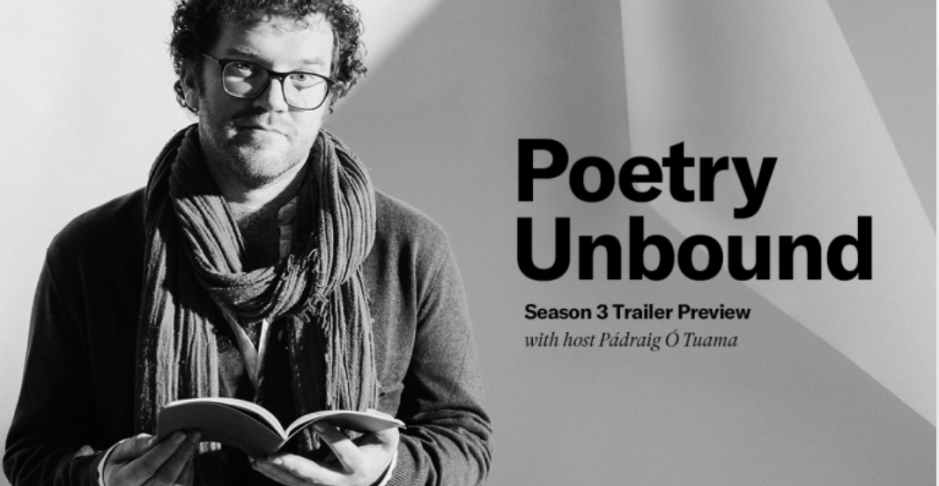
You can also sign up to receive daily poems from: Rattle, Your Daily Poem, Poem-a-Day, Poetry Daily, Poem of the Day. All these are free as is the wonderful podcast written and hosted by one of my favorite poets Padraig O Tuama: Poetry Unbound. I would also highly recommend Padraig’s wonderful book: 50 Poems to Open Your World.
Happy Reading!
~Ginny
Virginia Watts has been fortunate to have published nearly 100 pieces in literary magazines including CRAFT, The Florida Review, Reed Magazine, Pithead Chapel, Permafrost Magazine, Broadkill Review, Two Thirds North, Hawaii Pacific Review, Sky Island Journal, Eastern Iowa Review, Evening Star Review and Streetlight Magazine. Nominated four times for a Pushcart Prize and four times for Best of the Net, in 2019, Watts won The Florida Review Meek Award in nonfiction.
Sometimes words are hard to find. Like now, for me, when the words and feelings are so big they look like a giant ball of yarn; overwhelming and untangle-able.
That is when I find my words elsewhere. It might be “black-out poetry”, like the one made from my poetry submissions rejection letter collection. Or, it might be from refrigerator word magnets. Or, it might be from headlines in the New York Times. Opportunities abound and are yours for the taking. “Found Poetry”, which I first thought of as just weird, is actually quite fun. So, what is “found poetry”, anyway?
Found poetry is a literary collage, crafted by selecting and rearranging words from other sources to create something fresh and meaningful. Blackout poetry, cento, erasure poetry, and cut-up techniques are all ways to engage with found poetry. Not only is it a great exercise in close reading and creativity, but it can also be a meditative way to reconnect with language when traditional writing feels out of reach.
How to Create Found Poetry
Gather Your Source Material – This could be an old book, a newspaper, a diary entry, or any text that speaks to you.
Highlight Interesting Phrases – Look for unexpected word combinations, evocative imagery, or intriguing snippets of text.
Rearrange and Shape – Remove, rearrange, and add punctuation to shape the poem into something that feels complete.
Experiment with Form – Try blackout poetry (blotting out words with ink), centos (poems composed of lines from other works), or even digital found poetry using search engine results.
Literary Journals That Accept Found Poetry
If you’ve crafted a found poem that feels right, consider submitting it to a literary journal. Here are a few that welcome found poetry:
The Found Poetry Review – Dedicated to publishing only found poetry (currently on hiatus, but their archives are rich with inspiration).
Diode Poetry Journal – Occasionally publishes found poetry alongside traditional forms.
River Teeth: Beautiful Things – Accepts short, poetic nonfiction, including experimental found forms.
The Indianapolis Review – A journal that appreciates erasure poetry and visual found poetry.
Pangyrus – Open to hybrid and experimental poetry forms, including found poetry.
Entropy (Closed, but check for archives) – Previously published a variety of found and hybrid poetic works.
Fence – Open to experimental poetry, including found forms.
If you’re feeling stuck in your writing practice, found poetry offers a playful and rewarding way to engage with language. Whether you keep your found poems private or submit them for publication, the process itself can rekindle your creative spark, or even maybe begin to gently loosen your own giant yarnball.
(Black-Out Poem written from one of my rejection letters)
Have you tried writing found poetry before? Share your favorite sources of inspiration in the comments!
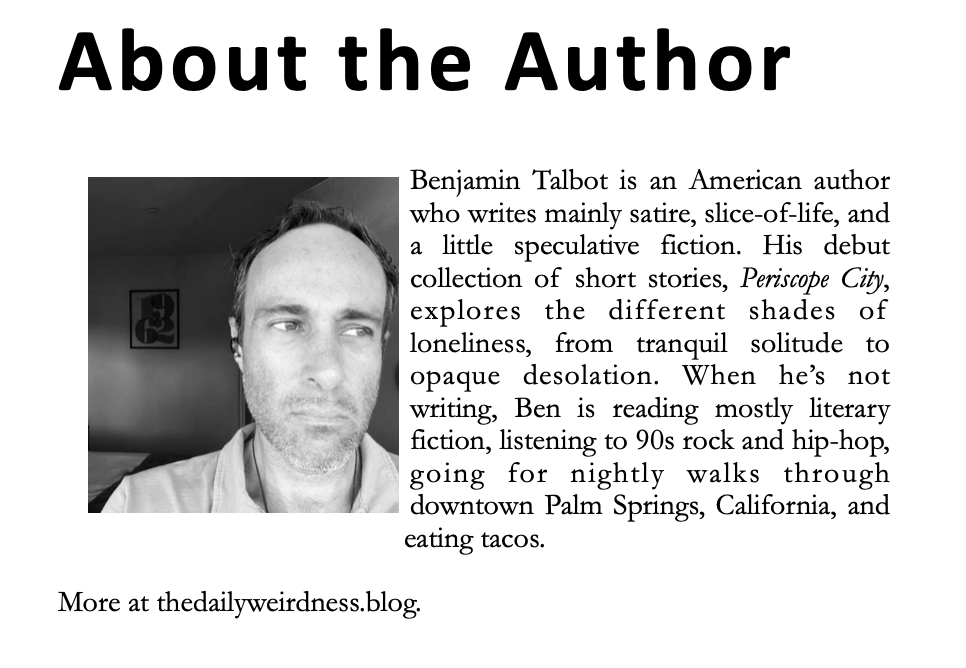
Ben’s book is, “A captivating series of short stories, both dramatically and philosophically enthralling.” KIRKUS
“Ben Talbot excels at depicting a world both alien and familiar at the same time.” MIDWEST BOOK REVIEW
Welcome to Periscope City, a place where nothing is quite as it seems. Its citizens are those with no one to love, caught in a paradox of escaping loneliness while clinging to it. Here, human emotion is fleeting, and love is nothing more than a transaction. Each story in this collection delves into the heights and depths of solitude through its characters: a writer torn between seeking validation from fleeting romances and finding comfort in the safety of isolation; a former college football star lost in nostalgia, unable to connect with the present; a young runaway scarred by her past, drawn to this desolate town inhabited by loners and serviced by robots. Prepare for an emotional gut-punch as you enter a strange, unsettling place where the broken-hearted choose to stay broken and prefer to live in solitude. Talbot’s haunting, satirical, and often absurd interconnected tales explore themes of self-destruction and elusive redemption. Periscope City will immerse you in a world where the boundary between reality and fantasy is constantly shifting.
Ben is going to read a little from his book, and then we will open it up for poems, flash fiction/non-fiction to give you a chance to add your voice to the conversation about love and loss and loneliness, and answer the age-old question, “What becomes of the broken-hearted?”
If you’re not a pro at reading, it is imperative that you come and try your luck! What better night? We can be awkward, clumsy, lonely, and literary together!
Hope to see you there, and hear you read. We’ll be sad without you….
In the meantime, enjoy this excerpt from the book!
Periscope City
A sign greeted me at the border: Periscope City: Where the Lonely Go to Live Alone.
It spoke my language, so I crossed in by foot, to the nearest place it took me to. That place was a one-story house with a long driveway called the Institute. There, they asked me dozens of questions about my immediate past and made me take a personality exam. I told them the truth: that I was a thirty-four-year-old loner whose friends had deserted him for marriage or death. They set me up in the Cramden Hotel.
During the first week, I interacted with only housekeeping and the concierge. They were all robots. It was the best the town could do to live up to its tagline.
—
Although I loved loneliness, I was still lonely as hell. After months of wallowing about my life situation, sinking into the lack of fellow humans, there was nothing I wanted more than to mix it up. I thought being lonely among robots was a different lonely as being lonely among humans. The scratch needed to be itched.
The concierge suggested a dating app called Loner, and the concierge said it had the best reputation for keeping the lonesome lonely. I filled out a profile and submitted it to the AI gods for review. It matched me with Raylene, a blonde Puerto Rican who stood over six feet. Her profile said very little about her beyond the fact that she’d moved from Buffalo, New York, and loved pets over people. In her picture, she sat on a snowy park bench and wore a fleece jacket. A French bulldog sat in her lap, and it wore a black-and-white dog poncho. It looked like a staged photo, like something in an L.L. Bean catalog, but where L.L. Bean was trying to pull off cozy, it was a cold, plastic, disconnected photo. I assumed her entire profile was an attempt at sarcasm.
Do you want to meet or not? she wrote.
Because of my lust for tall women, I wrote her back: Yes.
I have tickets to The Late Show, she wrote. Meet me at Geraldine Park at eight. I’ll be at the corner of Alaska and Winter Bear. And don’t be awkward.
—
When I showed up, Raylene was sitting on a snowy park bench in the same jacket as her photo, with her service bulldog in her lap. The dog even wore a black-and-white poncho. Raylene’s smile was all the picture was missing.
“Joe?” she asked.
Her perfume was cedar, or maybe it was the trees. Whatever the case, the scent had found its way to me, and it smelled lovely. The Loner profile was missing a smell.
“Raylene?”
“No,” she said. “Of course it is. How would I know your name was Joe?”
The bulldog barked at me.
“Sheepshead, knock it off,” she said.
Sheepshead? After Raylene fed her a pill, the dog calmed down. The pill must’ve been a fast-acting depressant, which they sold over the counter here in Periscope City. I know because of my own dog, but he didn’t need medication like me.
“You look different from your picture,” she said.
Ditto. Not only did she frown but her hair wasn’t blonde. It was purple. “How so?” I said.
“I thought you were taller,” she said.
I ignored her comment (let’s call it an insult), already being my tallest.
“Ask me something,” she said.
She was testing me, but then I remembered how sarcastic her profile had been attempting to be. The memory of it made me sweat a little with anxiety because I tried to think of something witty to say quickly, so I used a cliché. “If you could have dinner with anyone, who would it be?”
“Come on, dude,” she said. “Ask me something else.”
I gestured out to the surrounding park with my hands as if that were the explanation. “It was all I could think of,” I said.
“I told you, don’t be awkward,” she said. “What about you? Who would you have dinner with?”
I hated the question, too.
“Abraham Lincoln,” I said, and the words tasted like tinned fish.
“Why?”
“He was the first person who came to mind,” I said.
“Lame,” she said. “Now ask me a good question.”
“Okay,” I said. “Why did you name your dog Sheepshead?”
“Sheepshead Bay was the last place where I went with my husband,” she said.
“Did you separate?” I said.
She pressed her beanie down to her eyebrows, and I did the same with my trapper hat. We shared an awkward silence. It was what I got for asking a good question.
As we often hear, and know is true, writing is a solitary endeavor. Since I find long stretches of alone-time nourishing, I love that about it. But that doesn’t mean I want to go full-on-hermit. I need human interaction, even if it’s just Tina at the grocery store telling me about her cats.
Specifically, since my need for human interaction is limited, I’ve sought to find ways to find or create a writing community that is a balance of the two. Here are a few things I’ve come up with that might seen outwardly mundane, but with an added introverted twist:
· Online Writing Group: I created Bewilderness Writing, knowing that my role would be as guide, not teacher. Each week I read a poem, offer jump-off lines that folks can choose to use, or not, and then we free write for 10 minutes. Afterwards, each person reads what they’ve written and the group does not offer comment or critique. Sounds ridiculously simple, huh? It is. And what can’t be known beforehand is just how intimate and rich the writing can be within this container. Setting aside all the “writerly benefits”, it fills my need to see and hear others figuring out life using words on the page. There is great comfort there. And the tapestry of styles and voices enriches my own writing life.
There are many “writing alone, together” online opportunities without prompted writing, as well.
· In-Person Writing Group: I created “Writers in Coffee Shops” a few years ago using the social networking website Meetup. I set it up with straightforward parameters from the get-go of “writing alone, together”. We would meet at a local coffee shop, spend a few minutes sharing what we were working on, then get to it. At the end of the hour, we could share about how or what we did for the hour. After that time, folks were welcome to share their work and invite comment or critique.
For awhile, especially in the beginning, I had people who did not get the memo and wanted to chat. With gentle reinforcement those folks either got used to our system or didn’t come back. Eventually, I found a small, committed group, and we came to know our coffee shop time as not only a standing-date commitment to our writing, but a place to commiserate on the writing life. We became friends.
Want something similar?
Shut Up and Write: https://www.shutupwrite.com/While I might prefer my more “demure” group name, this is basically the same format and you can find them, with over 400 chapters all over the place
· Collaborative Writing: Recently, I had a friend and former Bewilderness group member contact me after taking a poetry class that included “renku,” which is a Japanese collective poetry composition of collaborative linked verse. My friend asked if I wanted to give it a try together. She would send me a few lines and I would send a few back. Since we’re just starting this adventure, I can’t tell you the outcome, but I’m hopeful. It is just the right mix of connection and effort for me. It intrigues me to see what might come out of it. Think of your favorite writing form, enlist your favorite writing friend, combine the two, and see what you might come up with!
These writing groups are for messy, first-draft writing where the intention is to get “your butt in the chair” and ideas on the page. While these groups all lack the comment/critique component, I am a big believer in getting other eyes and trusted opinions on your work, and there are plenty of in-person and online opportunities for that. Whichever one is your preference, there is great benefit to having others along for the ride alongside you, and what that looks like is for you to choose.
My first mystery novel, A Fire Circle Mystery: A Witch Awakens, about an amateur sleuth discovering her lineage as an Appalachian Granny Witch, comes out in Spring 2025.
By R. David Fulcher, Founding Member of the Old Scratch Press Poetry and Short Form Collective
Floetry (my definition) a written form of expression combining fiction and poetry.
It is uncommon, but not unheard of, for writers to embrace both fiction and poetry. As one of the writers in this category, I often wonder if this is a benefit or a detriment. To a purist, being competent in both could perhaps mean I’m a master of neither, to echo the old saying “jack of all trades, master of none”.
More recently, I’ve decided being fluent in both fiction and poetry is a definite advantage. To begin with, several of the masters of speculative fiction integrate poetry into their work to great effect. Consider these lines of from Stephen King’s novel The Tommyknockers:
Last night
And the night before,
Tommyknockers, Tommyknockers
Knocking at my door.
And these lines from Ray Bradbury’s novel Something Wicked This Way Comes:
By the pricking of my thumb,
Something wicked this way comes.
These are by no means the only examples. Dean Koontz dives into poetic verse within his many novels, and it can be argued that the fantasy writings of the Irish writer and dramatist Lord Dunsany (a possible influencer or JRR Tolkien, discover more here) read more like poetry rather than prose.
Therefore, having made the case for “floetry”, how do I employ it? Primarily I interweave poetry into my prose in two ways:
As bookends to start and end my books, with the remainder of the book being fiction, and
The Pumpkin King and Other Tales of Terror starts with my poem “Eulogy to E.A. Poe”:
Man of dark musings and opiate visions!
Mind of pits and rats,
Black cats and ancestral corpses!
How is it that love sparkled within those dark recesses, Like diamonds within a bedrock of obsidian— That verse sprang from that ebony hand,
As vibrant and unlikely as lilacs from snow?
Tales of cities under the sea,
Of waves weeping softly, “Annabel Lee!”
Did the bells, the bells, the bells, foretell of your demise, Or was it borne on Raven’s wings, thus falling from the sky?
Could it be that your last vision was your brightest?
Oh, soul of all that is night,
Inspire my pen to wail and to write.
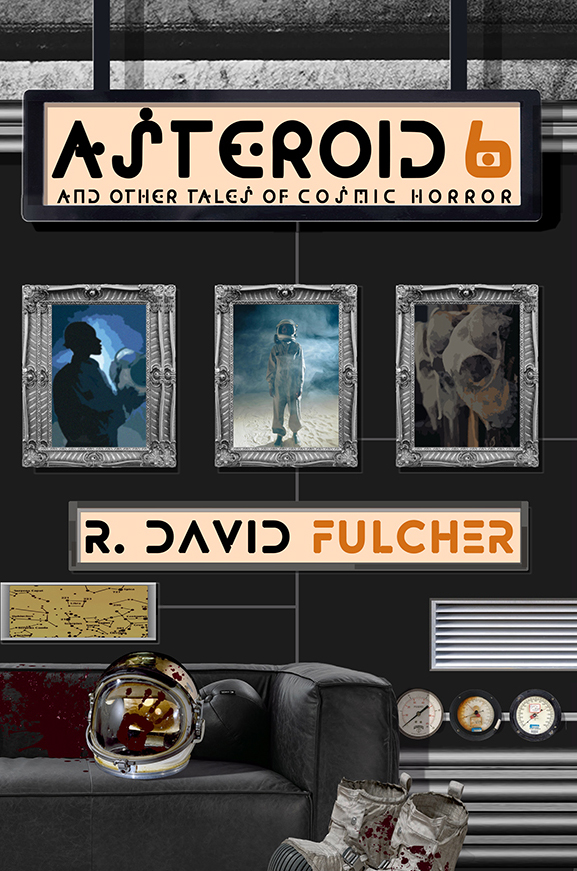
In a similar fashion, my book Asteroid 6 and Other Tales of Cosmic Horror starts with the poem “The Outer Reaches of Unknown Kadaath” (Kadaath is a reference to the works of H.P. Lovecraft):
Rest awhile, friend, for it is clear that you have walked far over hill and valley, and penetrated the wild and strange woods, to have happened upon this long-preserved manuscript beneath the moss-covered rocks.
I came upon this very spot, perhaps many years ago now, as just a lad. Here I took my respite, beckoned by a fair breeze sweeping over the verdant fields and a song sung in dulcet tones far sweeter than any produced by mortal throats. I was weary from hiking many miles, and my body eagerly fell into a deep sleep.
A song floated over my consciousness, sung by a thousand child-like voices:
Weary traveler,
Rest your head,
And sleep awhile
Where the faeries tread.
Weary traveler,
Laugh in kind,
And take deep draughts
Of faerie wine.
Weary traveler,
Spend the night,
Follow the trail
Of the faerie lights!
Additional stanzas of poetry are injected into other parts of the tale, with the intent of lulling the reader into a sleepy, dream-like state.
Final Thoughts
So there you have it – a brief introduction into the concept of “floetry” with several examples of usage.
What do you think?
Can poetry and prose peacefully coexist on the same page?
Please leave your thoughts in the comments!
Thanks for reading,
-R. David Fulcher, Old Scratch Press Founding Member
Thank you for reading. Please sign up to follow us on Facebook and to follow us here on WordPress to expand your knowledge about poetry and short form writing as well as to receive the latest news about publication opportunities.









 OLD SCRATCH PRESS