Words with Dual Meanings: A Writer’s Playground

by Nadja Maril

Words. They fascinate me, the way some words like dust can have two very different meanings. You dust the house, removing small particles of dirt and cobwebs. You dust the cake with confectioner’s sugar making it sweet.

The word weather has two opposite meanings as a verb. The new wood shingles on the house will look better when they weather and turn a soft natural gray. Or used differently you could write, When the next hurricane arrives, I’m not sure if we can weather the storm. As a noun, the meaning of weather is constant. The noun describes meteorological conditions.  Nice fall weather we’re having.

Applying Word Meanings to Getting Published

Every Monday when I read the updated lists of publishing opportunities in literary magazines, I read theme call-outs that generally consist of one word. Write to the theme, they ask, but sometimes that word can be open to wide interpretation.  However, that’s the job of a creative writer; to put our own perspective into our poems and stories.

Photo by Gaurav Ranjitkar on Pexels.com

I read the word dirt and I might picture a pile of soil or imagine filth within a house or think instead of scandalous information about a crooked politician. Playing in the dirt making mudpies can be a joyful experience for a child whereas cleaning away mounds of accumulated filth a tedious chore. The diverse interpretations of how we interpret words can be what makes a collection of writing interesting.

The diverse interpretations of how we interpret words can be what makes a collection of writing interesting.

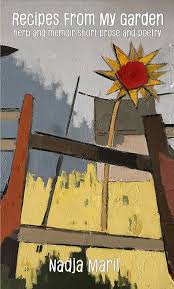
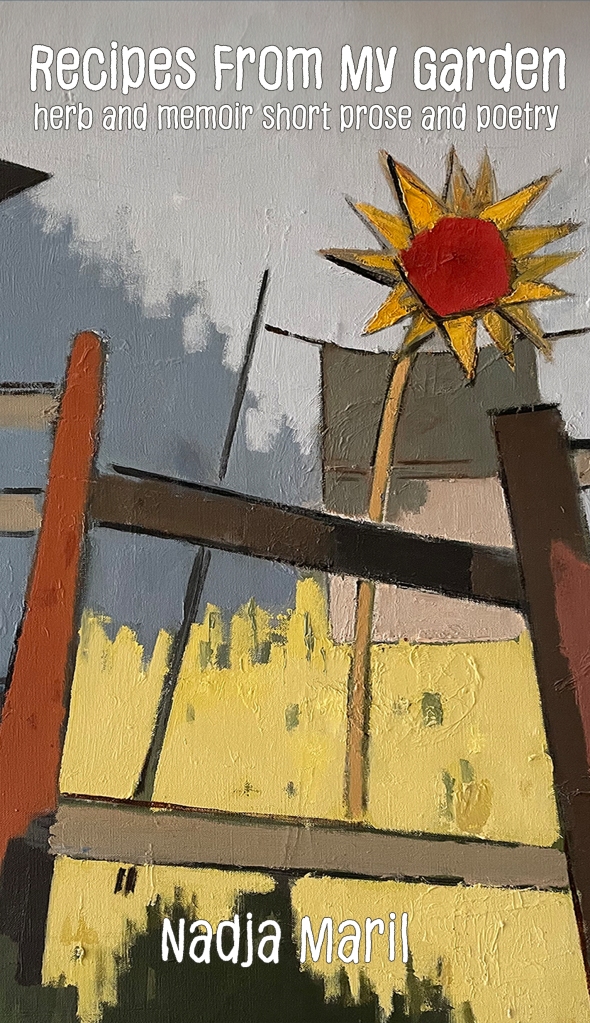
So, I was surprised when a friend told me their spouse had purchased my new book (Recipes From My Garden; herb and memoir short prose and poetry) and with the cold weather coming, they were planning on trying out some of my recipes.

i’d written a book of prose poems and memoir and my friend thought I’d just published a cookbook!

How Word Choice for Your Title Affects Marketing

Recipes. Yes, the word can mean instructions on food preparation, ie try my recipe for chicken soup, but it can also mean a way or approach to doing things. You might say I’ve got the recipe for a successful children’s birthday party, one adult for every child. Or on the opposite end of the spectrum, you might hear about a class trip to the amusement park with no parent chaperones and say, That’s a recipe for disaster.

I thought I was being clever when I chose the title to my little chapbook. I imagined that readers seeing the words memoir, prose, and poetry would understand the book’s double meaning. It does contain a few actual recipes and many references to food and kitchen gardens, but primarily I was thinking of the word recipe as a way or approach of doing things. As memoir, the usage becomes personal. As a poet, I’m sharing how I see the world, starting specifically with what is accessible to me: the sunflowers, tomatoes, a walk on the beach.

The good news for me is  if there is any doubt, the silver lining is people do talk about what they read and like. But if you are new to thie site and you are just reading about my chapbook for the very first time, I also have a book trailer. My talented publishers were able to use some of the video my husband took of our giant sunflowers along with old family photographs and more recent ones to create a wonderful book trailer. You can watch by clicking on the link: https://youtu.be/HxmwOx3-_QY

And going with the theme of the multiple meanings of words, here is a word WRITING PROMPT

To get you started I have chosen a few ambiguous words: long, cleave, bar, and duck. Select a word, choose a meaning, and start writing a scene. Take the word and use it with an alternate meaning. How many different ways can you use the same word and shade the meaning in different ways? Try using the word in a poem and play with the multiple meanings.  Have fun.

Thank You for reading! To read more of my work sign up for FREE to follow me on WordPress, Substack or Medium and visit my website at www.Nadjamaril.com.

Don’r forget to follow Old Scratch Press on Facebook and on WordPress.

Published by Nadja Maril

Nadja Maril’s prose and poetry has been published in literary magazines that include Change Seven, Lunch Ticket, Thin Air, and The Compressed Journal of Creative Arts. She is the author of Recipes From My Garden, a chapbook published by Old Scratch Press that includes both poetry and creative nonfiction prose. Author of two children’s books illustrated with paintings by her father Herman Maril, as well as Who IS Santa? for which she did her own illustrations, Nadja is also the author of two reference books on antique American Lighting, published by Schiffer. A former journalist and magazine editor, Nadja has an MFA in Creative Writing from the Stonecoast Program at the University of Southern Maine. To read more of her work and follow her weekly blog posts, visit Nadjamaril.com https://nadjamaril.com/ View more posts

LAST CHANCE!

Last Chance to get published this year!
SUBMISSIONS FOR 2025 ARE OPEN THROUGH 11.02.25.

The Old Scratch Press team asks that all fiction/non-fiction pieces adhere to a word count of 500 words or less.

Topics/themes for 2025

GRAVY is our 2025 winter holiday theme. Give us your best holiday gravy fails, mishaps, ridiculous gravy encounters (any December holiday, from Hanukkah, to Solstice, to NYE, etc.) or your best funny work about gravy, in general. The point of the end-of-year issue is to be light-hearted to downright silly.

Submissions close NOVEMBER 2, 2025; the issue will publish DECEMBER 1, 2025.

SUBMIT!

You know you want to!

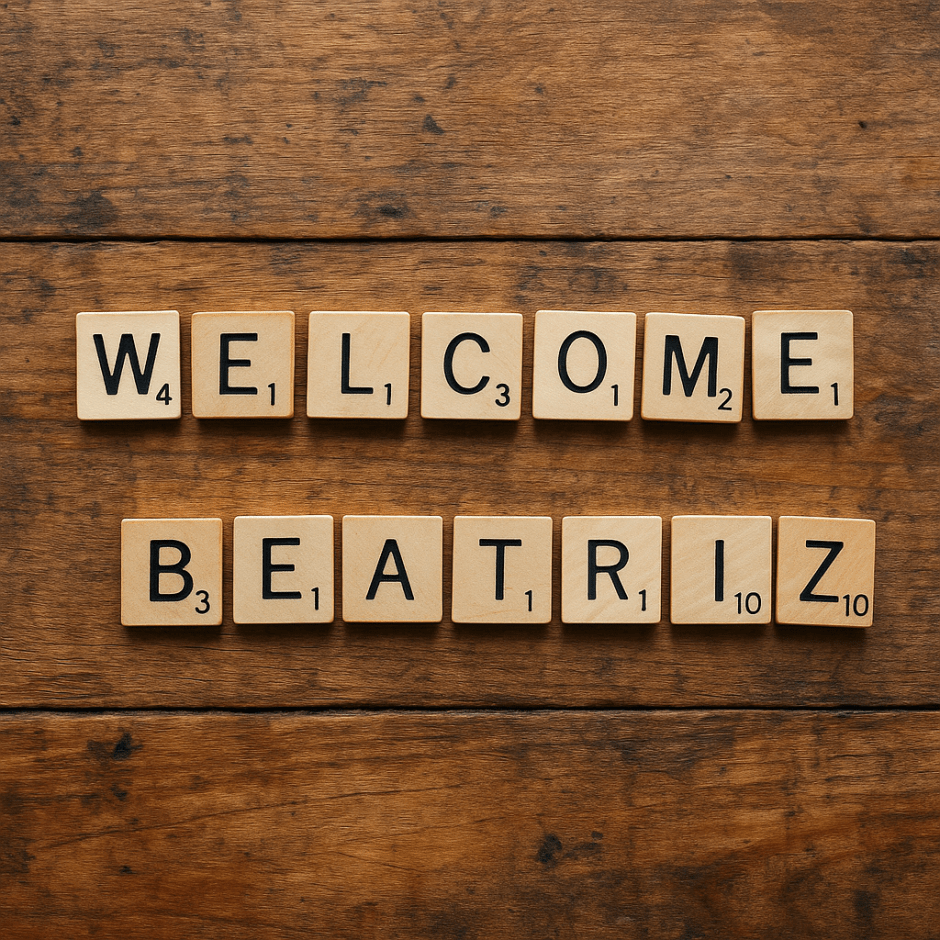
Welcome Beatriz Fernandez: Newest Member of Old Scratch Press

Old Scratch Press Short Form and Poetry Collective is pleased to announce that Beatriz Fernandez has recently become our newest member.  “I am thrilled and honored, “she says, “to join an online community of fellow writers from around the globe who support each other’s work, provide feedback and share our various skills and strengths.”

Although she didn’t try to get published until she was in her late forties, Beatriz has been writing all her life. 

“I write in both form and free verse, both mainstream and genre, and have recently begun to write flash and short fiction. In poetry, I favor historical persona poems written in the voices of women, whether historical, mythological, or fictional figures. I also write speculative poetry and short fiction. I try to include my love of robots, androids, or time travel in most of my stories.” 

Over the past ten years, Beatriz Fernandez’s work has been nominated for the Pushcart prize four times, and has been published in anthologies and journals as various as Label Me Latina/o, Prime Number Magazine, Strange Horizons, and Whale Road Review.  She’s authored three poetry chapbooks: the most recent, Simultaneous States, (Bainbridge Island Press, 2025) included some poetry set in Puerto Rico and some speculative poems.  Her eco-science fiction flash fiction piece, “Flow Time” was published this summer in a special Florida themed anthology by Gaslamp Pulp, a division of Nat 1 Publishing.  That publisher also just accepted her Puerto Rican Frog Prince adaptation titled “The Coquí Captain” for a children’s anthology of reimagined fairy tales.

Beatriz grew up in Philadelphia, Spain, and mostly Puerto Rico and then came to Florida to attend college.  During her junior year she established her Florida residency, met her husband, and began working in libraries.  “I fell in love with all three,” she says, “and subsequently found no reason to leave any of them!”

Describing herself as a late bloomer in both her library and writing careers; she became a professional librarian in her mid 30s.  On the way, she obtained an M.A. in English literature but found herself to be too much of a generalist to focus on a dissertation topic. 

“During this time,” she says, “I seemed to be under the impression I was a budding novelist while the reality was that I was writing more poetry than anything else.  My lightbulb moment came when I won a Writer’s Digest poetry contest that I entered on the very last day.  That stroke of luck seemed to finally put me on the right road and actively seeking to improve my poetry style.  I embarked on a long-distance phone tutorial with poet Andrea Hollander, who is a brilliant teacher and mentor, for several years; she helped me find my true voice. “

“Many writing classes, confabs and workshops later,” she says, “I’ve published almost every poem I’ve ever written! Now I feel I have come full circle—after starting out my writing career with long-distance tutorials, I’ve joined an online community of fellow writers.”

To learn more about Beatriz and to hear her radio interview on “Here and Now,” you can visit her website here

Thank you for reading this post and visiting the Old Scratch Press Blog. Next Saturday October 25th at 5:00 p.m., three members of the Old Scratch Press Team are participating in a special online reading from their newly published books. FREE. Read more about it here. And follow us on Facebook.

The Art of Borrowing Characters: A Literary Debate

by Nadja Maril, a founding member of Old Scratch Press Collective

A few months ago, I read a book purely for escapism, a cozy mystery populated by Jane Austen Characters entitled The Murder of Mr. Wickham by Claudia Gray. I didn’t have to think too hard as I’d already met: Fitzwilliam and Elizabeth Darcy, Marianne and Colonel Brandon, Anne and Frederick Wentworth, and Fanny and Edmund Bertram. Already familiar with the English country homes so well described in my favorite Jane Austen Novels: Emma, Persuasion, Mansfield Park, Pride and Prejudice, Sense and Sensibility, Northanger Abbey, I merely had to get to know the two new characters Jonathan Darcy (son of Fitzwilliam and Elizabeth) and Juliet Tilney ( daughter of Northanger Abbey’s Catherine and Henry) who team up together to solve the murder.

Photo by Alexander Mass on Pexels.com

Combine characters created by other authors with AI (artificial intelligence) and we stand on shaky territory.

What is it that makes human writing truly unique ?

The novel started me thinking about where writers find inspiration, because certainly this particular set-up would theoretically be the perfect candidate for an AI (artificial intelligence) generated book. A good portion of the plot of The Murder of Mr. Wickham  relies on tropes and scenes frequently present in other Jane Austen books.

As to be anticipated, in this cross between an Agatha Christie whodonit and a Jane Austen novel, we have  a series of misunderstandings between couples, friends and romantic prospects as well as a grand ball, a visit by the gentry to the village where they are shunned, a church scene with more snubbing, and conflicts that center on income and social class. While I was curious to find out the identity of the murderer, with so many characters possessing motive, I found myself more interested in the potential for a romance to develop between Jonathan and Juliet.

Is picking up ready-made characters cheating? Certainly, the use of characters who have already proven themselves to be favorites among readers, give a writer an advantage when looking to find a publisher.  What is the difference from taking a character or storyline from the Bible or a popular fairytale vs. taking a fictional character such as Sherlock Holmes or Sir Lancelot casting them in the starring role of your next short story or novel.

Folktales and Myths provide plenty of ideas for new versions of old stories. Photo by RDNE Stock project on Pexels.com

One thing I’ve noticed is the different ways a popular character can be used. Minor characters in a well-known fairy tale, perhaps one of the step-sisters in Cinderella may have a very different take on why Cinderella was not allowed to go to the ball. The Genie locked inside a bottle could probably tell a series of funny stories about badly chosen wishes. In the Broadway hit musical “Wicked,” partially adapted from the 1995 Gregory Maguire novel Wicked: The Life and Times of the Wicked Witch of the West, Glinda is not the spotless white witch she purports herself to be when one hears the tale from Elphaba’s prospective.

Anything that spurs new ideas is fair game, as long as borrowing a character or a plot is not plagiarism. The plot or the characters must have evolved and changed. The characters themselves must be unique (not duplicates of another author) and not protected by copyright rules.

As a general rule, for works created after January 1, 1978, copyright protection lasts for the life of the author plus an additional 70 years.

Thus, favorite characters such as the Harry Potter gang, are relegated to fan fiction only, meaning the work is “unauthorized” and cannot be used for monetary return.

Taking inspiration from classics can be a creative endeavor if not taken up by computers. It can make a great writing prompt.

You can use this prompt to write short stories and poetry, material that would be appropriate for a chapbook as well as specialized literary magazines.

Maybe Goldilocks brings three bowls of Creme Brulee to the bears as a peace offering. Photo by Gerardo Manzano on Pexels.com

WRITING PROMPT

Think of a favorite folk/fairy tale such as The Three Bears. What if Goldilocks had the opportunity to apologize for her rude intrusion into the Bear’s Cottage. Imagine and write down what might happen. If the men who pretended to sell invisible cloth to the emperor were to tell the story of The Emperor’s New Clothes, would they tell it differently than the traditional fairy tale? Try different approaches. Have fun.

Thank you for reading. Please sign up to follow Old Scratch Press here on WordPress and on Facebook.

Nadja Maril is an award winning writer and poet who has been published in dozens of online and print literary journals and anthologies including: Lunch Ticket, Spry Literary Journal, Invisible City Literary Review, Instant Noodles and The Journal of Compressed Creative Arts. She is the author of Recipes From My Garden, published by Old Scratch Press (September 2024), a Midwest Review California Book Watch Reviewer's Choice. An Anne Arundel County Arts Council Literary Arts Award winner, her work has been nominated for the Pushcart Prize and The Best of the Net. She has an MFA in creative writing from Stonecoast at USM. 
Check out Nadja's chapbook of flash memoir and poetry below.

https://rb.gy/olqjwe.

The Art of Storytelling: New Perspectives on Old Fairy Tales

By Nadja Maril

Perhaps it was the illustrations that captivated me when I’d pour through the fairytale books, the dragons and the princesses with long gowns and tresses, but of all the picture books in my room when I was a young child, I liked the fairytales the best.

I can still remember many of those books, the way they looked with their ornate borders and their detailed portraits of the handsome Puss N’ Boots or the angry face of Rumpelstiltskin as he stamps hard enough to crash through a floor and into oblivion. Styles evolve and change, and the animated images of the Walt Disney studios who’ve popularized many fairy tales by converting them into cartoon movies, don’t have the same depth of detail as those old illustrations. I love the old woodcut and color plate illustrations, but many contemporary artists add new magic and perspective to an old story.  When you read a fairytale or any story for that matter, the possibilities for elaboration are endless.

“Happily Ever After” isn’t always the case in some of the Hans Christian Anderson Tales, such as “The Red Shoes” and “The Little Mermaid.”  But as fairy tales have been told and retold so many times, multiple versions circulate. Children today probably have no idea that the original “Little Mermaid” is a tragic story of desire and loss. The little mermaid was unable to permanently become a human. Her attempts at transformation cause her to lose her life as a mermaid. What remains, is her hope that one day she’ll become part of the eternal universe.

In the hands of the Disney writing team, however, “The Little Mermaid,” became a story about family conflict, friendship, love, and fulfillment. The result is a story with a happy ending.

What story would you like to write?

But that’s okay, because fairy tales are part of our oral tradition and why not use the familiar tropes from our childhood as building blocks to create new stories or retell old ones. I think it is important to remember and learn from what went before. However, the stories of our lives keep evolving. So, what story would you like to tell?

To get you started, I’m sharing the work of several writers who were and still are inspired by fairy tales.

Many poetry enthusiasts will probably be familiar with the poem “Goblin Market “by Victorian era British poet Christina Rossetti(1830-1894). It utilizes the folklore of goblins to set the scene with lines like these:

"Pricking up her golden head:
"We must not look at goblin men
We must not buy their fruits:
Who knows upon what soil they fed
Their hungry thirsty roots?”
“Come buy,” call the goblins
Hobbling down the glen."

To read the entire poem and learn more about Christina Rossetti, click here.

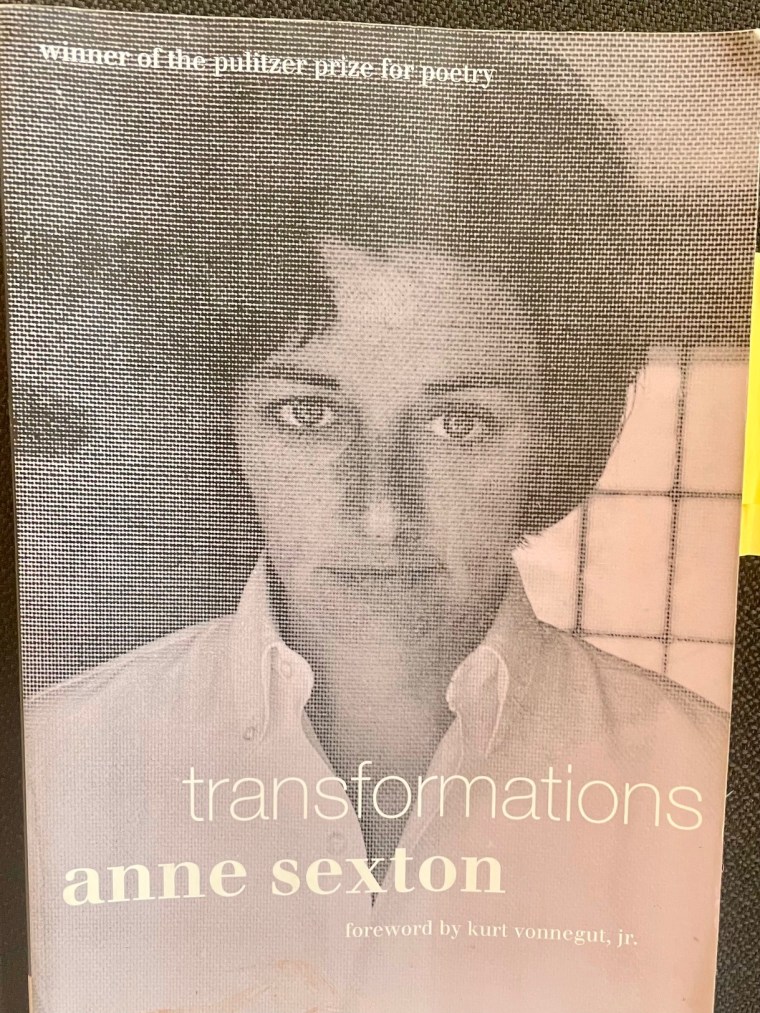
Another writer, Anne Sexton (1928-1974) took fairy tales as a launching point to reimagine social norms.

American poet Anne Sexton is considered a pivotal figure in the confessional poetry movement that emerged in the mid-20th century. Her work holds nothing back as it shares her personal struggles. Themes she explores include: mental illness, sexuality, and the complexities of womanhood. Her poetry collection Transformations contains seventeen poems inspired by Grimm Fairy Tales, that include Red Riding Hood, Rapunzel and CInderella, that challenged the prevailing norms of her times. I highly recommend adding this volume of poetry, the contents of which are unavailable online, to your library.

“The Cinder Girl Burns Brightly” by Theodora Goss is a different take on the Cinderella fairytale, told in poetry. Hungarian American author Theodora Goss (1968–) is a prolific author of novels, short stories, poetry and essays, and more of her work can be accessed at this link.

And finally I share a short story by American writer Michael Cunningham, famous for his novel The Hours, this little story, Wild Swan is inspired by the Hans Christian Anderson fairytale “The Wild Swans.” Brilliantly he takes the premise of the original story and creates an alternate re-telling set in modern times that focuses on one of the enchanted princes.

Need a writing prompt? Just read a favorite fairytale and think about how you’d like to retell it differently or take just one character or element and spin it into a poem or story.

Thank you for reading. Please sign up to follow Old Scratch Press here on WordPress and on Facebook.

Nadja Maril is an award winning writer and poet who has been published in dozens of online and print literary journals and anthologies including: Lunch Ticket, Spry Literary Journal, Invisible City Literary Review, Instant Noodles and The Journal of Compressed Creative Arts. She is the author of Recipes From My Garden, published by Old Scratch Press (September 2024), a Midwest Review California Book Watch Reviewer's Choice. An Anne Arundel County Arts Council Literary Arts Award winner, her work has been nominated for the Pushcart Prize and The Best of the Net. She has an MFA in creative writing from Stonecoast at USM. 


Like a blot from the blue: Are you reading your work?

Recently Robert Fleming was nice enough to get Old Scratch Press booked on Like a blot from the blue. Robert Fleming, Gabby Gilliam, Anthony Doyle, Alan Bern, Virginia (Ginny) Watts, and I showed up. I gave a little information on Old Scratch Press; Gabby gave some information Instant Noodles, and Anthony and Ginny read from their new books. Being there and presenting to an international audience was a fantastic opportunity for us, and the folks there were great.

What I liked even more were the other people who showed up.

I’m going to guess that there were about 30 people who showed up who were not us, one of whom was Fin Hall, the blot-in-chief. It was clear that many of these folks had been attending regularly for quite some time. One at a time, in turn, based on when they signed up, Fin called on each person, and the author read 1-3 poems, depending on length.

When I was in my twenties and thirties, which, sadly, I am not any more, I used to read at LIP (live, in person) open mics all the time, and I would often have to hang in until midnight to get my chance. Usually these were held in bars in Philadelphia, or in West Chester, Pennsylvania. I did my best to dress as “punk rock” as possible, and my general aim, if I’m honest, was to get laid. It’s frankly shocking how few times that happened, when that was clearly my intent. I usually had on a mini skirt and was showing cleavage, but, in truth, people who knew me then told me then, and will reiterate the very same thing today, that me punked-out and showing cleavage was, somehow, still giving Julie Andrews when what I was going for was Grace Slick. Ah well.

In any case, the thrill of reading, and the thrill of possibly getting lucky, and the location (always bars) also meant that, in all likelihood, by the time they got to me on the sign-up list, I was hella drunk. I was a smoker (Benson and Hedges 100s back then), but because I was also a poser: at those events I came with a pack of Dunhill Blue.

Waaaay too expensive to smoke all the time, but on open mic nights I always stopped at the news agent’s (Philadelphia had news agents!) to get a pack beforehand.

A few times/year the venues would ask me to be the featured reader, and I think that was because I was also volunteering with a little Zine called Magic Bullet (run by Andrew Craig, wherever he is today), which I had quite a few publications in, and, who knows, maybe I was good.

I was working my way through an MA and then an MFA from my twenties into my thirties, and my professors seemed to think I was good, as well, and I won the student awards each year, so maybe. When I read at the school events I was not drunk, but neither was I nervous, perhaps because my professors made me feel gifted.

And then, sometime around the end of my last degree, life took a turn. My very long relationship went very south. Another relationship pooped too quickly, and flamed out just as fast, and I remember I felt, while I was still prolific as a poet, that I had somehow lost at life. I wanted, you see, to become a published poet and a professor, and a spouse, and a parent, and I wanted all four things to work out perfectly, and just none of them did.

My life, then, became a series of edits. If it didn’t work to have the man with the red hair, then cut him from the piece, and write in another man, one with cheap beer on his lips. It was so time-consuming to send out work, one poem here, and one there, through the mail, keeping track of where it went, and keeping a lookout for the SASE to bring it back, and seeing if it was in decent enough condition to be mailed back out again, and I remember for awhile I was printing on onion skin to save money (who knows what that is?), and digging up the two dollars or eight quarters to send the piece of onion skin back out, and waiting for the SASE again to return, and each time writing a letter of introduction, sometimes including letters of introduction from my professors who were consistently and kindly encouraging. I remember two of them, who seemed to think my writing was the bee’s knees, were flummoxed that my poems weren’t getting entry, but maybe the long narrative style went out with Wordsworth. And life became more about driving from 9-5 job to college job to relationship, to moving out, to moving over there, to trying again, to keep on trying, to being, frankly, trying.

Little by little, returned SASE by SASE, edited dream by edited dream, the writing dribbled to a stop. Drip, drip, dr—

It was so quiet in my head.

Well, in the poetry part of my head at least.

And a decade and a half ran through my fingers.

And then I started writing again. Not only poetry, and not the plays I wrote in my twenties, but fiction, and memoir, which is, I guess, what this is.

I found myself in a place where the place, the locale, was so small and local, it felt small enough that I dared to go to a reading again.

But over the intervening years something just awful seemed to have happened. When I showed up to read at the open mics, even when I went with friends, I could not make it through a single poem without devolving into tears. And maybe there’s a reason for this shocking behavior, and maybe there isn’t, but it seems as inevitable to me as hair going grey, and as unavoidable as the red dot from a sniper’s gun in one of those movies with snipers.

And yet, at the simple evening with Blot from the blue I felt encouraged. The readers were great, and seemed normal (for the most part… I mean, poets, right?), and kindly, and on Zoom my head is no bigger than a Cerignola olive, so I am going to say I felt safe. I think it would be quite okay to join in, and I asked him later, and Fin said yes, folks can join. And folks could mean me, or you.

So what the hell, let’s try it!

Find out about Blot here.

And use this email to express interest likeablotfromtheblue@gmail.com.

And if you show up, be a goooood listener first, and a good reader second.

I’m not much of a drinker these days, so if I show up it will probably be very sober, and there hasn’t been any nicotine in these lungs for a long spell. I will, however, be caffeinated. And that’s at least something. The poem I am thinking of reading has some sound effects in it, which is probably ill-advised. But after I read, and make whatever sort of a fool of myself I am destined to be, I can write a new poem: Pearce With Her Pants Fallen Down.

Nadja often finishes her posts with a writing prompt, so here is me, stealing that excellent idea:

Think of an “edit” you made in your own life, by choice or by force. How did it work out for you?

Or

Have you ever read at an open mic? Write a flash memoir piece describing your experience.

Thanks for reading!

Dianne

Final Two Meet and Greets for New Members

Are you a flash fiction, poetry, or short memoir writer with a finished manuscript—or one nearly ready to go? Old Scratch Press, a collaborative collective supported by Current Words Publishing, is now accepting applications for two new members to join us in 2026.

We’re a tight-knit, skill-sharing group that publishes each other’s books, runs the lit mag Instant Noodles, and supports each other with editing, design, marketing, and community.

We are hosting meet and greets on August 6th and August 13. To be invited you have to send a small sample. There are no fees to submit, and there are no fees to join, and there are no fees to publish your collection. There are no fees. Who else you gonna find to collaborate with who dedicates an entire issue of a literary magazine to that most magical of elixirs… gravy?
If you’re eager to grow as a writer and be part of something creative and weird and wonderful, we’d love to meet you.

👉 Apply with a sample here:
https://duotrope.com/duosuma/submit/form.aspx?id=6idG3Mj-O0jFm-15Y7r2p

Spots are limited. Let’s make good things together.

Exploring the Art of Creative Nonfiction

By Nadja Maril

Before you read this you’ll want to check out the NEW issue of Instant Noodles Literary Magazine which has some excellent examples of creative nonfiction along with poetry, short stories and eye catching artwork.https://instantnoodleslitmag.com/

Now let’s talk a little about CNF.

In my previous profession as an antiques dealer, I came across many 18th and 19th century journals and often the most remarkable thing about them was their impeccable penmanship.

Nowadays the word journaling connotes the writing of innermost thoughts; but often the journals I encountered contained lists of items purchased and/or a record of weather events.  If someone did write down deep and personal information, they hadn’t left it behind to be found by a stranger.

Photo by RDNE Stock project on Pexels.com

In the 20th century it was fashionable to keep a “diary” and diaries came with locks and keys. Many stories have been told about a diary being read by a parent or a diary falling into the wrong hands. The locked diary contained things not meant to be shared.

Whatever was written in a journal or diary was someone’s truth.

Gradually a shift in what can be shared and what must be kept secret occurred.  True stories, nonfiction, became popular fodder for books, movies, and television series. We are intrigued by the unbelievable. In literature, the memoir that thoughtfully reveals the life of the author is celebrated.

Creative nonfiction is a writing genre that can be tricky to define. Based on a true event, the creative designation, indicates the importance of artistry. The writer seeks to use their craft to convey a feeling, a fear, a triumph, a predicament they personally experienced or witnessed.

Often creative nonfiction and poetry cross paths. A poem can be inspired by a witnessed event or experience, and therefore some might call it creative nonfiction.  A flash creative nonfiction story with rhyme, alliteration, and rhythmic sentences could be categorized by some as a prose poem.

Here is an example for you to ponder, a prose poem by American poet Amy Lowell.

Bath

               By Amy Lowell (1874-1925)

The day is fresh-washed and fair, and there is a smell of tulips and narcissus in the air.
      The sunshine pours in at the bath-room window and bores through the water in the bath-tub in lathes and planes of greenish-white. It cleaves the water into flaws like a jewel, and cracks it to bright light.
      Little spots of sunshine lie on the surface of the water and dance, dance, and their reflections wobble deliciously over the ceiling; a stir of my finger sets them whirring, reeling. I move a foot and the planes of light in the water jar. I lie back and laugh, and let the green-white water, the sun-flawed beryl water, flow over me. The day is almost too bright to bear, the green water covers me from the too bright day. I will lie here awhile and play with the water and the sun spots. The sky is blue and high. A crow flaps by the window, and there is a whiff of tulips and narcissus in the air.

***

Each person’s perception of what they witnessed is slightly different. Then the question shifts to how much is fact and how much is fiction. Has the story has been changed to suit the storyteller? In the telling and the writing, the emphasis of what was important may shift. Once again, this can be the result of artistic interpretation.

The process of writing creative nonfiction has me returning to it again and again. Pure fiction has its own joys, but creative nonfiction provides an opportunity for personal discovery. Why do i remember an event a certain way, I ask myself, while someone else remembers it differently? Maybe that tells me something about myself.

The best way to develop an appreciation for creative nonfiction is to read it.

Some magazines I like to read for their flash creative nonfiction include: Riverteeth https://riverteethjournal.com/beautiful-things/

Hippocampus Magazine. https://hippocampusmagazine.com/

and Bending  Genres https://bendinggenres.com/

Thank you for reading this post and visiting the Old Scratch Press Blog. This Sunday, August 3rd.  from 2:00 to 5:00 p.m., several members of the Old Scratch Press Team are participating in an international Poetry Reading, Blot of Blue

And you can attend online. Here is the information and invitation.

https://www.facebook.com/events/764779602578772/?acontext=%7B%22event_action_history%22%3A[%7B%22surface%22%3A%22home%22%7D%2C%7B%22mechanism%22%3A%22surface%22%2C%22surface%22%3A%22groups_highlight_units%22%7D]%2C%22ref_notif_type%22%3Anull%7D

Creative Writing Prompt Inspired by Ann Patchett’s novel Tom Lake

By Nadja Maril, a founding member of the Old Scratch Short Form and Poetry Collective.

Summer and reading go hand in hand. You go on vacation and take along a stack of all those books you’ve been meaning to read.

Sometimes, for me I have to confess I’m actually listening instead of turning pages.( Did you know that most of the books published by Old Scratch Press are available as audio books as well as ebooks?) Half of the books I enjoy these days are recorded books because I can listen and do various chores at the same time.

I can also eat lunch and be entertained by a book without smearing avocado or salad dressing on its pages.

And then if I really love the book, or just want to see it laid out on the page, I get a physical copy from the library and enjoy it again.

I try really hard not to read books by the same authors, so I can introduce myself to new voices. However, I couldn’t resist downloading Ann Patchett’s latest novel, Tom Lake, because I was curious about what it had to do with cherry orchards. The audio version is narrated by Meryl Streep. What a treat.

I’m a Meryl Streep fan and the narrator and protagonist of Tom Lake, the novel is a former actress. True, she is a different kind of actress, “a natural”, as she reveals in her story telling, unlike Streep who has portrayed a wide range of characters, but the protagonist has performed on stage and screen nevertheless. Streep does an impeccable job

What I truly want to recommend about the novel is its construction. So, writers, and aspiring writers pay attention. Not only does Patchett incorporate unpredictable twists and turns into the storyline, but she skillfully interweaves past and present.

The present setting is a farm near Traverse City Michigan during the Covid Pandemic. The past setting, that jumps back and forth into the storyline, is a summer stock theater also in Northern Michigan called Tom Lake. Part of the fun of this story is the gradual reveal of how present and past fit together.

I highly dislike predictable plotlines. Thus, I shout the praises for a novel that continued to surprise me to the very last page.

If you are a writer, continuing. on the journey of further refining your craft, you may be interested in the upcoming opportunity to join the Old Scratch Press Writing Collective or the opportunity to become published in Instant Noodles Literary Review. The Collective applications are available here and the deadline is closing soon.

The next theme subject for the Holiday/Winter Issue of Instant Noodles is Gravy. Write a true story, a poem or a piece of fiction related to Gravy. Keep it short. We prefer prose that is less than 500 words in length.

Back to my thoughts on the novel Tom Lake and not wanting to give any spoilers, I’m going to provide a WRITING PROMPT instead:

Photo by Sarah Chai on Pexels.com

IMAGINE your very first boyfriend or girlfriend, remember what they were like to be with and then write about what attracted you to them, what you admired. Now, write about their flaws.

Take a break. Maybe wait an hour or a day. Then imagine yourself with that person and what your life would be like. The third part to this writing assignment is to first think about what you would tell that person, if you had the opportunity, write them something—a letter, an essay, a poem—whatever genre form you choose. Do you have things you’d like to apologize about, or explain, or share?

Maybe this exercise will give you an idea for a story. Maybe not, but I guarantee you’ll learn something about yourself.

THANK YOU for reading. If you haven’t already signed up (it’s free!), please follow me on WordPress. Medium or Substack and visit my website Nadjamaril.com to read more of my work.

Nadja Maril is an award winning writer and poet who has been published in dozens of online and print literary journals and anthologies including: Lunch Ticket, Spry Literary Journal, Invisible City Literary Review, Instant Noodles and The Journal of Compressed Creative Arts. She is the author of Recipes From My Garden, published by Old Scratch Press (September 2024), a Midwest Review California Book Watch Reviewer’s Choice. An Anne Arundel County Arts Council Literary Arts Award winner, her work has been nominated for the Pushcart Prize and The Best of the Net. She has an MFA in creative writing from Stonecoast at USM. 

Join Us! You Know You Want To!