Have you ever considered a writing retreat? Most of them are (I think) outrageously expensive. How about a free one instead? Consider applying to Yaddo.
Yaddo is one of the most respected artist residencies in the world, offering writers something increasingly rare: uninterrupted time and space to focus deeply on creative work. Founded in 1900, Yaddo was created with a singular purpose, to support artists by removing everyday distractions so they can fully engage with their craft. Located on a wooded estate in Saratoga Springs, New York, Yaddo has quietly supported generations of writers whose work has gone on to shape contemporary literature.
What makes Yaddo especially appealing to authors is its emphasis on creative freedom. There are no required workshops, classes, or public obligations. Writers are given room, board, and a private workspace, allowing them to set their own rhythm and priorities. Residencies typically range from two weeks to two months, offering enough time to make real progress on a project or to rediscover momentum that may have been lost to teaching, work, or daily responsibilities.
Selection is based on the strength of the work itself. There is no expectation that writers arrive with a polished or market ready manuscript, and no requirement to produce a finished piece by the end of the residency. This makes Yaddo an ideal space for experimentation, risk taking, and deep revision. Many writers find that the absence of pressure allows them to work more honestly and adventurously than they can elsewhere.
While solitude is central to the Yaddo experience, a quiet sense of community is also part of daily life. Communal meals and shared spaces offer opportunities for informal conversation with artists working across disciplines, including music, visual art, film, and theater. These interactions are optional but often enriching, providing fresh perspectives without overwhelming the creative focus.
For authors navigating a literary world that increasingly demands constant productivity and self promotion, Yaddo offers a rare and valuable gift. Time to write. Time to think. Time to reconnect with the work itself. For writers serious about their craft, applying to Yaddo is not just an opportunity. It is an investment in the long life of their creative practice.
DEADLINE:
Dianne Pearce is the chief editor and bottle washer at Current Words Publishing, and the half-cocked imaginer behind Old Scratch Press and Instant Noodles. Pearce loves helping writers realize the dream of having their work published. I mean she is really crazy about doing that for some reason. To that end, to join in the fray, to look at the thing from the other side, to stand in another’s shoes, and all of those things, she is fully expecting and promising to publish her first collection of poetry, In the Cancer Cafeteria, spring of 2026. Please don’t hold your breath. For very long. Happy Holidays!
My grandfather was a schoolteacher, a school principal, and a child psychologist. He was an advocate for the idea that children should memorize poems. I believe he thought it would improve language skills, help with understanding rhythm in speech, and show children the joy of becoming emotionally attached to words and stories. There were five grandchildren. I was the youngest. I didn’t really want to memorize a poem. I remember it was summertime, and it felt too much like schoolwork, but I did. I chose the poem “Wynken, Blynken, and Nod” published in 1889 by Eugene Field. The original title of the poem was “Dutch Lullaby.” Field was known for his humorous newspaper columns and light verse for children. When I look back over my lifetime, I think my grandfather was onto something.
The poem is a charming, soothing rhyme about three children who go on a journey. They sail on a “river of crystal light” and “into a sea of dew.” They fish for stars and the moon sings to them, encouraging them as a friend and companion. Later, it becomes clear that the story is really about one child, his eyes are Wynken and Blynken, and his head is Nod. His mother is singing to him in his trundle bed of the, “…wonderful sights he’ll see.”
The poem was written at a time when people were fascinated with dreams. While it describes sleep, and falling asleep, and dreaming, it’s also about what you can do with your own imagination. It’s a lesson in fantasy. I have recited the poem in my head many times in my lifetime. I recited it to my children at bedtime. Like any good lullaby, it has comforted me and reminded me of hope, beauty, magic and that dreams can still come true. It is a piece of work that makes me feel safe. It has been my trusty companion. So perhaps it is true that all children should memorize at least one poem. I am not the only one who fell in love with “Wynken, Blynken and Nod” and stayed that way. Mankind in general has. It was made into a song in 1890 by Ethelbert Woodbridge. It was recorded as a song again in 1930 and later by the Doobie Brothers. The song was also performed on the television shows Barney & Friends and Sesame Street. In 1938, Walt Disney released an adorable cartoon on the poem featuring three pajama-wearing children. (You can watch this below.) In 1993, Mrs. Wilson recited the poem to Dennis in the movie Dennis the Menace. The poem is in the public domain and available to read from numerous sources, but here is the text:
Wynken, Blynken, and Nod one night
Sailed off in a wooden shoe—
Sailed on a river of crystal light,
Into a sea of dew.
'Where are you going, and what do you wish?'
The old moon asked the three.
'We have come to fish for the herring-fish
That live in this beautiful sea;
Nets of silver and gold have we!'
Said Wynken,
Blynken,
And Nod.

The old moon laughed and sang a song,
As they rocked in the wooden shoe,
And the wind that sped them all night long
Ruffled the waves of dew.
The little stars were the herring fish
That lived in the beautiful sea–
'Now cast your nets wherever you wish—
Never afeard are we';
So cried the stars to the fishermen three:
Wynken,
Blynken,
And Nod.

All night long their nets they threw
To the stars in the twinkling foam—
Then down from the skies came the wooden shoe,
Bringing the fishermen home;
'Twas all so pretty a sail it seemed
As if it could not be,
And some folk thought ’twas a dream they’d dreamed
Of sailing that beautiful sea–
But I shall name you the fishermen three:
Wynken,
Blynken,
And Nod.

Wynken and Blynken are two little eyes,
And Nod is a little head,
And the wooden shoe that sailed the skies
Is the wee one’s trundle-bed.
So shut your eyes while mother sings
Of wonderful sights that be,
And you shall see the beautiful things
As you rock in the misty sea,
Where the old shoe rocked the fishermen three:
Wynken,
Blynken,
And Nod.
May you find it soothes you to sleep too! Sweet dreams!
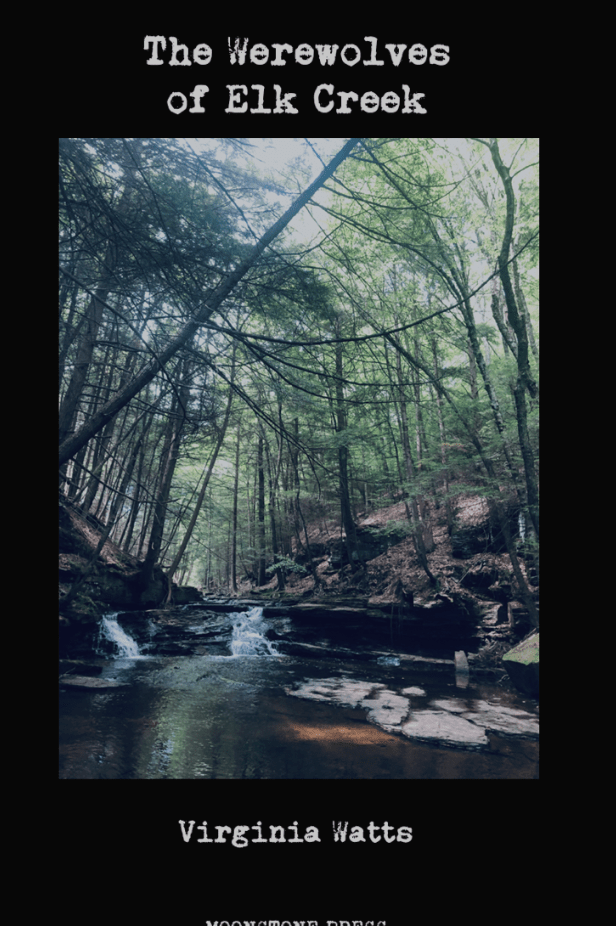
Virginia Watts is the author of poetry and stories found in The MacGuffin, Epiphany,CRAFT, The Florida Review, Reed Magazine, Pithead Chapel, Eclectica Magazine among others. She has been nominated four times for a Pushcart Prize. Her debut short story collection Echoes from the Hocker House was short listed for 2024 Eric Hoffer Grand Prize, selected as one of the Best Indie Books of 2023 by Kirkus Book Reviews, and won third place in the 2024 Feathered Quill Book Awards. Please visit her.
Virginia’s new book is now available from Old Scratch Press:
This week I listened to a webinar from a bit back on what you can and cannot use from others’ work in your work… spoiler alert, nope. nope, nope, you cannot use those Taylor Swift lyrics, no matter how perfect they are for your piece. Why? Because Taylor wrote them, for her piece. Cry me a small stream (see what I did there?) but you gotta write your own!
One form the webinar really did not recommend was Cento. And from the looks of my very unscientific Google search, there are a lot of them:
Well, why not?
As in the Taylor Swift example, those poets wrote those lines in their poems, to express their thoughts, and that doesn’t mean you can co-opt them, even though it is a fun writing exercise to try to knit them together. They also recommend against publishing Golden Shovels.
The webinar, for CLMP members, was helmed by Jeffrey Levine (a lawyer and Publisher of Tupelo Press) and Fred Courtright (President of The Permissions Company). And I was shocked to find out how many instances there are where authors should be getting permission, but maybe aren’t.
Copyright is, very basically, attached to intellectual property, so something we cannot touch with our fingers, even if those ideas are pressed into an LP, or printed in a book, or applied to watercolor paper. It’s the imaginings, the wordplay, the artistic or editorial or even advertising verbiage, or the design, creation, work of another artist. And we can’t use what isn’t ours without permission from its creator, or, and maybe more likely, its rights holder. Frankly, and this is where some writers disagree with me, this makes perfect sense to me if I think about someone taking my work, and using it in their own piece, and it also makes sense to me as an artist. I want so badly to use the lyrics to songs that I imbue with this meaning and emotion that only they can have, and it’s tougher to come up with my own “pretend” song, but I really need to push my writing to the next level, and do it. You don’t have to register your work with US Copyright to be protected, but we do copyright all books we publish as a matter of course.
What does copyright leave out? It does not apply to material that is not truly original, to anything already in the public domain, or to broad concepts such as ideas, systems, processes, or methods. Those belong more to patent and trademark, which overlap only in small ways that I’m not expert enough on to explain, so investigate. Copyright also does not cover names, titles, slogans, or very short phrases. In literary settings, though, it is usually safer to treat even brief lines as if they might be protected, simply to avoid trouble. How long does copyright protection remain in place? In most cases it lasts for the lifetime of the author plus an additional seventy years. For anonymous work or work created as a work for hire, the term is different. It lasts either ninety five years from the date it was first published or one hundred twenty years from the date it was created, and it ends when the earlier of those two periods runs out.
The publisher never takes copyright. The copyright remains with the author. The publisher only licenses the copyright, meaning the publisher has the right to print (or otherwise make available) or produce the work for some (limited) period of time. But if you publish a poem, for example, with a publisher, and you sign a contract, that poem may “belong” to the publisher for the duration of the contract. We’ve never held back an author from taking a work back or using it somewhere else, but I cannot speak for all publishers, so, though it should not be a problem to include in your chapbook a poem you published somewhere else, you may have to obtain permission to reprint it in another place. Do you have time to do that?
Another really interesting point the webinar brought up was that if a work is in the public domain, you do not need permission to use it. Fair use is a grey area, and so I would never recommend deciding on your own that something is fair use. I would suggest you contact Fred.
If you want to use an old poem in its original language, a piece that is long out of copyright, you can quote it freely. But if you want to use a modern translation of that same piece, the translation is probably under copyright. If you want to use something that is still in copyright, you might need permission from the copyright holder and also the holder of the copyright of the translation, and suddenly you’re in the weeds. And a lot of this costs money, to track down the copyright, and to pay for use. The webinar recommended the Watch File at the Harry Ransom Center as a good place to start. One person on the call said she often would ask bands directly, on their social media, if she could use their music or lyrics, but the presenters pointed out that while the band may (may, important distinction) hold copyright, someone else may hold the rights, and those folks could have very good “bots” looking for it on the internet, and show up with a big bill for you.
Even internet memes, tweets, etc., could belong to the person who posted them, and there could be consequences (of the financial kind is what we’re talking here) for you if you use them. And I liked that they made it clear that attribution (taken from “Friend of the Devil” by the Grateful Dead) does not give you permission: you can still find yourself on the hook for a lot of money. Yikes! And just because the author of a poem holds the copyright this doesn’t mean they’re not in a publishing deal where the publisher might own the reprint rights. You have to check it out to be sure.
The advice out there can differ greatly, and even The Poetry Foundation may have advice about fair use that the federal courts would not agree with, so the webinar strongly recommended that you either get permission, using someone like Fred, or skip it.
What do you think? Have you been playing with licensing fire? I am always encouraging authors to start an editing and publishing fund, but you may need a violation fund too! I hope not!
So friends I hope that you can sees
"fair use" doesn't grow like leaves
and poets and other fools like me
as much as you would like it free
accept that permission has a fee
and you can't pick from another's tree.
Dianne Pearce is the chief editor and bottle washer at Current Words Publishing, and the half-cocked imaginer behind Old Scratch Press and Instant Noodles. Pearce loves helping writers realize the dream of having their work published. I mean she is really crazy about doing that for some reason. To that end, to join in the fray, to look at the thing from the other side, to stand in another’s shoes, and all of those things, she is fully expecting and promising to publish her first collection of poetry, In the Cancer Cafeteria, spring of 2026. Please don’t hold your breath. For very long. Happy Holidays!
Thank you for reading. Please sign up to follow us on Facebook and to follow us here on WordPress to expand your knowledge about poetry and short form writing as well as to receive the latest news about publication opportunities.
Looking to get some final submissions in before we say good-bye to 2025? Here are some places that are open for submissions! Click the link to be taken to their submission guidelines.
FREE
Posit is accepting prose and poetry until December 5.
Have a good sense of humor? Defenestration is accepting short stories, poetry, creative nonfiction and visual submissions and seeking humorous pieces through December 5.
Up the Staircase Quarterly is accepting poetry and visual art until December 10. They have a tip jar option for $3.
Fish Barrel Review is open to poetry, prose, and visual art until December 15. Submissions are free, but they do also have paid option for expedited responses or feedback.
The theme for Spectrum‘s Vol. 69 is ‘consumption.’ You can submit fiction, poetry, nonfiction, and art until December 31.
Psychopomp is accepting poetry, fiction, nonfiction until December 31.
PAID
For a $3, $5, or $10 donation, Passages North is accepting fiction, poetry, short-shorts, and nonfiction until December 13.
OnlyPoems is open to both free and paid submissions for poetry until December 15.
Red Ogre Review is accepting poetry, music, and visual art until December 31 for $3 or $5 donations.
For a $3 reading fee, Five Points is accepting very short fiction until December 31.
Arc Poetry is accepting poetry submission for a fee of $2 per poem until December 31.
Calyx is accepting poetry and prose until December 31 for a $5 fee ($3 if you are a student).
These are only a handful of the journals that are currently open to submissions. There’s still time to get your writing in before the end of the year. Start 2026 off strong by submitting before December ends!
by Nadja Maril,a founding member of Old Scratch Press Collective
Food. We spend a substantial part each day preparing, serving, and eating. The tastes, aromas and textures bring back memories. And over the winter holidays, the sensations become magnified as we taste the turkey roasting in the oven, the creamy mashed potatoes, the fragrant puddings, the sweet and savory carrots, onion topped green beans, latkes and apple sauce, cheese blintzes, and buttery chocolate chip cookies.
This is why I enjoy writing about food. It’s easy. All I have to do is close my eyes, remember and think of words to describe memorable dishes, new tastes I discovered, and meals I’ve shared. Try it. Think of a favorite meal, why it stands out in your mind and the emotions you associate with that time. Write down you uncensored thoughts. Read over what you’ve written. Maybe cross out a few sentences and rewrite others. You’ve begun to write memoir, the start of what is called Creative Nonfiction and it wasn’t hard at all.
You can take those food thoughts and memories and turn them into fiction as well. There’s no shortage of food in fairy tales: the witch in Hansel and Gretal with the house made of gingerbread and candy, the red apple in Snow White, the porridge eaten by Goldilocks and the Three Bears.
Wonderful poems have been written about food ingredients. One of the most important items I use in savory dishes is onion. Chilean poet Pablo Neruda (1904-1973) wrote a wonderful poem about the onion I’d like to share.
ODE TO THE ONION
by Pablo Neruda

Onion,
luminous flask,
your beauty formed
petal by petal,
crystal scales expanded you
and in the secrecy of the dark earth
your belly grew round with dew.
Under the earth
the miracle
happened
and when your clumsy
green stem appeared,
and your leaves were born
like swords
in the garden,
the earth heaped up her power
showing your naked transparency,
and as the remote sea
in lifting the breasts of Aphrodite
duplicating the magnolia,
so did the earth
make you,
onion
clear as a planet
and destined
to shine,
constant constellation,
round rose of water,
upon
the table
of the poor.

You make us cry without hurting us.
I have praised everything that exists,
but to me, onion, you are
more beautiful than a bird
of dazzling feathers,
heavenly globe, platinum goblet,
unmoving dance
of the snowy anemone

and the fragrance of the earth lives
in your crystalline nature.
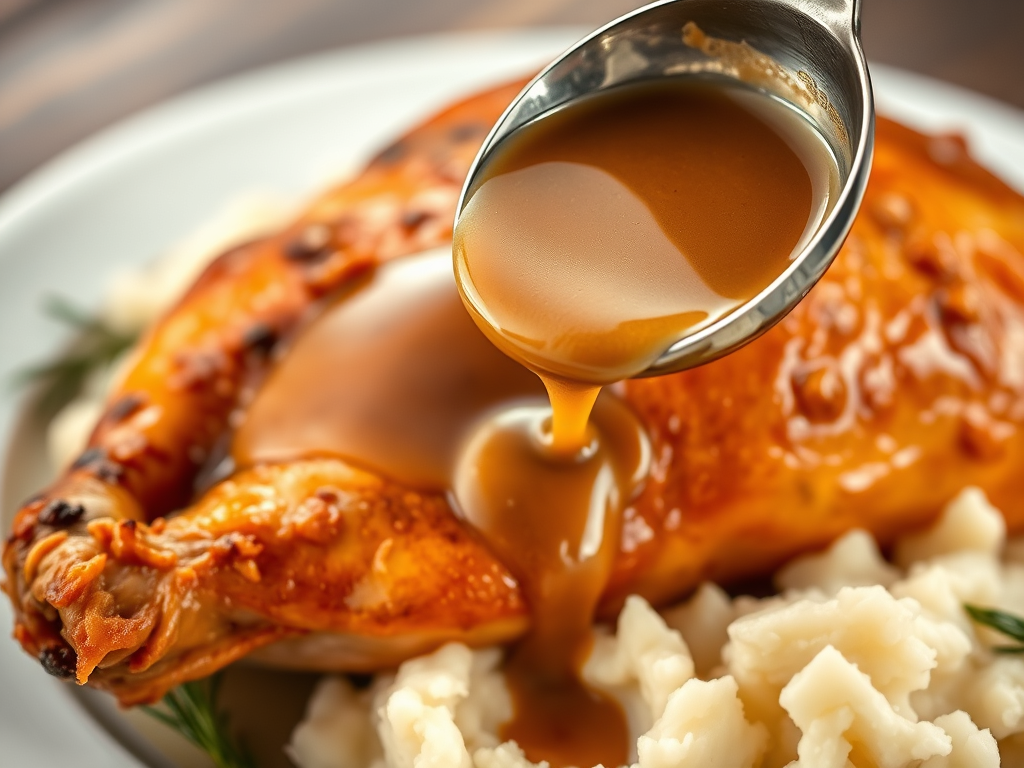
If you need more inspiration, start reading the latest issue of Instant Noodles Literary Magazine .All the stories and poems are inspired by GRAVY.
One of my favorites in this issue is “Thanksgiving Leftovers” by Arielle Arbushites which begins “Gravy gravy everywhere/and not a drop to drink” Hear her read the poem by clicking this link.
Forty-two creative expressions inspired by GRAVY! Who would have thought we’d get so many fine submissions on this topic. Read them and enjoy the writer’s different takes on the subject. Maybe it is a holiday dinner that goes wrong or a humble food offering that needs a splash of pzazz but all the stories have something to do with gravy.
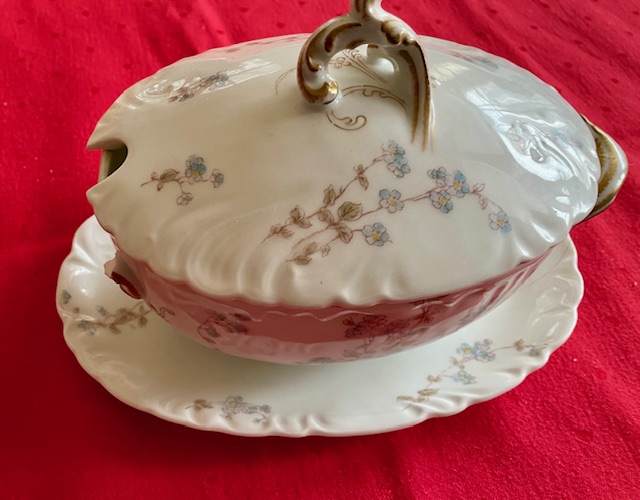
My creative nonfiction includes a nod to my great-grandmother’s Limoges covered gravy dish and a recipe. You can access it here or if you don’t want to read, you can listen here
Writers and Readers, don’t forget to forget to follow us on Facebook to get the latest news and learn about submission opportunities.
Nadja Maril is an award winning writer and poet who has been published in dozens of online and print literary journals and anthologies including: Lunch Ticket, Spry Literary Journal, Invisible City Literary Review, Instant Noodles and The Journal of Compressed Creative Arts. She is the author of Recipes From My Garden, published by Old Scratch Press (September 2024), a Midwest Review California Book Watch Reviewer’s Choice. An Anne Arundel County Arts Council Literary Arts Award winner, her work has been nominated for the Pushcart Prize and The Best of the Net. She has an MFA in creative writing from Stonecoast at USM.
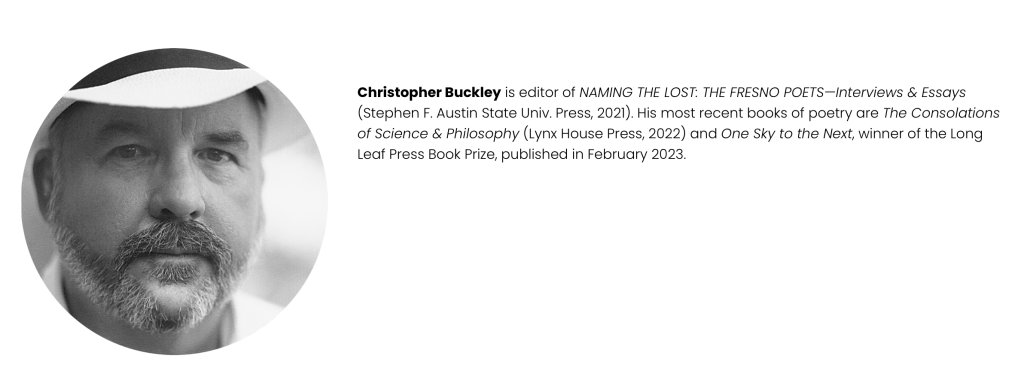
When I was in school studying writing, I had some just lovely, encouraging professors. One of them was Christopher Buckley.
Chris was always telling me other poets I reminded him of. One of those was Charles Simic, and another was Diane Wakowski. Chris was so wonderful, in fact, that he had studied with Diane, and he helped me organize for her to come and do a reading on campus, from Michigan to West Chester, Pennsylvania. It was a little bit strange, meeting Diane, because I had imagined her to be like if Twiggy and Patti Smith were merged into a single person who wrote kick-ass poetry. In reality she was a tiny thing, and a little prickly around the edges. I was star-struck and shy. I had read (lord knows how, as we didn’t have the internet, maybe in one of her poems) that she was a huge fan of freshwater pearls, and I bought a necklace and bracelet to give to her. She didn’t open the gift in my presence, and I never heard from her to hear if she liked them. But, in my very young mind, I thought she was everything I wanted to be: full-time professor, writing poetry all the time, and just generally badass, which, I guess, included being a little prickly and unfriendly. As introverted as I am, I am also a people-pleaser, so though I don’t want to talk in situations where I don’t know everyone, I do talk, because I am worried about not being nice enough to everyone else. And then I am exhausted after. Maybe Diane had already learned the art of taking care of herself. She was born the year after my dad, so she was well into middle-age when I met her.
The book I have pictured at the start of this post is the one that made me love her: The Motorcycle Betrayal Poems. I mean, she got on motorcycles. My sister (younger than me by 8 years) once had a motorcycle boyfriend, in fact he was a sweet guy, and we’re all still friends with him, and he once let me climb on behind him so that he could drive me around Sea Isle City on his motorcycle. But, to stay on behind a rider, you have to hold on to the rider’s body, and Reuel (the boyfriend) was incredibly fit and hot, like Brad Pitt in Thelma and Louise hot. I felt so afraid of falling off and dying and so wrong for gripping onto his body for dear life that I cut the ride short. Diane would not have cut the ride short even if it was with her sister’s hot boyfriend. Diane has always seemed to me like a woman who knows who she is and what she wants, and gets what she wants. She might have been the Taylor Swift of the 1970s, because to date her, and to break up with her, was to have a vicious poem written about you.
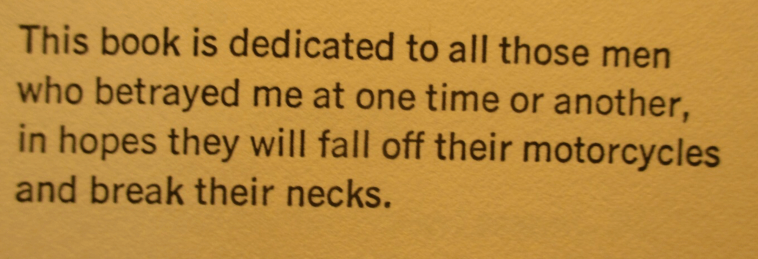
Dedication in the original The Motorcycle Betrayal Poems
At that point in my life I thought I had all possibilities ahead of me, as young optimistic people do. I thought I could become a thin woman who rode on the back of motorcycles and penned vicious poems about love. Diane also seemed… horny, which, raised by a very Methodist mother who got pregnant as a teenager, I was not allowed to be, so that seemed very flash and exciting to me too.
Honestly, you may think it silly yo say, because poetry is just poems, no big deal, but being a poet was such a monumental thing to me that I’m still trying to give myself permission to do it. Permission Diane never seemed to need, but Dianne definitely needs, to this very day.
If Diane was a sort of a hero, but not the warmest or nicest hero, why bring her up to you? Why not just let her, and her work, slide into obscurity?
I think because she is an unapologetic woman; she is who she is, lusty, strong, angry, successful (even if success did mean getting stuck in Michigan!), and felt no need to be mushy with a grad student who idolized her. No grad students have idolized me, but I expect it could be annoying as well as nice.
I told my sister last week that we’ve lost two Diane’s this year, Keaton and Ladd, both single Ns, unlike my double. Wakowski is up there, and also a single N. I don’t know if I can lose another one this year, so I hope she’s not on a motorcycle these days. And, then again, I kinda hope she is.
“She digs her teeth into the slaveries of woman, she cries them aloud with such fulminating energy that the chains begin to melt of themselves. Reaching into the hive of her angers, she plucks out images of fear and delight that are transparent yet loaded with the darknesses of life. Diane Wakoski is an important and moving poet.”–The New York Times
In 1971, Diane Wakoski published The Motorcycle Betrayal Poems to tremendous acclaim. Relevant, moving–at times shocking–it is Wakoski’s honesty and bravery as an artist that continues to astonish, delight, inspire, and liberate readers.
Wakoski responds to betrayal in a variety of ways including fantasies such as drilling bullet holes into the bodies of unfaithful lovers. But even her anger can be winking, as in the book’s sly dedication to “all those men who betrayed me at one time or another, in hopes they will fall off their motorcycles and break their necks.”
“The Bouquet”
“I Have Had to Learn to Live with My Face”
Have you heard of Diane Wakowski? What do you think of her? If you found any links to video of her, send it this way!
Celebrating Native American Heritage Month Through Reading
Each November, Native American Heritage Month invites us to recognize and honor the histories, traditions, languages, and contributions of Indigenous peoples across the United States. It’s a time not only for celebration but also for reflection—an opportunity to deepen our understanding of Native cultures and voices. One of the most meaningful ways to do this is through reading.
Books open doors to perspectives and stories that might otherwise remain unseen. When we read works by Native authors or books that authentically portray Indigenous experiences, we help ensure that these voices continue to be heard and valued. Reading becomes an act of both appreciation and advocacy.
Why Reading Matters
Reading stories by Native authors supports cultural awareness and empathy, especially among young readers. In classrooms and homes, these stories help children see the richness of Native traditions and the diversity within Native communities. For some readers, seeing their identities reflected in literature can be empowering; for others, it fosters respect and curiosity about cultures different from their own.
Books to Explore
Here are a few titles that celebrate Native stories for readers of all ages:
For Young Readers
We Are Water Protectors by Carole Lindstrom (Ojibwe) – A beautifully illustrated picture book celebrating environmental stewardship and Indigenous activism.
Fry Bread: A Native American Family Story by Kevin Noble Maillard (Seminole Nation)– A heartfelt celebration of family, tradition, and resilience.
Thunder Boy Jr. by Sherman Alexie (Spokane/Coeur d’Alene) – A picture book where the main character struggles with his name and tries to find a new one that better represents who he is.
For Middle Grades
Healer of the Water Monster by Brian Young (Navajo)– An adventure that weaves modern life and Navajo stories.
Indian No Moreby Charlene Willing McManis (Umpqua) and Traci Sorell (Cherokee Nation) – A novel that draws upon Umpqua author Charlene Willing McManis’s own tribal history which tells the story of a girl on a quest to understand her identity as an Indian despite being so far from home.
Ancestor Approved: Intertribal Stories for Kids, edited by Cynthia Leitich Smith (Muscogee Creek Nation) – A collection of intersecting stories and poems set at a powwow that bursts with hope, joy, resilience, the strength of community, and Native pride.
For Teens & Adults
The Firekeeper’s Daughter by Angeline Boulley (Ojibwe) – A young adult thriller that addresses social issues impacting Indigenous communities, such as the drug crisis, racism, colonialism, and violence against Native American women.
There There by Tommy Orange (Cheyenne and Arapaho Tribes) – A multigenerational story about violence and recovery, memory and identity, and the beauty and despair woven into the history of a nation and its people.
The Heartbeat of Wounded Knee by David Treuer (Ojibwe) – A compelling history that reframes Native American resilience and survival.
How to Celebrate Through Reading
Create space for Native voices in classroom and home libraries or book clubs.
Discuss what you read, focusing on themes of identity, resilience, and community.
Invite guest speakers or virtual author visits from Native writers.
Reflect on representation—whose stories are missing, and how can we bring them forward?
By reading and sharing Native stories, we help honor Indigenous heritage not just in November, but all year long. Books remind us that storytelling is one of humanity’s oldest and most powerful ways to preserve culture, inspire understanding, and connect us all.
Words. They fascinate me, the way some words like dust can have two very different meanings. You dust the house, removing small particles of dirt and cobwebs. You dust the cake with confectioner’s sugar making it sweet.
The word weather has two opposite meanings as a verb. The new wood shingles on the house will look better when they weather and turn a soft natural gray. Or used differently you could write, When the next hurricane arrives, I’m not sure if we can weather the storm. As a noun, the meaning of weather is constant. The noun describes meteorological conditions. Nice fall weather we’re having.
Applying Word Meanings to Getting Published
Every Monday when I read the updated lists of publishing opportunities in literary magazines, I read theme call-outs that generally consist of one word. Write to the theme, they ask, but sometimes that word can be open to wide interpretation. However, that’s the job of a creative writer; to put our own perspective into our poems and stories.
I read the word dirt and I might picture a pile of soil or imagine filth within a house or think instead of scandalous information about a crooked politician. Playing in the dirt making mudpies can be a joyful experience for a child whereas cleaning away mounds of accumulated filth a tedious chore. The diverse interpretations of how we interpret words can be what makes a collection of writing interesting.
The diverse interpretations of how we interpret words can be what makes a collection of writing interesting.
So, I was surprised when a friend told me their spouse had purchased my new book (Recipes From My Garden; herb and memoir short prose and poetry) and with the cold weather coming, they were planning on trying out some of my recipes.
i’d written a book of prose poems and memoir and my friend thought I’d just published a cookbook!
How Word Choice for Your Title Affects Marketing
Recipes. Yes, the word can mean instructions on food preparation, ie try my recipe for chicken soup, but it can also mean a way or approach to doing things. You might say I’ve got the recipe for a successful children’s birthday party, one adult for every child. Or on the opposite end of the spectrum, you might hear about a class trip to the amusement park with no parent chaperones and say, That’s a recipe for disaster.
I thought I was being clever when I chose the title to my little chapbook. I imagined that readers seeing the words memoir, prose, and poetry would understand the book’s double meaning. It does contain a few actual recipes and many references to food and kitchen gardens, but primarily I was thinking of the word recipe as a way or approach of doing things. As memoir, the usage becomes personal. As a poet, I’m sharing how I see the world, starting specifically with what is accessible to me: the sunflowers, tomatoes, a walk on the beach.
The good news for me is if there is any doubt, the silver lining is people do talk about what they read and like. But if you are new to thie site and you are just reading about my chapbook for the very first time, I also have a book trailer. My talented publishers were able to use some of the video my husband took of our giant sunflowers along with old family photographs and more recent ones to create a wonderful book trailer. You can watch by clicking on the link: https://youtu.be/HxmwOx3-_QY
And going with the theme of the multiple meanings of words, here is a word WRITING PROMPT
To get you started I have chosen a few ambiguous words: long, cleave, bar, and duck. Select a word, choose a meaning, and start writing a scene. Take the word and use it with an alternate meaning. How many different ways can you use the same word and shade the meaning in different ways? Try using the word in a poem and play with the multiple meanings. Have fun.
Thank You for reading! To read more of my work sign up for FREE to follow me on WordPress, Substack or Medium and visit my website at www.Nadjamaril.com.
Don’r forget to follow Old Scratch Press on Facebook and on WordPress.
Published by Nadja Maril
Nadja Maril’s prose and poetry has been published in literary magazines that include Change Seven, Lunch Ticket, Thin Air, and The Compressed Journal of Creative Arts. She is the author of Recipes From My Garden, a chapbook published by Old Scratch Press that includes both poetry and creative nonfiction prose. Author of two children’s books illustrated with paintings by her father Herman Maril, as well as Who IS Santa? for which she did her own illustrations, Nadja is also the author of two reference books on antique American Lighting, published by Schiffer. A former journalist and magazine editor, Nadja has an MFA in Creative Writing from the Stonecoast Program at the University of Southern Maine. To read more of her work and follow her weekly blog posts, visit Nadjamaril.com https://nadjamaril.com/ View more posts
Last Chance to get published this year! SUBMISSIONS FOR 2025 ARE OPEN THROUGH 11.02.25.
The Old Scratch Press team asks that all fiction/non-fiction pieces adhere to a word count of 500 words or less.
Topics/themes for 2025
GRAVY is our 2025 winter holiday theme. Give us your best holiday gravy fails, mishaps, ridiculous gravy encounters (any December holiday, from Hanukkah, to Solstice, to NYE, etc.) or your best funny work about gravy, in general. The point of the end-of-year issue is to be light-hearted to downright silly.
Submissions close NOVEMBER 2, 2025; the issue will publish DECEMBER 1, 2025.