Bob Dylan famously called himself a poet first, then a musician. It’s often been said that every poem is a song. Many famous musicians also published poetry including Patti Smith, John Lennon, Joni Mitchell, Lou Reed. More recent examples are Taylor Swift, Lana Del Rey, Drake, Halsey, Tupac Shakur, Kelsea Ballerini, Alicia Keys.
Jewel published her first book of poems in 1998 A Night without Armor. She sold over 2 million copies, and her book remains one of American’s best-selling poetry collections of all time. The poems were inspired by the journals Jewel kept throughout her life. She has talked about writing poems since childhood, that it’s not music she needs, but “poetry.” That poetry reflects who she really is and unlike pop music, it allows people to get her. There are poems in the collection about human life, family, her Alaskan childhood, heartbreak, healing, divorce. It’s one of those collections that feels brave as an open heart. Here is Jewel talking about her poetry and her process with Charlie Rose.
I focus on Jewel here because when I first heard her music, I immediately thought of it more as words on a page. The words led for me, and the tune came after. The images were so clear and inspiring. Poets should listen to music, because music can teach us about cadence and rhythm. Music helps with pacing. Sound is important in poems. Music also has structures that help with poetic structures such as refrain and verse. Also, listening to songs can be inspire us. Music evokes emotion. Boosts mood and creativity. Music takes our minds from where we are into another space and that often leads to words on a page. Here is a song by Jewel that demonstrates why songs are poems and poems are songs and why poets need music. We wouldn’t be at our best without it. We were meant for each other.
Virginia Watts is the author of poetry and stories found in The MacGuffin, Epiphany,CRAFT, The Florida Review, Reed Magazine, Pithead Chapel, Eclectica Magazine among others. She has been nominated four times for a Pushcart Prize. Her debut short story collection Echoes from the Hocker House was short listed for 2024 Eric Hoffer Grand Prize, selected as one of the Best Indie Books of 2023 by Kirkus Book Reviews, and won third place in the 2024 Feathered Quill Book Awards. Please visit her.
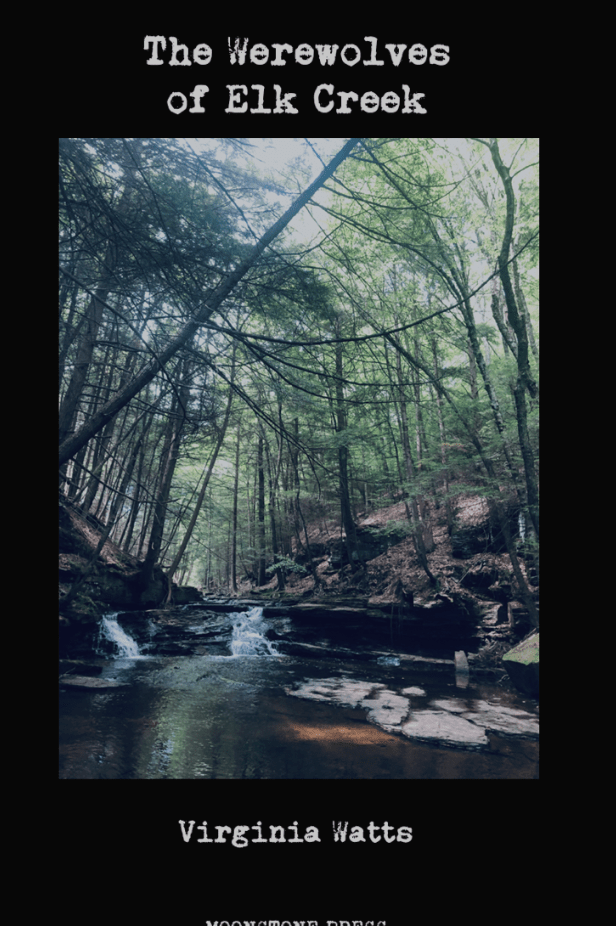
Virginia’s new book is now available from Old Scratch Press:
My grandfather was a schoolteacher, a school principal, and a child psychologist. He was an advocate for the idea that children should memorize poems. I believe he thought it would improve language skills, help with understanding rhythm in speech, and show children the joy of becoming emotionally attached to words and stories. There were five grandchildren. I was the youngest. I didn’t really want to memorize a poem. I remember it was summertime, and it felt too much like schoolwork, but I did. I chose the poem “Wynken, Blynken, and Nod” published in 1889 by Eugene Field. The original title of the poem was “Dutch Lullaby.” Field was known for his humorous newspaper columns and light verse for children. When I look back over my lifetime, I think my grandfather was onto something.
The poem is a charming, soothing rhyme about three children who go on a journey. They sail on a “river of crystal light” and “into a sea of dew.” They fish for stars and the moon sings to them, encouraging them as a friend and companion. Later, it becomes clear that the story is really about one child, his eyes are Wynken and Blynken, and his head is Nod. His mother is singing to him in his trundle bed of the, “…wonderful sights he’ll see.”
The poem was written at a time when people were fascinated with dreams. While it describes sleep, and falling asleep, and dreaming, it’s also about what you can do with your own imagination. It’s a lesson in fantasy. I have recited the poem in my head many times in my lifetime. I recited it to my children at bedtime. Like any good lullaby, it has comforted me and reminded me of hope, beauty, magic and that dreams can still come true. It is a piece of work that makes me feel safe. It has been my trusty companion. So perhaps it is true that all children should memorize at least one poem. I am not the only one who fell in love with “Wynken, Blynken and Nod” and stayed that way. Mankind in general has. It was made into a song in 1890 by Ethelbert Woodbridge. It was recorded as a song again in 1930 and later by the Doobie Brothers. The song was also performed on the television shows Barney & Friends and Sesame Street. In 1938, Walt Disney released an adorable cartoon on the poem featuring three pajama-wearing children. (You can watch this below.) In 1993, Mrs. Wilson recited the poem to Dennis in the movie Dennis the Menace. The poem is in the public domain and available to read from numerous sources, but here is the text:
Wynken, Blynken, and Nod one night
Sailed off in a wooden shoe—
Sailed on a river of crystal light,
Into a sea of dew.
'Where are you going, and what do you wish?'
The old moon asked the three.
'We have come to fish for the herring-fish
That live in this beautiful sea;
Nets of silver and gold have we!'
Said Wynken,
Blynken,
And Nod.

The old moon laughed and sang a song,
As they rocked in the wooden shoe,
And the wind that sped them all night long
Ruffled the waves of dew.
The little stars were the herring fish
That lived in the beautiful sea–
'Now cast your nets wherever you wish—
Never afeard are we';
So cried the stars to the fishermen three:
Wynken,
Blynken,
And Nod.

All night long their nets they threw
To the stars in the twinkling foam—
Then down from the skies came the wooden shoe,
Bringing the fishermen home;
'Twas all so pretty a sail it seemed
As if it could not be,
And some folk thought ’twas a dream they’d dreamed
Of sailing that beautiful sea–
But I shall name you the fishermen three:
Wynken,
Blynken,
And Nod.

Wynken and Blynken are two little eyes,
And Nod is a little head,
And the wooden shoe that sailed the skies
Is the wee one’s trundle-bed.
So shut your eyes while mother sings
Of wonderful sights that be,
And you shall see the beautiful things
As you rock in the misty sea,
Where the old shoe rocked the fishermen three:
Wynken,
Blynken,
And Nod.
May you find it soothes you to sleep too! Sweet dreams!
Virginia Watts is the author of poetry and stories found in The MacGuffin, Epiphany,CRAFT, The Florida Review, Reed Magazine, Pithead Chapel, Eclectica Magazine among others. She has been nominated four times for a Pushcart Prize. Her debut short story collection Echoes from the Hocker House was short listed for 2024 Eric Hoffer Grand Prize, selected as one of the Best Indie Books of 2023 by Kirkus Book Reviews, and won third place in the 2024 Feathered Quill Book Awards. Please visit her.
Virginia’s new book is now available from Old Scratch Press:
Thank you for reading. Please sign up to follow us on Facebook and to follow us here on WordPress to expand your knowledge about poetry and short form writing as well as to receive the latest news about publication opportunities.
Looking to get some final submissions in before we say good-bye to 2025? Here are some places that are open for submissions! Click the link to be taken to their submission guidelines.
FREE
Posit is accepting prose and poetry until December 5.
Have a good sense of humor? Defenestration is accepting short stories, poetry, creative nonfiction and visual submissions and seeking humorous pieces through December 5.
Up the Staircase Quarterly is accepting poetry and visual art until December 10. They have a tip jar option for $3.
Fish Barrel Review is open to poetry, prose, and visual art until December 15. Submissions are free, but they do also have paid option for expedited responses or feedback.
The theme for Spectrum‘s Vol. 69 is ‘consumption.’ You can submit fiction, poetry, nonfiction, and art until December 31.
Psychopomp is accepting poetry, fiction, nonfiction until December 31.
PAID
For a $3, $5, or $10 donation, Passages North is accepting fiction, poetry, short-shorts, and nonfiction until December 13.
OnlyPoems is open to both free and paid submissions for poetry until December 15.
Red Ogre Review is accepting poetry, music, and visual art until December 31 for $3 or $5 donations.
For a $3 reading fee, Five Points is accepting very short fiction until December 31.
Arc Poetry is accepting poetry submission for a fee of $2 per poem until December 31.
Calyx is accepting poetry and prose until December 31 for a $5 fee ($3 if you are a student).
These are only a handful of the journals that are currently open to submissions. There’s still time to get your writing in before the end of the year. Start 2026 off strong by submitting before December ends!
When I was in school studying writing, I had some just lovely, encouraging professors. One of them was Christopher Buckley.
Chris was always telling me other poets I reminded him of. One of those was Charles Simic, and another was Diane Wakowski. Chris was so wonderful, in fact, that he had studied with Diane, and he helped me organize for her to come and do a reading on campus, from Michigan to West Chester, Pennsylvania. It was a little bit strange, meeting Diane, because I had imagined her to be like if Twiggy and Patti Smith were merged into a single person who wrote kick-ass poetry. In reality she was a tiny thing, and a little prickly around the edges. I was star-struck and shy. I had read (lord knows how, as we didn’t have the internet, maybe in one of her poems) that she was a huge fan of freshwater pearls, and I bought a necklace and bracelet to give to her. She didn’t open the gift in my presence, and I never heard from her to hear if she liked them. But, in my very young mind, I thought she was everything I wanted to be: full-time professor, writing poetry all the time, and just generally badass, which, I guess, included being a little prickly and unfriendly. As introverted as I am, I am also a people-pleaser, so though I don’t want to talk in situations where I don’t know everyone, I do talk, because I am worried about not being nice enough to everyone else. And then I am exhausted after. Maybe Diane had already learned the art of taking care of herself. She was born the year after my dad, so she was well into middle-age when I met her.
The book I have pictured at the start of this post is the one that made me love her: The Motorcycle Betrayal Poems. I mean, she got on motorcycles. My sister (younger than me by 8 years) once had a motorcycle boyfriend, in fact he was a sweet guy, and we’re all still friends with him, and he once let me climb on behind him so that he could drive me around Sea Isle City on his motorcycle. But, to stay on behind a rider, you have to hold on to the rider’s body, and Reuel (the boyfriend) was incredibly fit and hot, like Brad Pitt in Thelma and Louise hot. I felt so afraid of falling off and dying and so wrong for gripping onto his body for dear life that I cut the ride short. Diane would not have cut the ride short even if it was with her sister’s hot boyfriend. Diane has always seemed to me like a woman who knows who she is and what she wants, and gets what she wants. She might have been the Taylor Swift of the 1970s, because to date her, and to break up with her, was to have a vicious poem written about you.
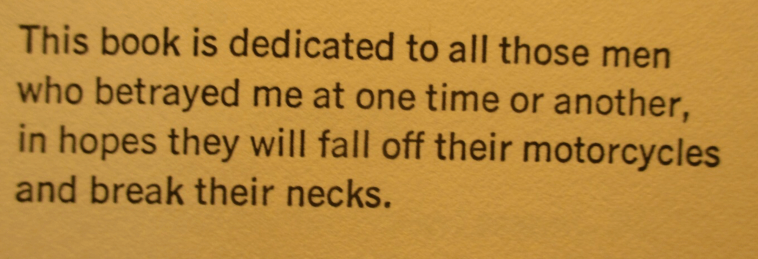
Dedication in the original The Motorcycle Betrayal Poems
At that point in my life I thought I had all possibilities ahead of me, as young optimistic people do. I thought I could become a thin woman who rode on the back of motorcycles and penned vicious poems about love. Diane also seemed… horny, which, raised by a very Methodist mother who got pregnant as a teenager, I was not allowed to be, so that seemed very flash and exciting to me too.
Honestly, you may think it silly yo say, because poetry is just poems, no big deal, but being a poet was such a monumental thing to me that I’m still trying to give myself permission to do it. Permission Diane never seemed to need, but Dianne definitely needs, to this very day.
If Diane was a sort of a hero, but not the warmest or nicest hero, why bring her up to you? Why not just let her, and her work, slide into obscurity?
I think because she is an unapologetic woman; she is who she is, lusty, strong, angry, successful (even if success did mean getting stuck in Michigan!), and felt no need to be mushy with a grad student who idolized her. No grad students have idolized me, but I expect it could be annoying as well as nice.
I told my sister last week that we’ve lost two Diane’s this year, Keaton and Ladd, both single Ns, unlike my double. Wakowski is up there, and also a single N. I don’t know if I can lose another one this year, so I hope she’s not on a motorcycle these days. And, then again, I kinda hope she is.
“She digs her teeth into the slaveries of woman, she cries them aloud with such fulminating energy that the chains begin to melt of themselves. Reaching into the hive of her angers, she plucks out images of fear and delight that are transparent yet loaded with the darknesses of life. Diane Wakoski is an important and moving poet.”–The New York Times
In 1971, Diane Wakoski published The Motorcycle Betrayal Poems to tremendous acclaim. Relevant, moving–at times shocking–it is Wakoski’s honesty and bravery as an artist that continues to astonish, delight, inspire, and liberate readers.
Wakoski responds to betrayal in a variety of ways including fantasies such as drilling bullet holes into the bodies of unfaithful lovers. But even her anger can be winking, as in the book’s sly dedication to “all those men who betrayed me at one time or another, in hopes they will fall off their motorcycles and break their necks.”
“The Bouquet”
“I Have Had to Learn to Live with My Face”
Have you heard of Diane Wakowski? What do you think of her? If you found any links to video of her, send it this way!
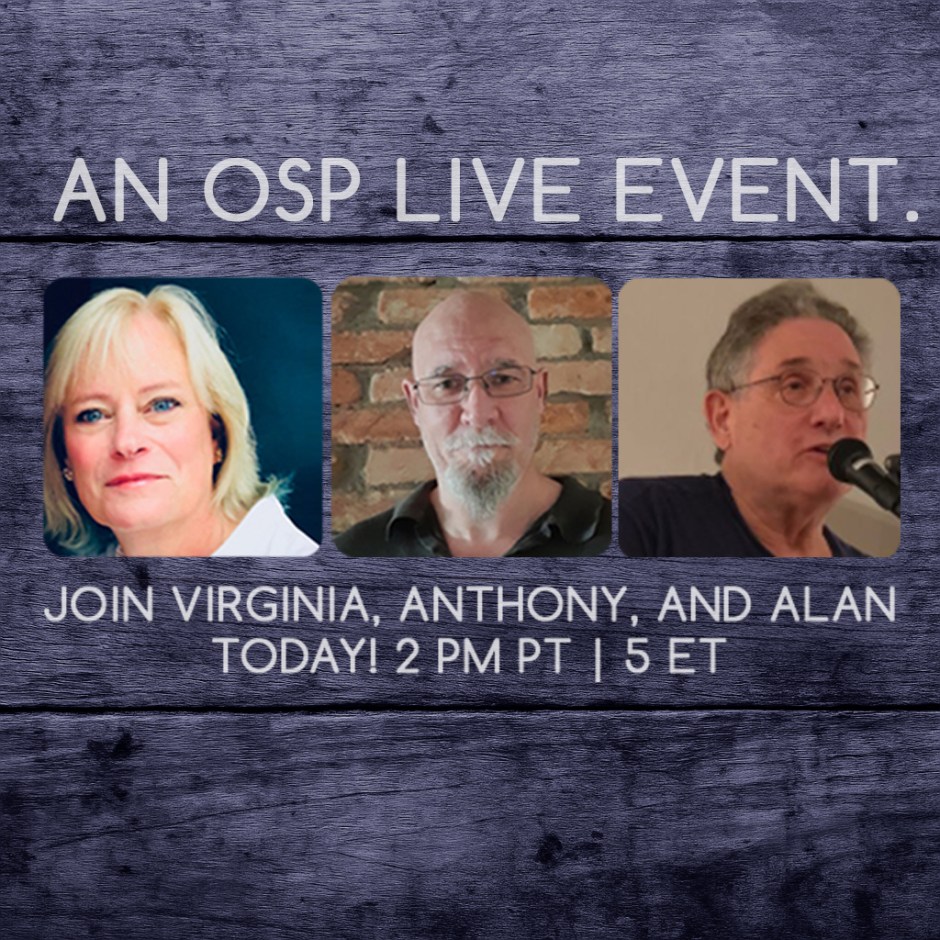
Join us today for a triple poetry book launch and live reading event taking place over Zoom.
This special online event will spotlight:
Alan Bern, Dreams of the Return
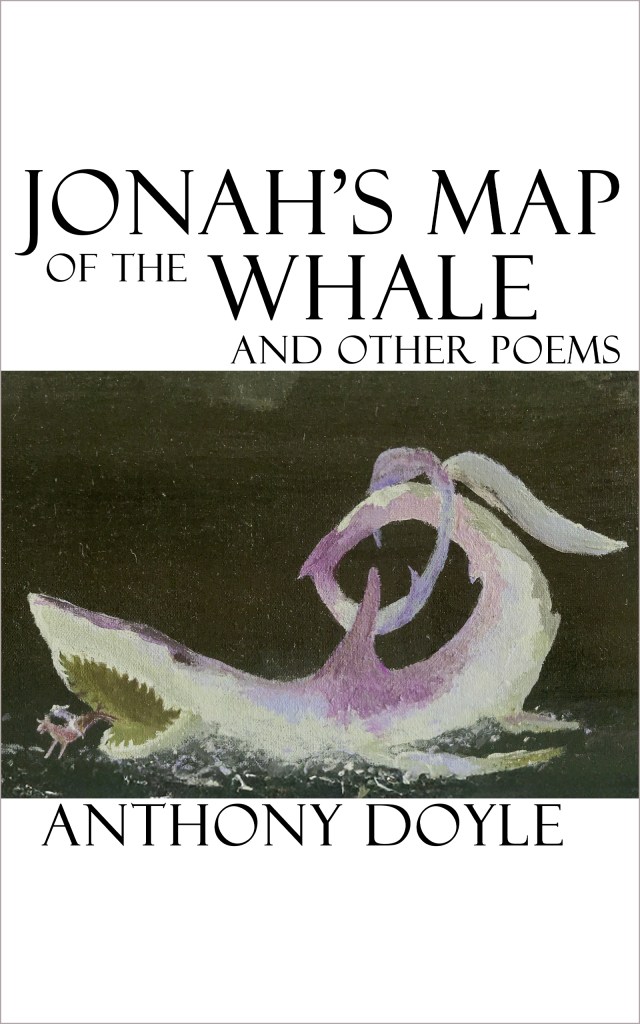
Anthony Doyle, Jonah’s Map of the Whale
Virginia Watts, Tracing Bodies
Each author will take the mic to share selections from their work, offering an intimate glimpse into the themes, rhythms, and stories behind their collections.
📅 Date: Saturday, October 25 ⏰ Time: 2:00 PM PT | 5:00 PM ET 💻 Format: Virtual meeting (Zoom)
Preregistration has ended, but you can still attend by following the link below. Meeting will start promptly at 2 PM PT.
Alan Bern is a poet, photographer, and retired children’s librarian whose creative work often explores themes of memory, migration, and belonging. His poetry pairs evocative imagery with emotional depth, reflecting on journeys both personal and collective. Alongside his writing, Bern’s photography provides a visual dialogue with the poetic world he creates, underscoring the interplay between text and image.
In Dreams of the Return, Bern reflects upon being a teenager in the mid-sixties, living in Napoli for a year with his family, and falling in love with it as if it were his true second home. His travels through Napoli and Southern Italy are expressed in poetry, prose, and photos, offering readers verse that moves fluidly between the outer landscapes of travel and the inner landscapes of longing.
“Bern captures nuances of disparate facets of Italian life with a flair for both drama and revelation.” MIDWEST BOOK REVIEW
Anthony Doyle
Anthony Doyle is an Irish writer and translator whose work bridges cultures and languages. He has published fiction, nonfiction, and poetry, and his projects often weave together myth, history, and human experience in unexpected ways. As a translator, Doyle has brought the works of Brazilian writers to English-speaking audiences, deepening cultural exchange.
Hibernaculum, Doyle’s gripping speculative fiction tale of human hibernation, is a 2024 Next Generation Indie Book Awards Finalist in the SF category. His new poetry collection, Jonah’s Map of the Whale, charts vast emotional and imaginative territory, drawing on his keen ear for rhythm and layered meaning. Doyle’s poetry speaks with both intimacy and universality, inviting readers to journey through mythic depths and modern consciousness alike.
“A wonderfully inspiring read.” MIDWEST BOOK REVIEW
Virginia Watts
Virginia Watts is a fiction writer and poet whose work has appeared in numerous literary journals and anthologies. Her writing frequently examines the intricacies of human connection, place, and memory, offering poignant and sharply observed narratives. With a background in both short fiction and poetry, Watts brings an attentive eye to detail and a lyrical sensibility to her storytelling.
Watts’ debut prose collection, Echoes From the Hocker House, IS a 2023 KIRKUS Best Indy Books selection and a 2024 Eric Hoffer Book Awards finalist.
Her latest collection, Tracing Bodies, reveals Watts’ skill at mapping emotional terrain—tracing the fragile lines between presence and absence, past and present. Her voice resonates with honesty and tenderness, leaving lasting impressions on her readers.
“A vulnerable, cleareyed portrait of humanity.” KIRKUS
Old Scratch Press Short Form and Poetry Collective is pleased to announce that Beatriz Fernandez has recently become our newest member. “I am thrilled and honored, “she says, “to join an online community of fellow writers from around the globe who support each other’s work, provide feedback and share our various skills and strengths.”
Although she didn’t try to get published until she was in her late forties, Beatriz has been writing all her life.
“I write in both form and free verse, both mainstream and genre, and have recently begun to write flash and short fiction. In poetry, I favor historical persona poems written in the voices of women, whether historical, mythological, or fictional figures. I also write speculative poetry and short fiction. I try to include my love of robots, androids, or time travel in most of my stories.”
Over the past ten years, Beatriz Fernandez’s work has been nominated for the Pushcart prize four times, and has been published in anthologies and journals as various as Label Me Latina/o, Prime Number Magazine, Strange Horizons, and Whale Road Review. She’s authored three poetry chapbooks: the most recent, Simultaneous States, (Bainbridge Island Press, 2025) included some poetry set in Puerto Rico and some speculative poems. Her eco-science fiction flash fiction piece, “Flow Time” was published this summer in a special Florida themed anthology by Gaslamp Pulp, a division of Nat 1 Publishing. That publisher also just accepted her Puerto Rican Frog Prince adaptation titled “The Coquí Captain” for a children’s anthology of reimagined fairy tales.
Beatriz grew up in Philadelphia, Spain, and mostly Puerto Rico and then came to Florida to attend college. During her junior year she established her Florida residency, met her husband, and began working in libraries. “I fell in love with all three,” she says, “and subsequently found no reason to leave any of them!”
Describing herself as a late bloomer in both her library and writing careers; she became a professional librarian in her mid 30s. On the way, she obtained an M.A. in English literature but found herself to be too much of a generalist to focus on a dissertation topic.
“During this time,” she says, “I seemed to be under the impression I was a budding novelist while the reality was that I was writing more poetry than anything else. My lightbulb moment came when I won a Writer’s Digest poetry contest that I entered on the very last day. That stroke of luck seemed to finally put me on the right road and actively seeking to improve my poetry style. I embarked on a long-distance phone tutorial with poet Andrea Hollander, who is a brilliant teacher and mentor, for several years; she helped me find my true voice. “
“Many writing classes, confabs and workshops later,” she says, “I’ve published almost every poem I’ve ever written! Now I feel I have come full circle—after starting out my writing career with long-distance tutorials, I’ve joined an online community of fellow writers.”
To learn more about Beatriz and to hear her radio interview on “Here and Now,” you can visit her website here
Thank you for reading this post and visiting the Old Scratch Press Blog. Next Saturday October 25th at 5:00 p.m., three members of the Old Scratch Press Team are participating in a special online reading from their newly published books. FREE. Read more about it here. And follow us on Facebook.
Old Scratch Press invites you to an unforgettable evening of words, imagery, and discovery. On Saturday, October 25 at 2:00 PM PT (5:00 PM ET), we’ll gather virtually to celebrate the launch of three extraordinary new poetry collections—each bringing a unique voice and vision to the page.
This special online event will spotlight:
Alan Bern, Dreams of the Return
Anthony Doyle, Jonah’s Map of the Whale
Virginia Watts, Tracing Bodies
Each author will take the mic to share selections from their work, offering an intimate glimpse into the themes, rhythms, and stories behind their collections.
📅 Date: Saturday, October 25 ⏰ Time: 2:00 PM PT | 5:00 PM ET 💻 Format: Virtual meeting (Zoom)
This event is free and open to the public, but preregistration is recommended. Come celebrate the power of poetry with Old Scratch Press and three remarkable voices—we can’t wait to see you there!
Meet the Authors
Alan Bern
Alan Bern is a poet, photographer, and retired children’s librarian whose creative work often explores themes of memory, migration, and belonging. His poetry pairs evocative imagery with emotional depth, reflecting on journeys both personal and collective. Alongside his writing, Bern’s photography provides a visual dialogue with the poetic world he creates, underscoring the interplay between text and image.
In Dreams of the Return, Bern reflects upon being a teenager in the mid-sixties, living in Napoli for a year with his family, and falling in love with it as if it were his true second home. His travels through Napoli and Southern Italy are expressed in poetry, prose, and photos, offering readers verse that moves fluidly between the outer landscapes of travel and the inner landscapes of longing.
“Bern captures nuances of disparate facets of Italian life with a flair for both drama and revelation.” MIDWEST BOOK REVIEW
Anthony Doyle
Anthony Doyle is an Irish writer and translator whose work bridges cultures and languages. He has published fiction, nonfiction, and poetry, and his projects often weave together myth, history, and human experience in unexpected ways. As a translator, Doyle has brought the works of Brazilian writers to English-speaking audiences, deepening cultural exchange.
Hibernaculum, Doyle’s gripping speculative fiction tale of human hibernation, is a 2024 Next Generation Indie Book Awards Finalist in the SF category. His new poetry collection, Jonah’s Map of the Whale, charts vast emotional and imaginative territory, drawing on his keen ear for rhythm and layered meaning. Doyle’s poetry speaks with both intimacy and universality, inviting readers to journey through mythic depths and modern consciousness alike.
“A wonderfully inspiring read.” MIDWEST BOOK REVIEW
Virginia Watts
Virginia Watts is a fiction writer and poet whose work has appeared in numerous literary journals and anthologies. Her writing frequently examines the intricacies of human connection, place, and memory, offering poignant and sharply observed narratives. With a background in both short fiction and poetry, Watts brings an attentive eye to detail and a lyrical sensibility to her storytelling.
Watts’ debut prose collection, Echoes From the Hocker House, IS a 2023 KIRKUS Best Indy Books selection and a 2024 Eric Hoffer Book Awards finalist.
Her latest collection, Tracing Bodies, reveals Watts’ skill at mapping emotional terrain—tracing the fragile lines between presence and absence, past and present. Her voice resonates with honesty and tenderness, leaving lasting impressions on her readers.
“A vulnerable, cleareyed portrait of humanity.” KIRKUS
There’s a certain stereotype about writers: distracted, dreamy, maybe a little moody, often lost in their own heads. Then there are those of us whose third-grade teacher writes on her report card, “Ellis is very sensitive. She says she doesn’t feel good when she doesn’t want to participate and sometimes puts her hands over her ears.”
What we don’t always name is that many of us identify with something more specific—ADHD, anxiety, depression, OCD, autism, bipolar disorder. In other words, neurodivergence.
Far from being a barrier, these brain patterns often come hand-in-hand with creativity. Our ability to notice connections others overlook, to hyper-focus on a project for hours, or to sense language at a heightened level can all be part of what makes us writers. (Doesn’t everyone have a list of words they hate simply because the way the word feels in their mouth?)
The Double-Edged Sword
Of course, the same brain that gifts us with creative leaps can also work against us. ADHD can make finishing projects feel like climbing Everest. Anxiety can whisper that nothing we write is ever good enough. Depression can steal the life-force necessary to even begin. The very sensitivity that makes us attuned to metaphor and meaning can leave us overwhelmed by the noise of the world.
Reframing the Narrative
Instead of treating neurodivergence as something to battle, what if we reframed it as part of the writer’s toolkit?
Hyperfocus can become a superpower for deep revision. Or help you finish the book!
Restless energy can fuel bursts of freewriting that break past creative blocks. That, and dance breaks.
Heightened sensitivity can deepen character work, dialogue, and description. As long as you remember to take breaks.
The key is learning how to manage the edges—finding rest, support, and strategies so that the gift doesn’t become a burden.
Practical Ways to Support Your Creative Brain
Chunk your writing time. Short, timed sessions (15–25 minutes) can harness focus without overwhelming you.
Write rituals, not rules. A small ritual (lighting a candle, stretching, a playlist) helps train your brain to enter writing mode.
Name the inner critic. Literally give it a name or persona so it loses power over you.
Seek community. Writing groups, workshops, or even online spaces help balance the solitary nature of the work.
Honor rest. Brains that run hot need recovery time. Pushing the pause-button isn’t failing—it’s part of the process.
Why It Matters
When we share openly about the link between writing and neurodivergence, we create permission for others. Permission to stop beating themselves up for struggling with deadlines. Permission to see their “quirks” as part of their artistry. Permission to make choices others might not understand. Permission to write anyway.
Do you identify as a neurodivergent writer? How does it show up in your creative process—both the gifts and the challenges?
Ellis Elliott
Founding member Old Scratch Press Poetry Collective
Author of Break in the Field poetry collection and A Witch Awakens: A Fire Circle Mystery.
Steps Toward Your First Acceptance in a Literary Journal
To my fellow writers out there, I began submitting prose and eventually poetry to literary magazines in 2014. Since that time, I have been published over a hundred times. How did I do it? I learned the ropes and never gave up. More importantly, I never wrote for the purpose of being published. It’s an honor, a wonderful feeling, to have a piece accepted, but in the end of the day, the real joy for me as it is for most writers, is the creative process. Publishing is a very small piece of this magical puzzle. Even so, as writers, most of us would like our work to be read so here are some tips I learned along the way.
Present your best work always. If you have written something, set it aside for some time and return to it later for perspective. ALWAYS have feedback through a professional writing group. One or two friends reading your work will not do. You need professional critique and then you must listen and learn to edit accordingly. None of us can judge our own writing. We simply cannot. Don’t let your ego get in the way of your success.
Prepare a third-person biography. Include information like your location, your publications if you have some, your social media handles and website. If you have not been published, simply say nothing about that or mention that this would be a debut publication. Don’t try to be funny or clever. Be professional.
Prepare a cover letter and keep it simple and professional as well. Address the editor by name if you can. Start with something like: I appreciate the opportunity to submit my fiction story titled “Wind Warp” of 4900 words. Follow with your biography. End by thanking the editor for considering your work. That’s it.
Make a list of journals where your work appears to be a fit as you prepare to submit your work. This will mean reading some of the work the journals have accepted in the past. Lucky for us, many journals are online now or have some excerpts online. Consult resources by Erika Krouse or Clifford Garstang for a ranking of literary journals.
At first, I tried to select mostly smaller, well-respected journals for the bulk of my submissions. Once I got some traction, I aimed higher. If you can find a local journal that limits submissions to local writers, even better. One example of this is Philadelphia Stories, a journal that only publishes writers who are living in or originally from Pennsylvania, Delaware or New Jersey. A smaller pool helps your odds. There is nothing wrong with submitting to a new journal either. In fact, I recommend it. New journals need our support.
I would send a piece to at least twenty journals to start with and see how it goes.
Use standard manuscript format 12-point font Times New Roman. Double Space prose. Single Space poetry. And don’t forget page numbers.
Be encouraged if editors write you a personal note about enjoying your work even though it was not accepted or asking you to submit more work in the future or telling you that you made it to the final cut. All of these are a very big deal so be happy!
You will receive a lot of rejections. I submitted for about a year and a half before I received my first acceptance. Since then, I have had times where I have been “hot” and times of drought. Don’t give up and don’t get discouraged. There are many reasons a piece is not chosen that have nothing to do with the quality of the writing. You get used to the rejections. Promise me. The way I look at it is this writing that I am submitting is what I have to offer. I’ve got nothing else! This is me. I write what comes to me and what I want to write about. Above all, I just hope to tell a good story. I give every poem or story my all. There have been stories that I never placed, and I am okay with that. Some of these did get out in the world in later collections of mine alongside published stories. Be true to yourself and what your heart wants to write about and you will be fine.
Do not follow up with inquiries about your work after it is submitted. If you don’t hear anything for a year, consider the piece unaccepted and move on.
Make sure you keep a list of all the places you submit a piece so when you do have an acceptance, you can quickly withdraw it from other journals considering your piece.
Remember too that when submitting to always follow the guidelines such as whether the journal wants to read blind or not.
Set up a Submittable account because most journals use that now for submissions although some still have their own Submission System or they accept submissions via email only.
Another good idea is to go out for dinner and some glasses of wine with fellow writers submitting their work to share your experiences. Laughter is the best medicine, and you can learn from each other.
I wish all of you the very best in your writing journey!
Virginia Watts is the author of poetry and stories found in The MacGuffin, Epiphany,CRAFT, The Florida Review, Reed Magazine, Pithead Chapel, Eclectica Magazine among others. She has been nominated four times for a Pushcart Prize. Her debut short story collection Echoes from the Hocker House was short listed for 2024 Eric Hoffer Grand Prize, selected as one of the Best Indie Books of 2023 by Kirkus Book Reviews, and won third place in the 2024 Feathered Quill Book Awards. Please visit her.
Virginia’s new book is now available from Old Scratch Press: