There’s a certain stereotype about writers: distracted, dreamy, maybe a little moody, often lost in their own heads. Then there are those of us whose third-grade teacher writes on her report card, “Ellis is very sensitive. She says she doesn’t feel good when she doesn’t want to participate and sometimes puts her hands over her ears.”
What we don’t always name is that many of us identify with something more specific—ADHD, anxiety, depression, OCD, autism, bipolar disorder. In other words, neurodivergence.
Far from being a barrier, these brain patterns often come hand-in-hand with creativity. Our ability to notice connections others overlook, to hyper-focus on a project for hours, or to sense language at a heightened level can all be part of what makes us writers. (Doesn’t everyone have a list of words they hate simply because the way the word feels in their mouth?)
The Double-Edged Sword
Of course, the same brain that gifts us with creative leaps can also work against us. ADHD can make finishing projects feel like climbing Everest. Anxiety can whisper that nothing we write is ever good enough. Depression can steal the life-force necessary to even begin. The very sensitivity that makes us attuned to metaphor and meaning can leave us overwhelmed by the noise of the world.
Reframing the Narrative
Instead of treating neurodivergence as something to battle, what if we reframed it as part of the writer’s toolkit?
Hyperfocus can become a superpower for deep revision. Or help you finish the book!
Restless energy can fuel bursts of freewriting that break past creative blocks. That, and dance breaks.
Heightened sensitivity can deepen character work, dialogue, and description. As long as you remember to take breaks.
The key is learning how to manage the edges—finding rest, support, and strategies so that the gift doesn’t become a burden.
Practical Ways to Support Your Creative Brain
Chunk your writing time. Short, timed sessions (15–25 minutes) can harness focus without overwhelming you.
Write rituals, not rules. A small ritual (lighting a candle, stretching, a playlist) helps train your brain to enter writing mode.
Name the inner critic. Literally give it a name or persona so it loses power over you.
Seek community. Writing groups, workshops, or even online spaces help balance the solitary nature of the work.
Honor rest. Brains that run hot need recovery time. Pushing the pause-button isn’t failing—it’s part of the process.
Why It Matters
When we share openly about the link between writing and neurodivergence, we create permission for others. Permission to stop beating themselves up for struggling with deadlines. Permission to see their “quirks” as part of their artistry. Permission to make choices others might not understand. Permission to write anyway.
Do you identify as a neurodivergent writer? How does it show up in your creative process—both the gifts and the challenges?
Ellis Elliott
Founding member Old Scratch Press Poetry Collective
Author of Break in the Field poetry collection and A Witch Awakens: A Fire Circle Mystery.
Steps Toward Your First Acceptance in a Literary Journal
To my fellow writers out there, I began submitting prose and eventually poetry to literary magazines in 2014. Since that time, I have been published over a hundred times. How did I do it? I learned the ropes and never gave up. More importantly, I never wrote for the purpose of being published. It’s an honor, a wonderful feeling, to have a piece accepted, but in the end of the day, the real joy for me as it is for most writers, is the creative process. Publishing is a very small piece of this magical puzzle. Even so, as writers, most of us would like our work to be read so here are some tips I learned along the way.
Present your best work always. If you have written something, set it aside for some time and return to it later for perspective. ALWAYS have feedback through a professional writing group. One or two friends reading your work will not do. You need professional critique and then you must listen and learn to edit accordingly. None of us can judge our own writing. We simply cannot. Don’t let your ego get in the way of your success.
Prepare a third-person biography. Include information like your location, your publications if you have some, your social media handles and website. If you have not been published, simply say nothing about that or mention that this would be a debut publication. Don’t try to be funny or clever. Be professional.
Prepare a cover letter and keep it simple and professional as well. Address the editor by name if you can. Start with something like: I appreciate the opportunity to submit my fiction story titled “Wind Warp” of 4900 words. Follow with your biography. End by thanking the editor for considering your work. That’s it.
Make a list of journals where your work appears to be a fit as you prepare to submit your work. This will mean reading some of the work the journals have accepted in the past. Lucky for us, many journals are online now or have some excerpts online. Consult resources by Erika Krouse or Clifford Garstang for a ranking of literary journals.
At first, I tried to select mostly smaller, well-respected journals for the bulk of my submissions. Once I got some traction, I aimed higher. If you can find a local journal that limits submissions to local writers, even better. One example of this is Philadelphia Stories, a journal that only publishes writers who are living in or originally from Pennsylvania, Delaware or New Jersey. A smaller pool helps your odds. There is nothing wrong with submitting to a new journal either. In fact, I recommend it. New journals need our support.
I would send a piece to at least twenty journals to start with and see how it goes.
Use standard manuscript format 12-point font Times New Roman. Double Space prose. Single Space poetry. And don’t forget page numbers.
Be encouraged if editors write you a personal note about enjoying your work even though it was not accepted or asking you to submit more work in the future or telling you that you made it to the final cut. All of these are a very big deal so be happy!
You will receive a lot of rejections. I submitted for about a year and a half before I received my first acceptance. Since then, I have had times where I have been “hot” and times of drought. Don’t give up and don’t get discouraged. There are many reasons a piece is not chosen that have nothing to do with the quality of the writing. You get used to the rejections. Promise me. The way I look at it is this writing that I am submitting is what I have to offer. I’ve got nothing else! This is me. I write what comes to me and what I want to write about. Above all, I just hope to tell a good story. I give every poem or story my all. There have been stories that I never placed, and I am okay with that. Some of these did get out in the world in later collections of mine alongside published stories. Be true to yourself and what your heart wants to write about and you will be fine.
Do not follow up with inquiries about your work after it is submitted. If you don’t hear anything for a year, consider the piece unaccepted and move on.
Make sure you keep a list of all the places you submit a piece so when you do have an acceptance, you can quickly withdraw it from other journals considering your piece.
Remember too that when submitting to always follow the guidelines such as whether the journal wants to read blind or not.
Set up a Submittable account because most journals use that now for submissions although some still have their own Submission System or they accept submissions via email only.
Another good idea is to go out for dinner and some glasses of wine with fellow writers submitting their work to share your experiences. Laughter is the best medicine, and you can learn from each other.
I wish all of you the very best in your writing journey!
Virginia Watts is the author of poetry and stories found in The MacGuffin, Epiphany,CRAFT, The Florida Review, Reed Magazine, Pithead Chapel, Eclectica Magazine among others. She has been nominated four times for a Pushcart Prize. Her debut short story collection Echoes from the Hocker House was short listed for 2024 Eric Hoffer Grand Prize, selected as one of the Best Indie Books of 2023 by Kirkus Book Reviews, and won third place in the 2024 Feathered Quill Book Awards. Please visit her.
Virginia’s new book is now available from Old Scratch Press:
Alan Bern is more than just the author of DREAMS OF THE RETURN—he’s also one of the founding voices of Old Scratch Press, a collective born from a group of terrific writers with a deep love of traditional and hybrid poetry, prose, and art. As a retired children’s librarian and cofounder (with Robert Woods) of the fine-press publisher Lines & Faces, Alan has long pursued the merging of word, image, and place.
In DREAMS OF THE RETURN, he turns his lens to Italy—in particular the South—bringing to life landscapes both storied and luminous through his own photographs and through classic Italian poetry, delivered both in its original form and in his own translations. The journey is lyrical, immersive: it’s not merely a travel guide, but a portrait of longing, place, memory, and beauty.
And that’s something Alan does beautifully—his artistry weaves together what he’s done throughout his life: poetry, prose, photography, memoir, all fueled by a love for Italy. Within the OSP community, he is known for “photo-poems,” a daily practice in which images and language overlap, inviting the reader to travel with him across geographies and inward, into self.
In addition to poems and photographs, DREAMS OF THE RETURN also includes intimate personal essays that layer history, memory, and lived experience. In “The Good One,” for example, Alan recounts a walk through Naples’ Quartieri Spagnoli with his friend Marco. What begins as a conversation about Jewish philosopher Don Isaac Abravanel and the sacred geography of southern Italy turns into a heartbreaking encounter with a community altar for “o’ Bono”—a young man accidentally killed during a New Year’s Eve celebration. Through this story, Alan reveals how place, tragedy, resilience, and human connection are intertwined in ways both profound and ordinary.
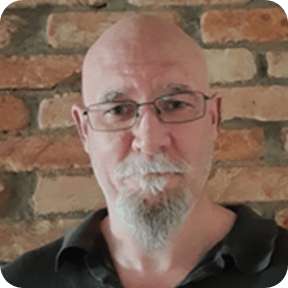
A true perfectionist, Alan (pictured left) worked closely with his good friend, Peter Truskier, to ensure that the photos selected would sparkle in the book just like the locations did in real life.
DREAMS OF THE RETURN is, in effect, another way Alan invites us to travel: through light and verse, through time and place. It’s a book to savor—start with a wind-soft sun, ruins, olive trees and history; consume it slowly with pizza margherita and red wine; linger into the evening with the sweetness of roccoco napoletani and an espresso kissed with Sambuca. You can order a copy of your own here:
Clearly the owner of that journal is not doing a good job of compiling her collection because on her journal is a slice of orange she is attempting to dry out, three crystals, and a paintbrush. The book is open and written in with a pencil, not good for preserving writing as (being a teacher for one-zillions years I can tell you) pencil smudges overtime to become indecipherable. She’s also got a pile of vintage mail (definitely older and already been mailed to her, to someone), which is deliciously tantalizing, and reading is much easier and more fun than writing.
Who is this mess of a woman? That’s a stock photo, but it could easily be my desk, with a few dozen highlighters and yesterday’s coffee added to the milieu.
It’s difficult for me to have a clean desk, no lie there. It’s difficult for me to spend time cleaning my desk, and not because I am not a neat person, but because I push my own things back. In fact, though I think of myself as a generally nice and “in a good mood” sort of person, I can get snappy when I feel tooo squeezed out.
I feel thin, sort of stretched, like butter scraped over too much bread.
JRR Tolkien, The Fellowship of the Ring (The Lord of the Rings, #1)
What a great bit of writing that is!
So I have made the bold assertion that I will publish my collection of poetry through Old Scratch Press in 2026. There. I said it to the group, and now I said it to you. I swear I’m gonna do it. I am going to occasionally clean my desk, and push in some room to get my collection together by pushing other things back (other things probably being sleep! Ha!). I just took on a new tutoring student, a few pro bono editing projects (my daughter’s school has a non-profit component to it, and I donated some editing to the auction, and it got bought!), a half dozen or so sample edits, in addition to the regular amount of edits, which is many hundreds of pages per month, and I signed up for a singing course with a friend, have a relative needing assistance for cancer treatments, a teen in need of a lot of “staying on track” help with school work and she is also involved in some theater projects her dad or I need to be the transportation for (and, in general, making sure she eats, remembers her glasses, etc.), and a business to run and a home and family, in addition to trying to squeeze in a daily run. I would love to run well enough to participate in a 5K, and I have been thinking of joining a thing in my neighborhood where I could get a running trainer. Of all of those things I am doing there is nothing I do not want to be doing, except for wishing my relative didn’t have cancer, of course. One friend had told me recently she was stepping back from a project, and I had anticipated it about four months earlier, actually, and I completely get it. My relative, who is staying with me this week and last for her treatments, woke up today and told me she is spending the last few days she needs to be local for her tests at a friend’s because she needs a change of scenery. I had expected that too, and I had prepared a to-go coffee for her before she woke up. However I have a HS friend on FB who is every bit as engaged in politics as I am, and worried about the general state of what we see as the slide into authoritarianism, and another HS classmate said to him, “We liked it better when you just wrote about your kids and scouting. You don’t have a lot of chapters (she actually wrote chapters!) left; don’t waste them on this.” and I could not agree less. Age, chapter of life, has nothing to do with wanting to accomplish things and caring about things outside of ourselves, so, no, I do not think he should stop fighting the good fight. Yet I feel that I do have an understanding that we literally cannot do it all, and don’t want to, and I respect it, and think it is a good thing, and I flatter myself that I am especially good at reading the room, and can see when change is coming. But, I’m not good at, “No.” I’m not good at giving up on something I’ve begun, even if it does not realize my own dream. It’s an obstacle because in order to publish one of my many projects, I assumed I would have to come up with a good, firm, “No.” And I simply can’t. So I have decided instead to come up with a good, slightly quavering, “Yes.” I’m outing myself that I am going to put my damn book out. I am saying it, and affirming it, and treating it, as much as possible, as a done deal. I think if I normalize it, the way I normalize all the other things, I will simply do it because it has a due-date, or a do-date. Both!
And so, here is my question to you:
If you have been writing short stories, short non-fiction, flash, poetry, for some time now (I’m not going to say I’ve been writing for decades, but at least since the synth-pop craze and the resurgence of skinny ties (the best kind of ties)), how do you choose what to include, and what to leave behind, resting, forever lost in a permanent dream state in the “my writing” file on your desktop? Though the synth-pop craze wasn’t what I would describe as a serious time in the world, I was a serious writer; I took myself very seriously, and I think that “me” has somehow stuck around, and I judge that writing to be more profound, when in reality for pretty much all of us our early writing is awful. I remember writing a poem laden with love and portent that was about a page long and contained only the word “baby” written over and over again in different combinations with possessive pronouns and a few sappy adjectives. Songs, when sung, can add meaning through cadence, tone, etc., but, with that “baby” experiment I learned that mere words on a page cannot do that. It was a piece of absolute dreck. I do not regret deleting it!
So, those old pieces hold special meaning for me, but most are not very good (I confess I still think some of them are genius!), and almost all are not even remotely relevant to who I am now. Though I am still a whiny liberal with a moral bent, and that still is there, even in the new pieces.
And this is it, my one chance to publish my poetry, to put it out there in the world. When I was in my MA and MFA programs I knew who the “it” poets were in the world of poets who published, and I wanted to join them, to earn their respect. And as I tried I very much felt borne farther away from them. Primarily by life circumstances and that inability to say no, that pushing back of my own things, more than anything else. And that very much was a tell (an inadvertent behavior or mannerism that betrays) that I didn’t belong among them. Writers who are successful (and success looks different for a poet than a novelist, or self-help book author, etc.) almost all have a modicum of selfishness that allows them to push things away that don’t serve them, and also leads them to self-preserve. They’re not going to be dumb enough to share their “baby” poem with their thesis advisor. Selfishness belongs on the seven deadly sins list, IMHO. But success almost needs it, like a plant needs water, to survive.
So, for better or for worse, committing a deadly sin or not, I am going to get this thing done as if it is not even my thing, so I will not be being selfish; I will simply be doing another job on the list.
But, again, I have this question: if you could put together a collection of your writing (or publish one of your novels, if you write long-form) how do you choose? How do you group? How do you look back over your body of work and say, “This goes; this doesn’t?” And if you could have your book published next year, what would you want on your cover, and why? While working with OSP one thing that has continually surprised me is that the authors seem to know what the cover needs to be. How in the heck….?
So, what about you? Would you know? I’m super curious to hear! Drop me a comment below!
It’s always a great time to immerse yourself in the literary world, but September seems to be an especially busy month if you want to celebrate books. Get ready to mark your calendar because whether you want to find a new read from an indie author, or you want to collect a signature from a well-known author, September gives you multiple chances to grab some new books for your TBR pile.
Organized by the Library of Congress, the National Book Festival in Washington, D.C. brings together a wide range of authors, journalists, and intellectuals to discuss literature and current affairs. With free events and a large roster of authors, this festival is a must-attend for book lovers.
Highlights:
Diverse Program: From fiction and memoirs to history and science, there’s something for everyone.
Author Signings: Meet bestselling authors and get your books signed.
Free Admission: All events are free to attend, making it accessible to everyone.
Panels & Discussions: Topics range from politics to personal stories and more.
FrightReads Book Festival is an all-ages event, dedicated to horror, sci-fi, mystery, paranormal and thriller books in Maryland! Featuring Celebrities, guest authors and tons to do! Old Scratch Press member Gabby Gilliam will be selling books at this event!
Free & Open to the Public: Kids 12 and under are free. Adult tickets need to be purchased.
Highlights:
Panels & Discussions: Topics cover everything from contemporary fiction to publishing trends.
Costume Contest: Categories for both children and adults.
Special Guests: Cosplayers, celebrities and more.
Film Festival: Screening 4 spooky films all afternoon.
One of the largest and most anticipated literary events in New York, the Brooklyn Book Festival offers nine days filled with book signings, panels, and performances. It’s a wonderful opportunity to explore the literary scene in the heart of Brooklyn. The Brooklyn Book Festival is celebrating its 20th anniversary this year! BKBF is dedicated to celebrating diversity in literature, so they aim to develop original programming that is hip, smart, diverse, and inclusive. They also present free, literary, cultural events at the BKBF Day & Literary Marketplace, Virtual Festival Day, and the family friendly Children’s Day. Additionally, BKBF presents Bookend events in venues across NYC and on-line, which are overwhelmingly presented free to the public.
Highlights:
Children’s Day: September 20 is all about young readers.
Diverse Program: From fiction and memoirs to history and science, there’s something for everyone.
Panel Discussions: Topics on writing, editing, and publishing.
This event, hosted by the Frostburg University Center for Literary Arts, brings together editors and publishers with writers and educators of the local community. This event celebrates the writers, publishers, and readers of small press and independent publishing. The weekend features a poetry slam, readings, roundtable discussions, practical “how to” sessions, and a small press book fair in Frostburg, Maryland. Two Old Scratch Press members (David Fulcher and Gabby Gilliam) will be reading and selling books at this event!
Highlights:
Free & Open to the Public: Many of the events are free, making it an accessible event for all.
Friday 9/26: Indie Lit Kickoff Reading featuring Lee Horikoshi Roripaugh at Main Street Books (2 E. Main St.), 7 PM
Followed by rock and roll with The Downstrokes at the Deep End (16 W. Main St.)
Saturday 9/27: Panels, workshops, and readings in City Place (14 S. Water St), Mountain City Traditional Arts (25 E. Main St.) and the Frostburg Public Library (65 E. Main St.), 11-5
Poetry Slam: Thursday night @7, sponsored by Savage Mountain Punk Arts.
Book Signings & Readings: Hear authors read from their works and engage in discussions.
Workshops and Panels for Readers and Writers: Learn the ins and outs of writing and publishing.
Poetry & Fiction: Events covering a wide range of genres and literary styles.
Don’t see anything local to you? Bookreporter has a calendar with even more upcoming festivals.
These festivals offer fantastic opportunities to hear from both bestselling authors and indie authors, attend workshops, and get involved in the global literary community. Mark your calendars for these exciting events, and let me know which ones you’re most excited to attend!
Perhaps it was the illustrations that captivated me when I’d pour through the fairytale books, the dragons and the princesses with long gowns and tresses, but of all the picture books in my room when I was a young child, I liked the fairytales the best.
I can still remember many of those books, the way they looked with their ornate borders and their detailed portraits of the handsome Puss N’ Boots or the angry face of Rumpelstiltskin as he stamps hard enough to crash through a floor and into oblivion. Styles evolve and change, and the animated images of the Walt Disney studios who’ve popularized many fairy tales by converting them into cartoon movies, don’t have the same depth of detail as those old illustrations. I love the old woodcut and color plate illustrations, but many contemporary artists add new magic and perspective to an old story. When you read a fairytale or any story for that matter, the possibilities for elaboration are endless.
“Happily Ever After” isn’t always the case in some of the Hans Christian Anderson Tales, such as “The Red Shoes” and “The Little Mermaid.” But as fairy tales have been told and retold so many times, multiple versions circulate. Children today probably have no idea that the original “Little Mermaid” is a tragic story of desire and loss. The little mermaid was unable to permanently become a human. Her attempts at transformation cause her to lose her life as a mermaid. What remains, is her hope that one day she’ll become part of the eternal universe.
In the hands of the Disney writing team, however, “The Little Mermaid,” became a story about family conflict, friendship, love, and fulfillment. The result is a story with a happy ending.
What story would you like to write?
But that’s okay, because fairy tales are part of our oral tradition and why not use the familiar tropes from our childhood as building blocks to create new stories or retell old ones. I think it is important to remember and learn from what went before. However, the stories of our lives keep evolving. So, what story would you like to tell?
To get you started, I’m sharing the work of several writers who were and still are inspired by fairy tales.
Many poetry enthusiasts will probably be familiar with the poem “Goblin Market “by Victorian era British poet Christina Rossetti(1830-1894). It utilizes the folklore of goblins to set the scene with lines like these:
"Pricking up her golden head:
"We must not look at goblin men
We must not buy their fruits:
Who knows upon what soil they fed
Their hungry thirsty roots?”
“Come buy,” call the goblins
Hobbling down the glen."
To read the entire poem and learn more about Christina Rossetti, click here.
Another writer, Anne Sexton (1928-1974) took fairy tales as a launching point to reimagine social norms.
American poet Anne Sexton is considered a pivotal figure in the confessional poetry movement that emerged in the mid-20th century. Her work holds nothing back as it shares her personal struggles. Themes she explores include: mental illness, sexuality, and the complexities of womanhood. Her poetry collection Transformations contains seventeen poems inspired by Grimm Fairy Tales, that include Red Riding Hood, Rapunzel and CInderella, that challenged the prevailing norms of her times. I highly recommend adding this volume of poetry, the contents of which are unavailable online, to your library.
“The Cinder Girl Burns Brightly” by Theodora Goss is a different take on the Cinderella fairytale, told in poetry. Hungarian American author Theodora Goss (1968–) is a prolific author of novels, short stories, poetry and essays, and more of her work can be accessed at this link.
And finally I share a short story by American writer Michael Cunningham, famous for his novel The Hours, this little story, Wild Swan is inspired by the Hans Christian Anderson fairytale “The Wild Swans.” Brilliantly he takes the premise of the original story and creates an alternate re-telling set in modern times that focuses on one of the enchanted princes.
Need a writing prompt? Just read a favorite fairytale and think about how you’d like to retell it differently or take just one character or element and spin it into a poem or story.
Thank you for reading. Please sign up to follow Old Scratch Press here on WordPress and on Facebook.
Nadja Maril is an award winning writer and poet who has been published in dozens of online and print literary journals and anthologies including: Lunch Ticket, Spry Literary Journal, Invisible City Literary Review, Instant Noodles and The Journal of Compressed Creative Arts. She is the author of Recipes From My Garden, published by Old Scratch Press (September 2024), a Midwest Review California Book Watch Reviewer's Choice. An Anne Arundel County Arts Council Literary Arts Award winner, her work has been nominated for the Pushcart Prize and The Best of the Net. She has an MFA in creative writing from Stonecoast at USM.
Sitting on a bench sharing a coffee with old friends in a little northern Pennsylvania village, I saw it for myself. How much poetry in public places matters, even there, in remote mountains, where only about a hundred people reside year-round. Dangling from the willing arms of trees, laminated cards with phrases from poems or short poems that captivated both young and old. Children read them to each other aloud. Adults stopped on their morning walk to pause, read, reflect, nod, sigh or smile. Even some hard to please teenagers stopped their bike tires to read. What I didn’t expect to feel is how much it meant to them and to me. Poetry matters, folks. It matters big time. All writing matters. The Arts make all the difference in the world.
This little town is reflecting other larger movements to display poetry in outdoor places from around the world. Many people have heard of the Poetry in Motion initiative launched 1992 by the NYC Metropolitan Transportation Authority and the Poetry Society of America to bring poetry to millions of harried and stressed commuters. Poetry was displayed is subway cars and digital screens in stations. Each poem was accompanied by artwork. By 2002, 150 poems had been shared from all over the world, spanning the centuries. The poems reached out and met people in their own busy lives and enriched them. Readers reported looking forward to a new poem. They would snap pictures and send them to their friends. The world was different, changed and better.
The Poetry in Motion Initiative was relaunched in 2012 under MTA Arts and Design. You can visit their website to read poems and learn of upcoming programs. Over 30 other US cities launched similar initiatives in the wake of Poetry in Motion including Philadelphia, LA, Nashville, San Francisco and Providence. Public poetry has popped up in many other places such as cafes, libraries, playgrounds and picnic tables in seven national parks thanks to Ada Limon our 24th Poet Laureate who championed the idea of transforming picnic tables into public art by including a historic poem with some connection to the park.
There is also a Facebook page “The Poetry in Public Places Project” that encourages everyone, you and me, to display poetry outdoors. You can visit this page to enjoy creative and inspiring ideas. For example, from Hoboken, NJ, a photo of a box of poetry where people are invited to TAKE ONE, yard signs from the Mercer County Library System, a poem painted on a breakwater in Milwaukee.
I wondered what poems went first in the NYC Poetry in Motion. There were four of them. “Crossing Brooklyn Ferry” by Walt Whitman, “When You Are Old” by William Butler Yeats, “Let There Be New Flowering” by Lucille Clinton and one of my favorites. Enjoy this poem and cheers to more poetry in the open air and hope!
—Ginny
“Hope” is the thing with feathers
“Hope” is the thing with feathers – That perches in the soul – And sings the tune without the words – And never stops – at all – And sweetest – in the Gale – is heard – And sore must be the storm – That could abash the little Bird That kept so many warm – I’ve heard it in the chillest land – And on the strangest Sea – Yet – never – in Extremity, It asked a crumb – of me.
Emily Dickinson
If the New York Subway System asked you for a poem, what would you write?
Virginia Watts has been fortunate to have published nearly 100 pieces in literary magazines including CRAFT, The Florida Review, Reed Magazine, Pithead Chapel, Permafrost Magazine, Broadkill Review, Two Thirds North, Hawaii Pacific Review, Sky Island Journal, Eastern Iowa Review, Evening Star Review and Streetlight Magazine. Nominated four times for a Pushcart Prize and four times for Best of the Net, in 2019, Watts won The Florida Review Meek Award in nonfiction.
Virginia’s new book is now available from Old Scratch Press:
By R. David Fulcher, Old Scratch Press Founding Member
While most authors have a preferred genre, many authors have dabbled in others. For example, while I am primarily a speculative fiction writer (horror, fantasy, and science fiction), I have also written historical fiction, drama, romance, and poetry.
However, I’ve always found one genre intimidating: Westerns.
I realize that author Louis L’Amour made a fine career out of writing Westerns, what he called “frontier stories,” but I haven’t been able to catch that particular spark. Perhaps it is simply that I’ve never invested the time to understand the difference between the gravy train or the chuck wagon, or when to precisely call in the calvary.
While I’ve enjoyed a few Western films such as Tombstone and True Grit, and appreciated the genre-blending Westerns such as Blazing Saddles, Cowboys & Aliens, and Firefly, I’d be lying if I said I were a true fan of Westerns.
Since every psychologist recommends facing your fears, I think I’ll give it a try.
So, without further ado, here is my flash fiction Western, “Down Goes the Rodeo Clown.”
Down Goes the Rodeo Clown
Roger Roy tightened his grip on the bridle. His horse, Mustang Sally, had a wild streak, and he didn’t intend to lose control while calf roping.
Suddenly the gate opened, and the crowd in the stands roared as a gate on the opposite side of the arena opened and a young black and white calf stumbled out.
Roger steered Sally towards the calf and reached for the lasso at his side to confirm it was there. Staring ahead, Roger didn’t notice that one of the loops of the lasso had caught the trigger of his six gun.
Something seemed off with the calf, too; it stumbled around like it was drunk.
Roger had a job to do, drunk calf or not, and approached the poor creature.
He tugged on the lasso to remove it, and it seemed stuck on something. Roger tugged harder the second time and felt his pistol shift and the hammer cock.
A single shot reverberated through the air: bang!
The calf awkwardly fell to the dirt with a gut-wrenching cry of anguish. A red blossom of blood stained the black and white coat.
Roger leaped off his horse to help the poor creature, only to see a pair of cowboy boots sticking out from under the coat.
He threw back the coat, only to see the body of the rodeo clown shoot right through the heart. His painted face was twisted in pain and his orange hair fluttered in the light breeze.
The crowd began to point and scream.
Roger Roy tipped his hat in their direction and said, “I guess that’s his last joke. This one was on him.”
And with a jangle of spurs Roger swung into the saddle and trotted away.
So there it is – corny, unbelievable even, but my first Western nonetheless, and you, dear reader, were there to witness it.
The moral of this story is to confront your fears, try that genre that has always scared you the most, and you might strike pay dirt.
Or as an old miner forty-niner might say, “There’s gold in them thar’ hills!”
Happy Writing!
R.David Fulcher, Founding Member of Old Scratch Press
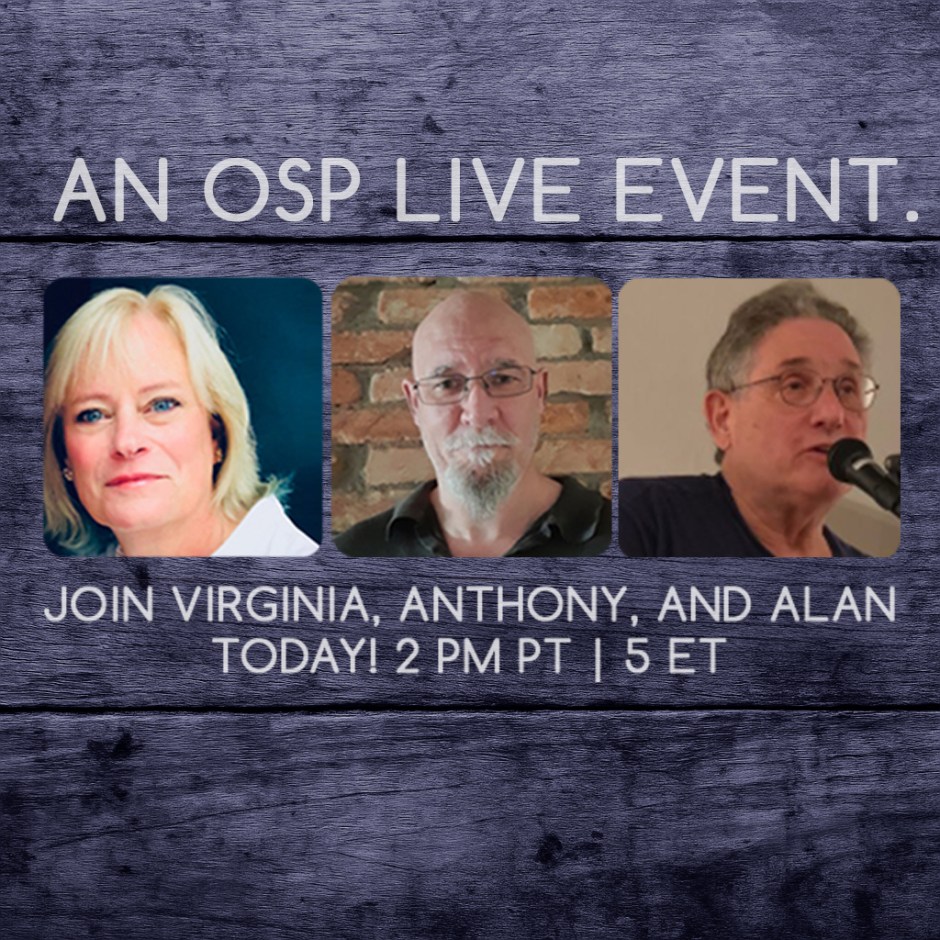
Recently Robert Fleming was nice enough to get Old Scratch Press booked on Like a blot from the blue. Robert Fleming, Gabby Gilliam, Anthony Doyle, Alan Bern, Virginia (Ginny) Watts, and I showed up. I gave a little information on Old Scratch Press; Gabby gave some information Instant Noodles, and Anthony and Ginny read from their new books. Being there and presenting to an international audience was a fantastic opportunity for us, and the folks there were great.
What I liked even more were the other people who showed up.
I’m going to guess that there were about 30 people who showed up who were not us, one of whom was Fin Hall, the blot-in-chief. It was clear that many of these folks had been attending regularly for quite some time. One at a time, in turn, based on when they signed up, Fin called on each person, and the author read 1-3 poems, depending on length.
When I was in my twenties and thirties, which, sadly, I am not any more, I used to read at LIP (live, in person) open mics all the time, and I would often have to hang in until midnight to get my chance. Usually these were held in bars in Philadelphia, or in West Chester, Pennsylvania. I did my best to dress as “punk rock” as possible, and my general aim, if I’m honest, was to get laid. It’s frankly shocking how few times that happened, when that was clearly my intent. I usually had on a mini skirt and was showing cleavage, but, in truth, people who knew me then told me then, and will reiterate the very same thing today, that me punked-out and showing cleavage was, somehow, still giving Julie Andrews when what I was going for was Grace Slick. Ah well.
In any case, the thrill of reading, and the thrill of possibly getting lucky, and the location (always bars) also meant that, in all likelihood, by the time they got to me on the sign-up list, I was hella drunk. I was a smoker (Benson and Hedges 100s back then), but because I was also a poser: at those events I came with a pack of Dunhill Blue.
Waaaay too expensive to smoke all the time, but on open mic nights I always stopped at the news agent’s (Philadelphia had news agents!) to get a pack beforehand.
A few times/year the venues would ask me to be the featured reader, and I think that was because I was also volunteering with a little Zine called Magic Bullet (run by Andrew Craig, wherever he is today), which I had quite a few publications in, and, who knows, maybe I was good.
I was working my way through an MA and then an MFA from my twenties into my thirties, and my professors seemed to think I was good, as well, and I won the student awards each year, so maybe. When I read at the school events I was not drunk, but neither was I nervous, perhaps because my professors made me feel gifted.
And then, sometime around the end of my last degree, life took a turn. My very long relationship went very south. Another relationship pooped too quickly, and flamed out just as fast, and I remember I felt, while I was still prolific as a poet, that I had somehow lost at life. I wanted, you see, to become a published poet and a professor, and a spouse, and a parent, and I wanted all four things to work out perfectly, and just none of them did.
My life, then, became a series of edits. If it didn’t work to have the man with the red hair, then cut him from the piece, and write in another man, one with cheap beer on his lips. It was so time-consuming to send out work, one poem here, and one there, through the mail, keeping track of where it went, and keeping a lookout for the SASE to bring it back, and seeing if it was in decent enough condition to be mailed back out again, and I remember for awhile I was printing on onion skin to save money (who knows what that is?), and digging up the two dollars or eight quarters to send the piece of onion skin back out, and waiting for the SASE again to return, and each time writing a letter of introduction, sometimes including letters of introduction from my professors who were consistently and kindly encouraging. I remember two of them, who seemed to think my writing was the bee’s knees, were flummoxed that my poems weren’t getting entry, but maybe the long narrative style went out with Wordsworth. And life became more about driving from 9-5 job to college job to relationship, to moving out, to moving over there, to trying again, to keep on trying, to being, frankly, trying.
Little by little, returned SASE by SASE, edited dream by edited dream, the writing dribbled to a stop. Drip, drip, dr—
It was so quiet in my head.
Well, in the poetry part of my head at least.
And a decade and a half ran through my fingers.
And then I started writing again. Not only poetry, and not the plays I wrote in my twenties, but fiction, and memoir, which is, I guess, what this is.
I found myself in a place where the place, the locale, was so small and local, it felt small enough that I dared to go to a reading again.
But over the intervening years something just awful seemed to have happened. When I showed up to read at the open mics, even when I went with friends, I could not make it through a single poem without devolving into tears. And maybe there’s a reason for this shocking behavior, and maybe there isn’t, but it seems as inevitable to me as hair going grey, and as unavoidable as the red dot from a sniper’s gun in one of those movies with snipers.
And yet, at the simple evening with Blot from the blue I felt encouraged. The readers were great, and seemed normal (for the most part… I mean, poets, right?), and kindly, and on Zoom my head is no bigger than a Cerignola olive, so I am going to say I felt safe. I think it would be quite okay to join in, and I asked him later, and Fin said yes, folks can join. And folks could mean me, or you.
And use this email to express interest likeablotfromtheblue@gmail.com.
And if you show up, be a goooood listener first, and a good reader second.
I’m not much of a drinker these days, so if I show up it will probably be very sober, and there hasn’t been any nicotine in these lungs for a long spell. I will, however, be caffeinated. And that’s at least something. The poem I am thinking of reading has some sound effects in it, which is probably ill-advised. But after I read, and make whatever sort of a fool of myself I am destined to be, I can write a new poem: Pearce With Her Pants Fallen Down.
Nadja often finishes her posts with a writing prompt, so here is me, stealing that excellent idea:
Think of an “edit” you made in your own life, by choice or by force. How did it work out for you?
Or
Have you ever read at an open mic? Write a flash memoir piece describing your experience.